Technorati Tags: humor

Monday, December 31, 2007


sobering year end
As you know I detest a lot of the stuff coming out of TeamPyro but it's stuff like this post, Drawing to an End, by Dan Phillips that keeps me coming back. Quite sobering. Worth going over there and reading.
it's time ...
Now after John was arrested, Jesus came into Galilee, proclaiming the gospel of God, and saying, “The time is fulfilled, and the kingdom of God is at hand; repent and believe in the gospel.” - Mk 1.14-15 (ESV)
After John was put in prison, Jesus went into Galilee, proclaiming the good news of God. 15"The time has come," he said. "The kingdom of God is near. Repent and believe the good news! - Mk 1.14-15 (NIV)
After John was arrested, Jesus went to Galilee preaching the Message of God: "Time's up! God's kingdom is here. Change your life and believe the Message." - Mk 1.14-15 (MSG)
Now after John was arrested and put in prison, Jesus came into Galilee, preaching the good news (the Gospel) of the kingdom of God, And saying, The [appointed period of] time is fulfilled (completed), and the kingdom of God is at hand; repent (have a change of mind which issues in regret for past sins and in change of conduct for the better) and believe (trust in, rely on, and adhere to) the good news (the Gospel). - Mk 1.14-15 (AMP)
Later on, after John was arrested, Jesus went into Galilee, where he preached God’s Good News. “The time promised by God has come at last!” he announced. “The Kingdom of God is near! Repent of your sins and believe the Good News!” - Mk 1.14-15 (NLT)
Now after that John was put in prison, Jesus came into Galilee, preaching the gospel of the kingdom of God, And saying, The time is fulfilled, and the kingdom of God is at hand: repent ye, and believe the gospel. - Mk 1.14-15 (KJV)
After John was arrested, Jesus went to Galilee and told the good news that comes from God. He said, "The time has come! God's kingdom will soon be here. [b] Turn back to God and believe the good news!" - Mk 1.14-15 (CEV)
After John was put in prison, Jesus went into Galilee, preaching the Good News from God. He said, "The right time has come. The kingdom of God is near. Change your hearts and lives and believe the Good News!" - Mk 1.14-15 (NCV)
And after the delivering up of John, Jesus came to Galilee, proclaiming the good news of the reign of God, and saying -- `Fulfilled hath been the time, and the reign of God hath come nigh, reform ye, and believe in the good news.' - Mk 1.14-15 (YLT)
But after John was delivered up, Jesus came into Galilee preaching the glad tidings of the kingdom of God, and saying, The time is fulfilled and the kingdom of God has drawn nigh; repent and believe in the glad tidings. - Mk 1.14-15 (Darby)
After John the Baptist was put in prison, Jesus came to the country of Galilee. He preached the Good News of God. He said, "The time has come. The holy nation of God is near. Be sorry for your sins, turn from them, and believe the Good News." - Mk 1.14-15 (NLV)
But after that John was taken, Jesus came into Galilee, and preached the gospel of the kingdom of God [preaching the gospel of the kingdom of God], and said [and saying], That the time is fulfilled, and the kingdom of God shall come nigh; do ye penance [repent ye], and believe ye to the gospel. - Mk 1.14-15 (WYC)
John was put in prison. Then Jesus went to Galilee. He told people the good news of God's kingdom. `The time has come,' he said. `The kingdom of God is here. Stop your wrong ways, turn back to God and believe the good news.' - Mk 1.14-15 (WE)
Questions?
After John was put in prison, Jesus went into Galilee, proclaiming the good news of God. 15"The time has come," he said. "The kingdom of God is near. Repent and believe the good news! - Mk 1.14-15 (NIV)
After John was arrested, Jesus went to Galilee preaching the Message of God: "Time's up! God's kingdom is here. Change your life and believe the Message." - Mk 1.14-15 (MSG)
Now after John was arrested and put in prison, Jesus came into Galilee, preaching the good news (the Gospel) of the kingdom of God, And saying, The [appointed period of] time is fulfilled (completed), and the kingdom of God is at hand; repent (have a change of mind which issues in regret for past sins and in change of conduct for the better) and believe (trust in, rely on, and adhere to) the good news (the Gospel). - Mk 1.14-15 (AMP)
Later on, after John was arrested, Jesus went into Galilee, where he preached God’s Good News. “The time promised by God has come at last!” he announced. “The Kingdom of God is near! Repent of your sins and believe the Good News!” - Mk 1.14-15 (NLT)
Now after that John was put in prison, Jesus came into Galilee, preaching the gospel of the kingdom of God, And saying, The time is fulfilled, and the kingdom of God is at hand: repent ye, and believe the gospel. - Mk 1.14-15 (KJV)
After John was arrested, Jesus went to Galilee and told the good news that comes from God. He said, "The time has come! God's kingdom will soon be here. [b] Turn back to God and believe the good news!" - Mk 1.14-15 (CEV)
After John was put in prison, Jesus went into Galilee, preaching the Good News from God. He said, "The right time has come. The kingdom of God is near. Change your hearts and lives and believe the Good News!" - Mk 1.14-15 (NCV)
And after the delivering up of John, Jesus came to Galilee, proclaiming the good news of the reign of God, and saying -- `Fulfilled hath been the time, and the reign of God hath come nigh, reform ye, and believe in the good news.' - Mk 1.14-15 (YLT)
But after John was delivered up, Jesus came into Galilee preaching the glad tidings of the kingdom of God, and saying, The time is fulfilled and the kingdom of God has drawn nigh; repent and believe in the glad tidings. - Mk 1.14-15 (Darby)
After John the Baptist was put in prison, Jesus came to the country of Galilee. He preached the Good News of God. He said, "The time has come. The holy nation of God is near. Be sorry for your sins, turn from them, and believe the Good News." - Mk 1.14-15 (NLV)
But after that John was taken, Jesus came into Galilee, and preached the gospel of the kingdom of God [preaching the gospel of the kingdom of God], and said [and saying], That the time is fulfilled, and the kingdom of God shall come nigh; do ye penance [repent ye], and believe ye to the gospel. - Mk 1.14-15 (WYC)
John was put in prison. Then Jesus went to Galilee. He told people the good news of God's kingdom. `The time has come,' he said. `The kingdom of God is here. Stop your wrong ways, turn back to God and believe the good news.' - Mk 1.14-15 (WE)
Questions?
Technorati Tags: Kingdom of God
ekklesia
"Ekklesia is not merely a human association, a gathering of like-minded individuals for a religious purpose, but is a divinely created affair" - Robert Banks
Technorati Tags: ecclesiology
the great debaters
I took my wife to see The Great Debaters yesterday - I cried at more than one point during the movie.
"I am here to help you to find and keep your righteous mind."
"I am here to help you to find and keep your righteous mind."

Sunday, December 30, 2007
maturity not age
In an earlier post I linked to a Pyromaniac post regarding "old soldiers to defend old truths". The Pyro post was a quote of Charles Spurgeon. David Mohler added a wonderful comment there that I think is worth posting here. He reacted specifically to Spurgeon's point that "New converts furnish impetus to the church, but her backbone and substance must, under God, lie with the mature members."
I think that maturity is needed but maturity is not the same as being old or even "seasoned".
Interesting words for a man who preached his first sermon at age 17 having been a "recent" convert only fourteen months prior.
While reading this, I was also recalled that Calvin was only 27 years old when the Latin edition of Institutes was published; Luther was only 34 when he offered his challenge against indulgences.
Weren't these three men young soldiers who had yet to fully brace themselves for the smoke and fire of the tempest? It seems to me that such is often the case; the fourth man in Job's story, Elihu, articulated his own frustration with the de facto notion that "old" means "wise" or "tested".
Many examples throughout Church history, even recent history, show that age - even experience - is not the key to eldership. Spurgeon does, of course, tell us what the key is: "mature Christians".
...
Spurgeon's concluding statement, "...we need also the cool, steady, well-disciplined, deeply-experienced hearts of men who know by experience the truth of God, and hold fast what they have learned in the school of Christ." is altogether true. But at the outset of this excerpt he says, The old guard, the men who have breathed smoke and eaten fire before, do not waver when the battle rages like a tempest, they can die but they cannot surrender.
The "old guard" is not our hope. A core of "old guys" does not necessarily equate to a core of mature Christians any more than a "youthful" elder board equates to immaturity and inevitable failure. There is ample evidence that God frequently uses young, inexperienced (and sometimes uneducated) men to correct the course of the Church, and Spurgeon is a prime example. The disciples are another.
We would be quick to point out that youthful leaders do not ever operate in a vacuum; but that also applies to the "old guys". Just because they have been through earthly fire (which, in human eyes, can look more noble than it is) does not mean they are immune to wavering "when the onslaught is fiercer than usual". Contrary to Spurgeon's idealistic assertion, they can and do surrender from time to time. If that were not true, we would not have the mess in the Church that we have today: somebody wavered.
...
I think that maturity is needed but maturity is not the same as being old or even "seasoned".
components of freedom
Robert Banks, in Paul's Idea of Community, proffers that for the Apostle Paul freedom consists of three main components:
Independence
Independence
- from certain things, e.g., sin, the Law, death, and alien powers
- for certain things, e.g., righteousness, conformity to Jesus, and suffering
- resulting in a personal and life-giving experience of liberty
- upon Christ, who terminated humanity's enslavement through his death and resurrection
- upon the Spirit, who communicates Christ's life and purpose as a received divine gift rather than innate possibility
- with others, since liberty leads to service and can only be practically defined in relation to their needs
- with the world, since the universe itself will experience the liberty of transformation along with those who are Christ's
- giving liberty a social and cosmic, as well as personal and theocentric, dimension
Technorati Tags: community
nfl history
The New England Patriots made NFL history last night defeating the New York Giants 38-35 making them the first team in 35 years (Miami Dolphins, 1972) to go undefeated in regular season. The Dolphins however did that in the shorter 14 game season while New England played a 16 game season. If the Patriots hold on to win the Super Bowl, they will be the greatest team in NFL history.
During the season finale over the Giants, Tom Brady set the season touchdown pass record at 50 and Randy Moss broke the touchdown reception record at 23.
Video highlights here - the game was awesome with both teams playing brilliantly!
During the season finale over the Giants, Tom Brady set the season touchdown pass record at 50 and Randy Moss broke the touchdown reception record at 23.
Video highlights here - the game was awesome with both teams playing brilliantly!
Technorati Tags: current events
early training
Jon Birch makes this interesting observation.

Phil Johnson posts this excellent quote from Spurgeon.
Mike Riccardi demonstrates that he, like many of the Pyro followers, are like the boy in Birch's cartoon rather than the mature man Spurgeon is trying to encourage.
I think represents the failure of the methodology employed by the TeamPyro approach to community ... church ... religion.
Phil Johnson posts this excellent quote from Spurgeon.
The church needs mature Christians very greatly, and especially when there are many fresh converts added to it. New converts furnish impetus to the church, but her backbone and substance must, under God, lie with the mature members.
Mike Riccardi demonstrates that he, like many of the Pyro followers, are like the boy in Birch's cartoon rather than the mature man Spurgeon is trying to encourage.
Today's motley crew of "reformers" [referring to "the Emerging crowd"] seem to want to go anywhere but the Scriptures.
I think represents the failure of the methodology employed by the TeamPyro approach to community ... church ... religion.
Technorati Tags: ecclesiology, Emerging Church
Saturday, December 29, 2007
freedom and community
Jesus came to set us free from the kingdom of darkness and bring us into the Kingdom of Light. We have been liberated from the those things by which we were inexorably gripped. Good News!
For one who has died has been set free from sin. - Ro 6.7
Now that you have been set free from sin and have become slaves of God, the fruit you get leads to sanctification and its end, eternal life. - Ro 6.22
If Christ is in you, although the body is dead because of sin, the Spirit is life because of righteousness. 11 If the Spirit of him who raised Jesus from the dead dwells in you, he who raised Christ Jesus from the dead will also give life to your mortal bodies through his Spirit who dwells in you. - Ro 8.10-11
You were dead in the trespasses and sins in which you once walked, following the course of this world, following the prince of the power of the air, the spirit that is now at work in the sons of disobedience— among whom we all once lived in the passions of our flesh, carrying out the desires of the body and the mind, and were by nature children of wrath, like the rest of mankind. But God, being rich in mercy, because of the great love with which he loved us, even when we were dead in our trespasses, made us alive together with Christ—by grace you have been saved— and raised us up with him and seated us with him in the heavenly places in Christ Jesus, so that in the coming ages he might show the immeasurable riches of his grace in kindness toward us in Christ Jesus. - Ep 2.1-7
With this freedom we are more than transferred out of a broken relationship with God and a defective solidarity with others into a new community with God and others - we are now to live with others in the kind of life that extends and deepens that new community.
To those outside the law I became as one outside the law (not being outside the law of God but under the law of Christ) that I might win those outside the law. - 1 Co 9.21
Bear one another's burdens, and so fulfill the law of Christ. - Gal 6.2
Though I am free from all, I have made myself a servant to all, that I might win more of them. - 1 Co 9.19
Being affectionately desirous of you, we were ready to share with you not only the gospel of God but also our own selves, because you had become very dear to us. - 1 The 2.8
For one who has died has been set free from sin. - Ro 6.7
Now that you have been set free from sin and have become slaves of God, the fruit you get leads to sanctification and its end, eternal life. - Ro 6.22
If Christ is in you, although the body is dead because of sin, the Spirit is life because of righteousness. 11 If the Spirit of him who raised Jesus from the dead dwells in you, he who raised Christ Jesus from the dead will also give life to your mortal bodies through his Spirit who dwells in you. - Ro 8.10-11
You were dead in the trespasses and sins in which you once walked, following the course of this world, following the prince of the power of the air, the spirit that is now at work in the sons of disobedience— among whom we all once lived in the passions of our flesh, carrying out the desires of the body and the mind, and were by nature children of wrath, like the rest of mankind. But God, being rich in mercy, because of the great love with which he loved us, even when we were dead in our trespasses, made us alive together with Christ—by grace you have been saved— and raised us up with him and seated us with him in the heavenly places in Christ Jesus, so that in the coming ages he might show the immeasurable riches of his grace in kindness toward us in Christ Jesus. - Ep 2.1-7
With this freedom we are more than transferred out of a broken relationship with God and a defective solidarity with others into a new community with God and others - we are now to live with others in the kind of life that extends and deepens that new community.
To those outside the law I became as one outside the law (not being outside the law of God but under the law of Christ) that I might win those outside the law. - 1 Co 9.21
Bear one another's burdens, and so fulfill the law of Christ. - Gal 6.2
Though I am free from all, I have made myself a servant to all, that I might win more of them. - 1 Co 9.19
Being affectionately desirous of you, we were ready to share with you not only the gospel of God but also our own selves, because you had become very dear to us. - 1 The 2.8
Technorati Tags: community, Kingdom of God
works and salvation
NT Wright regarding the argument between "being saved" and "doing good works" ...
This important set of arguments has become fairly thoroughly confused in the last hundred or two hundred years because it's got muddled up with various others, including (a) the Romantic notion that genuine religion is all about inwardness rather than externals ('How I feel deep down' vs 'What I do outwardly') and (b) the existentialist notion that 'authenticity' consists in being true to what one finds within oneself rather than conforming to outward regulations etc.
Part of the difficulty today is that most people who speak about 'being saved' in a 'religious' or 'faith' sense mean by it, quite simply, 'going to heaven when you die'. Heaven is important, and our immediate destiny after death is important (I write from a Christian point of view, of course), but it is not the final destination, since in the New Testament the final destination is the 'new heavens and new earth' we are promised in Revelation 21, the renewed, redeemed creation we are promised in Romans 8, the 'summing up of all things in heaven and earth' we are promised in Ephesians 1.10.
[T]his final destination, not the intermediate 'heavenly' state, is 'salvation'; because the creation is good and God-given, so that to imagine that 'salvation' means being rescued FROM the world is to deny the most fundamental article of the creed. If 'salvation' means simply 'leaving behind the world of space, time and matter', then this is not really 'salvation' from the ultimate enemy, death itself, which destroys God's good creation, but colluding with it. Rather, 'salvation' in the New Testament -- though of course our culture has done its best to distort this -- is all about God rescuing humans AND CREATION AS WELL from death -- in other words, the redemption and renewal of creation, and of human beings within that, into a newly embodied world of which the present world is simply the foretaste.
If that is 'being saved', what about 'good works'? From Ephesians 1.10 to Ephesians 2.10: we are saved by grace through faith FOR GOOD WORKS WHICH GOD PREPARED BEFOREHAND for us to walk in. Separating the two is like saying 'which is more important, breathing or eating?' Obviously if you stop breathing you won't do much eating, but equally if you never eat you will find your breathing eventually in trouble. Not a perfect analogy, but the 'salvation' which is 'by grace through faith' is precisely the rescue of our humanness from all that corrupts it, including ultimately death, and sin which anticipates death -- so if we are indeed rescued from sin and death then it makes no sense whatever to say 'well, I'm saved, so I won't bother about good works'. We aren't saved BY good works but we are saved FOR good works -- for the rich, wise, mature human life which reflects God's glory into the world.
Technorati Tags: Kingdom of God, service, soteriology
community and salvation
Robert Banks, in Paul's Idea of Community, does a wonderful job of summarizing man's condition and the link between salvation and community.
Though [men] are made for a relationship with God and are intended to be integrated persons, they are in reality divided beings who have generally lost sight of their way [Acts 17.27-30; Ro 3.9-18; 7.15-24]. ... Paul asserts that people are so "enslaved" by their baser inclinations that they are no longer "free" to properly know or pursue their real potential and destiny. This takes place in three main ways:
1) They find themselves under an inner compulsion to "sin," [Ro 6.17, 20; 7.14, 25] and to put their confidence in "works" and the "flesh" [Gal 3.10; Ro 2.17ff; 3.20; Phil 3.3ff]. That is to say, they are overly preoccupied with their own concerns and aspirations and regard their own heritage or traditions as the ground of their future expectations.
2) They are hampered, if Jews, from responding rightly to the moral regulations in the Mosaic law (Ro 2.23; 7.7-12) or, if Gentiles, to those moral demands of God inscribed upon their wills (1.32). This can take two forms. If they rebel against the revealed or implanted "law" of God, they drift into an amoral and unnatural way of life (Ro 1.24ff). If they focus all their energies on the Law, it deceives them and becomes merely another channel for their self-centered natures (Ro 10.1-3).
3) They are in bondage to certain realities outside themselves, whether supernatural "powers" that they allow to influence and affect their lives [Gal 4.3; Col 2.8; Eph 6.12]; the "god of this world" - Satan himself - by whom they are misled and manipulated (2 Co 4.4; Ep 2.2); or "death" that experienced spiritually now and physically later ultimately brings all their aspirations, relationships, and achievements to an end [Ro 1.32; 6.13, 16, 21, 23; 7.5; Ep 2.2]. Thus people are not as "free" as they would like to think, but are "in bondage" to baser inclinations, moral obligations, and alien forces. These largely shape their characters and dominate their lives.
Although all are constrained in these various ways, this does not mean that they are completely unfree. Paul allows that up to a point people are able to know the truth about God and do what is right [Ac 17.28; Ro 1.19-21; 2.14-15; cf. Phil 4.8], just as those in authority over them are able to govern society in a morally responsible fashion (Ro 13.1ff). But their capacity to do these things is limited [1 Co 11.32-33; Ro 1.21-23]. So it is that every person - beginning with "the first man," whose failure allowed sin to begin to exert its power in human affairs, required law to contain sin, and gave death its abnormal significance - experiences a solidarity with their fellows in "Adam." However, a second community has now come into existence through the achievement of that other person, whom Paul terms "the second Man." Through his obedience the trend initiated by the first member of the human race has been reversed (Ro 5.12ff). Although the full impact of sin fell upon him, it gained no control over him and was defeated (2 Co 5.21; Ro 8.3). Although he experienced the condemnation meted out to the lawless, his behavior transcended the law and terminated it (Gal 3.13; Ro 10.4). Although death unjustly made its claim upon him, he triumphed over it and the alien powers as well (Ro 1.4; Col 2.15). Since he did this not for his own sake but for the sake of all people as their representative [2 Co 5.14ff; Ro 6.3ff; Col 3.3], he is the foundation of a new community, humanity, or creation [1 Co 15.20ff; 2 Co 4.6; 5.17; Col 3.10; Ep 2.14-15].
[W]e see how closely Paul's understanding of freedom, or salvation, is bound up with his idea of community. He does not view salvation as simply a transaction between the individual and God. Prior to their encounter with Christ people belong to a community, however much their actions incline them to pursue their own (or their immediate circle's) self-interest. And it is into a new community that their reconciliation with God in Christ brings them, however much they experience that event as an individual affair. Correlatively, the salvation effected by Christ follows from his being not just an individual but a corporate personality, the "second" and "last" Adam (or, as it has been so strikingly expressed, "Adam - at last!"). This means not only that Christ's actions impinge upon the lives of others and are decisive for them but ... that his very life enters into them, enabling theirs to enter into his.
Technorati Tags: community
Friday, December 28, 2007
ortlund on revival
Jesse Phillips posted these three tips from Jay Ortlund Jr. for those seeking to facilitate revival.
- lead your people spiritually
- preach the gospel expectantly
- accept suffering meekly
the reason for 25 december
Now that Christmas has come and gone along with all of the discussion regarding whether or not 25 December is the correct date and whether or not Christians should participate in the celebration, here is the real reason we celebrate 25 December.
Chuck Norris sent Jesus a birthday card on December 25th and it wasn't Jesus’ birthday. Jesus was to scared to correct Chuck Norris and to this day December 25th is known as Jesus' birthday.
Chuck Norris sent Jesus a birthday card on December 25th and it wasn't Jesus’ birthday. Jesus was to scared to correct Chuck Norris and to this day December 25th is known as Jesus' birthday.
Technorati Tags: humor
kiss the son
Kevin Prosch - Kiss the Son
When you've been broken, broken to pieces.
And Your heart begins to faint
'cause you don't understand.
And when there is nothing to rake from the ashes.
And you can't even walk
onto the fields of praise.
But I bow down and kiss the Son.
Oh, and I bow down and kiss the Son.
Let the praise of the Lord be in my mouth.
Let the praise of the Lord be in my mouth.
Well, though You slay me, I will trust You, Lord.
Well, though You slay me, I will trust You, Lord.
Though You slay me, I will trust You, Lord.
Though You slay me, I will trust You, Lord.
When the rock falls, falls upon you.
And you get ground to dust
no music for your pain.
You open the windows, the windows of heaven.
And then You opened me
and You crushed me like a rose.
(Psa 2.12; Job 13.15; Mt 21.44; Isa 24.18)
When you've been broken, broken to pieces.
And Your heart begins to faint
'cause you don't understand.
And when there is nothing to rake from the ashes.
And you can't even walk
onto the fields of praise.
But I bow down and kiss the Son.
Oh, and I bow down and kiss the Son.
Let the praise of the Lord be in my mouth.
Let the praise of the Lord be in my mouth.
Well, though You slay me, I will trust You, Lord.
Well, though You slay me, I will trust You, Lord.
Though You slay me, I will trust You, Lord.
Though You slay me, I will trust You, Lord.
When the rock falls, falls upon you.
And you get ground to dust
no music for your pain.
You open the windows, the windows of heaven.
And then You opened me
and You crushed me like a rose.
(Psa 2.12; Job 13.15; Mt 21.44; Isa 24.18)
Thursday, December 27, 2007
kingdom fruit
Mt 21.33ff - “Hear another parable. There was a master of a house who planted a vineyard and put a fence around it and dug a winepress in it and built a tower and leased it to tenants, and went into another country. When the season for fruit drew near, he sent his servants to the tenants to get his fruit. And the tenants took his servants and beat one, killed another, and stoned another. Again he sent other servants, more than the first. And they did the same to them. Finally he sent his son to them, saying, ‘They will respect my son.’ But when the tenants saw the son, they said to themselves, ‘This is the heir. Come, let us kill him and have his inheritance.’ And they took him and threw him out of the vineyard and killed him. When therefore the owner of the vineyard comes, what will he do to those tenants?” They said to him, “He will put those wretches to a miserable death and let out the vineyard to other tenants who will give him the fruits in their seasons.”
Jesus said to them, “Have you never read in the Scriptures:
“‘The stone that the builders rejected
has become the cornerstone;
this was the Lord's doing,
and it is marvelous in our eyes’?
Therefore I tell you, the kingdom of God will be taken away from you and given to a people producing its fruits. And the one who falls on this stone will be broken to pieces; and when it falls on anyone, it will crush him.”
Where are you in this story? Are you embracing the fullness of the Gospel and the Kingdom of God? Has this caused you to repent and bear fruit for righteousness? As noted before, the Kingdom of God is not about arguing theology yet at the same time is not about the acceptance of sin. It is about turning one's life completely around and living for our great King - and to this one righteousness, peace, and joy will mark his life rather than rule and regulation. The true ambassador of the King pronounces freedom not bondage. He speaks with power and authority. And He brings Good News.
Do not be deceived, many today say they know Jesus but they have rejected Him in favor of their religion. Others on the opposite end of the spectrum are embracing all things as right and fail to acknowledge that there is only one King and way to the Father. These are treacherous times and the man of God must walk wisely.
Jesus said to them, “Have you never read in the Scriptures:
“‘The stone that the builders rejected
has become the cornerstone;
this was the Lord's doing,
and it is marvelous in our eyes’?
Therefore I tell you, the kingdom of God will be taken away from you and given to a people producing its fruits. And the one who falls on this stone will be broken to pieces; and when it falls on anyone, it will crush him.”
Where are you in this story? Are you embracing the fullness of the Gospel and the Kingdom of God? Has this caused you to repent and bear fruit for righteousness? As noted before, the Kingdom of God is not about arguing theology yet at the same time is not about the acceptance of sin. It is about turning one's life completely around and living for our great King - and to this one righteousness, peace, and joy will mark his life rather than rule and regulation. The true ambassador of the King pronounces freedom not bondage. He speaks with power and authority. And He brings Good News.
Do not be deceived, many today say they know Jesus but they have rejected Him in favor of their religion. Others on the opposite end of the spectrum are embracing all things as right and fail to acknowledge that there is only one King and way to the Father. These are treacherous times and the man of God must walk wisely.
Technorati Tags: Kingdom of God
evangelical divide
There are two kinds of wisdom and the wisdom from above is first pure, then peaceable, gentle, open to reason, full of mercy and good fruits, impartial and sincere. And a harvest of righteousness is sown in peace by those who make peace.
Today I find many Evangelicals who in their effort to guard the truth have done exactly the opposite. They have failed in Paul's simple instruction to Timothy. In their war for truth they have created their own earthly knowledge, packaged it as Christianity, and have missed the wisdom that comes only from above.
Our goal is love which comes from a pure heart, a good conscience, and a sincere faith. These false teachers want to be teachers of the law but they do not know what they are talking about.
Their teaching does not represent the God of love. Aware that their heavy yokes cause men to respond negatively to them, they teach that true spirituality is confronting error, that this is what Jesus did, and this is why the world hated Him and subsequently them. They dissect the Bible as some kind of text book to prove what tickles their ears and miss the whole of what God is saying.
I was recently struck by this yet again while reading through the Pyromaniac blog. Phil Johnson is posting excerpts from John MacArthur's Truth Wars. On Christmas Eve Dan Phillips posted Can the world "like Jesus"? What he wrote was (as is usually the case) true. But the message remains a far cry from the Gospel. The message of the angels on Christmas eve wasn't, "here comes a judge who will confront you - comply or go to hell." The message was “Fear not, for behold, I bring you good news of great joy that will be for all the people. For unto you is born this day in the city of David a Savior, who is Christ the Lord."
Evil is confronted in the Gospel but it looks like deliverance from darkness not a clash of theologies. There is a large segment of Evangelicalism that has lost sight of the trust they were instructed to guard. They have created for themselves a religion and are actively working to burden others rather than free them.
We need to recognize and reject this and at the same time we need to see why such deception is thriving among the Body of Christ - but that's for another post.
Today I find many Evangelicals who in their effort to guard the truth have done exactly the opposite. They have failed in Paul's simple instruction to Timothy. In their war for truth they have created their own earthly knowledge, packaged it as Christianity, and have missed the wisdom that comes only from above.
Our goal is love which comes from a pure heart, a good conscience, and a sincere faith. These false teachers want to be teachers of the law but they do not know what they are talking about.
Their teaching does not represent the God of love. Aware that their heavy yokes cause men to respond negatively to them, they teach that true spirituality is confronting error, that this is what Jesus did, and this is why the world hated Him and subsequently them. They dissect the Bible as some kind of text book to prove what tickles their ears and miss the whole of what God is saying.
I was recently struck by this yet again while reading through the Pyromaniac blog. Phil Johnson is posting excerpts from John MacArthur's Truth Wars. On Christmas Eve Dan Phillips posted Can the world "like Jesus"? What he wrote was (as is usually the case) true. But the message remains a far cry from the Gospel. The message of the angels on Christmas eve wasn't, "here comes a judge who will confront you - comply or go to hell." The message was “Fear not, for behold, I bring you good news of great joy that will be for all the people. For unto you is born this day in the city of David a Savior, who is Christ the Lord."
Evil is confronted in the Gospel but it looks like deliverance from darkness not a clash of theologies. There is a large segment of Evangelicalism that has lost sight of the trust they were instructed to guard. They have created for themselves a religion and are actively working to burden others rather than free them.
We need to recognize and reject this and at the same time we need to see why such deception is thriving among the Body of Christ - but that's for another post.
cross carrying
From Eric Smith;
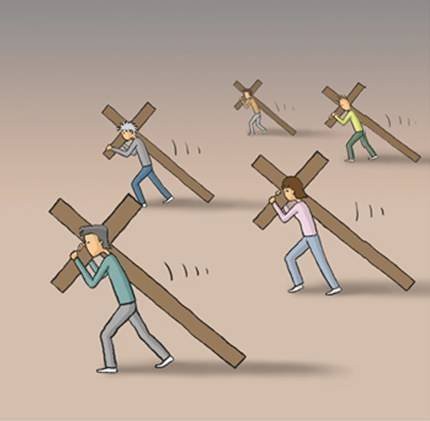


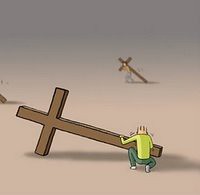

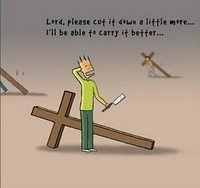
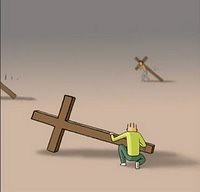
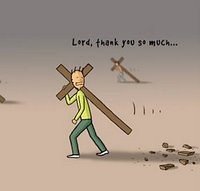
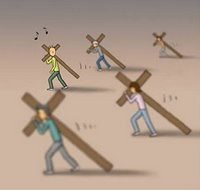


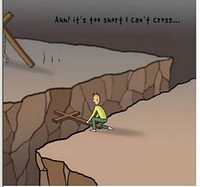
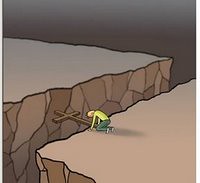
Some of the most powerful words of Jesus Christ are: "Whoever would come after me, let him deny himself, and take up his cross, and follow me." Jesus also said, "whoever does not bear his cross and come after Me cannot be My disciple."
Wednesday, December 26, 2007
wesley on gifts
John Wesley, speaking on why gifts of the Spirit seemed to have subsided after just a few centuries;
The grand reason why the miraculous gifts were so soon withdrawn, was not only that faith and holiness were well nigh lost; but that dry, formal, orthodox men began even then to ridicule whatever gifts they had not themselves, and to decry them all as either madness or imposture.
Technorati Tags: spiritual gifts
do you understand?
In the beginning was the Word, and the Word was with God, and the Word was God. He was in the beginning with God. All things were made through him, and without him was not any thing made that was made. In him was life, and the life was the light of men. The light shines in the darkness, and the darkness has not overcome it. - Jn 1.1-5
Make sense?
Make sense?
gift givers
And Jesus called them to him and said to them, “You know that those who are considered rulers of the Gentiles lord it over them, and their great ones exercise authority over them. But it shall not be so among you. But whoever would be great among you must be your servant, and whoever would be first among you must be slave of all. For even the Son of Man came not to be served but to serve, and to give his life as a ransom for many.” - Mk 10.42-45
John Wimber would say, "An elder is as an elder does. Let's see who elds." That is, it's not about the title given to you, it's about what you are doing with what the Father has given you.
This is an especially important concept in regard to the gifts of the Spirit. These gifts are for every Christian. There is no concept of "good" Christians or "bad" Christians. The gifts aren't dispensed based on how long or short one has been a believer. It doesn't even depend on level of maturity - the Bible is replete with stories of the immature being used by God.
The reason for this is that the gifts are for the receiver not the messenger. The one "delivering the gift" is simply passing on to the receiver what the Father is giving. The only thing the messenger really provides is being available.
In 1 Co 12 Paul describes some of these gifts and their purpose. The word for "manifestation" is "phanerosis". Mel Robeck is said to have described this as "the dancing hand of God". It is God that moves on the gathered people and causes them to participate in mutually edifying ways. We don't carry the gifts around with us. The Holy Spirit provides what He wills at the time for the building up of the body and the redeeming from darkness into the light. The question for us is will we be available. The concept has been termed gracelets (here, here, and child-level here). The gifts are not badges or awards, they are simply tools that God gives as needed.
Are you available to be used by God in this way?
John Wimber would say, "An elder is as an elder does. Let's see who elds." That is, it's not about the title given to you, it's about what you are doing with what the Father has given you.
This is an especially important concept in regard to the gifts of the Spirit. These gifts are for every Christian. There is no concept of "good" Christians or "bad" Christians. The gifts aren't dispensed based on how long or short one has been a believer. It doesn't even depend on level of maturity - the Bible is replete with stories of the immature being used by God.
The reason for this is that the gifts are for the receiver not the messenger. The one "delivering the gift" is simply passing on to the receiver what the Father is giving. The only thing the messenger really provides is being available.
In 1 Co 12 Paul describes some of these gifts and their purpose. The word for "manifestation" is "phanerosis". Mel Robeck is said to have described this as "the dancing hand of God". It is God that moves on the gathered people and causes them to participate in mutually edifying ways. We don't carry the gifts around with us. The Holy Spirit provides what He wills at the time for the building up of the body and the redeeming from darkness into the light. The question for us is will we be available. The concept has been termed gracelets (here, here, and child-level here). The gifts are not badges or awards, they are simply tools that God gives as needed.
Are you available to be used by God in this way?
Technorati Tags: grace, Kingdom of God, Signs & Wonders, spiritual gifts
Tuesday, December 25, 2007
more on good news
John Wimber on the Gospel:
Preaching the Gospel is all encompassing. It's telling people about Jesus, and salvation, but it's also feeding the hungry and praying for the sick. All these come under the banner of the "Good News". Furthermore, Jesus was sent to proclaim release to the captive. He came to earth with the power and authority to release people kept in bondage through "every disease" and "every sickness". Matthew purposely used terms of a general nature, indicating the broad scope of Jesus' ministry, not the narrowness. Thus, Jesus brings a measure of release to the gamut of maladies in which people find themselves entangled, whether they are a direct result of human or demonic oppression. There are many different kinds of prisoners ... not all are behind bars.
Technorati Tags: Kingdom of God
the humanity of christ
"In our Christian Creed we confess that Christ was conceived and made man or was incarnate (if I may so speak), that He became a real human being by assuming a body. We confess that He assumed genuine flesh and blood from the Virgin Mary, that He did not pass through her as the sun shines through a glass but brought her virgin flesh and blood with Him. If this had taken place only with the cooperation of Mary, the Babe would not have been pure. But though Mary has been conceived in sin, the Holy Spirit takes her flesh and blood and purifies them; and thence He creates the body of the Son of God. This is why it is said that "He was conceived by the Holy Ghost." Thus He assumed a genuine body from His mother Mary, but this body was cleansed from sin by the Holy Spirit. If this were not the case, we would not be saved." - Martin Luther
Technorati Tags: Christology
christmas stabbing
Whatever you think the real meaning of Christmas is, you must agree that these newlyweds missed it. As for us, we waited cautiously until my wife said it was ok to open gifts ... and even then we were on guard.
Cops: Woman Stabbed Hubby for Opening Christmas Gift Early
ROCK SPRINGS, Wyo. — A woman stabbed her husband with a kitchen knife following an argument that began when she accused him of opening a Christmas present early, authorities said Friday.
full story
Cops: Woman Stabbed Hubby for Opening Christmas Gift Early
ROCK SPRINGS, Wyo. — A woman stabbed her husband with a kitchen knife following an argument that began when she accused him of opening a Christmas present early, authorities said Friday.
full story
Technorati Tags: current events
Monday, December 24, 2007
Sunday, December 23, 2007
thanks adrian
I want to link to Adrian Warnock to thank him for the link in his post thanking those that linked to him. Make sense?
I made number 55 on the list. I'm honored.
Adrian isn't taking comments so that's why the link about links. I like Adrian, He is busy listening to God rather than his commenters. Of course some aren't happy with that but I think it's cool.
I made number 55 on the list. I'm honored.
Adrian isn't taking comments so that's why the link about links. I like Adrian, He is busy listening to God rather than his commenters. Of course some aren't happy with that but I think it's cool.

out of the mouth of babes
Well - it may be some time until the final verdict is in but Nikolai, the son of my dearest cessationist friends, Sergiy and Julie, is investigating the continuationist view. I understand that he may already be speaking in tongues. Praise God!

Technorati Tags: cessationism, charismata, Signs & Wonders
hier stehe ich
"Hier stehe ich. Ich kann nicht anders. Gott helft mir. Amen." - Martin Luther
I got this in an email today from Daniel Chew and loved it. I find it interesting how sometimes the smallest things can really strike you. I cannot explain it but this caused me to stop what I was doing and thank God. And so I simply pass it along ...
I got this in an email today from Daniel Chew and loved it. I find it interesting how sometimes the smallest things can really strike you. I cannot explain it but this caused me to stop what I was doing and thank God. And so I simply pass it along ...
Saturday, December 22, 2007

this kid's ready
 I wanted to work through the holidays ... it's typically a good time to catch up on things but just about everything I am working on is dependent on someone else to take the next step ... so, I guess I'll just be staring at the lights for a couple of weeks.
Technorati Tags: personal
Friday, December 21, 2007

small group hazing on the rise
 When will the madness stop ...
Study: Small Group Hazing At All-Time High
2 Dead, Some Churches Impose Outright Ban
CHICAGO – A new study to be published in Christianity Today magazine exposes a dangerous wave of church subculture that has built enormous momentum over the past decade. Hazing, which until now has been almost entirely associated with college fraternities and sororities, has made its way into our churches as a method of initiating would-be small group members and filtering out those too weak to join. While most colleges have squelched hazing in recent years, a new surge in small group hazing—resulting in at least two fatalities—is causing some pastors to follow suit and ban the practice altogether.
Rest of the story ...
Technorati Tags: humor, small groups
Thursday, December 20, 2007
santa is a calvinist
This is too good to be true ... turns out Santa Claus is a Calvinist and since I am one also, surely he will choose me ... here are some of Santa's comments ... read the whole article only at TBNN.
I actually don't deliver most of the presents that you see on Christmas. I would guess that about 15-20% of Christmas presents actually come from my sleigh.
The decision is up to me. No one influences me in my decision.
Each year I choose who will get presents. I only give gifts to people who believe I am real. How do they believe? They are the ones I show myself to. So both their belief in me and their gifts come from my hand. They can't earn it.
Nobody deserves anything good from me. I simply give gifts to those who believe; and they can only believe because I chose them to believe. I never looked into the future to see who would believe and then chose them. That's just silly.
No one deserves any presents. I simply choose who gets them. The gifts are limited to those I choose. When I give gifts, no one rejects them. I keep those who believe in me so that they never stop believing.
purgatorio
Good news! Purgatorio is back. Marc Heinrich has been absent from the blogsphere for quite some time. Hopefully he hasn't lost his edge. Previous comment, normally through a simple photo, was excellent.
Wednesday, December 19, 2007
outcasts are welcome
"The outcast classes are entering the Kingdom, and there is no evidence that the outwardly respectable leaders will respond. Even the sight of the outcasts streaming into the Kingdom has not changed their attitude." - F.V. Filson
Filson wrote that in 1960 based on Mt 21.31-32 in which Jesus said, "the tax collectors and the prostitutes go into the kingdom of God before you. For John came to you in the way of righteousness, and you did not believe him, but the tax collectors and the prostitutes believed him. And even when you saw it, you did not afterward change your minds and believe him."
The message is timeless. Many who see themselves as spiritual leaders are missing the Kingdom. They even criticize others because they don't seem to have perfect understanding. In doing so, they themselves miss out on the Kingdom and fail to experience the Fatherhood of God today. Schade ...
Filson wrote that in 1960 based on Mt 21.31-32 in which Jesus said, "the tax collectors and the prostitutes go into the kingdom of God before you. For John came to you in the way of righteousness, and you did not believe him, but the tax collectors and the prostitutes believed him. And even when you saw it, you did not afterward change your minds and believe him."
The message is timeless. Many who see themselves as spiritual leaders are missing the Kingdom. They even criticize others because they don't seem to have perfect understanding. In doing so, they themselves miss out on the Kingdom and fail to experience the Fatherhood of God today. Schade ...
Technorati Tags: Kingdom of God
huckabee on god & creation
This was refreshing ... agree or not and nit-pic if you'd like - it's unusual for a politician to speak in such clear concise terms. I like it. Here is Mike Huckabee answering a question on evolution.
Technorati Tags: current events, politics
fred thompson
Oh my, initially I was with Mike Huckabee because of the Chuck Norris endorsement. Now Fred Thompson is challenging that. Hmmm ... I sure hope I will not be reduced to actually thinking this voting season ...
Here Thompson responds to Michael Moore ... as a whacko right-winger, I like it. Feel free to rebuke me but be forewarned, it will fall on deaf ears.
Here Thompson responds to Michael Moore ... as a whacko right-winger, I like it. Feel free to rebuke me but be forewarned, it will fall on deaf ears.
a camel through a needle
Mt 19.16ff - And behold, a man came up to him, saying, “Teacher, what good deed must I do to have eternal life?” And he said to him, “Why do you ask me about what is good? There is only one who is good. If you would enter life, keep the commandments.” He said to him, “Which ones?” And Jesus said, “You shall not murder, You shall not commit adultery, You shall not steal, You shall not bear false witness, Honor your father and mother, and, You shall love your neighbor as yourself.” The young man said to him, “All these I have kept. What do I still lack?” Jesus said to him, “If you would be perfect, go, sell what you possess and give to the poor, and you will have treasure in heaven; and come, follow me.” When the young man heard this he went away sorrowful, for he had great possessions.
And Jesus said to his disciples, “Truly, I say to you, only with difficulty will a rich person enter the kingdom of heaven. Again I tell you, it is easier for a camel to go through the eye of a needle than for a rich person to enter the kingdom of God.” When the disciples heard this, they were greatly astonished, saying, “Who then can be saved?” But Jesus looked at them and said, “With man this is impossible, but with God all things are possible.” Then Peter said in reply, “See, we have left everything and followed you. What then will we have?” Jesus said to them, “Truly, I say to you, in the new world, when the Son of Man will sit on his glorious throne, you who have followed me will also sit on twelve thrones, judging the twelve tribes of Israel. And everyone who has left houses or brothers or sisters or father or mother or children or lands, for my name's sake, will receive a hundredfold and will inherit eternal life. But many who are first will be last, and the last first.
Conversion that leads to salvation is humanly impossible.
This man approaches Jesus claiming to have kept the whole law - including loving his neighbor as himself. It seems however that Jesus does not agree with his assessment. He tells the man that if he wants to accomplish what is needed to inherit eternal life he must free his heart from his possessions, attain a heart for the poor, treasure God in heaven, and then follow Him.
Sadly the man leaves grieving. To this Jesus teaches that, "Only with difficulty will a rich person enter the kingdom of heaven. Again I tell you, it is easier for a camel to go through the eye of a needle than for a rich person to enter the kingdom of God." How difficult will it be? Impossible. A camel cannot go through the eye of a needle.
Some would argue and try to create some way in which it may be possible. They might even claim that this man only needed to follow the direction Jesus provided and then create some story like the eye of a needle isn't really that but rather a gate in a wall that camels can only pass through after stripping everything off. I don't think so but even if it were so, that's not the point. The man cannot do this on his own.
The disciples understood that. They asked, "Who then can be saved?" Jesus could have replied that the poor can be saved or believers can be saved or my followers can be saved or ... but instead He taught a greater truth. He understood our propensity for formulas and methods. He taught us that "With man this is impossible, but with God all things are possible."
The problem isn't wealth (although that surely can be an obstacle). The problem is the human heart. No man can find salvation unless God intervenes and changes his heart. The Kingdom of God is about grace. It is about the Holy Spirit touching a heart in a way that illumines the pathway to Truth. He empowers us to receive forgiveness from our King and follow His leadership. This is a present reality and as well as a future hope. Short of that, man is lost - separated from the Fatherhood of God forever.
And Jesus said to his disciples, “Truly, I say to you, only with difficulty will a rich person enter the kingdom of heaven. Again I tell you, it is easier for a camel to go through the eye of a needle than for a rich person to enter the kingdom of God.” When the disciples heard this, they were greatly astonished, saying, “Who then can be saved?” But Jesus looked at them and said, “With man this is impossible, but with God all things are possible.” Then Peter said in reply, “See, we have left everything and followed you. What then will we have?” Jesus said to them, “Truly, I say to you, in the new world, when the Son of Man will sit on his glorious throne, you who have followed me will also sit on twelve thrones, judging the twelve tribes of Israel. And everyone who has left houses or brothers or sisters or father or mother or children or lands, for my name's sake, will receive a hundredfold and will inherit eternal life. But many who are first will be last, and the last first.
Conversion that leads to salvation is humanly impossible.
This man approaches Jesus claiming to have kept the whole law - including loving his neighbor as himself. It seems however that Jesus does not agree with his assessment. He tells the man that if he wants to accomplish what is needed to inherit eternal life he must free his heart from his possessions, attain a heart for the poor, treasure God in heaven, and then follow Him.
Sadly the man leaves grieving. To this Jesus teaches that, "Only with difficulty will a rich person enter the kingdom of heaven. Again I tell you, it is easier for a camel to go through the eye of a needle than for a rich person to enter the kingdom of God." How difficult will it be? Impossible. A camel cannot go through the eye of a needle.
Some would argue and try to create some way in which it may be possible. They might even claim that this man only needed to follow the direction Jesus provided and then create some story like the eye of a needle isn't really that but rather a gate in a wall that camels can only pass through after stripping everything off. I don't think so but even if it were so, that's not the point. The man cannot do this on his own.
The disciples understood that. They asked, "Who then can be saved?" Jesus could have replied that the poor can be saved or believers can be saved or my followers can be saved or ... but instead He taught a greater truth. He understood our propensity for formulas and methods. He taught us that "With man this is impossible, but with God all things are possible."
The problem isn't wealth (although that surely can be an obstacle). The problem is the human heart. No man can find salvation unless God intervenes and changes his heart. The Kingdom of God is about grace. It is about the Holy Spirit touching a heart in a way that illumines the pathway to Truth. He empowers us to receive forgiveness from our King and follow His leadership. This is a present reality and as well as a future hope. Short of that, man is lost - separated from the Fatherhood of God forever.
Technorati Tags: Kingdom of God

Tuesday, December 18, 2007
the spirit and the kingdom
We have been delivered from the domain of darkness and transferred into the Kingdom of Jesus - the beloved Son of the Father (Col 1.13). To be in the Kingdom is to be in the Holy Spirit, the result of which is righteousness, peace and joy (Ro 14.17). This new age, that is of being in the Kingdom by the power of the Spirit, came first in the ministry of Jesus (Mt 12.28) and then at Pentecost. Living in God's redemptive reign is to live in the Spirit.
Technorati Tags: Kingdom of God
ladd on the kingdom
Goerge Eldon Ladd - "God is seeking out sinners and inviting them to submit themselves to His reign that He might be their Father."
In reference to the eschatological salvation, the righteous will enter into the Kingdom of their Father (Mt13.43). The Father is the one whom has prepared for the blessed the eschatological inheritance of the Kingdom (Mt 25.34). The Father will bestow upon Jesus' disciples the gift of the Kingdom (Lk 12.32). In that day, Jesus will enjoy a renewed fellowship with His disciples in the Father's Kingdom (Mt 26.29).
God's Fatherhood is a blessing and a relationship that cannot be enjoyed by all people. This is reserved for those who enter the eschatological Kingdom. Those that do not enter the Kingdom will not enjoy relationship with God as their Father.
But - this gift of Fatherhood does not only belong to the eschatological Kingdom; it is also a present gift. In fact, the future blessing of the Kingdom is dependent upon a present relationship. Jesus taught His disciples to see God and call Him as Father. The highest good in life is the Kingdom of God and its righteousness. Those that know God as their Father live this in the present (Mt 6.32-33; Lk 12.30).
The Kingdom of God is both present and future. To enter it is to know God as Father and to walk in the light of His glory.
In reference to the eschatological salvation, the righteous will enter into the Kingdom of their Father (Mt13.43). The Father is the one whom has prepared for the blessed the eschatological inheritance of the Kingdom (Mt 25.34). The Father will bestow upon Jesus' disciples the gift of the Kingdom (Lk 12.32). In that day, Jesus will enjoy a renewed fellowship with His disciples in the Father's Kingdom (Mt 26.29).
God's Fatherhood is a blessing and a relationship that cannot be enjoyed by all people. This is reserved for those who enter the eschatological Kingdom. Those that do not enter the Kingdom will not enjoy relationship with God as their Father.
But - this gift of Fatherhood does not only belong to the eschatological Kingdom; it is also a present gift. In fact, the future blessing of the Kingdom is dependent upon a present relationship. Jesus taught His disciples to see God and call Him as Father. The highest good in life is the Kingdom of God and its righteousness. Those that know God as their Father live this in the present (Mt 6.32-33; Lk 12.30).
The Kingdom of God is both present and future. To enter it is to know God as Father and to walk in the light of His glory.
Technorati Tags: Kingdom of God

Monday, December 17, 2007
macarthur ... charasmatic
I almost fell out of my chair this morning while reading my daily blogs. It seems John MacArthur has gone charismatic ... again. In a Q&A session at Grace Church and published in Pulpit Magazine, MacArthur responds to a question regarding the Scriptural reference of a believer being unequally yoked with a non-believer.
I agree with the following but it exemplifies an issue within the MacArthur camp.
While I agree, it seems clear that MacArthur is saying the same thing as many Charismatics and the "Experiencing God" gang. He writes this and is applauded while he and his disciples rail against others for stating that same. I've said it before and I'll say it again, these guys could do the body of Christ a lot of good if they would lay down their spiritual pride and stop allowing Satan to fill them with disdain for others.
I agree with the following but it exemplifies an issue within the MacArthur camp.
Practically speaking, you will have to make the judgment as to what a particular partnership involves and whether you can be part of it – based on biblical principles, prayer, and godly counsel. The Spirit of God will lead you in that.
While I agree, it seems clear that MacArthur is saying the same thing as many Charismatics and the "Experiencing God" gang. He writes this and is applauded while he and his disciples rail against others for stating that same. I've said it before and I'll say it again, these guys could do the body of Christ a lot of good if they would lay down their spiritual pride and stop allowing Satan to fill them with disdain for others.
Technorati Tags: judging
Sunday, December 16, 2007
Friday, December 14, 2007
why i'm not attractive
Jonathan Brink asks the question, "what draws you to church?" This was triggered by some thinking he was doing regarding the "attractional church" and a flyer he got in which a church was describing its virtues.
Raquel gave a good response, i.e., "God". I like that. Perhaps something more precise like, "God in us"?
I think the real issue is "what is church". If it is our building, meetings, programs, etc., then we have to work on being attractional. And there are of course good and bad ways to do that. And we can discuss forever the rightness and wrongness of this. But the fundamental problem is that have a wrong base ... this is not Church and the whole attractional point is moot.
If church is the body of Christ, a community of believers working out their faith together in love, etc., then we don't think about being attractional. In fact, the concept would be contrary to our focus. We will love God. We will live together in love with each other against all worldly logic. We will serve each other and serve those that are bound by darkness. We will demonstrate and proclaim the Gospel of the Kingdom. We will be making disciples among the ones we live with. Etc.
This will attract those that have been made alive by His Spirit to come be within the family of God. It will also attract those that want to earn something from God. It will also drive some away to cry out blasphemy or whatever. And it will cause some to want to kill us.
Attractional? Not in the sense of the attractional church. But, it will certainly command a response - and it won't be due to a flyer in the mail. I'm not pro or con flyers - it's simply that it's not about that.
I'll repost something I did two years ago ... I still like it and find it relevant.
In The Pursuit of God in the Company of Friends, Richard Lamb explains, "...Jesus is the tangible incarnation of God, and his manner of inviting people into deep relationship with himself is the manner we have available to us today. Jesus gathered a group of people together, some good friends and brothers, some complete strangers and natural enemies, and eventually he told them that by their love for one another people would know that they had been touched and changed by God incarnate. In fact, this kind of friendship, inexplicable apart from God, was the apologetic by which he demonstrated his power to the world (Jn 13.35; 17.20-21). He told his disciples that their friendships would either make or break the mission of the church, his mission in the world."
“What would it be like to pursue – and find – God in the company of friends? What would those friendships look like? The process we call discipleship, and the context we call community.”
Lamb later provides some definitions for friendship by citing Aristotle in Nicomachean Ethics 8; "... qualities enjoyed by friends that continue to be apt and helpful today: friends (1) enjoy one another, (2) are useful to one another, and (3) share a common commitment to "the good".
I no longer feel awkward about having relationships for purpose. My passion for pursuing God now leads me to connect with those that are useful and share the same passion. My compassion for the lost now leads me to connect with those that I perceive God is working in. While I care for the "crowd", I am selective about time spent building relationship without one of these purposes.
The Word became flesh and blood,
and moved into the neighborhood. (The Message)
Raquel gave a good response, i.e., "God". I like that. Perhaps something more precise like, "God in us"?
I think the real issue is "what is church". If it is our building, meetings, programs, etc., then we have to work on being attractional. And there are of course good and bad ways to do that. And we can discuss forever the rightness and wrongness of this. But the fundamental problem is that have a wrong base ... this is not Church and the whole attractional point is moot.
If church is the body of Christ, a community of believers working out their faith together in love, etc., then we don't think about being attractional. In fact, the concept would be contrary to our focus. We will love God. We will live together in love with each other against all worldly logic. We will serve each other and serve those that are bound by darkness. We will demonstrate and proclaim the Gospel of the Kingdom. We will be making disciples among the ones we live with. Etc.
This will attract those that have been made alive by His Spirit to come be within the family of God. It will also attract those that want to earn something from God. It will also drive some away to cry out blasphemy or whatever. And it will cause some to want to kill us.
Attractional? Not in the sense of the attractional church. But, it will certainly command a response - and it won't be due to a flyer in the mail. I'm not pro or con flyers - it's simply that it's not about that.
I'll repost something I did two years ago ... I still like it and find it relevant.
In The Pursuit of God in the Company of Friends, Richard Lamb explains, "...Jesus is the tangible incarnation of God, and his manner of inviting people into deep relationship with himself is the manner we have available to us today. Jesus gathered a group of people together, some good friends and brothers, some complete strangers and natural enemies, and eventually he told them that by their love for one another people would know that they had been touched and changed by God incarnate. In fact, this kind of friendship, inexplicable apart from God, was the apologetic by which he demonstrated his power to the world (Jn 13.35; 17.20-21). He told his disciples that their friendships would either make or break the mission of the church, his mission in the world."
“What would it be like to pursue – and find – God in the company of friends? What would those friendships look like? The process we call discipleship, and the context we call community.”
Lamb later provides some definitions for friendship by citing Aristotle in Nicomachean Ethics 8; "... qualities enjoyed by friends that continue to be apt and helpful today: friends (1) enjoy one another, (2) are useful to one another, and (3) share a common commitment to "the good".
I no longer feel awkward about having relationships for purpose. My passion for pursuing God now leads me to connect with those that are useful and share the same passion. My compassion for the lost now leads me to connect with those that I perceive God is working in. While I care for the "crowd", I am selective about time spent building relationship without one of these purposes.
The Word became flesh and blood,
and moved into the neighborhood. (The Message)
Technorati Tags: community, discipleship, ecclesiology, Kingdom of God
doubt a virtue?
I find this post by Dan Phillps at Pyromaniacs interesting at several levels.
Phillips opted to recycle one of the demotivating posters created by Phil Johnson. I discussed this specific one months ago. The poster references an article that I think said nothing related to the implication by TeamPyro. The implication seems to be that Emergents see doubt as a virtue even above faith. However I found the article to be about an individual's struggle in search of truth and faith. He wrote honestly about this difficult process and shared that there was value simply in the journey. His personal struggle helped him form the necessary hard questions.
Asking the right question is more important than finding the right answer to the wrong question. Challenging existing paradigms can strengthen a current position through real understanding rather than dependance on tradition. Conversely, to question to identify and jettison unhealthy traditions dressed up as true religion to later find real truth is good. Etc..
And isn't it often true that lessons learned the hard way are the most valuable or become the most deeply embraced?
Phillips takes a look Jesus' words to His disciples as recorded in Luke, "Why are you troubled, and why do doubts arise in your hearts?" I like it. To Phillips' point, why are you doubting is not a question Jesus was asking to gather information. He was saying that by now it should be impossible that you disbelieve (again and again) - stop it.
So I like Phillips' point. If you know Jesus, if you have experienced His saving grace at all, then stop doubting in His ability to sustain you. He is our Rock and our Fortress - forever faithful.
What I dislike is Phillips' implication that it is wrong to go through a "dark night of the soul" or to question things such as "does knowing Jesus really require me to vote Republican and sit in a red-brick building listening to someone in a suit lecture every Sunday morning?"
Doubting is healthy. If we never doubt, we will never seek truth. But once we find Him, the Truth, we should never doubt Him. And we should never hold doubt as more valuable than finding the answer. But to imply that searching and questioning is wrong or to mislead others to think that a group such as emergents value doubt over faith - well, that's a lie.
Phillips opted to recycle one of the demotivating posters created by Phil Johnson. I discussed this specific one months ago. The poster references an article that I think said nothing related to the implication by TeamPyro. The implication seems to be that Emergents see doubt as a virtue even above faith. However I found the article to be about an individual's struggle in search of truth and faith. He wrote honestly about this difficult process and shared that there was value simply in the journey. His personal struggle helped him form the necessary hard questions.
Asking the right question is more important than finding the right answer to the wrong question. Challenging existing paradigms can strengthen a current position through real understanding rather than dependance on tradition. Conversely, to question to identify and jettison unhealthy traditions dressed up as true religion to later find real truth is good. Etc..
And isn't it often true that lessons learned the hard way are the most valuable or become the most deeply embraced?
Phillips takes a look Jesus' words to His disciples as recorded in Luke, "Why are you troubled, and why do doubts arise in your hearts?" I like it. To Phillips' point, why are you doubting is not a question Jesus was asking to gather information. He was saying that by now it should be impossible that you disbelieve (again and again) - stop it.
So I like Phillips' point. If you know Jesus, if you have experienced His saving grace at all, then stop doubting in His ability to sustain you. He is our Rock and our Fortress - forever faithful.
What I dislike is Phillips' implication that it is wrong to go through a "dark night of the soul" or to question things such as "does knowing Jesus really require me to vote Republican and sit in a red-brick building listening to someone in a suit lecture every Sunday morning?"
Doubting is healthy. If we never doubt, we will never seek truth. But once we find Him, the Truth, we should never doubt Him. And we should never hold doubt as more valuable than finding the answer. But to imply that searching and questioning is wrong or to mislead others to think that a group such as emergents value doubt over faith - well, that's a lie.
Wednesday, December 12, 2007
what kind of bug
When praying for the sick, John Wimber suggests it is more important to know what kind of person has the bug than what kind of bug has the person.
Technorati Tags: healing
healing in the kingdom
John Wimber writes on Jesus' perspective on healing.
Then Jesus said ... And proclaim as you go, saying, ‘The kingdom of heaven is at hand.’ Heal the sick, raise the dead, cleanse lepers, cast out demons. You received without paying; give without pay.
Jesus was motivated to heal people not only because of His love for them, but also because of His hatred of the forces that bound them.
Jesus healed because He was opposed to anything which bound or enslaved men. He recognized that the forces of darkness were in some way connected with the man's physical infirmities, and in opposing these infirmities, He was in essence showing His opposition to Satan and his kingdom.
Then Jesus said ... And proclaim as you go, saying, ‘The kingdom of heaven is at hand.’ Heal the sick, raise the dead, cleanse lepers, cast out demons. You received without paying; give without pay.
Technorati Tags: Kingdom of God
the gospel in community
“The centrality of the community to the gospel means that the message is never disembodied. The word must always become flesh, embodied in the life of the called community. The gospel cannot be captured adequately in propositions, or creeds, or theological systems, as crucial as all of these exercises are. The gospel dwells in and shapes the people who are called to be its witness. …If there is good news for the world, then it is demonstrably good in the way that it is lived out by the community called into its service… The lived out testimony of the Christian community is to become a witness, visible and audible, given in and to the world, so that the gospel will spread.” — Darrell Guder
HT:AH
HT:AH
fruit v. doctrine
Jesus never said, “you shall know them by their doctrine,” but rather, “you shall know them by their fruits.” Right doctrine, though essential for salvation, is never a sure sign of salvation. The fruit of a man, which we are instructed to examine, goes beyond a good theology. It is the outward evidence of doctrinal truths blossoming to life in the heart of a believer. It is possible, said Stephen Charnock, for a man to be theologically knowing while spiritually ignorant. Let us make sure that truth is constantly flowing from the Bible into our minds, from our minds into our hearts, and from our hearts into our lives. Because truth without works is just as dead as works without truth. - Symphony of Scritpure
HT:PC
HT:PC
Tuesday, December 11, 2007
more kindness
Over the next two Saturdays we will not do our normal Saturday service activities. Instead we each have been challenged to gather a few others to do special group activities. Each group will pick a family from the low income housing areas we normally serve. We will invite them out for a $100 shopping spree and then take the family to lunch. In that time we will also give them a Bible and talk to them about themselves, ourselves, their impressions of the service work we do, and mostly about the Kingdom of God.
We are calling this effort The Feast of Kindness. Pray for us.
We are calling this effort The Feast of Kindness. Pray for us.
Technorati Tags: service
spurgeon on the spirit
I love this Spurgeon quote from Peter Cockrell.
CH Spurgeon, “Gleanings Among the Sheaves”
Let us ever remember that Christ on the cross is of no value to us, apart from the Holy Spirit in us.
In vain that blood is flowing, unless the finger of the Spirit applies the blood to our conscience; in vain is that garment of righteousness wrought out, unless the Holy Spirit wraps it around us and arrays us in its costly folds.
The river of the water of life cannot quench our thirst, till the Spirit presents the goblet and lifts it to our lips.
All the things which are in the paradise of God could never be blissful to us, so long as we are dead souls — and dead we are, until that heavenly wind comes and breathes upon us, that we may live.
We do not hesitate to say that we owe as much to God the Holy Spirit as we do to God the Son. Indeed, it were a high sin and misdemeanor to attempt to put one person of the divine Trinity before another.
You, O Father, are the source of all grace, all love and all mercy towards us.
You, O Son, are the channel of Your Father’s mercy, and without You Your Father’s love could never flow to us.
And You, O Spirit, are He who enables us to receive that divine virtue which flows from the fountainhead, the Father, through Christ the channel, and which, by Your means, enters into our heart and there abides, bringing forth its glorious fruit. Magnify, then, the Spirit.
There never yet was a heavenly thought, a hallowed deed, or a consecrated act, acceptable to God by Jesus Christ, which was not worked in us by the Holy Spirit.
CH Spurgeon, “Gleanings Among the Sheaves”
living for something bigger
And speaking of being not fully living out the Gospel, Matt Adair posts this wonderful piece from Paul Tripp's A Quest For More: Living For Something Bigger Than You. This is GREAT.
What kingdom shapes your decisions and sets your schedule? Have you shrunk your life to the size of your life, or have you expanded everything you are doing to the size of God's kingdom? These final questions are designed to help you accurately evaluate your lifestyle, and my hope is that they will produce in you a quest for more.
1. Are you doing the concrete things in your life regularly because you are living for something bigger than your own personal definition of happiness?
2. Do you live aware of the deceptive nature of the kingdom of self (remember, it really is a costume kingdom), regularly examining your motives and how you are investing your time and energy?
3. Are you living that form-and-freedom jazz life that God has called you to? Are you committed to staying within the boundaries of what he has written, yet enjoying the freedom to improvise in the situations and relationships where he has placed you?
4. Are you dissatisfied with the broken world that you live and work in every day? And do you work for its restoration to wholeness in any way you can?
5. Have you allowed yourself to be so busy with work on earth that you do not have time to long for heaven? Or is everything you do done with one eye on the present and one eye on eternity? Are you able to deal with the pain and disappointment of today because you really have embraced the promise of a day when this world and everything in it will be made completely new?
6. Do you hold loosely to your plans, your schedule, your agenda, your expectations? Are you always looking for way to be part of what God is doing wherever you are, no matter how mundane the moment is?
7. Do you live with a deep appreciation for the Lord Jesus Christ and the gift of grace that has fundamentally changed you and the course of your life? Do you work to keep your love and worship of him fresh and new? Do you live with a sense of humble privilege that not only have you been chosen to be a citizen of his kingdom, but his ambassador as well?
We were never made or remade to live for ourselves. We were created for transcendence. The borders of our lives were always meant to be way bigger than the borders of our lives. When we live this way, by his grace, we not only become part of the most important work in the universe, but we are given back to our humanity.
gospel blindness
Phil Johnson of Pyromaniacs just posted Gospel Lite, a piece on how evangelicalism has lost its proper view and practice of the Gospel. The opener is:
This set me up for some good old fashioned introspection and honesty. But alas, true to Pyromaniac/MacArthurite fashion, those that have strayed from the purer life have been (1) redefined as sects never really part of evangelicalism and (2) established as those other than ourselves.
Johnson ends with this excellent statement.
Unfortunately the middle of the article is filled with what's wrong with those guys and not ourselves. I am tempted to point out what is wrong with the Pyromaniac/MacArthurite thinking and practice of the Gospel but then I would be guilty of the same.
Instead I ask myself where have I intentionally or unintentionally deviated from the true Gospel message.
For me, I continue to struggle in the work environment. I can generally press in with the Gospel message to a stranger on the street but at work, unless I sense a "Gospel friendly" crowd, I typically remain silent on that point. I don't really know why. I don't feel fear and certainly it's not about trying to curry favor. Perhaps I have rationalized in my mind that to help those that are open to the Gospel by providing direction is appropriate but to encourage someone to look at the Gospel is not. I'm not sure but I need to think and pray about that one more.
The other thing I have to be careful of is around the area of service. I am involved in several different activities to care for the needy and I find it easy to slip into a mood of serving but (1) not proclaiming the truth of the Gospel nor (2) demonstrating its power outside of providing temporary relief through giving. I don't think that is sufficient and even when I am cognizant of this I often allow myself to somehow feel enough was done when more could have been done. Somewhat complacent with the simple act of sharing.
Don't misread me. I'm not down on myself. But these are areas that I need to continue to challenge myself to be more true to my convictions.
What about you?
The defining principle of historic evangelicalism was an unwavering devotion to the gospel. But the broad movement that calls itself "evangelical" today no longer stands for any clear point of view and can't seem to find consensus on even the most basic of gospel truths. How did that happen?
This set me up for some good old fashioned introspection and honesty. But alas, true to Pyromaniac/MacArthurite fashion, those that have strayed from the purer life have been (1) redefined as sects never really part of evangelicalism and (2) established as those other than ourselves.
Postmodernism, Open Theism, and the New Perspective (along with several other ideas and movements that aren't really evangelical at all in the historic sense) have managed to make themselves at home under the broad tent of the contemporary evangelical "movement."
Johnson ends with this excellent statement.
It is not now and never has been a valid goal to make our gospel message more winsome, more politically correct, more sophisticated-sounding, or simpler than it already is. Since Scripture recognizes and makes no apology for the fact that the message of the cross is itself a stumbling block and mere foolishness to unbelievers (1 Corinthians 1:23-25), Christians who are determined to devise a smart-sounding or inoffensive message are not being faithful ambassadors for Christ. He has commanded what our message should be. Our only duty is to deliver it without altering the sense of it.
Evangelicals for the past half-century have done a miserably poor job at that task, and it's time to take our calling more seriously.
Unfortunately the middle of the article is filled with what's wrong with those guys and not ourselves. I am tempted to point out what is wrong with the Pyromaniac/MacArthurite thinking and practice of the Gospel but then I would be guilty of the same.
Instead I ask myself where have I intentionally or unintentionally deviated from the true Gospel message.
For me, I continue to struggle in the work environment. I can generally press in with the Gospel message to a stranger on the street but at work, unless I sense a "Gospel friendly" crowd, I typically remain silent on that point. I don't really know why. I don't feel fear and certainly it's not about trying to curry favor. Perhaps I have rationalized in my mind that to help those that are open to the Gospel by providing direction is appropriate but to encourage someone to look at the Gospel is not. I'm not sure but I need to think and pray about that one more.
The other thing I have to be careful of is around the area of service. I am involved in several different activities to care for the needy and I find it easy to slip into a mood of serving but (1) not proclaiming the truth of the Gospel nor (2) demonstrating its power outside of providing temporary relief through giving. I don't think that is sufficient and even when I am cognizant of this I often allow myself to somehow feel enough was done when more could have been done. Somewhat complacent with the simple act of sharing.
Don't misread me. I'm not down on myself. But these are areas that I need to continue to challenge myself to be more true to my convictions.
What about you?
Monday, December 10, 2007
another take on tongues
Here's an interesting point regarding Paul's bragging about his speaking in tongues brought to us by Jesse Phillips.
The only time the "Chief of Sinners" explicitly compared himself favorably with someone else was when it came to speaking in tongues. ... Paul spoke in tongues more than others, and for some reason he had the freedom to publically thank God for that fact. I know Paul had reasons why he would make such a statement. My point here is that I think he meant what he said. Paul truly was grateful to God for helping him speak in tongues more than even those wild-eyed charismatics at Corinth.
Technorati Tags: spiritual gifts
it is well with my soul
Matt Dabbs and I are in an unofficial Wintley Phipps fest ... hope you enjoy.
The Creation
Whether singing, speaking, or simply smiling Phipps moves me.
The Creation
Whether singing, speaking, or simply smiling Phipps moves me.
Sunday, December 09, 2007
christmas prep
I spent the today getting ready for Christmas and New Year's Eve ... I couldn't find the sugar cone and a bridge but I think I can cheat with sugar cubes and a strainer (I hope).
Feuerzangebowle (Fiery Wine Punch)
3 bottles (0.7 liter each) fruity red wine (a good quality Merlot is perfect)
2 cups orange juice
½ cup lemon juice
3 cinnamon sticks
1 sliced orange
1 sliced lemon
10 cloves
1 sugar cone
Barcardi 151 Proof rum (rums with less alcohol may not stay lit)*
Mix red wine, lemon juice, orange juice and spices in a pot and heat. DO NOT BOIL. Add the sliced oranges and lemon and let simmer on low heat for 30 minutes. (You can make the punch earlier in the day and then reheat it shortly before serving.) Pour the hot punch into a heat-proof punch bowl. Put the sugar cone on the bridge and soak well with 151 proof rum. Use a long match or lighter to light the sugar and let the flame melt the sugar into the punch. Serve when most of the sugar has dripped into the punch bowl. As always, when combining fire and alcohol, be careful and don't allow children or immature adults too close to the flame.
Feuerzangebowle (Fiery Wine Punch)
3 bottles (0.7 liter each) fruity red wine (a good quality Merlot is perfect)
2 cups orange juice
½ cup lemon juice
3 cinnamon sticks
1 sliced orange
1 sliced lemon
10 cloves
1 sugar cone
Barcardi 151 Proof rum (rums with less alcohol may not stay lit)*
Mix red wine, lemon juice, orange juice and spices in a pot and heat. DO NOT BOIL. Add the sliced oranges and lemon and let simmer on low heat for 30 minutes. (You can make the punch earlier in the day and then reheat it shortly before serving.) Pour the hot punch into a heat-proof punch bowl. Put the sugar cone on the bridge and soak well with 151 proof rum. Use a long match or lighter to light the sugar and let the flame melt the sugar into the punch. Serve when most of the sugar has dripped into the punch bowl. As always, when combining fire and alcohol, be careful and don't allow children or immature adults too close to the flame.
no calls from god
From nakedpastor ...

What do you do when God doesn't call? You can invent a theology around the idea that He doesn't do that anymore and simply left us some good reading material that teases you with the idea that at one time He did talk with people. Or - you can cry out to Him and seek Him with your whole being in the hope that as you draw near too Him He might soon speak.
I'll go with the latter.
What do you do when God doesn't call? You can invent a theology around the idea that He doesn't do that anymore and simply left us some good reading material that teases you with the idea that at one time He did talk with people. Or - you can cry out to Him and seek Him with your whole being in the hope that as you draw near too Him He might soon speak.
I'll go with the latter.
Saturday, December 08, 2007
i am what i am
"Though I am not what I ought to be, nor what I wish to be, nor what I hope to be, I can truly say that I am not what I once was, a slave to sin and Satan. And I can heartily join with the apostle and acknowledge that by the grace of God I am what I am." - John Newton
HT:Deb
HT:Deb
intellectual spirituality
"Knowledge is not spirituality. Knowledge is important. Intellectual spirituality is rooted in my story not God’s story. There is a difference between knowing about God and knowing God. The former is not the latter; the latter always involves the former. Knowing God involves contemplating the mysteries of God’s grace." - Scott McKnight
christian living
Christian living is not a method or technique; it is an entirely different, revolutionary principle of life. - Carlos Shelton
Friday, December 07, 2007
supra v infra
Sam Storms' article forced me to do a little more reading on supralapsarianism versus infralapsarianism. I remain Calvinist albeit now a little more confused one.
Phil Johnson provides this helpful chart in his Notes on Supralapsarianism & Infralapsarianism.

I also found a table compiled by Robert Higby that does a nice job delineating the idea of selection from election.
Phil Johnson provides this helpful chart in his Notes on Supralapsarianism & Infralapsarianism.
I also found a table compiled by Robert Higby that does a nice job delineating the idea of selection from election.
Technorati Tags: soteriology
Subscribe to:
Posts (Atom)