Tuesday, October 23, 2007

piper on valuing biblical manhood

John Piper defines masculine Christianity as:
The theology and the church and the mission are marked by over-arching male leadership and an ethos of tender-hearted strength and contrite courage and risk-taking decisiveness and readiness to sacrifice to protect and provide for the community—the feel of a great, majestic God making the men lovingly strong and the women intelligently secure.

He then outlines eleven benefits associated with that.

1. Men are freed to have feminine traits without being effeminate and women are freed to have masculine traits without being tomboys. (The most admirable women have masculine traits and the most admirable men have feminine traits: Lopsided masculinity and femininity are not as admirable.)

2. Men are more properly attracted to the Christian life when it does not appear that he must become effeminate to be a Christian. (Dominance of female leadership undermines the proper sense of a man’s call to be a leader, protector, and provider.)

3. Women are more properly drawn to a Christian life that highlights the proper place of humble, strong, spiritual men in leadership. This more properly feels freeing and safe. It feels like a place where the men in her life might learn to take initiative without being domineering.

4. We are freed to celebrate strong, courageous women of God who love the biblical vision complementarity, without and sense of compromise. The men are so clearly strong and secure in their leadership that they are not threatened by women who are spiritually mature and effective in ministry.

5. Men are awakened to their responsibilities at home to lead the family and protect the family and provide for the family. A clear definition of manhood helps a man take responsibility.

6. Youth leaders and parents will catch a clearer definition of how to answer the question of a boy: “Daddy, what does it mean to grow up and be a man and not a woman?” And a clearer definition of how to answer the question of a girl: “Mommy, what does it mean to grow up and be a woman and not a man?”

7. The meaning of masculinity and femininity in singleness will be clearer and a lifetime of singleness without sexual intercourse will be more understandable and livable. (The definitions of masculinity and femininity in What’s the Difference? are not marriage-specific.)

8. The corporate worship teams are not dominated by women and the songs chosen are not dominated by a one-sided feel of intimacy or majesty. The presence of masculine men and strong theology and music give the corporate worship a feel of strength that helps men discover and express the fullness of the emotions toward God that God calls for.

9. The God of the Bible will be more fully portrayed and known than where the tone is more feminine. The God of the Bible is overwhelmingly powerful and authoritative and often violent. He is Lord and King and Master and Sovereign and Father and Ruler. His tenderness and gentleness and patience shine in their beauty because of appearing in this dominant light. Women need an ethos of this kind so that they can relax and be more of their nurturing selves without fearing that they must work to create the ethos of God’s grandeur lest it be lost because the men are not speaking it and modeling it.

10. Preaching is more readily prized. Preaching is “expository exultation”—a forceful acclamation of the greatness of God and a passionate appeal for full-blooded response to him. The fear of strong preaching is part of the effeminizing of the church, and the full range of the way God is and appears on the Bible is not known where preaching is simply casual and conversational.

11. A wartime mindset and a wartime lifestyle will feel more natural. And that is what the world needs from us—a readiness to lay our lives down for a great and global cause making all the sacrifices necessary to push the word of Christ into the most inhospitable places.

Technorati Tags:

binding and loosing

I [Jesus] will give you the keys of the kingdom of heaven, and whatever you bind on earth shall be bound in heaven, and whatever you loose on earth shall be loosed in heaven. - Mt 16.19

No, no, no ... this is not "binding and loosing Satan," whatever that is supposed to mean. It's one of the oft misused passages in the Bible but it's meaning is relatively straight-forward.

The keys are plural and they represent at least the authority to preach the gospel of Christ (Mt. 16:16) and thus to open the door of the kingdom of heaven and allow people to enter. The second authority includes the authority to exercise discipline within the church.

The keys are more than simply entrance into the kingdom, they also suggest some authority within the kingdom. Jesus' statement about “binding” and “loosing” parallel his words in Matthew 18, in which “binding” and “loosing” mean placing under church discipline and releasing from church discipline.

The keys of the kingdom of heaven are the ability to admit people to the kingdom through preaching the gospel and authority to exercise church discipline for those who do enter.

The authority to carry out discipline in the church is an authority that must be carried out in accordance with the standards of Scripture. Church discipline has a heavenly sanction. Whenever the church enacts discipline it can be confident that God has already begun the process spiritually. Whenever it releases from discipline forgives the sinner, and restores personal relationships, the church can be confident that God has already begun the restoration spiritually (Jn 20:23).

Technorati Tags: ,

old versus new

“Have you understood all these things?” They said to [Jesus], “Yes.” And he said to them, “Therefore every scribe who has been trained for the kingdom of heaven is like a master of a house, who brings out of his treasure what is new and what is old.” - Mt 13.51-52

So, are you one of those that think the old is out and only the new is good? Or are you one of those that think it's only 'old truth' and there's no place for new?

Jesus' simple question was if you have put it together yet? Good and evil will continue to coexist in this Church Age. If you want into the Kingdom of God it will cost you everything. Only at the end of the age will there be the real separation of good and evil.

If you get it, then you are ready to go out into the harvest. We are to go out and sow the message (ourselves through demonstration and proclamation) of the Kingdom. If we get it, we will be like a master of a house dispersing treasure!

Technorati Tags: ,

Monday, October 22, 2007

pasta shapes

I like to follow-up on who is linking to my blog and today I got a link from Michael Bells. When I went to his site I found something I love - the world directory of pasta shapes and names! Excellent!!!

This is great ... now I have a reason to have an iPhone. When I go to a restaurant serving pasta, I guess because I'm Italian, people always ask me what pasta is what. I get frustrated so I commit an Italian sin, that is I just tell them, "I don't know, they're all the same ... just shaped different." Now if I get that iPhone I can look it up and look like the real deal ... ah, life just keeps getting better.

Technorati Tags:

the separation at the end of the age

Again, the kingdom of heaven is like a net that was thrown into the sea and gathered fish of every kind. When it was full, men drew it ashore and sat down and sorted the good into containers but threw away the bad. So it will be at the close of the age. The angels will come out and separate the evil from the righteous 50 and throw them into the fiery furnace. In that place there will be weeping and gnashing of teeth. Mt 13.47-50

The power of the kingdom draws men into it. It draws good and bad. It is only when the net is up on shore, i.e., at the close of the age, will the good and the bad be separated.

The separation is not between the fish which didn’t get caught in the net of the kingdom and those which did. The separation is between two kinds of people who are swept into the net of the kingdom. One is kept and the other is cast into the fire.

The mystery of the kingdom is not only that the kingdom is at first limited in its scope and its effect in the world, i.e. like the mustard seed, but also the mystery of the kingdom is that the people who come under the power of God’s kingdom are mixture. Some are true disciples and some are not.

Technorati Tags:

the good doctor on experience

Adrian Warnock posts this excellent quote from Doctor Martyn Lloyd-Jones on experiential knowledge.
There are, unfortunately, even many evangelical Christians who deny that God has any direct dealings with men today, and who hold feeling and emotion at a discount. They frequently substitute for true emotion a flabby sentimentalism. They are afraid of the power of the Holy Spirit, and so afraid of certain excesses which are sometimes found in mysticism and in certain people who claim to have unusual experiences of the Holy Spirit, that they 'quench the Spirit' and never have any personal knowledge of Christ. Indeed, they often go so far as to deny the possibility of such a knowledge.

This is obviously something with which we must deal, for if we hold this particular view we shall clearly never seek the knowledge of which the Apostle is speaking, and therefore shall never have it. How then do we answer this charge?

There is, of course, a false mysticism. This becomes quite clear in books on the subject and especially in the biographies of certain mystics. Beyond a doubt, there were aberrations in the lives of many of them, and much that was morbid and unhealthy. There is a morbid, introspective, selfish, impractical and useless type of mysticism. But because certain mystics have been guilty of such things we should not allow ourselves to be blinded to that which is a true and healthy mysticism, a mysticism which is taught in the Bible itself . . .

. . . we must remind ourselves that this teaching is found, perhaps supremely, in the words of our blessed Lord Himself. In the fourteenth chapter of John's Gospel, having told them that He is about to leave them, our Lord says: 'Let not your hearts be troubled. Ye believe in God, believe also in me'. They were troubled when told that He was going to leave them. They had been with Him three years, they had looked into His face, they had seen His miracles, heard His sermons, and could always ask Him questions. But now He is going to leave them, and they feared that they could not possibly continue to live and be happy without Him. His answer was, 'I will come unto you. I will manifest myself to you' (vv. 18, 21, 22). But still more explicitly in the sixteenth chapter we find Him saying, 'It is expedient for you that I go away' (v. 7). It would be good for them that He was going to leave them and to go away from them in the form in which He was then with them, because (as He proceeded to explain) 'if I go not away, the Comforter will not come unto you; but if I go away I will send him unto you'. How can it be expedient for the disciples that He should leave them in the flesh and go away from them in the body? How can that be true if it is not possible for the Christian to know Him immediately and directly? Obviously the supreme blessing is to be with Him, in His presence and in His company. What He is really saying is that after He has gone and has baptized them with the Holy Ghost, He will be more real to them than He was at that moment. And this is what actually happened. They knew Him much better after Pentecost than they knew Him before. He was more real to them, more living to them, more vital to them afterwards than He was in the days of His flesh. His promise was literally fulfilled and verified . . .

Nothing stands out more prominently in the life of George Whitefield than his consciousness of the love of Christ. He knew it to an exceptional degree and you will find that it was always after he had had some exceptional experience of Christ that he was given unusual enlargement and liberty in his preaching, and that men and women were broken down and melted before his holy eloquence and his portrayal of the love of God in Christ Jesus. Charles Wesley knew it equally well, and so writes:

Enlarge, inflame, and fill my heart
With boundless charity divine!
So shall I all my strength exert,
And love them with a zeal like Thine.


This has been true of God's greatest servants in all ages, in all centuries, in all places.

. . . The secret of the early Christians, the early Protestants, Puritans and Methodists was that they were taught about the love of Christ, and they became filled with a knowledge of it. Once a man has the love of Christ in his heart you need not train him to witness; he will do it. He will know the power, the constraint, the motive; everything is already there. It is a plain lie to suggest that people who regard this knowledge of the love of Christ as the supreme thing are useless, unhealthy mystics. The servants of God who have most adorned the life and the history of the Christian Church have always been men who have realized that this is the most important thing of all, and they have spent hours in prayer seeking His face and enjoying His love. The man who knows the love of Christ in his heart can do more in one hour than the busy type of man can do in a century. God forbid that we should ever make of activity an end in itself. Let us realize that the motive must come first, and that the motive must ever be the love of Christ.

I end with the question which I asked at the beginning: To which of the circles do you belong? Are you pressing your way right into the centre? You may have seen people in a crowd, when the Queen or some other notable person is passing, trying to push themselves forward in order to have a front-line view. The same thing occurs at various games. There are those who always want to be in the front to have the best view. Are we pressing into the innermost circle? Are we seeking the Lord's face? Are we coveting the knowledge of His love? The Apostle prayed for every single member of the Church at Ephesus that he or she 'might be able to comprehend with all saints what is the length and breadth and depth and height, and to know the love of Christ, which passeth knowledge.' How tragic it is that any of us should be living as paupers, out on the cold street, while the banqueting chamber is open and the feast prepared. Let us search for the knowledge of the Lord in the Scriptures and read about it in the lives of the saints throughout the centuries. As we do so, we shall never be content until we are in the innermost circle and looking into His blessed face.

Sunday, October 21, 2007

christ-centered influencers

Christ-centered influencers:
  • have perspective - that is the see the big picture as revealed by God and not as we see in the near-sighted here and now
  • pray
  • see people (as opposed to projects) as the priority
  • see influence as a process that requires perserverence

Technorati Tags:

pasta sauce

"It should never be a bowl of soup, it should be noodles with a little stuff." Ah ... pasta sauce Italian style ...

dark side of the moon

DsotmI was hanging out with a neighbor reminiscing about the old days of recording. I remember when I got my first cassette tape recorder sitting in front of the radio for hours. Since I was recording 'through the air', i.e., no wires, I had to wait until everyone was out of the house - I needed absolute quiet. The radio was to big to easily move around so there I sat in the living room holding that cassette recorder up to the stereo speaker box. Crazy.

My neighbor was stranger. As a musician he wanted to record himself on multiple tracks. Therefore he had two recorders. He recorded one part on the first recorder, then played that back while recording with the second recorder and playing another part of a song.

So with that said, if you have an hour and you really like Pink Floyd and hearing how things were done back in the day, here are some clips explaining the making of Dark Side of the Moon.


"That's not to say the potential of for the sun to shine doesn't exist, walk down the path towards the light rather than walk into the darkness."

Technorati Tags:

Saturday, October 20, 2007

the simple message

This timely message comes from John Michael Talbot ...
We need not win an argument. We need only proclaim the simple message of Jesus. "The word of God will not return void," said Isaiah the prophet. Speak in clear simplicity and confidence. Let the Spirit do the rest. You may not win the intellectual argument, but you will win the spiritual battle for the soul! As Socrates wrote, "Just because you win an argument does not mean you possess the truth."

Do we rely on the power of the Spirit when we share about Jesus with others? Do we share in the Spirit, or simply argue with the mind? The Spirit leads to humility and gentleness, while the mind only leads to presumption and pride. Do not be afraid. God will use your simple testimony and your personal story to evangelize even the powerful of this world.

Technorati Tags:

jesus' baptism

John Wimber on Jesus' baptism.

Jesus did not get baptized for remission of sin. In fact, when Jesus asked His cousin John to baptize Him, John says to Jesus that He should be baptizing him. He knew that Jesus was sinless. But Jesus insists, so that "all righteousness will be fulfilled." Jesus saw in the provision of baptism something that He wanted to identify with, so that His called-out one - the Church - would do the same from that day forward.

Jesus saw a declaration, a dedication of Himself to the Father that could only be accomplished through the initiation of baptism. Baptism was a provision of God that demonstrated identification and commitment to purity of life and a new order of existence.

Technorati Tags:

church sex

There's some banter on the blogsphere regarding churches and how they are approaching the topic of sex.

This church caught some heat about fliers they sent out entitled Red Hot Sex.


Another one did a mashup of the voice mail complaints they got over the fliers they sent out.

I'm not going to comment. I was a leader at a church that once proposed a full day workshop for married couples on the topic. The workshop was to include a one hour practical experience session - I didn't understand what the other 57 minutes was for.

Technorati Tags:

imagine me

My friend Iggy pointed me to the very cool music video ... Imagine Me by Kirk Franklin.

Friday, October 19, 2007

what's the kingdom worth?

Mt 13.44-46; The kingdom of heaven is like treasure hidden in a field, which a man found and covered up. Then in his joy he goes and sells all that he has and buys that field. Again, the kingdom of heaven is like a merchant in search of fine pearls, who, on finding one pearl of great value, went and sold all that he had and bought it.

What is the Kingdom of God worth? EVERYTHING!

Discipleship to Jesus means participation in the Kingdom of God. This is a treasure worth more than all other possessions. Every person should seek it at any cost.

Technorati Tags:

mustard seeds and leaven

Mt 13:31-32; [Jesus] put another parable before them, saying, “The kingdom of heaven is like a grain of mustard seed that a man took and sowed in his field. It is the smallest of all seeds, but when it has grown it is larger than all the garden plants and becomes a tree, so that the birds of the air come and make nests in its branches.”

He told them another parable. “The kingdom of heaven is like leaven that a woman took and hid in three measures of flour, till it was all leavened.”


The Kingdom of God has entered the world in a form that is hardly perceptible but it will ultimately rule over all of the earth. This is a parable about contrast. Today it is small (not even revealed to some) but there comes a time when it will be great and apparent to all. This is clear from the mustard seed. The leaven is not teaching that this change is gradual but again reinforcing that what was once small compared to the whole lump of dough will one day permeate the entire loaf. The Kingdom of God will one day prevail so that no rival sovereignty exists.

Technorati Tags:

kjv only typo

This post from TBNN really hit my funny bone ... I have to do it but here it is in its entirety. Please pop by the Tominthebox News Network for my pointed humor.

KJV "Typo" Nullifies Pastoral Calling, Perhaps More

Woodsville, Washington - Pastor William Herliksen is finding himself in a bit of a "faith crisis" these days. Herliksen, who has pastored Bible Believers Baptist Church for the past twelve years has made two things the primary focus of his ministry.

"We do two things here at BBBC" said Herliksen. "We lift up the King James Bible above all, and we follow only what Paul teaches."

Under Herliksen's leadership the church has adopted a KJV-only position that even some who advocate only using the King James Bible find "radical." Some of those views taken directly form BBBC's statement of faith include,

* One cannot be saved with any other version of the Bible other than the King James
* All translations into other languages must be made from the King James Bible

But lately Herliksen has had to come face-to-face with his own words. Last week, as Herliksen was on vacation with his wife he woke up one morning to read his Bible. Realizing he had left his Bible in his bedroom and not wanting to wake up his wife, he decided to pick up her Bible and read. He began reading in Romans chapter 13, and was only 10 verses into the chapter when he noticed something strange. The passage in his wife's Bible read, "Love worketh no ill to his neighbour: therefore love is the fulfilling of the law." The problem lay with the word "neighbour" which Herliksen immediately noticed was spelled differently than he had been used to in his Bible.

"I became instantly concerned" stated Herliksen. "I was almost certain that my Bible spelled the word 'neighbor.'"

Herliksen pondered the problem for some time and waited until his wife woke up to retrieve his Bible.

"As soon as I walked in the living room Bill just shot up off of the couch and tore into the bedroom" said wife Lillian. "No 'good morning' or anything."

Upon retrieving his Bible Herliksen's "worst fears" were confirmed. In his Bible, the Bible that he had used for over 30 years, it read "neighbor" and not "neighbour." Upon further investigation, Herliksen soon discovered that his own copy of the KJV was a misprint.

"I was devastated" said Herliksen. "That was the Bible I was reading when I supposedly got saved. That's the Bible I've preached from for over 30 years."

The crisis for Herliksen now is this; because of the typo his Bible cannot technically be called a real "King James Bible" thus nullifying all of his ministry including preaching, teaching and personal reading. But more frightening to Herliksen than anything else is the possibility that he has missed salvation altogether because of the mistake.

"This means that the Bible I was reading when I got saved was not really a King James Bible. I'm probably not even saved. This means that the Bible I have been preaching from to people all of these years has not really been a King James Bible, and that means all of those people who have walked the aisle are not really saved either. I've spent the past 30 years using a Satanic translation."

Since making the discovery Herliksen has resigned his position as pastor of BBBC.

"I don't know what I'm going to do now" stated Herliksen. "I'm still going to the church each week, but I just don't know if I can be forgiven of this sin. I've gotten another Bible, but I'm so scared that there might be another typo in it. My eternal destiny rests upon me actually reading the exactly right and perfect translation. How can I know that I have that? How can I be certain?"

Technorati Tags: ,

friedensspruch

Two key mottos came out of the reformation, the first asserts that "we speak where the Bible speaks, and are silent where the Bible is silent." The second dictum received a special name "Friedensspruch" or "Peace Saying." It originates from Peter Meiderlin (known better by his Latin anagram Rupertus Meldenius), a Lutheran theologian and pastor in Augsburg in the seventeenth century.

In 1626 Meldenius wrote the tract Paraenesis votiva pro pace ecclesiae ad theologos Augustanae confessionis auctore Ruperto Meldenio Theologo regarding the controversy over the orthodoxy of Johann Arndt. His closing words are, "were we to observe unity in essentials, liberty in incidentals, and in all things charity, our affairs would be certainly in a most happy situation".
The Latin phrase, "in necessasariis, unitas; In dubiis, libertas; in omnibus, caritas" is now more commonly repeated as, "In all things essential, unity. In all things non-essential, liberty. In all things, charity."

We have drifted a long way from both of these mottos. Schade ...

Thursday, October 18, 2007

expository preaching?

What!?!? Is Mark Driscoll saying that the Bible doesn't demand expository preaching verse-by-verse? Is he really suggesting it is ok to follow the model outlined in the Bible as opposed to the system we created after it was written?

What's next? Continuationalism?

Read here if you haven't a clue what Driscoll is now up to (and you care).

Technorati Tags: ,

we are called

First and foremost we are called to Someone (God), not to something (such as motherhood, politics, or teaching) or to somewhere (such as the inner city or Outer Mongolia). - Os Guinness

HT:Hobbes

discipleship 101

Willow Creek gets it! According to the article in Out of Ur, Bill Hybels said:
Some of the stuff that we have put millions of dollars into thinking it would really help our people grow and develop spiritually, when the data actually came back it wasn’t helping people that much. Other things that we didn’t put that much money into and didn’t put much staff against is stuff our people are crying out for.

We made a mistake. What we should have done when people crossed the line of faith and become Christians, we should have started telling people and teaching people that they have to take responsibility to become ‘self feeders.’ We should have gotten people, taught people, how to read their bible between service, how to do the spiritual practices much more aggressively on their own.

Greg Hawkins, executive pastor at Willow Creek, says:

Our dream is that we fundamentally change the way we do church. That we take out a clean sheet of paper and we rethink all of our old assumptions. Replace it with new insights. Insights that are informed by research and rooted in Scripture. Our dream is really to discover what God is doing and how he’s asking us to transform this planet.

speaking of the truth

Speaking of the truth, in his 30 years as a believer, Dan Edelen has discovered 100 pretty decent truths.

truth is humbling

I really enjoy the posts at New Attitude. How Truth Humbles Us by Thabiti Anyabwile is no exception. As my dear friend Randy No-Blog would say, I agree with almost everything Anyabwile wrote.

The article begins with a small, off-topic distraction for me.
The Apostle Paul spent a lot of time teaching. He taught in the synagogues, in the streets, in the markets, with women by the river, at all night Bible studies where people fell out of windows, and from house to house. The center of his ministry was the proclamation and explanation of the truth about God.

I felt "proclamation and explanation of the truth" is not as forceful as "proclamation and demonstration of the truth". Not that Anyabwile said anything wrong, I am simply sensitized to anything that misses the practice of our faith as much as the knowledge of it.

After that Anyabwile describes how Paul saw that there is a proper and an improper knowledge. Superior knowledge is based on a superior truth which is the knowledge of the truth about God and of course, if we want to see that truth, we need only look at Jesus. The key point then is that this truth humbles us rather than puffs us up as worldly knowledge would do.

To the rest of Anyabwile's post I can only add AMEN!

1. Truth teaches us that God is big and we are small.

When reading the scripture, one can’t escape the vastness of God. We are presented with the truth that God rules all things, and He rules them according to His own will and pleasure (Eph. 1:11). He even accomplishes the salvation of sinners in accord with His sovereign mercy (Rom. 9:14-18). There is no place that He is not (Ps. 139:7-8). And there is no being or happening that jeopardizes His rule (Rev. 19-20).

The Lord God leaps off the pages of scripture and we are confronted with this truth: He is the gigantic center of all things and humankind are but role players in the drama of redemption. We are not the main actors we imagine ourselves to be, not even in our salvation. God is the truly big One and we are small. An accurate apprehension of the truth helps us to see this and to humble ourselves accordingly.

2. Truth teaches us that God is holy and we are sinners.

“Holy, holy, holy is the Lord God almighty!” That’s the heavenly song of the angels in the presence of God (Is. 6:2-3; Rev. 4:8). Stephen Charnock once remarked, “Power is God’s hand or arm, omniscience His eye, mercy His bowels, eternity His duration, but holiness is His beauty.”

When we learn the truth about God we are left awestruck by an unimaginable beauty and glory called holiness. Men are prone to project themselves onto God, to make God in our image, to imagine that the Lord is like us only more so. But it is His utter holiness that confounds this conceit. Here’s how A.W. Tozer puts it: “We cannot grasp the true meaning of the divine holiness by thinking of someone or something very pure and then raising the concept to the highest degree we are capable of. God’s holiness is not simply the best we know, infinitely better. We know nothing like the divine holiness. It stands apart, unique, unapproachable, incomprehensible and unattainable. Only the Spirit of the Holy One can impart to the human spirit the knowledge of the holy.”

And when the Spirit of God opens our eyes to see God’s holiness and the sinfulness of our sin in light of His holiness, bowing to the dust in humility is the only acceptable response. God is beautiful and we are not. God is beautiful in holiness and we are ugly in our sin. That truth works humility in us.

This is why the gospel humbles us. The gospel joins together the recognition that there is a holy God with the awareness that we are unlike Him and deserving of His holy wrath. And the fact that we don’t merit his love, grace or mercy—and yet receive it freely in Christ—keeps us lowly and meek before the Savior’s glorious face.

3. Truth teaches us that God is omniscient and we know partially.

The Apostle Paul points out that our knowledge is partial and passing (1 Cor. 13:8-9). “We all possess knowledge,” true enough. But it’s the possession of that partial knowledge that should remind us of how little we know. If we’re overconfident that we know something, we are destined for pride. The apostle writes, “The man who thinks he knows something does not yet know as he ought to know.” Such a man is puffed up.

When we recognize that God knows all things (1 Sam. 2:2-3), including the effects and end of sin (Gen. 3:5), the secrets of men’s hearts (Ps. 44:20-21; Luke 16:15), who really belongs to Him (2 Tim. 2:19), and what is hidden in His own secret counsels (Deut. 29:29), then the truth has its humbling effect. Our limited knowledge pales in comparison to the infinite knowledge of God Almighty. Who can boast of knowledge when the truth tells us at every point that we don’t know as we ought? Who can rightly engage the truth and emerge as a self-confident know-it-all? We can be sure that wherever our knowledge puffs us up, we’ve not even begun to know the truth as we ought.

Wednesday, October 17, 2007

everything lifehouse

If you don't believe in mixing the arts and theology, skip this. If you like that sort of thing, you'll enjoy this skit done to the song Everything by Lifehouse. It's a little slow at first but for me it was worth watching through.

csn&y - down by the river

I still like that classic rock-n-roll ... Crosby, Stills, Nash and Young - Down by the River ...

Technorati Tags:

opting out

I'm not sure if this is ok for a Christian but I'm opting out of everything.

Technorati Tags:

counseling 101

I love Bob Newhart and although this is old, the advice is timeless.

Technorati Tags:

iBrick

For those of you that have hacked their iPhone to use with other carriers, here's help.

Technorati Tags: ,

Tuesday, October 16, 2007

the kingdom of god - seeds and weeds

Mt 13.24-30; 36-43 - [Jesus] put another parable before them, saying, “The kingdom of heaven may be compared to a man who sowed good seed in his field, but while his men were sleeping, his enemy came and sowed weeds among the wheat and went away. So when the plants came up and bore grain, then the weeds appeared also. And the servants of the master of the house came and said to him, ‘Master, did you not sow good seed in your field? How then does it have weeds?’ He said to them, ‘An enemy has done this.’ So the servants said to him, ‘Then do you want us to go and gather them?’ But he said, ‘No, lest in gathering the weeds you root up the wheat along with them. Let both grow together until the harvest, and at harvest time I will tell the reapers, Gather the weeds first and bind them in bundles to be burned, but gather the wheat into my barn.’”

Then he left the crowds and went into the house. And his disciples came to him, saying, “Explain to us the parable of the weeds of the field.”He answered, “The one who sows the good seed is the Son of Man. The field is the world, and the good seed is the sons of the kingdom. The weeds are the sons of the evil one, and the enemy who sowed them is the devil. The harvest is the close of the age, and the reapers are angels. Just as the weeds are gathered and burned with fire, so will it be at the close of the age. The Son of Man will send his angels, and they will gather out of his kingdom all causes of sin and all law-breakers, and throw them into the fiery furnace. In that place there will be weeping and gnashing of teeth. Then the righteous will shine like the sun in the kingdom of their Father. He who has ears, let him hear.


I love this and the parable of the sower for many reasons. First of all, the sower is not us. Many take these parables to mean that we are sowing God's Word liberally as one going about scattering seed. I see it very differently. I see we are dying where God plants us and through our death, life is given and if it is healthy life, it eventually bears fruit - which of course yields more seed to be planted yet again. This deserves more development but this is a blog not a sermon.

The second thing I see is that we are not the reapers and that the reaping doesn't come until the end of the age. This continues in the theme of my friend Iggy in that we are contenders not defenders. Our role is to not go about pulling out weeds. Our role is to grow strong in the Kingdom bearing fruit for His Name's sake.

And finally, this deals with the eschatology of the Kingdom. We should not expect that the Kingdom will gradually take over the world nor that the world as a whole will stop being a broken field with mixed crops. In fact, the children of the Kingdom of God will co-exist with the children of the kingdom of Satan until the end of the age.

Technorati Tags: ,

Monday, October 15, 2007

calvinists love the kingdom of god

If you are a Calvinist, or more precise, if you hold to the doctrine of election, and you like that Kingdom of God stuff, then this verse surely brings a smile to your face.

And he answered them, “To you it has been given to know the secrets of the kingdom of heaven, but to them it has not been given. - Mt 13.11

I don't know what an Arminian makes of it but please feel free to enlighten me.

Technorati Tags: ,

there's a new deal in town

In Matthew 11 we learn that the age of the Law and the prophets has come to an end and a new age has begun. We call this the Church age or more precisely it is the beginning of the Kingdom of God. But that is not to say that the Kingdom of God is new. It is simply that the thrust of history is different. The greatest in the prior age, i.e., John the Baptist, is now as the least in this new age. There has been a change, the Kingdom is now coming in a new (or renewed) power.

Jesus has come and set up a powerful movement that is now working mightily in mankind. This new movement demands a powerful reaction. Until now the rabbis taught the yoke of the Kingdom was to accept the Law as the norm. Jesus is now saying that this is not enough. He is teaching freedom and He is teaching it with authority and power. The only proper reaction to this is radical repentance. Entering into this Kingdom is no passive act, it is violent. It turns all that you know or did on its head.

What are the signs (or symptoms) of this Kingdom? Go and tell John what you hear and see: the blind receive their sight and the lame walk, lepers are cleansed and the deaf hear, and the dead are raised up, and the poor have good news preached to them.

Jesus wants use to now take on His yoke. In it we become lowly and humble but not as one weighed down but as one truly set free. In this Kingdom, every thing is turned upside down. The low and humble will be the greatest. The oppressed will be set free. The ruler of the earth is destroyed!

Technorati Tags:

Sunday, October 14, 2007

what are we to do?

What is our role as ambassadors for the King, i.e., as disciples of Jesus? Is it to sort out some form for Sunday morning gatherings? Is it to blog or write books to confront those that are doing something we arbitrarily define as church but since they don't do it the same as us they are wrong? Is it to confront those guys that are confronting those other guys? Is it to build buildings? Protect the environment? Fight abortion? Whatever????

Jesus told His disciples (Mt 10) to first of all, go out. Then to proclaim as they go, that the kingdom of heaven is at hand. Then He told them to demonstrate that by healing the sick, raising the dead, cleansing lepers, and casting out demons. They should do this without pay because this is what they received without paying.

I guess that's why we need to work so hard ... it's really hard to create a program that matches that stuff [heavy sarcasm].

Bottom line - have you seen Kingdom of God? Then enter in ... no program needed.

Technorati Tags:

what does it take to get into the kingdom of god?

If you want to be great in the the Kingdom of God, you have to do and teach (there's that full Gospel thing again) all the God commands (Mt5.19) - that's a tall order. But more, to even enter the Kingdom of God according to Mt 5.20, your righteousness needs to exceed that of the scribes and Pharisees (in today's vernacular, other bloggers).

In fact, many will be more than these teachers, they will also be doers and claim to know the Lord, but even they will not be recognized by Him (Mt 7.21). Apparently the fruit is what matters and to have proper fruit one must have a proper heart (Mt 7.15-20).

The Good News is that in spite of these difficulties, many will enter from quite a diverse background (Mt 8.11).

Technorati Tags:

what the kingdom of god promises

Mt 5.2-11 - And he opened his mouth and taught them, saying: “Blessed are the poor in spirit, for theirs is the kingdom of heaven. Blessed are those who mourn, for they shall be comforted. Blessed are the meek, for they shall inherit the earth. Blessed are those who hunger and thirst for righteousness, for they shall be satisfied. Blessed are the merciful, for they shall receive mercy. Blessed are the pure in heart, for they shall see God. Blessed are the peacemakers, for they shall be called sons of God. Blessed are those who are persecuted for righteousness' sake, for theirs is the kingdom of heaven. Blessed are you when others revile you and persecute you and utter all kinds of evil against you falsely on my account. Rejoice and be glad, for your reward is great in heaven, for so they persecuted the prophets who were before you."

John Piper explains:
Notice that all of these are promises for the future. "They shall be comforted . . . They shall inherit the earth . . . They shall be satisfied . . . " And so on. But the promise of the first and last beatitude in verses 3 and 10 seems to relate to the present: the disciples are assured that "theirs is the kingdom of heaven."

By sandwiching six promises in between two assurances that such people have the kingdom of heaven, I think Jesus means to tell us that these six promises are blessings of the kingdom. In other words, these six things are what you can count on when you are a part of God's kingdom. This is what the kingdom brings: comfort, earth ownership, satisfied righteousness, mercy, a vision of God, and the awesome title, son of God. You don't have to pick and choose among these promises. They all belong to the kingdom. That is the first implication I see in the fact that Jesus begins with the assurance, "Theirs is the kingdom of heaven," and ends with the assurance, "Theirs is the kingdom of heaven," with six promises sandwiched in between.

Technorati Tags:

what did jesus preach

What was Jesus' message?

From that time [after the temptation in the wilderness] Jesus began to preach, saying, “Repent, for the kingdom of heaven is at hand.” - Mt 4.17

Technorati Tags:

Saturday, October 13, 2007

discipleship, the gospel, and stuff ...

My friend Geoff Matheson pulls together some excellent quotes and then asks the tough question. The first is from Jonathan Brink on Jesus and Leadership Structure (I'll use a larger excerpt from Brink's post than Matheson did because it is so good).
When Jesus said the provocative words, “Come follow me,” there must have been a chill that ran up the spine of the disciple’s backs. Imagine the moment. Ordinary people being called by an extraordinary man. This was the man who healed people, restoring their dignity and inviting them out of oppression. He touched lepers without harm, turned water into wine and caused the fish to flood the nets. To follow Him was an epic call, a moment to be part of something good. What did He see that they didn’t? His very invitation invited them into a larger mission of restoration.

But imagine for a second, after calling his disciples to follow him, he proceeded to invite them to come to the local synagogue on Sunday morning for a couple of hours and Wednesday night for another couple of hours. Forget following him around and watching Him do things. And when they got to there, he sat them down and led them through a couple of songs. Everyone sat in the same direction facing Jesus as they listened to him speak from behind a small upright box. The message was on average an hour long, tightly scripted with an introductory joke to arouse the crowd and was primarily about how to “not sin”. It usually included three points, a story from His personal life, and a summary to wrap it all up. He always finished with a challenge to his disciples to do better and closed with another song. At some point in the process he passed a large basket around expecting them to put a little something in to pay the rent and help build a larger meeting place. The reality was that those in setup were tired of unpacking and packing up each time they met in this rented building. A new, obviously larger building just made sense. As long as those in the crowd showed up, the disciples were good. Invite their friend and they were better. Serve on a committee and they were golden. Under this scenario you have to imagine the original call to “Come follow me” seems to lose its impact, doesn’t it?

Matheson then pulls this piece from Alan Hirsch.

We are all familiar with the gospel stories where Jesus selects a band of disciples, lives his life with them, ministers with them, and mentors them. This approach to the formation of followers was common in the Israel of Jesus’ day. Most rabbis would initiate and develop their schools of thought through similar means. It was this life-on-life phenomenon that facilitated the transfer of information and ideas into concrete historical situations.

Finally Matheson hits us with the big question: "What does Jesus' model of discipleship best look like in contemporary culture?" I like that. It's an excellent question. I think the answer is that it looks the same as it did 2000 years ago, i.e., it looks like the Kingdom of God.

Many wrestle with what that looks like but more and more I thinking our wrestling is inappropriate. Jesus said, as recorded in Matthew 4, "To you has been given the secret of the kingdom of God, but for those outside everything is in parables."

Jacob Hantla quotes Mark Dever on the Gospel.

The good news is that the one and only God, who is holy, made us in his image to know him. But we sinned and cut ourselves off from him. In his great love, God became a man in Jesus, lived a perfect life, and died on the cross, thus fulfilling the law himself and taking on himself the punishment for the sins of all those who would ever turn and trust in him. He rose again from the dead, showing that God accepted Christ's sacrifice and that God's wrath against us had been exhausted. He now calls us to repent of our sins and trust in Christ alone for our forgiveness. If we repent of our sins and trust in Christ, we are born again into a new life, an eternal life with God.

Now I'm no Mark Dever. Although I have never met him, heard him speak, nor read much of his writings, I have the perception that he is a godly man. But I have to say this particular definition while good, falls a little short. Jesus went around teaching, proclaiming the gospel of the kingdom, and healing, i.e., demonstrating the gospel of the kingdom (Mt 4.23; 9.35). The Gospel is what Dever stated and more. And it is this more that is the answer to Matheson's question. If we seek first the Kingdom of God, all the rest comes together (Mt 6.33).

Technorati Tags: ,

kingdom of god and repentance

Repent, for the kingdom of heaven is at hand. - Mt 3.2

Turn! Turn from your way of thinking and your way of life. The Kingdom of God is at hand. It's time for a new paradigm. This new thinking will drive new behavior.

Technorati Tags:

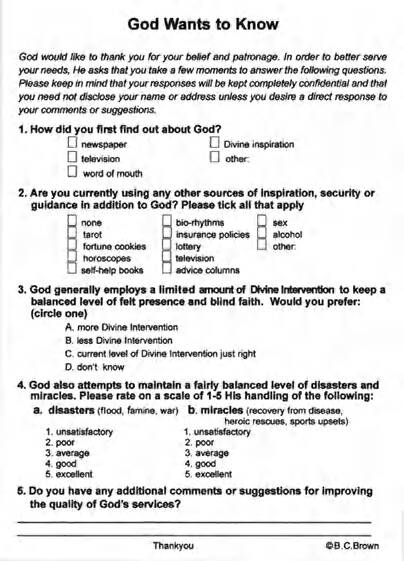
god's customer service survey

I don't know where he found it but Mike Clawson posts this interesting survey from God.

74413733 110351E9C1 O

Technorati Tags:

Friday, October 12, 2007

the full gospel

Dan Edelen posted a great piece Two Halves of the Whole Gospel.

Edelen uses Ephesians 2:8-10 to illustrate "two-halves" of the same Gospel.

v. 8 For by grace you have been saved through faith. And this is not your own doing; it is the gift of God, 9 not a result of works, so that no one may boast. 10 For we are his workmanship, created in Christ Jesus for good works, which God prepared beforehand, that we should walk in them.

He describes verses 8-9 as the half loved by the Elect.
They obsess about doctrine, detest even a whiff of works righteousness, and are enormously concerned with getting people saved. They got their marching orders at the Reformation and consider it the high point in modern history. And heaven help anyone who’s not in total agreement with them.

He contrasts that to verse 10 which is favored by the Fieldworkers.

They obsess about helping those in need, detest the hypocrisy of not walking the talk, and are enormously concerned with bettering the lives of everyone around them. They can’t point to any one point in time for their marching orders, but earnestly believe that we need a new Reformation. And heaven help anyone who’s not in total agreement with them.

Edelen then does a nice job of describing how each half can tend to "bash" the other half because of course, the other half's version of the Gospel falls short. The issue of course isn't that either side is wrong. It's that each side is in fact true, but they are half of the truth. He makes the following wonderful conclusion.

The whole Gospel contains both the power to raise the dead in spirit to spiritual life in the name of Jesus AND the power to tenderize the human heart toward the service of others in the name of Jesus.

The whole Gospel is the whole Gospel. If we’re not concerned with seeing people saved through hearing the message of salvation, maintaining the integrity of our doctrine, and preaching that we can’t earn our way to heaven, then we’re blowing it. If we’re not concerned about taking care of those in need, living out the love of Christ in practical ways, and fighting for the betterment of everyone we meet, then we’re blowing it.

Technorati Tags:

the trinity

A guy in our small group was recently asking about the Trinity and 'coincidentally' Justin Taylor just posted a simple yet excellent article on the topic.

Wayne Grudem’s Systematic Theology defines the Trinity as follows: “God eternally exists as three persons, Father, Son, and Holy Spirit, and each person is fully God, and there is one God” (p. 226).

Broken down, this amounts to three propositions:

* God is three persons.
* Each person is fully God.
* There is one God.

In addition, it’s helpful to elaborate on the fact that when we say “God is three persons,” we mean that he is not just one person, and that the persons of the Trinity are not to be confused. So we can also say:

* The Father is God.
* The Son is God.
* The Holy Spirit is God.
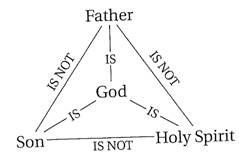
* The Father is not the Holy Spirit, and the Holy Spirit is not the Father.
* The Holy Spirit is not the Son, and the Son is not the Holy Spirit.
* The Son is not the Father, and the Father is not the Son.

If your head is starting to spin—then perhaps this little diagram can help give you a snapshot of what we’ve been saying:


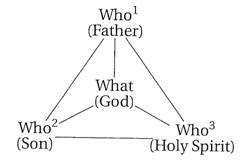
Theologians have typically described God as being of “one essence” but “three persons.” But what exactly do we mean by “essence” and “person”? In its simplest terms, essence answers the question, “What are you?” Person answers the question, “Who are you?”

So when we say that the Trinity entails “one essence” (God) and “three persons” (Father, Son, and Spirit), we are saying that the Trinity has one What and three Who’s. We can draw this as follows:

computer illiterate

I just wanted the world to know that I am completely computer illiterate - in addition to not being that smart.

The background is that I've been having trouble with the distance on my home wireless network. I called the support folks for Apple even though it was a problem with my Belkin router not my Macs. They gave me some good advice but because it wasn't an Apple problem, I just took notes and worked on it later.

You can imagine how embarrassed I felt when I realized I needed to change the router cast rate not castrate.

Technorati Tags:

Thursday, October 11, 2007

to defend or contend, that is the question

I like Iggy's take on the defending the truth issue. I haven't spent a lot of time to decide if I agree with every detail of his post but in principle, I'm there. Are you a contender for the faith or a defender of truth - or worse, a defender of your own version of truth?

Tuesday, October 09, 2007

rc sproul on the kingdom of god

Essential Truth 99 (at least in RC Sproul's Essential Truths of the Christian Faith).

World history has witnessed a multitude of divergent forms of government. The most common types have been dictatorships ruled by military strength, republics ruled by law, democracies ruled by majority vote, and two types of monarchies—constitutional monarchies (in which the monarch’s powers are limited) and absolute monarchies (in which the monarch’s word is law).


The kingdom of God is an absolute monarchy. God has no external constitution to bind Him. He needs no consent from the governed to rule over them. He is not limited by referenda or by majority vote. His word is law; His rule is absolutely sovereign.


In any monarchy, the virtues of honor and loyalty to the throne are exceedingly important. There is no monarchy where these elements are more vital than in God’s kingdom. Yet the fundamental sin of the human race is grounded in our refusal to honor God as God (Romans 1:21) and in our disloyalty to the King of Kings.


The theme of the kingdom of God is a central motif that runs as a thread through both Old and New Testaments. The theme accents God’s reign over His people. The coming Messiah is announced as God’s anointed King who will be enthroned in heaven as the King of Kings and Lord of Lords.


The Old Testament points to the kingdom as coming in the future. The New Testament opens with the announcement of John the Baptist that “the kingdom of heaven is at hand” (Matthew 3:2). The historical situation is described in images such as “the ax is laid to the root of the trees” (Matthew 3:10) and “His winnowing fan is in His hand” (Matthew 3:12), both indicating radical nearness. It was the breakthrough into history of God’s kingdom that heralded the New Testament gospel. John’s message that “the King is coming” signaled the urgency of the times.


The accent of Jesus’ own preaching also falls on the announcement of the gospel of the kingdom. He declares that the kingdom has come with power and is in the midst of His people. At His ascension, Jesus commanded His disciples to be His witnesses in the world. They are to witness to the reign of Jesus as King of Kings. Jesus’ current status as cosmic King is invisible. The world is either ignorant of His sovereignty or denies it. It is the task of the church to give visible witness to the invisible kingdom.


Jesus inaugurated the kingdom of God. He has already been enthroned in heaven. But it is as though He is a King in exile with few loyal subjects. At His return He will fully consummate His reign.


The New Testament indicates that the kingdom of God is both present and future. There is an “already” and a “not yet” to the kingdom. Both aspects must be understood and embraced by Christians. To view the kingdom either as already totally realized or as totally futuristic is to do violence to the message of the New Testament. We serve a King who has already been enthroned. Yet we await His triumphal return in glory when every knee will bow before Him.


Summary:

1. God’s kingdom is by absolute rule.

2. The theme of God’s kingdom links the Old and New Testaments.

3. The New Testament announces the inauguration of the kingdom of God with Jesus’ appearance and subsequent enthronement.

4. The kingdom of God exists already but will be fully consummated at His glorious return.


Biblical passages for reflection:

Psalm 10:16-18

Psalm 22:27-31

Daniel 2:44

John 18:36

Hebrews 1:8-14

Technorati Tags:

Monday, October 08, 2007

global warming

Here's why I support global warming ... it has nothing to do with being a Calvinist, Republican, or anything like that.

Technorati Tags: ,

complementarian challenge

Again, because he has no blog of his own, my friend Randy sent me this article by David Gushee challenging complementarians such as myself. Gushee is correct, many of us (regardless of the issue) focus so much on defending our position that we often fail to properly execute our position. In his article, Gushee asks four simple questions and to be honest, I fall short on some. The point is that if I really believe what I say, then my actions need some improvement.
1. Are you successfully communicating to young men the conviction that a complementarian perspective must elevate rather than diminish the dignity of women, and therefore inculcating a moral commitment on their part to act accordingly?

It has been my experience that a context of male leadership, and steady teaching that reinforces it, can sometimes lead young men to a rather boorish attitude toward the women in their midst. While perhaps church leaders are teaching a highly nuanced complementarian view stripped of classic male chauvinism, this is not always successfully transmitted to the next generation. Many young Christian women, and even some sensitive young men, come to associate the complementarian position with outright sexism and male chauvinism, and therefore reject it. How can you prevent this outcome?

2. Are you absolutely clear on which positions of Christian service (you believe) are barred to women?

Complementarians often seem to lack either consensus or precision related to this question. Is it only the senior pastor position that is banned for women? What about co-pastor or pastoral team arrangements? Is it all ordained positions? All positions in which adult men are taught? All ministerial positions? All paid positions? What about seminary or Christian college professors? In what fields?

Doctrinal precision requires clarity on your part about which positions are barred to women, with clear biblical warrants offered. Otherwise, what often remains is a kind of blanket discouragement for women to think of themselves as ministers, or to pursue ministry positions in the church. What can also occur is a wide variety of approaches, even within the same church, about what the Bible actually teaches concerning the role of women in the church.

3. Once you have determined what positions of Christian service are barred to women, you have therefore also determined which positions are permitted. Are you active in encouraging women to pursue the positions that are permitted?

It is possible to take very different approaches related to encouraging the use of women's gifts from within versions of the complementarian position. For example, in Catholicism women are barred from the priesthood, but in daily and weekly Catholic life they are otherwise highly visible in teaching, worship, committee work and local service.

Yet some complementarian settings seem to go out of their way to present an entirely male face to the world, all the way down to the ushers handing out the programs and the men taking up the offering. Is there really biblical warrant for excluding women from these and other roles? Are you aggressively looking for ways to affirm and make use of the gifts of women in all roles not barred by your understanding of Scripture?

4. When women occupy positions of church leadership that parallel those of men, are their positions named equally and are the individuals involved treated equally?

Many larger churches have internships for promising young men and sometimes also promising young women. Consider a church that has a female youth ministry intern and a male one. Are they paid the same? Is one called "youth ministry intern" and the other called "youth assistant"? Are they both actively apprenticed by older leaders? Are they given a similar mix of "ministry-type" and "non-ministry type" duties? Are they treated with similar respect for their contributions? In my experience, this is often not the case, with women interns treated more as office assistants than as ministry peers.

Technorati Tags: ,

Sunday, October 07, 2007

macarthur on worship

Based on Heb 10.22, let us draw near with a true heart in full assurance of faith, with our hearts sprinkled clean from an evil conscience and our bodies washed with pure water, John MacArthur extracts four helpful tips for preparing one's heart for worship.
  • Am I sincere?
  • Am I coming in faith?
  • Am I humble?
  • Am I pure?
I think these are excellent questions to ask ourselves. Given MacArthur's criticisms of 'mystics' and 'manipulators', I'm not sure where he would allow space for this process of introspection. That aside, he is right about the questions and I highly recommend we take some time to still our hearts and minds to search ourselves for the answer to each of these (just be careful what you name it and you should be ok).

Technorati Tags:

christian influence

From Matt Massey today as we discussed being a people of influence.
Influence is to have a burden and a passion in our hearts to see another person know Jesus and to be all they are intended to be in Christ. It is done by calling out that life in them. It has no strings attached and is unconditional love, i.e., in spite of the outcome or response.

Technorati Tags:

what or who is correct?

I've been reading about the importance of right doctrine and since I agree I've posted what I've posted what I read. But I want to emphasize that while right doctrine is important, without right practice it is of no value. Many critical bloggers, preachers, writers, etc. these days have right doctrine (mostly right anyway) but are very critical of those that do not. John Michael Talbot provides the following excellent reminder in his post today.

Luke 10:25-37

And who is my neighbor? v. 29

This question was an attempt to rationalize the radical nature of Jesus’ words, to take the edge off what Jesus said. The questioner did not want to change his current and comfortable "religious" lifestyle.

OUR IMAGE OR HIS?

Many of us do the same thing today upon hearing a word that makes us uncomfortable. We hear Jesus challenge us to change our lives radically, and we respond negatively. We aren’t atheist or agnostic. By and large we agree that we should believe in God. We go to Bible studies and seminaries where we are told not only what Jesus said, but what he meant to say! Usually the interpretation is far less radical and challenging than the literal words of Christ. We would often rather meditate on a modern Bible commentary than on the Bible itself. When we do this, we conform Jesus to our desired image rather than allowing the Spirit and his words to transform us into the image of Christ. Is this anything short of idolatry?

Notice that the people who passed by the man who had been assaulted by robbers were all religious and respectable. Yet none of them did the will of God. It was a Samaritan, a fundamentalist heretic in the eyes of the Jews, who did God’s will.

IT'S A MATTER OF THE HEART

Doctrinally, the Jews were correct, but they did not please God. Doctrinally, the Samaritans did not perceive the full and ongoing revelation of God to his people through the prophets, the psalms, and the wisdom literature. Yet the Samaritan did the will of God because he had compassion; his heart was right even though his doctrine wasn't.

Do we have compassion, or do we just have doctrine? Do we intellectually rationalize, or do we radically obey? Jesus wants disciples who allow their lives to be radically transformed by compassion and love, without which our doctrines may be correct, but our life with God will still be wrong.

speaking of essentials ...

Speaking of essentials, here are a couple of basic concepts that will get you far ...
  • Be aware that this world's systems are under Satan's control
  • Be aware that Jesus Christ came to change all of Satan's plans
1 john 5.19 - We know that we are from God, and the whole world lies in the power of the evil one.

According to Luke, chapter 4, Jesus began this when He proclaimed, "The Spirit of the Lord is upon me, because he has anointed me to proclaim good news to the poor. He has sent me to proclaim liberty to the captives and recovering of sight to the blind, to set at liberty those who are oppressed, to proclaim the year of the Lord's favor."

Acts 10.38 - God anointed Jesus of Nazareth with the Holy Spirit and with power. He went about doing good and healing all who were oppressed by the devil, for God was with him.

And Christ is now in a place of absolute authority (Ep 1.20-21; 1 Tim 6.15).

And this is why we now pray Your kingdom come, your will be done, on earth as it is in heaven! We live between the already not yet. We live between the cross' victory over sin and Satan and the coming age inaugurated by Christ's return. We have assurance of eternal life now yet we experience the benefits of the Kingdom only in part.

Our King however left a very clear message in Matthew 28, "All authority in heaven and on earth has been given to me. Go therefore and make disciples of all nations, baptizing them in the name of the Father and of the Son and of the Holy Spirit, teaching them to observe all that I have commanded you. And behold, I am with you always, to the end of the age."

Technorati Tags:

personal devil

Martin Lloyd-Jones in The Christian Warfare.
Indeed, I suggest that belief in a personal devil and demon activities is the touchstone by which one can most easily test any profession of Christian faith today. In a world of collapsing institutions, moral chaos, and increasing violence, never was it more important to trace the hand of "the prince of the power of the air." If we cannot discern the chief cause of our ills, how can we hope to cure them?

Again, too many are off fighting the wrong fight. Lord, may your Kingdom come.

Technorati Tags: ,

proper view redux

The below is a recycling of thoughts I've posted before but since it comes up repeatedly in my life, I'm reposting it. Specifically, this is a letter (edited) I just sent to a friend of mine in the role of senior pastor (he's a church planter). We were talking about the activities that consume us in the organization we call church and the seemly endless arguing within and between churches ...

Regarding aging and wisdom ... while somewhat out of context, I think these play well ...

Psa 90.10 - The years of our life are seventy, or even by reason of strength eighty ...
Psa 90.12 - So teach us to number our days that we may get a heart of wisdom.

On my birthday this year, I will have lived 16,801 days - almost half of that with Our Lord's forgiveness and under His leadership. If I live until 70, I have only 8,763 days left. If I make it to 80, I have 12,419 left. Who knows, I may not make it until tomorrow. Only God knows.

Psa 111.10 - The fear of the Lord is the beginning of wisdom; all those who practice it have a good understanding .

I love James 4.13ff because it combines these two principles from Psalms.

Come now, you who say, "Today or tomorrow we will go into such and such a town and spend a year there and trade and make a profit"— yet you do not know what tomorrow will bring. What is your life? For you are a mist that appears for a little time and then vanishes. Instead you ought to say, "If the Lord wills, we will live and do this or that." As it is, you boast in your arrogance. All such boasting is evil. So whoever knows the right thing to do and fails to do it, for him it is sin.

The difference between the evil man and us is a proper understanding of God and a proper understanding of life ( i.e., it is a vapor).

Knowing how little I have left and knowing the awesome reality of God in my life, how do I want to spend my remaining days? Bickering over doctrine? Making money for P&G? Building a fine organization with a great community center?

NO!

Is doctrine good? Absolutely.
Is working for P&G good? For me so far yes.
Is building up your "church" with a great community center good? I suspect yes.

But are these things the goal? Should they ever consume us? Should the become our passion? Should they be points of dissension? Never let it be so!

Ecc 12.13 - The end of the matter; all has been heard. Fear God and keep his commandments, for this is the whole duty of man.

And of course the greatest commands are to love God and to love people.

doctrine is important

New Attitudes posts Mark Dever's thoughts on what is orthodoxy. Coincidentally I had lunch with a friend in which we asked the same question. What are the essentials?

The article begins by considering three of the ways we learn.
For one, the Bible: We learn the truth fundamentally, supremely, finally and mostly through the Bible. This is God’s word written. So study your Bible. Get to know God’s word well. Always be growing in your understanding of it. We love the Lord and because we love the Lord, we love the Lord’s word. We must give ourselves to know it, to meditate on it, to appreciate the great gift that God has given us in His word.

Second, the church: God does not intend us to be earthly orphans—self-taught, self-regulating, self-centered. God has called us to be in local churches that teach the Bible well, and accurately, and that are full of people whose lives show the fruit of faith in God and of the work of His Spirit. We should submit ourselves to them and their teaching.

Christians together in our churches should have a clear grasp on what the Gospel is that saved them. Paul assumes this in Galatians 1:8-9 that these young Christians, the Galatians, could sit in judgment over him, an apostle, if he comes and teaches a different message.

[T]here is a simplicity and a clarity to the Gospel itself that every true Christian knows. It’s the duty of the Christian church, and particularly the elders of that church, to define what we must agree upon to be a Christian and to be a member of that congregation in particular. Pray for your elders, submit to them, thank God for them and their ministry.

Third, we also learn through our conscience: Now each of us has a conscience. But because of the fall, our conscience has been radically harmed. This important part of God’s moral image is not lost, but it’s not all right. It’s not been eliminated, but it’s not always accurate.

We all have an inherent sense of right and wrong, but the conscience is inherent, not inerrant. You cannot assume that your own conscience always tells you the truth. And so you need your conscience to be educated, we need our consciences to be trained and taught according to God’s word.

Yes, I know that many Evangelicals claim we 'hear God' only through Scripture but since Scripture tells us that is not true, I'll stick with what Scripture says on that (hope that made sense?).

Next we are offered a simple four part test to determine if a doctrine is important enough to seek agreement on, i.e., is it an essential.

1. How clear is it in Scripture?
2. How clear do others think it is in Scripture? (Especially those that you respect as teachers of God’s word and trust.)
3. How near is it to the Gospel? (Or how near are its implications to the gospel itself?)
4. What would the affects be doctrinally and practically if we allowed disagreement in this area?

Some would say all doctrine is essential. At one level I agree but I would add that there is a prioritization of doctrines that must take place. Some things are more clear than others and some things are more important than others - or at least the manner in which the doctrine is practice is subordinate to another.

1 Cor 15 - Now brothers, I want to remind you of the Gospel I preached to you, which you received and on which you have taken your stand, by this Gospel you are saved if you hold firmly to the word I preached to you, otherwise you have believed in vain. For what I have received, I passed on to you, as of first importance, that Christ died for our sins according to the Scriptures, he was buried, and he was raised on the third day according to the Scriptures and that he appeared to Peter, and then to the twelve.

Scripture is full of admonition regarding the importance, i.e., the "essentiality" of doctrine - but all doctrine must work together for it to be true. Any doctrine pulled from the rest and practiced out of order becomes a perversion. This does not nullify the doctrine, it nullifies the practice.

NA then attempts to pull three essentials around which the rest are formed. These are: God. The Bible. The gospel.

God
We have to believe in the one true God. We have to believe that God is one, and that he is Triune: Father, Son and Holy Spirit. We have to believe that He is uncreated, that He is self-existing, that He is not dependent upon anyone else. And we must believe that He is morally perfect, that He is characterized by holiness and by love, that He is by His own will our Sovereign Creator and our Lord and our Judge. He is the one that we’re called to believe in.

The Bible
The Bible is how we know the truth about God.

The Gospel
We must agree on the gospel—the good news.

If we agree on these things we are brothers and ought act like it. If we do agree, we are not brothers. Worse, if we agree but do not act in love, we sin.

I think many who call themselves christian disagree in one or more of the three points above. Yet when we engage with someone we disagree with we spend time debating points other than these. It seems that without alignment here, the rest can never make sense.

Friday, October 05, 2007

mega churches

I don't think the video 'proves' a lot so please do not use this as a launching pad for criticism. I think its value is in the introspection we could choose to do, i.e., it should give us reason to pause and think. Why are we doing the things we do in this thing we call church? And I think the point applies to any 'church' - mega on not ...

The video is of Jim Henderson (known for buying atheists on ebay) discussing a recent church visit with Matt Casper.


HT:GR

Technorati Tags:

pharisees

Kurt Gebhards writes on raising pharisees in Pulpit Magazine. He rightly notes children raised within the church are more susceptible to becoming a pharisee rather than becoming outright rebellious. He makes this short list of characteristics a teen might manifest if this spirit is left unchecked as he grows.
  • This teen prefers well-defined, black and white rules, for they give him a sense of certainty that God must surely reward those achievements (Lk. 18:12).
  • He adds a layer of rules to the Word of God (like not watching any movies, not listening to popular music, et cetera), giving the impression that he holds to a higher standard than Holy Scripture (Mt. 23:4).
  • He tends to propose personal preferences as, or elevate them above, divine imperatives (Mt. 15:2-3).
  • He pursues perfectionism (Phil. 3:6), not excellence (Phil. 3:12-14).
  • He separates himself from others he considers of lesser cultural morality – people whose table manners, courtesy of speech, and refinement of mannerisms do not match middle-class norms (Lk. 15:1-2).
  • He is judgmental – he excels at fault-finding, he loves to pick verbal fights – and the standard by which he condemns others is not primarily biblical, but personal, preferential, or traditional (Mt. 7:5). He fights against many people, against many issues, but he does not know who he is fighting for.
Great article and good list - one could easily substitute blogger/writer/preacher for teen ... I have a certain group in mind but please, no name calling here ...

Technorati Tags:

Thursday, October 04, 2007

the law and the gospel

Run, John, run, the law commands
But gives us neither feet nor hands,
Far better news the gospel brings:
It bids us fly and gives us wings.


- John Bunyan

The Gospel Driven Blog brings us this great quote from Casper Olevianus, A Firm Foundation: An Aid to Interpreting the Heidelberg Catechism.

10. Q. What is the difference between the law and the gospel?

A. The law is a doctrine that God has implanted in human nature and has repeated and renewed in His commandments. In it He holds before us, as if in a manuscript, what it is we are and are not to do, namely, obey Him perfectly both inwardly and outwardly. He also promises eternal life on the condition that I keep the law perfectly my whole life long. One the other hand, He threatens eternal damnation if I do not keep every provision of the law my whole life long but violate it in one or more of its parts. As God says in Deuteronomy 27[:26] and Galatians 3[:10], “Cursed is everyone who does not continue in all things which are written in the book of the law, to do them.” And once the law has been violated, it has no promise that by the help of the law, that is, by works of the law, our sins might be forgiven. Rather, the sentence of condemnation is imposed upon us.

The gospel of good news, however, is a doctrine of which even the wisest knew nothing by nature but which is revealed from heaven. In it God does not demand but rather offers and gives us the righteousness that the law requires. This righteousness is the perfect obedience of the suffering and death of Jesus Christ, through which all sin and damnation, made manifest by the law, is pardoned and washed away (Rom. 5; Gal. 3). Furthermore, God does not give us forgiveness of sins in the gospel on the condition that we keep the law. Rather, even though we never have kept it nor will ever be able to keep it perfectly, He still has forgiven our sins and given us eternal life as an unmerited gift through faith in Jesus Christ. John 1[:17] says, “The law was given through Moses, but grace and truth come through Jesus Christ.” And Romans 8[:3, 4]: “The law is not of faith but ‘The man who does it shall live by it.’ Christ, however, redeemed us from the curse of the law when He became a curse for us (for it is written, ‘Cursed is everyone who hangs on a tree’), that the blessing of Abraham might come upon the Gentiles in Christ Jesus and we thus might receive the promised Spirit through faith.”

I am not ashamed of the gospel, because it is the power of God for the salvation of everyone who believes: first for the Jew, then for the Gentile. For in the gospel a righteousness from God is revealed, a righteousness that is by faith from first to last, just as it is written: "The righteous will live by faith" (Romans 1:16-17).

The Good News of God's Kingdom is that because of God's love and grace and because of the cross of Christ, we who justly deserved eternal condemnation have now become heirs of eternal life through faith in Him.

church in denial

Jon Birch delivers another stinger ... it is amazing the stuff (often considered 'sacred') that we tack onto the way we do church. These things very often have nothing to do with the real issues we face nor the real goal we pursue.

Additions

Technorati Tags:

Tuesday, October 02, 2007

power napping

The following is going to triple my productivity ... well maybe not ...

Scientists say that a successful midday nap depends on two things: timing and caffeine consumption. Experiments performed at Loughborough University in the UK showed that the sleep-deprived need only a cup of coffee and 15 minutes of shut-eye to feel amazingly refreshed.
  • Right before you crash, down a cup of java. The caffeine has to travel through your gastro-intestinal tract, giving you time to nap before it kicks in.
  • Close your eyes and relax. Even if you only doze, you'll get what's known as effective microsleep, or momentary lapses of wakefulness.
  • Limit your nap to 15 minutes. A half hour can lead to sleep inertia, or the spinning down of the brain's prefrontal cortex, which handles functions like judgment. This gray matter can take 30 minutes to reboot.

Monday, October 01, 2007

mcmanus on scripture's proper place

Knowing God, knowing His heart, knowing His character is really about falling passionately in love with God and experiencing His love. Of course, there are dynamics to that: the Scriptures are essential. God speaks through the cosmos, God speaks through creation, God speaks through human experience and conscience, God speaks through everything, yes—but I do see the Scriptures as the primary access, a portal into God’s presence. I began to have a clear sense of God’s voice in my life through reading the Scriptures and hearing God’s voice through the Scriptures.

I build my life not on the Word of God, but the voice of God. The Scriptures are to me the instrument that God has placed in history for me to learn the voice of God. I treasure the Scriptures.

Erwin McManus - Relevant Magazine

Technorati Tags:

reftagger