Showing posts sorted by relevance for query birthline. Sort by date Show all posts

Thursday, February 08, 2007

spiritual birthline

Justin Taylor has an interesting interview with Stephen Smallman in which Smallman explains a helpful analogy from his book Spiritual Birthline.

384083104 00B51E7096


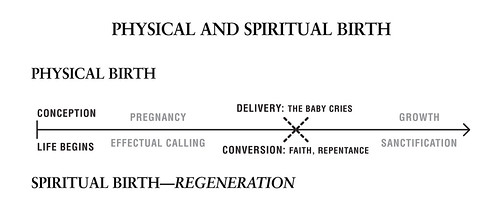
... a way to understand spiritual birth was to reflect on our physical birth--which is certainly what Jesus caused Nicodemus to do. If physical birth is really a process, marked by an event when the unborn baby goes public, doesn't that help us understand the process of spiritual birth?

... the parallel of physical and spiritual birth makes it clear that they both should be thought of in terms of process rather than event. I present this by first walking through the familiar experience of physical birth. If there is a key moment, it has to be the point of conception, which is private and virtually invisible. Over time that new life grows until it inevitably "goes public." We don't speak of life as beginning at the time of delivery, but now the child begins a new phase of growth--through infancy, childhood, and adulthood. I suggest that helps to explain the process of spiritual birth: it begins when God sovereignly begins a new life in our dead souls. Jesus made it clear (John 3) this was a work of the Holy Spirit, and in fact "born again" can be properly translated "begotten again," or "begotten from above." But rather than instantly appearing, the new life grows like a spiritual pregnancy until we are compelled, in one form or another, to "go public," and we "call on the name of the Lord." This is the experience we commonly label as conversion--it is our response to the inward calling/convicting work of the Spirit when the truth of the gospel burns itself more and more into our consciousness. Reformed theologians typically speak of this season of spiritual pilgrimage as "effectual calling," and Paul frequently reminds believers in the beginning of his epistles of their calling to Christ (Rom. 1:6; 1 Cor. 1:2, 9). The Westminster Shorter Catechism (#31) explains that the work of effectual calling by the Spirit brings us to the point where we "embrace Jesus Christ freely offered to us in the gospel." I represent that "embrace" or conversion with a dotted X. At first I simply drew it as an X on the timeline, but as that helped people to think through their actual experience of conversion I began to appreciate the remarkable variety of ways people came to the place of actually expressing faith. In the end we can only say that when the Spirit calls us it will bring us to surrender to Jesus, but the form or time that takes cannot be confined to a moment or a formula.

Finally, what the birthline makes clear is that the process begun by the Spirit will continue into what we typically define as sanctification. There tends to be so much focus on the conversion experience in our evangelical culture that spiritual growth is viewed as a good thing, but not necessarily present with all converts. But a biblical understanding of salvation assumes that those whom the Lord calls to himself will continue in that calling, and I try to reflect this in the idea of the birthline.

I should add that I use the birthline as a helpful tool to explain the invisible, supernatural work of the Spirit; what Jesus referred to as the "wind blowing where it wills." We are in the presence of divine mystery in the work of God in the soul, and there is no final way to describe it.
The whole piece is worth the time.

Tuesday, June 26, 2007

spiritual birthline again

I first saw the concept of a spiritual "birthline" through an interview done by Justin Taylor with Stephen Smallman, author of Spiritual Birthline: Understanding How We Experience the New Birth. Worship.com just posted on this insightful paradigm.

Here the summary and implications for witness are outlined as follows:

1. God justifies people solely because of the work of Christ on the cross. This was accomplished 2000 years ago. But God the Father’s saving love is not only what Christ accomplished, but that he also sends his Spirit to our dead spirits.
2. The Holy Spirit awakens one dead in sin and gives the gift of saving faith. Any presentation of the Gospel will fall on deaf ears until the Spirit begins to "call." For most people their “awakening” is very much like waking up from sleep—it doesn’t happen immediately.
3. In the actual experience of coming to Christ, very few people have an adequate understanding of the work of the cross. The faith that is exercised to reach out to Christ is frequently based on very elementary knowledge. This can be seen in many Scriptural and contemporary examples of people coming to Christ.
4. Those who share the good news of the Gospel must be careful not to omit essential elements of the truth. At the same time it is vital to be sensitive to the realities of what is stated in #3. The beginnings of experiencing life in Christ should not be made to depend on understanding certain information, however true. (However people cannot truly come to Christ if they reject truths of the Gospel.) Life in Christ is a gift of pure grace, received by childlike faith, which is part of the gift. We come to believe in Jesus, however inadequately we may understand.
5. Spiritual growth of those who have begun with Christ is rooted in a deepening awareness of Jesus (the Gospels) and the cross (Romans). Assurance of salvation in Christ will come as new steps of understanding and obedience are taken. Do not talk people into assurance of faith, this is a witness of the Spirit.

Technorati Tags:

reftagger