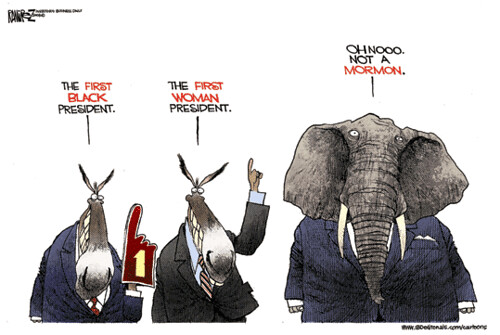
He just posted on his observation that "there appears to be a clarifying work of God going on in within the Visible Church." Read more here.
Technorati Tags: judging

Technorati Tags: judging
Censoriousness - What It Is
Censoriousness is composed of self-conceit and severity; a self-conceit that we are superior to others, and are entitled to some sort of lordship over them; and then a severity of judging others by the outward letter of righteousness instead of by the Spirit. There are other people who are censorious besides Christians, but it does not look so conspicuous in their lives, for it is the very nature of religion to make a streak of badness look more ugly.
Censoriousness has a special facility of fastening itself on a religious person, and on persons professing a great deal of religion, and its very intensity is in the proportion to the intensity of religious zeal, and seems to find its greenest pastures in those who profess the perfection of love.
It is a parasite which, like the mistletoe, fastens itself on the tree of religion, and seeks to spread itself until it claims to be the tree, and, in fact, if not killed off, will succeed in killing the tree, which, indeed, it often does.
There seem to be certain weaknesses, and ugly, disagreeable infirmities, latent in the soul that nothing even develops till he becomes religious, and sometimes the more intense the religion the more glaring are these infirmities. There is nothing disagreeable in handling a piece of dry wood, but if you undertake to make the wood pass into a live coal of fire then will develop the unpleasant concomitant of smoke, and soot, and ashes, which would never have been known but for the process of burning, and there is something like this in the soul’s transition from a state of nature to that of the pure, burning love of God, and though all souls do not manifest the same disagreeable things, yet, as God’s grace is burning us through, it seems inevitable that there will be a smoke in the shape of some religious infirmity.
Censoriousness is not grace, but is assumes the profession of grace, and oftentimes of great sanctity, and it seems to develop in some characters only when they are really under the operations of grace, as an iceberg throws off a heavy fog when it comes near the Gulf stream. One thing is certain, that many professors of very high grace are very censorious, and they were never very censorious until some time after their declaration of entire yielding to God. Perhaps we can never understand the metaphysics of it, but we know it is a delusion of Satan to get religious people to mistake censoriousness for sanctity. One of the remedies against it is a clear understanding of what it is.
Technorati Tags: judging
How do we relate to those who do not understand us? Do we love them or hate them? Even if they are our enemies, Jesus said, "Love your enemies." (Mt 5:44.) Do we really "love" our family members who do not understand us? Can we still love them when they claim to be "Christian" and clearly aren’t following Christ? The one who can love us all the best is Jesus. If we love him more than anyone, we will come to really love everyone, especially family members.

Technorati Tags: ecclesiology, judging
Missional living is about spirituality before it is about strategy or congregational structure. So, the first big issue is the reclamation of authentic discipleship. Churches must rediscover spiritual formation for missional living and develop systems for encouragement and accountability of a living faith.
Becoming a missional church is about being–being conformed to the image of God, bearing His heart–before it is about doing. Therefore, leaders must connect their congregations with His heart via the Scriptures.
Technorati Tags: humor
Appropriate contextualization means "adapting my communication of the gospel without changing its essential character." In short, we must retain the essentials and adapt the non-essentials.
In [Paul's] first letter to the Christians at Corinth. "I have become all things to all men," he says, "that I might by all means save some" (1 Cor 9:22, RSV). This does not mean that Paul compromises his beliefs and practices by simply conforming them to those he happens to be addressing at any particular time. It means that he is always taking such beliefs and practices into account and making them the starting point for his own message and behavior. Wherever he can do so, he acknowledges the validity of other approaches and incorporates them into his own (Acts 17:22–34). Where he cannot, he asserts the superiority of his approach over others and argues that it fulfills the aspirations that have been misguidedly invested in the other approaches (Col 2:8–23). Either way the things he is saying and doing cannot be properly appreciated without reference to the context in which he is speaking and acting.
Another reason Paul should be studied in the context of his culture is his frequently expressed concern with the social attitudes and structures of his day. On some occasions he calls these into question and contradicts them by his own statements or behavior (1 Cor 6:1–6); on others he insists they be carefully noted and followed (11:14–15). Where accepted conventions come into conflict with a basic implication of the gospel message, there is no doubt in his mind as to which has to give way (10:14–22). Where less central implications of the gospel are concerned and where there is the likelihood of causing offense among those outside the Christian group, there should be a willing avoidance of practices that, all things being equal, are quite legitimate in themselves (8:7–13; 10:23–30).
WALLACE: And what about Mitt Romney? And I’ve got to ask you the question, because it is a question whether it should be or not in this campaign, is a Mormon a true Christian?
OSTEEN: Well, in my mind they are. Mitt Romney has said that he believes in Christ as his savior, and that’s what I believe, so, you know, I’m not the one to judge the little details of it. So I believe they are.
And so, you know, Mitt Romney seems like a man of character and integrity to me, and I don’t think he would — anything would stop me from voting for him if that’s what I felt like.
WALLACE: So, for instance, when people start talking about Joseph Smith, the founder of the church, and the golden tablets in upstate New York, and God assumes the shape of a man, do you not get hung up in those theological issues?
OSTEEN: I probably don’t get hung up in them because I haven’t really studied them or thought about them. And you know, I just try to let God be the judge of that. I mean, I don’t know.
I certainly can’t say that I agree with everything that I’ve heard about it, but from what I’ve heard from Mitt, when he says that Christ is his savior, to me that’s a common bond.

Technorati Tags: humor
Calvin didn't just plant small fledgling churches; he planted mega-churches that in turn planted more churches. It is difficult to fathom the extraordinary success of these Genevan sponsored missionaries. Even in our modern era, such statistics are unheard of.
Technorati Tags: Calvinism
So the word total in "total depravity" refers to the extent of our sinfulness, not the degree to which we manifest it. It means evil has contaminated every aspect of our being—our wills, our intellect, our emotions, our conscience, our personality, and our desires.
Technorati Tags: Calvinism
I recently heard someone say that the motto of Christianity nowadays is
“And now these three things remain: faith, hope and love. But the greatest of these is truth.”
Discernment cannot be understood as a practice that stands on its own. Neither is it something we do for its own sake—we are not discerning for the sake of discernment but rather for the sake of purity in doctrine and in practice. A person who wishes to be discerning must also be willing to take into account the Bible’s other teachings about loving one another, about speaking the truth in love, and so on. Many of these “discernment ministries” and “discernment blogs” seem to understand the importance of separating truth from error, even while falling into error in their responses. The Bible does not account for a lone wolf Christian making it his business to critique every author or teacher or ministry who happens to stumble into his crosshairs. In the book I suggest that the local church is the best and most natural context for the practice of discernment and I’ll stand by that!
Technorati Tags: judging
I am still not so sure about your continual attack on people like Pastor Ken. If they are wrong, can't you point out specifically where they are wrong, instead of just blanket condemnation? FOr example, let's take this as an example. Do you have any problems with it? If so, what are they?
Ingrid Schlueter: So what you’re saying is that the question of whether the Gospel exists in other religions is a thrilling question that we should be asking.
Doug Pagitt: I think it’s the biblical question. Yes, I think it’s the right biblical question. I think, I find that you couldn’t read the New Testament without that question being raised and without the answers to it being the answers that we should be paying to; which is there is no culture or religion which holds God in complete isolation or purity. (15:25-15:56)
There is always the act of the Spirit outside of our religious systems. That's true of ... all religions. There is nobody who should be able to say that what we believe is the end of the story and that there is nothing else that God can contribute through people in the world. Or that there is nothing else that God is ever going to do in the world. That is a serious overstatement. There is no Christian expression which is not also a cultural expression. We do not have a culturally neutral Christianity. So what we have in any system of belief ... we are now engaged in a culturally invented Christianity which has its limitations.
Ingrid Schlueter: So we could interpret what you’re saying as how is God at work; how is the Gospel present within Buddhism, Hinduism, Sikhism—all of the different religions of the world.
Doug Pagitt: Yeah, for sure because—I mean—Buddhism, Hinduism, Sikhism, those are not—I me—they are the right way to say ‘em. They are “isms,”right; so they are a school of thought, and they are also embedded in a particular cultural setting. And so I think someone could say, “yes, I can see how God—how God is expressed, talked about, understood, through these schools of thought.” Which I find to be quite helpful and they’re not all in contrast with my Christianity. (17:05-17:47)
And I could find other parts of those same systems that I think I could say I don't think that is at all the way God operates in the world. But I find that very same thing inside the Christian context.
Jesus was killed because of how He confronted a particular socioeconomic religious system. He’s a first-century Galilean revolutionary who proclaimed a Kingdom other than the kingdom of Herod,
We refer to ourselves [at Mars Hill] as aggressively nonpartisan, so we don’t engage in partisan politics in terms of “Here’s whom you should vote for; here’s whom you should support.” We do acknowledge that the Gospel has deeply political edges to it, but that should not surprise anyone. Jesus was killed because of how He confronted a particular socioeconomic religious system. He’s a first-century Galilean revolutionary who proclaimed a Kingdom other than the kingdom of Herod, so the Gospel does have political edges.
The interest is in giving voice to people who have no voice and using all of our abundance and wealth and resources on behalf of those who have a shortage. Some of our pastors had a meeting with the mayor of [Grand Rapids], which was simply for the purpose of asking who the most forgotten and the most hurting in our city are. They mayor had several very specific answers, and so we’ve actually reorganized a whole area of our church, putting the majority of our efforts around trying to take care of the worst problems in our city. I don’t know if you would say that’s political or not, even though it involved meeting with the mayor, but if Jesus comes to town and things don’t get better, then we have to ask some hard questions.
I would say that we have a historic opportunity in that all truth belongs to God. It is not owned by the Republicans. It is not owned by the Democrats. It is not owned by the liberals. It is not owned by the conservatives. All truth belongs to God. And God has set us free in Christ.
Our culture worships at the altar of duality. Everything that comes to people - ‘Is it this, or is it this? Is it conservative or is it liberal? It it modern or post-modern? Is it emergent or is it non-emerging?’ And the Kingdom of God - “how God wants things” - transcends whatever divisions our culture has created.
We, as a church, will remain aggressively non-partisan. The gospel has political edges to it. So when a person says ‘oh, no, Jesus just came for the personal’ - [I say] ‘then why did they kill him’? There were deep political edges that had implications.
The environment and our care of the earth is not a Democratic party issue. It is a Genesis 1 issue. If I met a woman today who is pregnant and thinking about terminating that pregnancy, I would introduce her to about ten women in our congregation who would tell her their stories, and I say ‘we are desperate for you to not make that choice.’ That is not a Republican issue. That is an issue of ’we want to affirm life, and we believe mistakes and redemption become opportunities for grace’. So - any side that wants to say ‘we own this issue’ - if it’s true you only own that because you borrowed that from God.
I’ve had people say - ‘well, if you’re saying that, you must be against the President’, or ‘if you’re saying that, you must be for him’. I’m trying to articulate the way of Jesus, and I don’t really care who is for it or against it - I just want to get the word out so that everyone can do it. If you take the gospel seriously, it will always feel lik you are flirting with various political parties, because it is not surprising that different groups would grasp different dimensions of God’s truth. ’Well, if you’re advocating for the poor, that seems to be a Democratic thing’, or ‘if you’re advocating micro-finance that seems capitalistic - is that a Republican thing?’ As far as we know, it’s true and it doesn’t belong to anybody, because it belongs to God.
Can we be a church that transcends all of the ways our culture tries to divide us? What we are trying to do here at Mars Hill is to say that there is a truth that is not the swinging of the pendulum. It is the kingdom of God and it transcends all of the ways we try to divide ourselves. The beautiful thing here is that truth and love seem to be winning. I would beg this community to consider that when Jesus is fully on display, it won’t fit ANY of your boxes, so just toss your boxes out now. I am only trying to come from one perspective: Jesus. NOBODY will co-opt this stage or this community or hijack the agenda, which is that jesus would be put on display for the whole world to see.
I would beg this community to consider that what we are doing here is inviting ourselves to be a part of something our culture has not seen: ‘OK, it’s nice that you have that disagreement, and it’s nice that you have that ‘thing’, but let’s take communion together and then let us break ourselves open and pour ourselves out for the world. So, I would beg our community to have no fear. There is nothing to fear - Jesus can be trusted, so let’s go…
A cutting-edge church leader known for his innovative ideas on reaching a post-modern generation for Christ contends the reason why churches are declining in America is because they are self-centered.
“My primary assessment would be because American Christians tend to be incredibly self-indulgent so they see the church as a place there for them to meet their needs and to express faith in a way that is meaningful for them,” said cultural architect Erwin McManus, lead pastor at Mosaic Church in Los Angeles, to The Christian Post Monday.
“There is almost no genuine compassion or urgency about serving and reaching people who don’t know Christ,” he added.
Right; as if man-centered seeker sensitive emerging churches with lead pastors billing themselves as cultural architects are not exactly like this themselves.