Tuesday, June 10, 2008

right counts

The following is an excellent word from R.C. Sproul (yep - the dude that led me down to the pits of Reformed Theology).

Right Now Counts Forever

The nineteenth-century philosopher Friedrich Nietzsche is famous for his declaration that "God is dead." That brief dictum does not give the whole story. According to Nietzsche, the cause of the Deity's demise was compassion. He said, "God is dead; He died of pity." But before the God who was the God of Judeo-Christianity perished, Nietzsche said that there were a multitude of deities who existed, such as those who resided on Mount Olympus. That is, at one time there was a plurality of gods. All of the rest of the gods perished when one day the Jewish God, Yahweh, stood up in their assembly and said, "Thou shalt have no other gods before me." Hearing this, according to Nietzsche's satirical summary, all of the rest of the gods and goddesses died. They died of laughter.

In our day, where pluralism reigns in the culture, there is as much satirical hostility to the idea of one God as there was in Nietzsche's satire. But today, that repugnance to monotheism is not a laughing matter. In the culture of pluralism, the chief virtue is toleration, which is the notion that all religious views are to be tolerated, all political views are to be tolerated. The only thing that cannot be tolerated is a claim to exclusivity. There is a built-in, inherent antipathy towards all claims of exclusivity. To say that there is one God is repulsive to the pluralists. To say that one God has not revealed Himself by a plurality of avatars in history is also repugnant. A single God with an only begotten Son is a deity who adds insult to injury by claiming an exclusive Son. There cannot be only one Mediator between man and God. There must be many according to pluralists today. It is equally a truism among pluralists that if there is one way to God, there must be many ways to God, and certainly it cannot be accepted that there is only one way. The exclusive claims of Christianity in terms of God, in terms of Christ, in terms of salvation, cannot live in peaceful coexistence with pluralists.

Beyond the question of the existence of God and of His Son, and of a singular way of salvation, there is also a rejection of any claim to having or possessing an exclusive source of divine revelation. At the time of the Reformation, the so-called solas of the Reformation were asserted. It was said that justification is by faith alone (sola fide), that it is through Christ alone (solus Christus), that it is through grace alone (sola gratia), and that it is for God's glory alone (soli Deo gloria). But perhaps most repugnant to the modern pluralist is the exclusive claim of sola Scriptura. The idea of sola Scriptura is that there is only one written source of divine revelation, which can never be placed on a parallel status with confessional statements, creeds, or the traditions of the church. Scripture alone has the authority to bind the conscience precisely because only Scripture is the written revelation of almighty God. The implications of sola Scriptura for pluralism are many. Not the least of them is this: It carries a fundamental denial of the revelatory character of all other religious books. An advocate of sola Scriptura does not believe that God's revealed Word is found in the Bible and in the Book of Mormon, the Bible and in the Koran, the Bible and in the Upanishads, the Bible and in the Bhagavad Gita; rather, the Christian faith stands on the singular and exclusive claim that the Bible and the Bible alone is God's written word.

Pluralism
The motto of the United States is e pluribus unum. However, since the rise of the ideology of pluralism, the real Unum of that motto has been ripped from its foundation. What drives pluralism is the philosophical antecedent of relativism. All truth is relative; therefore, no one idea or source can be seen as having any kind of supremacy. Built into our law system is the idea of the equal toleration under the law of all religions. It is a short step in people's thinking from equal toleration under the law to equal validity. The principle that all religions should be treated equally under the law and have equal rights does not carry with it the necessary inference that therefore all religions are valid. Even a cursory, comparative examination of the world's religions reveals points of radical contradiction among them, and unless one is prepared to affirm the equal truth of contradictories, one must not be able to embrace this fallacious assumption.

Sadly, with a philosophy of relativism and a philosophy of pluralism, the science of logic doesn't matter. Logic is escorted to the door and is firmly booted out of the house onto the street. There is no room for logic in any system of pluralism and relativism. Indeed, it's a misnomer to call either a system, because it is the idea of a consistent, coherent view of truth that is unacceptable to the pluralist. The fact that people reject exclusive claims to truth does not invalidate those claims. It is the Christian's duty to hold firm to the uniqueness of God and of His Christ and not compromise with the advocates of pluralism.

Technorati Tags:

Monday, June 09, 2008

stott on grace and other stuff

Dan Bowen posts a series of great quotes by John Stott.

On Justification:

"Justification is a legal or forensic term belonging to the law courts. It's opposite is condemnation. Both are the pronouncements of a judge. In a Christian context they are the alternative eschatological verdicts which God the Judge may pass on Judgement Day. So when God justifies sinners today, He anticipates His own final judgement by bringing into the present what properly belongs to the last day".

"Some scholars maintain that 'justification' and 'pardon' are synonymous ... But surely this cannot be so. Pardon is negative, the remission of a penalty or debt; justification is positive, the bestowal of a righteous status, the sinner's reinstatement in the favour and fellowship of God".

"Pardon and justification are therefore essentially distinct. The one is the remission of punishment. The other is a declaration that no ground for the infliction of punishment exists".

Sir Marcus Loane has written; "The voice that spells forgiveness will say; "You may go, you have been let off the penalty which your sin deserves". But the verdict which means acceptance (sc. justification) will say; "You may come; you are welcome to all My love and My Presence".

On Grace:

"Grace is God loving, God stooping, God coming to the rescue, God giving Himself generously in and through Jesus Christ".

"If God justifies sinners freely by His grace, on what grounds does He do so? How is it possible for the righteous God to declare the unrighteous to be righteous without either compromising His righteousness or condoning their unrighteousness? This is our question. God's answer is the Cross".

Technorati Tags: ,

need to be green

Here's a calculator that suggests due to my carbon footprint I should die at age 1.3 ... oh noooo ...

How did you do?

freaking out

I don't know why but I was fascinated by several behaviors in this video.


HT:BH

right words

Even true words are not always right.

Sharkwords
Thanks David Hayward.

nicole

I bumped into Nicole via Jonathan Brink's blog so I cruised over to her blog and was instantly captivated by the first line of the first post there.

What is it about us humans that allows us to pursue so many useless passions with such fervor?

That's brilliant.

random molecules

In my classes in the seminary, I raise questions like, “Is God in control of every single molecule in the universe?” When I raise that question, I say, “The answer to that question will not determine whether you are a Christian or a Moslem, a Calvinist or an Arminian, but it will determine whether you are a theist or an atheist.” Sometimes the students can’t see the connection.

And I say to them, “Don’t you realize that if there is one molecule in this universe running around loose outside the scope or the sphere of God’s divine control and authority and power, then that single maverick molecule may be the grain of sand that changes the entire course of human history, that blocks God from keeping the promises he has made to his people?” It may be that one maverick molecule that will prevent Christ from the consummation of his kingdom. For if there is one maverick molecule, it would mean that God is not sovereign. If God is not sovereign, then God is not God. If there is any element of the universe that is outside of his authority, then he no longer is God over all. In other words, sovereignty belongs to deity. Sovereignty is a natural attribute of the Creator. God owns what he makes, and he rules what he owns. ~ -R. C. Sproul

HT:SOS

Technorati Tags:

Sunday, June 08, 2008

ministry idolatry

Darryl Dash writes When Ministry Becomes Idolatry. There are many people set on exposing error of various pop ministries. When I read these I typically wonder why they have to look so far. Dash rightly reminds us "that sin goes a lot deeper than you normally think. It's getting meaning and identity from someone or something else than God. ... Sin is not always the pursuit of bad things; it's inordinate affection for good things."

The prideful person is obsessed with comparisons, always measuring himself/herself against others. The proud person finds his identity in relation to someone he thinks of as a lesser (which encompasses just about everyone). The humble person finds his identity in relation to someone he knows is greater: Jesus! ~ Sam Storms

Technorati Tags:

i will change your name

I Will Change Your Name
D.J. Butler

I will change your name
You shall no longer be called
Wounded, outcast
Lonely or afraid

I will change your name
Your new name shall be
Confidence, joyfulness
Overcoming one
Faithfulness, friend of God
One who seeks my face.


unity in character

One of the many things I love about Jonathan Brink is how he causes me to think. In God is Love, I wrote about God's attribute of love because Brink recently wrote that perhaps the wrath of God is love. Brink contends that the base characteristic that defines God is love and everything else is secondary. I think that is not a correct nor a helpful way of thinking about God. Instead, I think it is more correct (true to Scripture) and helpful to think of God in the sense of unity, that is, He is not divided into parts. Here I am not speaking of the concept of the Trinity but of His attributes = different attributes of God are emphasized at different times.


When Scripture speaks about God’s attributes it never singles out one attribute of God as more important than all the rest. It seems that every attribute is completely true of God and is true of all of God’s character. In 1 John 1.5, John can say that “God is light” and just a little later say also that “God is love” (1 John 4:8). Scripture does not suggest that part of God is light and part of God is love, or that God is partly light and partly love, nor that that God is more light than love or more love than light. Instead it is God himself who is light, and it is God himself who is also love.


Exodus 34:6–7 provides a similar list of characteristics. The Lord passed before him and proclaimed, “The Lord, the Lord, a God merciful and gracious, slow to anger, and abounding in steadfast love and faithfulness, keeping steadfast love for thousands, forgiving iniquity and transgression and sin, but who will by no means clear the guilty, visiting the iniquity of the fathers upon the children and the children’s children, to the third and the fourth generation.” This does not mean that these attributes are only characteristic of some part of God, instead they are characteristic of God himself and therefore characteristic of all of God.

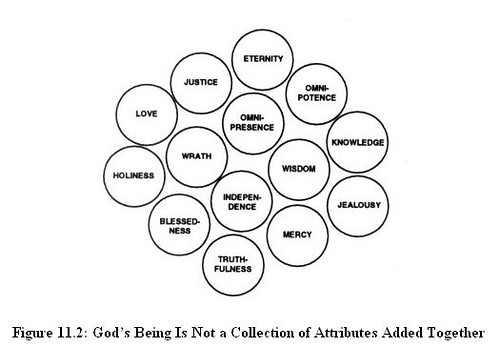
Using these simple graphics, Wayne Grudem depicts that God should not be thought of as a collection of characteristics.

2560336527 1Da4F0F9A8

Nor should the characteristics of God be thought of as additions to His real being.
2560339403 09699D8B4D
I find it more helpful and correct to understand this as God’s unity. Grudem tries to flesh this out in the following two diagrams. In the first, assume that the horizontal lines represent the attribute of love, and that the vertical lines represent the aspect of God’s justice.

2560349969 C34C009Bae

Next imagine the diagonal lines going from upper left to lower right as representing God’s holiness and the diagonal lines going from upper right to lower left as representing God’s wisdom.

2560349955 28C2790784


This could go on to cover all each of the different attributes of God. But it should be clear that each attribute is simply a way of describing one aspect of God’s total character or being. God himself is a unity a unified and completely integrated whole person who is infinitely perfect in all of these attributes.


God reveals the various aspects of His nature separately and over time simply for our benefit, i.e., due to our inability to fully grasp even one at a time. These should never be set in opposition to one another, they are just different ways of looking at the totality of God’s character. We should not see God as loving at one point and wrathful at another. He is always the same God and He is fully consistent within Himself.


It would be untrue to God Himself to elevate one characteristic above the other.

Saturday, June 07, 2008

god is love

A friend of mine, Jonathan Brink, loves God passionately. In a recent post of his, he commented that the base characteristic that defines God is love and everything else is secondary. I disagree with his thinking but I do love the love of God so I thought I take a moment to post on that great love.

God’s love means that God eternally gives of himself to others; that is, His love is self-giving for the benefit of others ... to bring about blessing or good for others.

In 1 John 4.8 we read that “God is love”. Among the Trinity, from the Father to the Son, this attribute was active even before creation and continues through to the present time. That love is also reciprocal and I think we can presume characterizes their relationship with the Holy Spirit. This eternal love within the Trinity makes heaven a world of love and joy because each person of the Trinity seeks to bring joy and happiness to the other two.

This self-giving also finds clear expression in God’s relationship to mankind, and especially to sinful men. Paul acknowledges an awareness of the directly personal application of Christ’s love to individual sinners. What joy to know that the purpose of God the Father, Son, and Holy Spirit was to give of themselves to us to bring us true joy and happiness. God’s nature is to act this way toward those upon whom he has set his love. And even better, he will continue to act that way toward us for all eternity.

In the comments of Brinks post, an astute Raquel noted that we are to imitate this communicable attribute of God. How? By first by loving God in return, and second by loving others in imitation of the way God loves them. This of course means we will obey his commands and not the world. And what's amazing is that all of this is because He first loved us.

God gives His love to make us happy so that we can in return give of ourselves to bring joy to God’s heart.

God’s love in us is seen in our love for others and this is so that the world recognizes us as belonging to Him. God gives us his love to enable us to love each other and even to love our enemies.

Technorati Tags:

Friday, June 06, 2008

for the willow haters

Many in the blogsphere spend an inordinate amount of their time trying to find what is wrong with others. That should be no surprise since that has been part of the nature of man since the fall. I'm only saddened that so many Christians haven't demonstrated God's redemption in that aspect of their lives.

Bill Hybels and Willow Creek are often in the cross-hairs. While I'm not a big fan of Willow (I say that about many ministries/ministers), I have benefited from that ministry and have used some of their materials to help others.

Here's a decent video response by Bill Hybels to some of the nonsense going around ... it renewed my love for what God has done and is doing through him.

seeing and loving

Three lines from John Piper in God is the Gospel.

The gospel of God and the love of God are expressed finally and fully in God's gift of Himself for our everlasting pleasure.

Love is doing whatever you need to do to help people see and savour the glory of God in Christ forever and ever.

The better we see Him, the better we will reflect Him - to all eternity.

HT:DB

Technorati Tags:

Thursday, June 05, 2008

sovereign grace

The sovereignty of God in grace gives us our only hope of success in evangelism. ... Some fear that belief in the sovereign grace of God leads to the conclusion that evangelism is pointless, since God will save His elect anyway, whether they hear the gospel or not. This . . . is a false conclusion based on a false assumption. . . . So far from making evangelism pointless, the sovereignty of God in grace is the one thing that prevents evangelism from being pointless. For it creates the possibility–indeed, the certainty–that evangelism will be fruitful. Apart from it, there is not even a possibility of evangelism being fruitful. Were it not for the sovereign grace of God, evangelism would be the most futile and useless enterprise that the world has ever seen, and there would be no more complete waste of time under the sun than to preach the Christian gospel. ~ J.I. Packer, Evangelism and the Sovereignty of God

Timmy Brister provides three key points that according to Packer, the sovereign grace of God should produce.

1. It should make us bold.
2. It should make us patient.
3. It should make us prayerful.

Read Brister's post for details.

Technorati Tags: , ,

cheap shot

Here's a quote from a guy that I absolutely do not support. I cannot align with his theology but when I read this I thought it perfectly said what I would like to say to my cessationist friends.

"In the absence of experience, bad theology is formed". ~ Bill Johnson, Face to Face with God - The Ultimate Quest to Experience His Presence

I find it ironic that many cessationist accuse continuationists of basing their theology on experience while all along I believe it is the cessationist that bases theirs on the lack thereof.

Now go ahead, take your cheap shots at me ... I deserve it since this is clearly one from me.

Technorati Tags: ,

being part of the journey

I'm learning that as a leader, it's not just about helping others "get there" - it's also about being a part of their JOURNEY of getting there. And by acknowledging the slight positive shifts, people feel more empowered to keep making those slight shifts - until eventually.......they're there! ~ Scott Hodge

Technorati Tags: ,

Tuesday, June 03, 2008

essential doctrine defined

Michael Patton offers these three criterion to determine if a doctrine is essential.

1. Historicity: Does the doctrine have universal historical representation?
2. Clarity (Perspicuity): Is the doctrine represented clearly in Scripture?
3. Explicity: Does the passage of Scripture explicitly teach that a certain doctrine is essential?

Details here.

clear communication

Yet another reminder of the importance of clear communication.


HT:TR

the good news

Here it is, the good news ...

Starbucks will try to lure more customers by offering two hours of free AT&T Wi-Fi a day. TheWi-Fi freebie will be available starting Tuesday to customers who purchase a minimum $5 reloadable Starbucks Card, register online for the Starbucks Rewards Card program, and use the card at least once a month. The two hours must be consecutive. New members also receive a voucher for a free drink.

It just doesn't get gooder.

piper on being born again

Another reason I am eager to focus on the new birth is to help you know what really happened to you when you were born again. It is far more glorious than you think it is. It is also more glorious than I think it is. It is wonderful beyond all human comprehension. But that mystery is not because there is little about it in the Bible. There is much about it in the Bible. It’s because when all is comprehended there is still more. So I hope that you will know more and know better what happened to you when you were born again.

And the reason I want you to know what happened to you in your new birth and others to know what must yet happen to them is threefold.

1) When you are truly born again and grow in the grace and knowledge of what the Lord has done for you, your fellowship with God will be sweet, and your assurance that he is your Father will be deep. I want that for you.
2) If God would be pleased to bring this kind of awakening to his church, then the world will get the real deal of radical love and sacrifice and courage from the church and not all these fake Christians that live just like the world.
3) If you know what really happened to you in your new birth, you will treasure God and his Spirit and his Son and his word more highly than you ever have. And he will be glorified.

John Piper, You Must Be Born Again: Why This Series and Where Are We Going?

Monday, June 02, 2008

motivation

There is, then, a great gulf between the understanding that God accepts us because of our efforts and the understanding that God accepts us because of what Jesus has done. Religion operates on the principle “I obey- therefore I am accepted by God.” But the operating principle of the gospel is “I am accepted by God through what Christ has done- therefore I obey.”

Two people living their lives on the basis of these two different principles may sit next to each other in the church pew. They both pray, give money generously, and are loyal and faithful to their family and church, trying to live decent lives. However, they do so out of two radically different motivations, in two radically different spiritual identities, and the result is two radically different kinds of lives.

“Religion operates on the principle “I obey- therefore I am accepted by God.” But the operating principle of the gospel is “I am accepted by God through what Christ has done- therefore I obey.”

The primary difference is that of motivation. In religion, we try to obey the divine standards out of fear. We believe that if we don’t obey we are going to lose God’s blessing in this world and the next. In the gospel, the motivation is one of gratitude for the blessing we have already received because of Christ. While the moralist is forced into obedience, motivated by fear of rejection, a Christian rushes into obedience, motivated by a desire to please and resemble the one who gave his life for us.

Tim Keller, The Reason for God, pp. 179-180

HT:JF

speaking of lists

I've posted a few lists recently ... here's another. John Piper's 20 Reasons I Don't Take Potshots at Fundamentalists.

1. They are humble and respectful and courteous and even funny (the ones I've met).

2. They believe in truth.

3. They believe that truth really matters.

4. They believe that the Bible is true, all of it.

5. They know that the Bible calls for some kind of separation from the world.

6. They have backbone and are not prone to compromise principle.

7. They put obedience to Jesus above the approval of man (even though they fall short, like others).

8. They believe in hell and are loving enough to warn people about it.

9. They believe in heaven and sing about how good it will be to go there.

10. Their "social action" is the helping the person next door.

11. They tend to raise law-abiding, chaste children, in spite of the fact that Barna says evangelical kids in general don't have any better track record than non-Christians.

12. They resist trendiness.

13. They don’t think too much is gained by sounding hip.

14. They may not be hip, but they don’t go so far as to drive buggies or insist on typewriters.

15. They still sing hymns.

16. They are not breathless about being accepted in the scholarly guild.

17. They give some contemporary plausibility to New Testament claim that the church is the “pillar and bulwark of the truth.”

18. They are good for the rest of evangelicals because of all this.

19. My dad was one.

20. Everybody to my left thinks I am one. And there are a lot of people to my left.

humans pray

I'm one of those that follow-up on links to my blog. I'm not sure why, perhaps I feel important that way ... who knows. Paul Hill just linked to me for something I copied from Michael Patton so while I am not likely important, at least I provide a connection. That aside, Hill has a quote of Eugene Peterson that I really like. Perhaps it's not that great but it seems important because of some conversation my small group has recently had regarding humanity v. the animal kingdom (don't ask ...).

Prayer is the most deeply human action in which we can engage. Behavior we have in common with the animals. Thinking we have in common with the angels. But prayer — the attentiveness and responsiveness of the human being before God — this is human. ~ Eugene Peterson in Under the Predictable Plant

Technorati Tags:

know him

The essence of eternal life is not found in having my sins forgiven, in possessing a mansion in heaven, or in having streets of gold on which to walk forever. Rather, the essence of eternal life is intimately knowing God and Jesus Christ whom He has sent. Everything else that God gives to me in the gospel serves merely to bring me to Himself so that this great end might be achieved. ~ Milton Vincent

HT:SOS

My only add ... would have been nice to mention the Holy Spirit but ...

his throne

There is no attribute of God more comforting to his children than the doctrine of Divine Sovereignty. Under the most adverse circumstances, in the most severe troubles, they believe that Sovereignty hath ordained their afflictions, that Sovereignty overrules them, and that Sovereignty will sanctify them all. There is nothing for which the children of God ought more earnestly to contend than the dominion of their Master over all creation—the kingship of God over all the works of his own hands—the throne of God, and his right to sit upon that throne.

On the other hand, there is no doctrine more hated by worldlings, no truth of which they have made such a foot-ball, as the great, stupendous, but yet most certain doctrine of the Sovereignty of the infinite Jehovah. Men will allow God to be everywhere except on his throne. They will allow him to be in his workshop to fashion worlds and to make stars. They will allow him to be in his almonry to dispense his alms and bestow his bounties. They will allow him to sustain the earth and bear up the pillars thereof, or light the lamps of heaven, or rule the waves of the ever-moving ocean; but when God ascends his throne, his creatures then gnash their teeth; and when we proclaim an enthroned God, and his right to do as he wills with his own, to dispose of his creatures as he thinks well, without consulting them in the matter, then it is that we are hissed and execrated, and then it is that men turn a deaf ear to us, for God on his throne is not the God they love. They love him anywhere better than they do when he sits with his scepter in his hand and his crown upon his head. But it is God upon the throne that we love to preach. It is God upon his throne whom we trust. ~ Charles Spurgeon

HT:SOS

Technorati Tags:

lakeland

I've resisted posting on the topic of Todd Bentley and the Lakeland revival. There is plenty on the internet about it and you will easily find people on extremes (pro and con) and from time to time find folks in the middle. I was tempted to link to these but that would bring the added weight of discerning what others say in addition to what I see in the Lakeland events. One thing at a time is more than enough for me.

I'll start by saying that I have never been to Lakeland, never read or listened to a full book/sermon/whatever by Bentley, etc.. There is no need. The thoughts I want to share are generic and can be applied to this outpouring as well as any other.

Here's what I know ... I love the Bereans, they exemplify Christian living in terms of being eager and teachable. Here comes a new guy, Paul, proclaiming and doing all kinds of strange things (to them) yet as far as we can tell they were not judgmental, critical, nit-picky, etc.. They loved God and wanted all that He might be doing. At the same time they were not gullible and did not mindlessly accept all that was thrown at them. They were guided by Scripture (and presumably the Holy Spirit speaking through that) rather than by Paul's speaking skill or accompanying signs and wonders.

Some however still want to know whether or not the Holy Spirit is at work in Lakeland. I'm not sure why that is important for me sitting in Cincinnati but here's my guess. Yes and no. I think God is at work everywhere and I'm confident that He has at least a little to do with what is going on there. I understand from some that the Name of Jesus has been and is being lifted up. That's always God. However the presence and power of His Spirit does not necessarily mean He has given His seal of approval on the anointed one or everything that flows from that person's lips (Balaam's donkey, Balaam himself, Samson, Saul, etc.).

Others seem to need to understand if the miracles are real or not. As above, I'm sure some are and I'm sure some are not. I'm not an old man, only 47, but I've been around long enough to know that mixture is likely the case. I think it is foolishness to deny as some do any possibility of the power of God. On the other hand, some number of verifiable anythings does not prove a thing about the rest - but that holds true both ways. Some are eager to show some real miracle as if the proves the rest must be. Even more seem eager to expose a fake or false claim as if this proves all the rest are not real ... or worse, as if that teaches us something about the heart of all of those involved in that thing. I have to say, people mixed up in this kind of analysis expose more about themselves than they do about the thing they are railing on.

What I find interesting about this real or not real point is that I'm unclear what it proves. If a miracle(s) was real, what would that mean? It's interesting that those set on finding false miracles are those that do not believe in them anyway. They think Charismatics are whack because theology is somehow swayed by the presence of God showing up. Frankly, that is what is whack! It is not true and secondly, what do these people say when they cannot prove all of the proclaimed activity is false? I don't get it. And conversely, what if the majority were real and only some false? What does that mean? Does either position change what I think of the great and awesome God that created all the universe? Again, this hunt speaks more about the hunter than the prey.

That leaves us with Bentley's theology. Come on ... really? Are we really going to go there? Read his statement of faith, it is full of excellent stuff. Let me tell you, the devil isn't promoting those beliefs. On the other hand, it isn't the Bible and guess what? There are things in the statement that I completely disagree with. Does that make Bentley a messenger of the enemy? Moreover, I'm sure the things I disagree with are not the same things some others disagree with. So what does this prove? Bentley is clearly not one of the great Bible teachers of our time. So what?

Unfortunately, one doesn't have to wander too far from the statement of faith to begin finding some things that are more than a little arguable (Hebrews co-written by Abraham, partnering with angel of finance, etc.). Bottom line, there's enough that isn't aligned with Scripture that I could safely say, "steer clear" if you are going to this guy for spiritual growth. Does that make him a heretic? An agent of Satan? A deceiver? I don't think so. I'm not willing to say that about cessationists or Arminians so I'm not willing to say that here. But I can say I am not recommending his teaching to others ... in fact I would steer you away from this guy.

A final word; in my nearly 30 years of growing in christlikeness, I have found a few constants. One constant is that while I encourage people to go to conferences, it is inevitable that regardless of the nature of the conference, they will come back excited reporting that the local church needs to adapt what they saw at this other place. When they say that I know that they, like me, have still not reached maturity.

Do not quench the Spirit. Do not despise prophecies, but test everything; hold fast what is good. Abstain from every form of evil. ~ 1 The 5.19-22

Saturday, May 31, 2008

you just might be a calvinist ...

From the wonderful people at TBNN ...

You Might Be A Calvinist

Atlanta, Georgia -- Note: TBNN is pleased to have Jeff Foxworthy as Saturday Morning's guest writer.

Jeff: I'm happy to fill in to today for Brother Slawson.

You know, between Lakewood and Lynchburg, there's over 30 million people who I'd call "my people." Many of these folks are Calvinists, they just don't know it. I've designed for today a few little test questions to help you determine if there is a large likelihood that you are a Calvinist. So, if sitting in a tub full of scissors sounds more appealing to you than listening to a Sunday School class share their personal gut feelings about a Bible verse, you are a good candidate.

If you have a Martin Luther Jell-O mold, you just might be a Calvinist.

If your child’s first word was “Westminster”, you just might be a Calvinist.

Or, if you send your mother tulips on Mother’s Day,

… you might be a Calvinist.


If you still remember the 8 speakers in order from the recent T4G conference, or

If a free Bible has ever arrived in the mail to you from John McArthur, or

If you have ever purchased 100 or more copies of the same John Piper book to hand out to random people you meet,

…you just might be a Calvinist.


If you purchased an MP3 player with the sole purpose of downloading sermons, or

If you were shocked to just discover that some people download MP3 files that are not sermons, or

If you have adjusted the default passage setting at www.biblegateway.org from “NIV” to “ESV”

… you might be a Calvinist.


If your preacher says to turn to Obadiah and you do not use the index, or

If you think a 50-minute sermon is too short, or

If you’ve ever heard a wave of groans sweep through Sunday School when you refer to Romans 9,

…you just might be a Calvinist.


If you find yourself talking to the Lord Jesus more than to your family, and

If you find yourself wanting to read your Bible instead of watching television, and

If quotes from Pink, Spurgeon, Luther, Piper, and McArthur pop into your head at random times during the day

…you might be a Calvinist.


If you are confused when someone uses the term “my Bible” as if they only have one, and

If your Bibles must be replaced in less than a year due to pages separating from the spine, and

If you smile, nod and hold your tongue with your teeth after a lively church service when someone says, “God showed up today”

…you might be a Calvinist.


If you’ve ever shouted “YES!” when the pastor says to turn to 1st Thessalonians, and

If you see 6:37 on a digital clock and think of the Lord Jesus’ words in John, and

If you’ve muted a Thanksgiving football game because it’s interfering with your family discussion of Ephesians 1

…you might be a Calvinist.


If you have bookmarked three or more preachers’ scripture index webpages, and

If you’ve ever been banned from a Sunday School class for quoting scripture, and

If you have ever purposefully sung a different word in a hymn to conform to scripture,

… you might be a Calvinist.


If your kids own more Bibles than televisions, and

If your children never ask you “Where are we going?” on Sunday morning, Sunday night, and Wednesday night, and

If you’ve ever read parts of “The Bondage of the Will” to children under ten and prayed that it would change their lives

…you just might be a Calvinist.


If your child received detention at his Christian school after shouting, “But I am a Hedonist Pyromaniac!” or

If your children argue and you require them to listen to a Piper Sermon as punishment, or

If you visit pyromaniacs, tominthebox, spurgeon.org, desiringgod.org, and gty.org, more than once a day, yes…

You just might…. I say you just might…. Yes… you just might be a Calvinist

Technorati Tags: ,

the cross

Every time we look at the cross Christ seems to say to us, ‘I am here because of you. It is your sin I am bearing, your curse I am suffering, your debt I am paying, your death I am dying.’ Nothing in history or in the universe cuts us down to size like the cross. All of us have inflated views of ourselves, especially in self-righteousness, until we have visited a place called Calvary. It is here, at the foot of the cross, that we shrink to our true size. ~ John Stott, The Message of Galatians (Downers Grove, Ill.: InterVarsity Press, 1968), 179.

HT:FE

Friday, May 30, 2008

the secret to church growth

Some of you spotted him right away as a heretic and now here's the proof ... Rick Warren on the secret to church growth.


Ok - yes, I thought that was funny. And while I'm no fan of Warren, I cannot follow the logic that because he promotes ecumenicalism and/or is Arminian he is therefore a heretic destined for eternity apart from God. So throw whatever rocks you will, I still find this humorous.

Technorati Tags: ,

dispensationalist road crossing

Michael Patton's blog is hot these days with "why did the X cross/not-cross the road?" humor. Today's offering is TOP TEN REASONS THE DISPENSATIONALIST DID NOT CROSS THE ROAD.

10. Thought he would be raptured before he got there anyway.

9. Thought that the other side was for the ‘Israel’, and this side was for the ‘church’.

8. Charles Ryrie was still on this side of the road, why cross?

7. Thought it was pointless since Jesus was just going to bring him back after 7 years.

6. Like the OT prophets and the church age, he was unable to see the other side.

5. He was afraid that if he went, there would be nothing to restrain the man of lawlessness.

4. He was not a part of the dispensation of ‘crossing’.

3. Dallas Theological Seminary hadn’t yet published anything telling him how to do it.

2. Thought there was a two thousand foot gap between the 69th and 70th step.

1. By taking a consistently literal approach, he thought that ‘cross the road’ meant something about the crucifixion.

That was great. And you all thought I was not wear bells of equal opportunity.

Thursday, May 29, 2008

reformed theologian road crossing

Michael Patton posted yesterday Top Ten Reasons Why the Emerger Didn't Cross the Road. It was kind of funny but I really like today's Top Ten Reasons the Reformed Theologian Did Not Cross the Road. Perhaps I related more to the latter. Who knows. Very funny stuff either way.

Top ten reasons why the Reformed Theologian did not cross the road:

10. A woman already crossed, and he would be in sin if he followed

9. The road is not safe if it wasn’t built between 1500-1700 AD

8. He believes that “road crossing” has ceased

7. The crossing guard was only helping people cross from one side, so he suspiciously thought he was denying double pre-destination

6. Romans 9 says nothing about crossing roads

5. The “Walk” sign was gender neutral

4. The road was called Tiber Ave

3. John Wesley said that God’s prevenient grace would pave the way, but he had to take the steps himself

2. He wasn’t elected to cross before the foundation of the road

1. Piper said that God is most glorified when we are most satisfied where we are

Technorati Tags: , ,

Wednesday, May 28, 2008

the power of the gospel

James White's closing statement against George Bryson is EXCELLENT! The Gospel from the Doctrine of Election perspective.


PS - Note that the debate took place at one of the early bastions of heresy, the Anaheim Vineyard [heavy sarcasm here].

Technorati Tags:

what to call it?

The answer to what to call this thing often referred to as baptism in the Spirit is "being filled with the Spirit”. Not only is this phrase found in Scripture, but it is frequently used in contexts that speak of Christian growth and ministry. Wayne Grudem explains as follows:
Paul tells the Ephesians, “Do not get drunk with wine, for that is debauchery; but be filled with the Spirit” (Eph. 5:18). He uses a present tense imperative verb that could more explicitly be translated, “Be continually being filled with the Holy Spirit,” thus implying that this is something that should repeatedly be happening to Christians. Such fullness of the Holy Spirit will result in renewed worship and thanksgiving (Eph. 5:19–20), and in renewed relationships to others, especially those in authority over us or those under our authority (Eph. 5:21–6:9). In addition, since the Holy Spirit is the Spirit who sanctifies us, such a filling will often result in increased sanctification. Furthermore, since the Holy Spirit is the one who empowers us for Christian service and gives us spiritual gifts, such filling will often result in increased power for ministry and increased effectiveness and perhaps diversity in the use of spiritual gifts.

We see examples of repeated filling with the Holy Spirit in the book of Acts. In Acts 2:4, the disciples and those with them were “all filled with the Holy Spirit.” Later, when Peter was standing before the Sanhedrin, we read, “Then Peter, filled with the Holy Spirit said to them...” (Acts 4:8). But a little later, when Peter and the other apostles had returned to the church to tell what had happened (Acts 4:23) they joined together in prayer. After they had prayed they were again filled with the Holy Spirit, a sequence of events that Luke makes clear: “After they prayed, the place where they were meeting was shaken. And they were all filled with the Holy Spirit and spoke the word of God boldly” (Acts 4:31 NIV). Even though Peter had been filled with the Holy Spirit at Pentecost (Acts 2:4) and had later been filled with the Holy Spirit before speaking to the Sanhedrin (Acts 4:8), he was once again filled with the Holy Spirit after the group of Christians he was meeting with had prayed.

Filling with the Holy Spirit is not a one-time event but is an event that can occur over and over again in a Christian’s life. It may involve a momentary empowering for a specific ministry (Acts 4:8; 7:55) or it may refer to a long-term characteristic of a person’s life (Acts 6:3; 11:24). Stephen serves as an example of both. He was a man “full of the Spirit and of wisdom” (Acts 6:3, 5), yet when he was being stoned he received a fresh new filling of the Holy Spirit in great power (Acts 7:55).

on the cross ...

God the Father entered into an eternal covenant with God the Son; he made Christ the head, the representative of the elect, as Adam was the head, the representative of all his seed. For these the Lord Jesus Christ undertook to fulfill the covenant of works. For these Jesus Christ died a painful, cursed, ignominious death; and by his obedience, and by his death, wrought out an everlasting righteousness for them. ~ George Whitefield, quoted by Steve Jeffery, et al. in Pierced for Our Transgressions (Wheaton, Ill.; Crossway Books, 2007), 193.

HT:FE

arminianism

This just in, the theological word of the day ...

Arminianism
(ahr-mih‘-nee-uhn-iz’-um)

A summary of teachings that are attributed to 17th century Dutch theologian Jacob Arminius. Arminian theology took issue with the teachings of John Calvin on 5 points, articulated in the Five articles of Remonstrance of 1610. The doctrines can be summarized as universal (prevenient) grace, conditional election, unlimited atonement, resistable grace, and uncertainty of perseverance. This eventually let to the Synod of Dort of 1618-1619, which resulted in the State church upholding what later became the 5 Points of Calvinism, while condemning Arminianism. Arminian theology later received official toleration by the State and has since continued in various forms within Protestantism.

For more on Arminianism, click here.

Nope - I ain't one ...

Technorati Tags:

Tuesday, May 27, 2008

baptism in the spirit - what to make of it?

Our god is alive and well! He is active in the world today. What should we make of those that call His activity in their lives "the baptism in/of the Holy Spirit"?

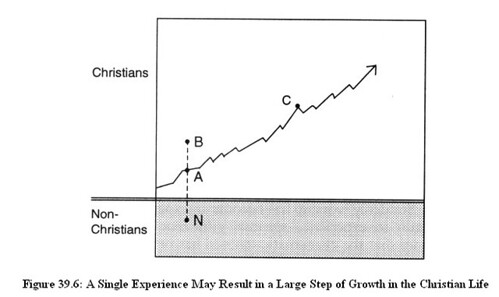
Wayne Grudem uses the below diagram to help us understand. The horizontal axis is time and it is expected that we mature as we move through time. While this maturity should be progressive, it may increase at different rates through our lives and it is even possible probable that we will have set-backs.

Relative to "baptism in the Spirit", it is commonly taught the "receiver" should confess all known sins, repent of any remaining sin in their lives, trust Christ to forgive those sins, commit every area of their lives to the Lord’s service, yield themselves fully to him, and believe that Christ is going to empower them in a new way and equip them with new gifts for ministry. Then after that preparation, they are encouraged to ask Jesus in prayer to baptize them in the Holy Spirit.

How can that ever be a bad thing? What does this preparation do? Grudem rightly puts it this way:
It is a guaranteed prescription for significant growth in the Christian life! Such confession, repentance, renewed commitment, and heightened faith and expectation, if they are genuine, can only bring positive results in a person’s life. If any Christian is sincere in these steps of preparation to receive baptism in the Holy Spirit, there will certainly be growth in sanctification and deeper fellowship with God. In addition to that, we may expect that at many of these times the Holy Spirit will graciously bring a measure of the additional fullness and empowering that sincere Christians are seeking, even though their theological understanding and vocabulary may be imperfect in the asking. If this happens, they may well realize increased power for ministry and growth in spiritual gifts as well.

Therefore, using the diagram below, it could be said that a person has moved from point A to point B and has made one very large step forward in the Christian life. That's a good thing. Prayer and Bible study and worship begin to seem more meaningful. Fruitfulness in evangelism and other kinds of ministry increases.

2529270394 Fd2468C0C3
The key point however is that this person that moves from A to B is not now in a separate category of Christians called those who have been “baptized in the Holy Spirit”.

As an example, Grudem explains that there may be other Christians in the same community who has never had such a large step of growth but who has nonetheless been making steady progress for the last forty years of his or her Christian life and has come to point C on the chart above. Though that person has never had a single experience that Pentecostals would call a “baptism in the Holy Spirit,” he or she is still much farther along the path of Christian growth than the younger Christian who has recently been “baptized in the Holy Spirit” (according to Pentecostal terminology) and moved from point A to point B. Although the Christian who moved from point A to point B is not farther along in the Christian life than another person who is at point C, the person who moved to point B is certainly farther along than he or she was before and this is certainly a positive result in his or her life. Thus, with this understanding of the Christian life, we have no divisions of Christians into two categories.

All of this however still leaves me with the dilemma of what to call that thing referred to as "the baptism of the Spirit". I see that the use of this term implies a two-category Christianity, and worse for this to be seen as a common experience that can and indeed should happen to Christians at one point in time, and, once it has happened, does not need to be repeated.


So far I have opted to continue to use the phrase. What help can you offer me? Especially to describe this step-change in maturity when accompanied by a powerful, intimate encounter with God?

Technorati Tags:

Monday, May 26, 2008

the glory of the gospel

From John Fonville quoting Martin Lloyd-Jones:

The glory of the gospel is that it is primarily an announcement of what God does, and has done, in the Person of Jesus Christ.

That was the essence of Paul’s gospel…That was the gospel which was preached by all the apostles. They preached Jesus as the Christ. They made a proclamation, an announcement. Primarily, they called upon people to listen to what they called ‘good news’.

They did not in the first instance outline a programme for life and living…They preached, not a programme but a Person. They said that Jesus of Nazareth was the Son of God come from Heaven to earth. They said that He manifested and demonstrated His unique deity by living a perfect, spotless, sinless life of complete obedience to God, and by performing miracles. His death on the Cross was not merely the end of His life but the result of His rejection by His own countrymen, it had a deeper and more eternal significance…

The glory of the gospel is that it is primarily an announcement of what God does, and has done, in the Person of Jesus Christ.

‘God was in Christ reconciling the world to himself’ and making ‘him to be sin for us, who knew no sin; that we might be made the righteousness of God in him’ (2 Corinthians 5:21). But that was not all. He had risen from the grave, had manifested Himself unto certain chosen witnesses, and then ascended into Heaven. From Heaven He has sent the gift of the Holy Spirit upon the early Church, and He had brought unto them…new life and power. Their lives had been entirely changed, and they now had life which was life indeed.

They did not in the first instance outline a programme for life and living…They preached, not a programme but a Person.

That was the message. Its entire emphasis was upon what God had done. Its content was God’s way of salvation and of making men righteous. Man had but to accept it and submit to it.

Martyn Lloyd-Jones, The Plight of Man and the Power of God, pp. 82-83

Thursday, May 22, 2008

speaking of sovereignty

I just noticed that Peter Cockrell posted the same piece as I regarding John Piper's thoughts on God-centerness. Cockrell went a step further by adding this excellent post by Justin Childers.

God’s sovereignty carries at least 2 ideas:
1. God is independent of any outside influences.
-God does as He pleases, only as He pleases, when He pleases, and always as He pleases.
2. God is in complete control of everything that takes place.
-Everything that happens is ordained and orchestrated by God.

CH Spurgeon: “I believe that every particle of dust that dances in the sunbeam does not move an atom more or less than God wishes – that every particle of spray that dashes against the steamboat has its orbit, as well as the sun in the heavens – that the chaff from the hand of the winnower is steered as the stars in their courses. The creeping of an aphid over the rosebud is as much fixed as the march of the devastating pestilence – the fall of leaves from a poplar is as fully ordained as the tumbling of an avalanche. He who believes in God must believe this truth. There is no standing point between this and Atheism. There is no halfway between an Almighty God, who works all things according to the good pleasure of his will, and no God at all!”

Jonathan Edwards: “Absolute sovereignty is what I love to ascribe to God. God’s sovereignty has ever appeared to me, a great part of his glory. It has often been my delight to approach God, and adore him as a sovereign God.”

Seven Aspects of God’s Sovereignty:
God’s sovereignty over all.
· Isa. 46:9-11; Psalm 115:3; 135:5-6; Ephesians 1:11
God’s sovereignty over man.
· Prov. 16:9; 21:1; Gen. 20:6; Deut. 2:30; Gen. 50:20
God’s sovereignty over small details.
· Prov. 16:33; James 4:13-16; Jonah 1:4; 1:17; 2:10; 4:6-8
God’s sovereignty over Satan.
· Job 1:12; 2:4-6; Mark 1:23-27; Luke 22:31-32; Revelation 20:10
God’s sovereignty over nature and weather.
· Psalm 135:7; Jeremiah 10:12-13
God’s sovereignty over salvation.
· Rom. 9:18; John 5:21; 6:44
God’s sovereignty over the cross.
· Isaiah 53:10; Acts 4:27-28; John 10:18

How should God’s Sovereignty impact our lives?
1) God’s sovereignty should give us a sense of deep reverence and thankful joy in Him.

2) God’s sovereignty should help us obey certain commands. Three commands that cannot be obeyed unless you believe in God’s absolute sovereignty:
  • Be joyful always (having joy in all circumstances implies that you believe God is in control and has a purpose for whatever comes to pass).
  • Do not fear (if God is in control there is nothing to fear; if God is not in control there is a lot to fear).
  • Do not complain (not complaining will only happen when we believe that the things worth complaining about are ordered by God).
3) God’s sovereignty should give us radical boldness as we lean on His promises.

Technorati Tags:

god-centered

I've had some really good exchange with my friend Jonathan Brink (a good man who loves God) regarding God's sovereignty as compared/contrasted to His love. From my perspective, God is sovereign and He is love but these two 'attributes' do not have the same meaning.

Here John Piper expounds on what God-centered means.

The psalmist describes the motivation of God in saving sinners like this:

Both we and our fathers have sinned... Yet he saved them for his name’s sake, that he might make known his mighty power. (Psalms 106:6, 8)

God was motivated to rescue them and us from our sin and its penalty “for his name’s sake.” What does “for his name’s sake” mean? It means “that he might make known his mighty power.”

What we mean when we say God is “God-centered” is that he acts like that. He saves for the sake of his name. He saves to make known his own power.

And what we mean when we say we are God-centered (or desire to be) is that we like to have it that way. It satisfies us to have God save us for God’s sake. We are happy that this is the way it is. We get pleasure in seeing it and savoring it.

We like to talk about God doing it that way.

Technorati Tags: ,

Wednesday, May 21, 2008

worshipping the trinity

All three Persons of the Godhead are to be acknowledged, honoured and intimately encountered in worship activities that aim to please God. We can have fellowship with Father, Son and Holy Spirit, all three and enjoy their manifest Presence among us ... When we encounter one, we encounter all three - God above us, God beside us, God inside us. ~ Greg Haslam - "God in Three Persons" - Newfrontiers Magazine - April - June 2008 - Volume 3 - Issue 7 - (p34).

HT:DB

Technorati Tags:

orthopraxy

I've used the word before ... so now here's the definition.

Orthopraxy
[or‘-thuh-prak’-see]

(Greek orthos, “right, true” + praxy, “action”)

The corollary of orthodoxy, its emphasis is on the performance of correct doctrine as it pertains to the Bible. That is, it corresponds to the action or response to right thinking or teaching. Much is considered with respect to what actions are considered the correct ones. Historical definitions on Christian orthopraxy maintain church attendance, sacraments such as prayer and the Lord’s supper, even fasting. In the end, the fundamental explanation of orthopraxy is acting in a manner worthy of the call of God as it pertains to being conformed to the image of Christ (cf. Eph. 4:1, Rom. 8:29).

Tuesday, May 20, 2008

proper authority

Authority must arise out of freedom and is only bounded by love. Our freedom is in Christ and no authority should press us otherwise. Even though Paul feels a need to "punish", it is not his preference - nor ours.

Authority is for building up - not for tearing down. Real authority is not simply attaining conformity to some set of rules. Truth must be seen and happily embraced. Nominal obedience alone does not lead to real growth.

Robert Banks outlines this well.

1) all authority stems from God the Father as revealed in his Son Jesus Christ and is mediated by their Spirit;

2) in the prophetic history of Israel, as recorded in the OT scriptures, and in the apostolic development of the church, this authority was decisively present, but the person and the work of Jesus Christ and the message about him enshrined in the apostolic writings are the definite expression of God's will and are normative for all that precedes and follows;

3) through the Spirit God continues to speak and work authoritatively, not through coercion of people's personalities but by convincing their minds of the truth and warming their hearts with love so that they freely embrace it;

4) authority is exercised through the service of others in word and deed, not through their domination, and Jesus is the example par excellence of the way this takes place, since "though he was in the form of God, [he] did not count equality with God a thing to be grasped, but emptied himself, taking the form of a servant ..." (Phil 2.6-7);

5) authority is conveyed in this way primarily through the apostles, who still live in their writings, and in differing measure through all Christians, who are instruments of Christ's authority when they manifest Christ to one another according to the ministries given them by the Spirit.

led by the spirit

I happened to read the below verses today. They caused me to wonder why some insist that those who claim to be led by the Spirit must comply to some OT standard for prophets. It seems Paul had no such notion in mind as he pondered what to do with the unmarried and widowed He clearly sees himself as being led by the Spirit but he states it is not a command from the Lord.

1 Cor 7.25 - Now concerning the betrothed, I have no command from the Lord, but I give my judgment as one who by the Lord's mercy is trustworthy.

1 Cor 7:40 - Yet in my judgment she is happier if she remains as she is. And I think that I too have the Spirit of God.

words

“Your words were found, and I ate them, and your words became to me a joy and the delight of my heart.” ~ Jeremiah 15:16 (ESV)

What did you have for lunch today?

Monday, May 19, 2008

it's only logical

Well it happened, this is what you get when it is no longer "between a man and a woman" ... the logical conclusion ...

California Narcissist Plans to Marry Himself

"I'm still speechless," Potter told TBNN. "I've been wanting to marry myself for years now. This new decision to not limit marriage to just between a man and a woman finally opens up the door for me to plan that big day that I've waited for so long."

Technorati Tags: ,

how we learn

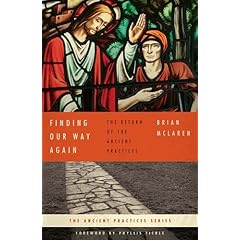
51Nbbtr12Jl. Sl500 Aa240 In Finding Our Way Again: The Return of the Ancient Practices, Brian McLaren speaks on learning via community and tradition.

One of my mentors contrasts deciding and trying with training. Deciding is necessary, he says. Nobody finds out they've accidentally trained for a marathon for six months without intending to. But deciding isn't enough, as all of us who have decided to lose weight know. I could even add to my deciding a healthy dose of trying: Sincerely! Passionately! With great commitment and resolution! But unless I put between my decision and the starting line sufficient training of the right sort, it will be 'Marathon- 26.5, Brian- 0'

That same mentor defines training like this: employing appropriate actions within our power by which we become capable of doing things currently beyond our power, and by which we become people we are currently incapable of being. Those "appropriate actions" we could further define as practices. And the community of people who teach us the practices we could define as a community of practice that carries on the tradition...

Most of the truly important skills we learn in life come through training, practice, and tradition or community. For example, we didn't learn to speak our native tongue by deciding or trying, but by training. We didn't even realize we were in training, and our parents (who were the community of practice, carrying on the tradition of English or Chinese or Zulu or whatever) probably didn't even realize that they were training us most of the time... Similarly, when they withheld something from us until we said 'please' and 'thank you,' they were the community training us in the tradition of community, and we were practicing so that courtesy would become natural to us.

It took a couple of years of practice, but in the process, largely without realizing it, we became fluent speakers of our native tongue, and maybe courteous people, to boot. Without the community, without the tradition, and without the practice neither possibility would have been actualized.


HT:BH

Technorati Tags:

Sunday, May 18, 2008

revelation song

Karl Jobe singing Revelation Song.


Revelation 5
Worthy is the, Lamb who was slain
Holy, Holy, is He
Sing a new song, to him who sits on
Heaven's mercy seat

Holy, Holy, Holy
Is the Lord God Almighty
Who was, and is, and is to come
With all creation I sing
Praise to the King of Kings
You are my everything
And I will adore You

Clothed in rainbows, of living color
Flashes of lightning, rolls of thunder
Blessing and honor, strength and glory and power be
to You the only wise King

Holy, Holy, Holy
Is the Lord God Almighty
Who was, and is, and is to come
With all creation I sing
Praise to the King of Kings
You are my everything
And I will adore You

Filled with wonder, awestruck wonder
At the mention of your name
Jesus your name is power
Breath, and living water
Such a marvelous mystery
Yeah...

Holy, Holy, Holy
Is the Lord God Almighty
Who was, and is, and is to come, yeah
With all creation I sing
Praise to the King of Kings
You are my everything
And I will adore You

calvinist dancing?

DancingkuyperI love this piece entitled Teaching a Calvinist to Dance by James Smith in Christianity Today. Smith does a fine job of journaling his personal experience to demonstrate that the two 'doctrines' do not stand in antithesis of each other but rather compliment one another.

The heart and soul of that Pentecostal spirituality is not the manifestations, but rather the courage and openness to see God in those unexpected manifestations, and to say, "This is what the Spirit promised." ... I long for a kind of "Pentecostalized" Reformed spirituality that expects the sovereign Lord to show up in ways that might surprise us. If we take our Reformed convictions about God's sovereignty seriously, then we can, with Peter, be boldly open to the Spirit's surprise.

Friday, May 16, 2008

tough break

Sometimes life is tough.

love v. sovereignty

Jonathan Brink has asked some excellent questions via comments to various posts on this blog. I think these quotes of John Piper recently posted by Peter Cockrell provide clearer answers than I have.

In a paragraph:

“The most terrifying news in the world is that we have fallen under the condemnation of our Creator and that he is bound by his own righteous character to preserve the worth of his glory by pouring out his wrath on the sin of our ingratitude. But there is a fourth great truth that no one can ever learn from nature or from their own consciences, a truth which has to be told to neighbors and preached in churches and carried by missionaries: namely, the good news that God has decreed a way to satisfy the demands of his righteousness without condemning the whole human race. He has taken it upon himself apart from any merit in us to accomplish our salvation. The wisdom of God has ordained a way for the love of God to deliver us from the wrath of God without compromising the righteousness of God. And what is this wisdom?”

In a sentence:

“Jesus Christ, the Son of God crucified, is the Wisdom of God, by which the love of God can save sinners from the wrath of God, and all the while uphold and demonstrate the righteousness of God.”

against heresy

Martin Downes nails this one. Here are his conclusions regarding how we are to deal with (or not) heresies.

1. Ministers must be polemical in their public teaching when they need to be, but not otherwise. In the course of expounding passages dealing with these matters, and when there is real threat. In their private study there is of course need to be aware of men and movements that are dangerous. This is not an appeal for ignorance or dropping our guard.

2. Congregations should be spared from hearing about the specific details of false teaching unless it is absolutely necessary. There are winds of doctrine in the evangelical world, but are they affecting us? Should we not concentrate on things that are? If false teaching is unprofitable and worthless what good can come from considering it? Should we not look at our own sins and situations and address those issues instead?

3. Concentrate on the positive upbuilding of the church. There is work enough here. The rest of 1 Timothy expands on this. Buchanan says that truth is one, more is gained by the positive exposition of the truth than by detailing the forms of error which are multiple. Don't waste time on matters that are not a threat to your situation. The time is short. Is that not how Nehemiah treated his opponents? Put good things before the church and have nothing to do with silly, irreverent myths (4:6-7).

4. Guard your heart and your ministry. As Francis Schaeffer once wrote, reflecting on the battle for the gospel in the 1930s, “be careful what habits you pick up in controversy”. Dr. Lloyd-Jones made the same point in his discussion with T. T. Shields. A polemical ministry is necessary, we must contend for the faith, but we must guard against a contentious spirit. Preoccupation with error is not good for the minister or the church. This is Paul's charge to Titus. The gospel of salvation is excellent for people, the root of faith promotes the fruit of good works. This is profitable. But these other teachings are unprofitable and useless. Avoid them, they thrive in an atmosphere of contention (Titus 3:9-11).

Thursday, May 15, 2008

the path to maturity

I found this EXCELLENT summary by Dan Phillips on the Christian's growth from pre- to maturity:
  1. We start out wrong about everything important. We have an innate sense of God, but we suppress and pervert it (Romans 1:1-32). We're dead and blind (Ephesians 2:1-3; 4:17-19). In this condition, even if we hear the Word of God, nothing savingly significant happens (Matthew 13:4-7, 18-22).
  2. God sovereignly gives us life (Ephesians 2:5), causes His word to be life to us (1 Peter 1:23-25), enables us to see what we had been unable to see (2 Corinthians 4:3-6), and saves us by grace through faith as a gift (Ephesians 2:8-10).
  3. Thus awakened and made alive, we respond to God's word in faith (Romans 10:17), yoke ourselves to Christ in repentant faith (Matthew 11:28-30; Acts 11:18; 17:31), in witness to which we are baptized (Acts 2:38) and committed to a lifelong process of learning His word (Matthew 28:18-20; John 8:31-32).
  4. Our goal then becomes to grow to maturity in and unto Christ (Ephesians 4:15-16; 2 Peter 3:18).
  5. Specifically, what this maturity looks like involves (among other things) a grounded stability in God's revealed truth that is resistant to the gusty winds of fad and fashion (Ephesians 4:13-14), and a well-practiced adeptness in the Word of God that enables us to assess, discern, and judge right from wrong, good from evil, and truth from falsehood (Hebrews 4:12; 5:14).

Tuesday, May 13, 2008

do not quickly judge

Some video to remind us not to judge too quickly.

john 3.16 bible

This just in at TBNN - CBD introduces the John 3:16 Bible.

CBD announced this week the exciting arrival of its newest product, the "John 3:16 Bible."

CBD Chairman Bill Moss, told TBNN, "This is usually a down time of year for our overall sales, so we are thrilled to be launching this new product at this time. During the summer months, with people so busy traveling, they don't have much time to read. Also, there are no holidays for giving gifts. CBD needs this new bible now to boost our stock offerings."

The "John 3:16 Bible" offers its buyers a quick and easy source for the only bible verse they usually know. It's easy to carry around because it only has twenty pages. Each page provides a different translation of the special verse. For example, page one has the Greek, page two the KJV, page three the NKJV, page four the NIV, page five the ESV, etc.

On the final page (20), you will find The Message version of John 3:16. Since The Message is the most popular bible version, it will be easy to find - just inside the back cover.

Below is a sampling of what the new bible looks like on the inside:

Page 2: "For God so loved the world, that he gave his only begotten Son, that whosoever believeth in him should not perish, but have everlasting life." KJV

Page 4: "For God so loved the world that he gave his one and only Son, that whoever believes in him shall not perish but have eternal life." NIV

Page 6: "For God loved the world in this way: He gave His One and Only Son, so that everyone who believes in Him will not perish but have eternal life." HCSB

Page 10: "For God so loved the world that he gave his only Son, so that everyone who believes in him may not perish but may have eternal life." NRSV

Page 15: "For God so loved the world that he gave his only Son, so that everyone who believes in him will not perish but have eternal life." NLT

Page 20: "This is how much God loved the world: He gave his Son, his one and only Son. And this is why: so that no one need be destroyed; by believing in him, anyone can have a whole and lasting life." The Message

United Methodist Pastor Jim Ulmer, after trying out the "John 3:16 Bible," said, "This is a gift I have been waiting for. What a relief. I find myself constantly turning to this verse. In fact, it is what I preach from just about every week. I have frequently wanted an easier way to get to John 3:16, and now I have it!"

Duke Divinity School President Dr. Mark Little is also excited. "Our students frequently engage in debates with those of the Calvinistic persuasion. The strategy we employ is simple. No matter what the Calvinist says, no matter what bible passage he brings up, no matter what historical document he references, no matter what he says about biblical context, we simply quote John 3:16. For us, that answers the question and wins the debate. We don't even have to put much thought or effort into it. We just quote John 3:16. This new bible will further enhance our debate skills."

CBD informed TBNN that if the "John 3:16 Bible" is a big seller, then next year they may release a sequel - the "II Peter 3:9 Bible."

Thursday, May 08, 2008

cj on condemnation

Because of the gospel’s power, you can be completely free of all condemnation.

Not mostly free; completely free.

Don’t buy the lie that cultivating condemnation and wallowing in your shame is somehow pleasing to God, or that a constant, low-grade guilt will somehow promote holiness and spiritual maturity.

It’s just the opposite! God is glorified when we believe with all our hearts that those who trust in Christ can never be condemned. It’s only when we receive his free gift of grace and live in the good of total forgiveness that we’re able to turn from old, sinful ways of living and walk in grace-motivated obedience.

~ C.J. Mahaney, The Cross Centered Life, 39, 40

HT:OFI

ok - i guess i am one

The theological word of the day is "Calvinism". Since I didn't know much about Calvin I want to tell people I am not a Calvinist but since people like to link you to someone I say I am a Calvinist. With this definition of Calvinist, I guess "I be one" although I much prefer the more comprehensive phrase "Reformed theology" - but that's harder to use in a sentence and our culture likes to link people to others to facilitate guilt by association.

Anyway, here's the definition offered ...

Also, “Reformed theology,” “the Reformed faith,” or “the Reformed tradition.”

A theological framework based on the teachings of 16th century French Protestant reformer John Calvin. The emphasis of this system is on the sovereignty of God over all things, with specific reference to soteriology (the doctrine of salvation). Though the distinctives of Calvinist theology may be stated in numerous ways, the best known summary is contained in the “Five points of Calvinism.” These points are: Total depravity, Unconditional election, Limited atonement, Irresistible grace, Perseverance of the Saints.

Wednesday, May 07, 2008

it was destined to come

Today's theological word of the day is a natural follow-on from yesterday's.

Infralapsarianism
[in’-fruh-lap-sair‘-ee-uh-niz’-um]
(Latin infra, “after” + Latin lapsus, “fall” = “After the fall”)
Also, “sublapsarianism.”

A system of belief among certain Calvinists believing in a theoretical plan of God that occurred before creation concerning his decree to save mankind. In the “infra” scheme, God first decreed creation, second he decreed to allow the fall, third he decreed to elect some to salvation while passing over others, and fourth he decreed the atonement as a means of salvation for the elect. In this order one can surmise that the damnation of the reprobate came as a result of the self-determined fall of mankind, not God’s active reprobation (double predestination).

Tuesday, May 06, 2008

paradise regained

“The story of paradise lost becoming paradise regained is the story of God’s grace bringing us from alienation from him to membership in his family. God’s grace restores us to what Adam lost for us - sonship to the God who made us, loves us, and provides for us in every detail in life.” ~ Sinclair Ferguson, Children of the Living God (Carlisle, PA: The Banner of Truth Trust, 1989), 6.

HT:JH

what's love got to do with it

I caused some confusion some days ago. I sometimes send messages that indicate that I think love has nothing to do with God saving us. That's not what I think. Sometimes, because I'm a Calvinist, even when I don't imply that people still hear it. Oh well, I'm doing the best I can. Here's a love quote I like which may help clarify at least a little.

“The Christian gospel is that I am so flawed that Jesus had to die for me, yet I am so loved and valued that Jesus was glad to die for me. This leads to deep humility and deep confidence at the same time. It undermines both swaggering and sniveling. I cannot feel superior to anyone, and yet I have nothing to prove to anyone. I do not think more of myself nor less of myself. Instead, I think of myself less.” ~ Timothy Keller, The Reason For God, New York, NY: Dutton, 2008, p. 181.

HT:AW

a mouth full

I can't say this word but it's our theological vocabulary word of the day ...

Supralapsarianism
Lat. “before the fall”
also antelapsarianism

A system of belief among certain Calvinists believing in a theoretical plan of God that occurred before creation concerning his decree to save mankind. In the supra scheme, God first decreed who the elect and reprobate (non-elect) were, second he created both the elect and reprobate, third he decreed the fall as a means of damnation for the non-elect, and forth he decreed the atonement as a means of salvation for the elect. In this order one can surmise that the damnation of the reprobate primarily came as a result of God’s reprobating (non-electing), and only secondarily through the fall. This is to be distinguished from other more moderate forms of Calvinism such as infralapsarianism and sublapsarianism. Supralapsarianism is held by most proponents of double predestination.

Sunday, May 04, 2008

jesus at 12 years old

When Jesus was 12, his family accidently left Him behind in Jerusalem. When they found him three days later, He said to them, "Why were you looking for me? Did you not know that I must be in my Father's house?" They did not understand. Why?

(1) Jesus referred to Yahweh in a possessive way, i.e., "My Father", thereby shattering the old way of relating to God. Now He is personal and knowable by all.

(2) Jesus never doubted who He was.

(3) Jesus knew what mattered - being with His Father and being about His Father's business.


(careful, this has the "poopy" word in it more than once)

As Christians, the one thing is intimacy with God. All that matters in life flows from that - intimacy with God. When He was older, Jesus repeated the message (recorded in Lk 10.38-42) - only one thing is necessary.

Micah 6.6-8 ~ With what shall I come before the Lord,and bow myself before God on high? Shall I come before him with burnt offerings, with calves a year old? Will the Lord be pleased with thousands of rams, with ten thousands of rivers of oil? Shall I give my firstborn for my transgression, the fruit of my body for the sin of my soul?” He has told you, O man, what is good; and what does the Lord require of you but to do justice, and to love kindness, and to walk humbly with your God?

Ecclesiastes 12.13-14 ~ The end of the matter; all has been heard. Fear God and keep his commandments, for this is the whole duty of man. For God will bring every deed into judgment, with every secret thing, whether good or evil.

reftagger