“If God desires every knee to bow to Jesus and every tongue to confess Him, so should we. We should be ‘jealous’ for the honor of His name—troubled when it remains unknown, hurt when it is ignored, indignant when it is blasphemed, and all the time anxious and determined that it shall be given the honor and glory which are due to it.
The highest of all missionary motives is neither obedience to the Great Commission (important as that is), nor love for sinners who are alienated and perishing (strong as that incentive is, especially when we contemplate the wrath of God), but rather zeal—burning and passionate zeal—for the glory of Jesus Christ.
Only one imperialism is Christian, and that is concern for His Imperial Majesty Jesus Christ, and for the glory of his empire or kingdom. Before this supreme goal of the Christian mission, all unworthy motives wither and die." ~ John Stott, The Message of Romans
HT:OFI
I think we must be obedient to God AND we must love those that are alienated ... but the key here is our primary motive. I've seen those caught up in either of the first two with the result being some kind of perversion. I have yet to find one whose primary purpose is to glorify God who didn't also then bring the balance of obedience and love.

Thursday, April 30, 2009


Wednesday, April 29, 2009
i hate this
Yes - I see you people everywhere ... driving while on the phone or worse texting/reading. Please stop!
Monday, April 27, 2009
who's that wretched man
I was asked to do some digging into "indwelling sin" considering the idea has been propagated by John Piper and Mark Driscoll - guys I have respect for. I figured I'd post what I came up with here ...
The phrase itself comes from Ro 7.17, "So now it is no longer I who do it, but sin that dwells within me." The key to indwelling sin is to understand who the wretched man in Ro 7 is.
I didn't look to Mark Driscoll. While I like him a lot, I don't see him as a theologian so I just didn't bother.
Interestingly, Wayne Grudem skips Ro 7 ... :)
So, is the "I", i.e., the wretched man, in Ro 7, the pre-Christian Paul, the Christian Paul, or an unbeliever other than Paul? I think that regardless of which side one chooses, we are not in "heresy" or "unorthodox" land. But to keep this from becoming a watershed point, I think it important to view it from a pastoral perspective. Regardless of which side one lands on, it is clear that we sin and the remedy is the same, i.e., forgiveness, redemption, and freedom through Christ Jesus.
It should also be noted the thrust of Ro 7 is not to teach that believers or non-believers sin but rather to defend the rightness of the Law and that we ought not blame it for our failings ... and more gloriously, Jesus Christ our Lord is our deliverer (Ro 7.25a and then particularly Ro 8).
Before unpacking this further, one should first be firmly grounded in the idea of justification. Terry Virgo's God's Lavish Grace and Robert McGee's The Search for Significance are great primers. Both of these lay the necessary foundation although the latter requires a bit of caution because it leaves unguarded or unfinished some points. I'm imagining a construction site where some of stairwells or flooring is not completed. They are out of scope for the book which is fine but these should be boarded up a bit better to keep the untrained from falling in.
Virgo teaches justification is like a base coat in a painting. That is, Biblical principles are like a painting. There are some foundational truths that need to be settled and allowed to dry before the rest of the painting can be done. If the base isn't there, the picture is incomplete with great big holes and just doesn't hang together. But just as bad, if the base isn't allowed to dry, the picture is blurry as one layer blends into the other. If one continues to paint before justification by faith has dried and set-up, we have a mess; it all runs together. Many Christians live in that mess.
Second, in my 20+ years of eldering, pastoring, small grouping, etc. rarely a meeting goes by where someone doesn't throw back to, "Yeah but no one is perfect." "Yeah but we all fail." "Yeah but ..." While true in practice, this is not the message of the Gospel and is the excuse of those who have not grasped its beauty and power.
Focusing on the reality that I will fail to live every moment of my life rightly will in no wise help me attain that prize for which Christ took hold of me. It's a trap. To quote John Piper (who speaks to the pastoral point well even though I think he falls out on the wrong side of the overall question):
So - who is the wretched man?
Great guys - Piper, Spurgeon, Owen, Packer, Augustine, Luther, Calvin, and many others - would say Paul is speaking of the Christian Paul and by inference, you and me. Piper has a comprehensive look at this here (Who is This Divided Man? Parts 1-6 are excellent) and after each time I read these I have to work hard to remind myself why I don't buy into this perspective. I like how he uses verses 15, 22, and 24. These are the words of a regenerate heart. Piper is saying that Paul sees us winning the war on sin and this passage reflects our attitude when confronted with "tactical defeats" - which we all clearly experience.
He also deals nicely with the phrase "sold into bondage" (Ro 7.14b). This is one of the key arguments from the "this isn't speaking of a Christian" camp that Paul must be speaking of the pre-Christian since we cannot be slaves to sin. Piper likens this to Gal 5.1, "It was for freedom that Christ set us free; therefore keep standing firm and do not be subject again to a yoke of slavery." He believes Paul is simply saying that when we give in to temptation it is like going back into slavery and we don't want to do that.
This thinking is what allows many to say their true nature is that of "forgiven sinner". It allows one to read verse 21 as there will never be a point in one's earthly life at which one is truly free from sin. But I think this is inconsistent with what Paul says elsewhere. He considers himself a model to be imitated (1 Co 11.1) and reminds us that there is no condemnation in us (Ro 8.1, 33-34).
Some of the better theologians wouldn't say this but some believe Paul can call the "I" fleshly and contrast that with being spiritual because of 1 Co 3.1. Paul refers to spiritual infants as fleshly so some think the "I" is simply those that are spiritually immature. But that couldn't fit Paul. Elsewhere he refers to himself as quite the opposite. He's bold in proclaiming himself as a model and one with spiritual authority.
So I do not agree with the "I" being Paul as a Christian. As for the possibility that this is pre-Christian Paul, that could be but Paul seems quite confident in his pre-Christian performance (Phil 3.2-6). I do not really see that.
I think this "I" is not Paul nor do I think it is a believer. The "I" can be a fictive term or the collective "Adam" apart from Christ, it is more likely a specific fictive "I".
This is the thinking of folks like The Good Doctor (Martyn Lloyd-Jones) and Terry Virgo. They would say the "I" is the unregenerate as only an informed Christian can see it or perhaps a pious person who knows the spirituality of the law and wishes to do what is good but cannot. Paul seems to be musing about the condition of his fellow Jews. They lay claim to the law without understanding what its real purpose is. They try to do good while all the time missing the point of justification by faith in Christ, not by works of the law. This is not a description of the Jew agonizing over their situation - if so, they would change. It is from the vantage point of a converted Jew looking back at the futility of that life. This is why Piper sees some of the verses as from a "Christian" perspective, they are but not that of the "I".
I didn't spend a lot of time looking at NT Wright (pg 16). I'm not sure if he is saying the same thing or taking it a step further. He sees the wretched man in Ro 7 as Israel living under the Torah. I think that's the same but I'm always leery to commit with him.
I just cannot see this as a believer. MLJ states, "When the Christian talks about his sin and failure he does not talk about it primarily in terms of the law; he talks about it primarily in terms of love, about his failure to live to his glory. The Christian does not go on speaking in terms of the law as the man in Ro 7 does. He is no longer ‘under the law’ but ‘under grace.’ Furthermore, as the Apostle will show us . . . the Christian must never allow himself to feel the condemnation of the law . . . the whole object of this great 8th chapter is to emphasise that: ‘No condemnation . . . no separation.’" This reinforces to me why the "I" is not the "forgiven sinner" that the majority of scholars believe.
When Paul confronts sin, I don't read, "yeah, I'm there, we all do it." or "yeah, that happens." Instead I read, "hey, stop that!" Don't you know who you belong to and that He made you new? You are not who you used to be. You are new."
So yes, we still sin. But I have to say, I am not a sinner. Sadly I'm still drawn to old sin patterns, I'm all too familiar and comfortable with these, etc. but that's not who I am. And focussing on who I am is what will set me free.
In the end, I think Romans 7:14-25 has been read out of context. Chapters 6 and 8 describe the Christian experience and 7:14-25 does not, but it is 7:14-25 that is seen as the normative Christian experience, and chapters 6 and 8 have been relegated to something like "positional" truth (i.e., something true in God's cosmic account book but definitely not true down here on earth). The liberating news of chapters 6 and 8 must not be overshadowed by the helplessness seen in 7:14-25.
So I don't see the other views as heretical ... just unhelpful ... and not true. :)
The phrase itself comes from Ro 7.17, "So now it is no longer I who do it, but sin that dwells within me." The key to indwelling sin is to understand who the wretched man in Ro 7 is.
I didn't look to Mark Driscoll. While I like him a lot, I don't see him as a theologian so I just didn't bother.
Interestingly, Wayne Grudem skips Ro 7 ... :)
So, is the "I", i.e., the wretched man, in Ro 7, the pre-Christian Paul, the Christian Paul, or an unbeliever other than Paul? I think that regardless of which side one chooses, we are not in "heresy" or "unorthodox" land. But to keep this from becoming a watershed point, I think it important to view it from a pastoral perspective. Regardless of which side one lands on, it is clear that we sin and the remedy is the same, i.e., forgiveness, redemption, and freedom through Christ Jesus.
It should also be noted the thrust of Ro 7 is not to teach that believers or non-believers sin but rather to defend the rightness of the Law and that we ought not blame it for our failings ... and more gloriously, Jesus Christ our Lord is our deliverer (Ro 7.25a and then particularly Ro 8).
Before unpacking this further, one should first be firmly grounded in the idea of justification. Terry Virgo's God's Lavish Grace and Robert McGee's The Search for Significance are great primers. Both of these lay the necessary foundation although the latter requires a bit of caution because it leaves unguarded or unfinished some points. I'm imagining a construction site where some of stairwells or flooring is not completed. They are out of scope for the book which is fine but these should be boarded up a bit better to keep the untrained from falling in.
Virgo teaches justification is like a base coat in a painting. That is, Biblical principles are like a painting. There are some foundational truths that need to be settled and allowed to dry before the rest of the painting can be done. If the base isn't there, the picture is incomplete with great big holes and just doesn't hang together. But just as bad, if the base isn't allowed to dry, the picture is blurry as one layer blends into the other. If one continues to paint before justification by faith has dried and set-up, we have a mess; it all runs together. Many Christians live in that mess.
Second, in my 20+ years of eldering, pastoring, small grouping, etc. rarely a meeting goes by where someone doesn't throw back to, "Yeah but no one is perfect." "Yeah but we all fail." "Yeah but ..." While true in practice, this is not the message of the Gospel and is the excuse of those who have not grasped its beauty and power.
Focusing on the reality that I will fail to live every moment of my life rightly will in no wise help me attain that prize for which Christ took hold of me. It's a trap. To quote John Piper (who speaks to the pastoral point well even though I think he falls out on the wrong side of the overall question):
[T]he question is: How are we to live in view of this double truth about ourselves? The answer comes from watching the amazing way that Paul speaks to us about our deliverance and our newness in Christ. What he does again and again is to say: This new man is who you decisively and irrevocably are in Christ. This free man is your deepest and truest identity. Now act on it. Look to Christ, trust his help, and by his Spirit become what you are.
If your besetting sin is anger, affirm that in Christ you have died to that identity and in Christ you have his patience and kindness. Look to him and trust in him and rejoice in him. And fight against anger as one who has the victory in him.
If your besetting sin is heterosexual or homosexual lust, affirm that the truth that in Christ you have died to this fallen and distorted identity. I recall many conversations with Joe Hallett who came out of the homosexual life and lived among us with AIDS for 10 years and died a few years ago. He never tired of saying: Do not say "I am a homosexual." Say rather, "I struggle with homosexual desires." That was not a superficial mind over matter trick. It was a profound Biblical insight into Romans 6 and 7: In Christ our old selves have died - whatever their distortion and corruption - and we are decisively and irrevocably new. In Christ Jesus homosexual, fornicator, adulterer, covetous, thief, alcoholic, are not who we truly are. Affirm that by faith in Christ. Trust him as your all-satisfying treasure and look to him for the help to become (as much as possible in this life) who you truly are in Christ.
So - who is the wretched man?
Great guys - Piper, Spurgeon, Owen, Packer, Augustine, Luther, Calvin, and many others - would say Paul is speaking of the Christian Paul and by inference, you and me. Piper has a comprehensive look at this here (Who is This Divided Man? Parts 1-6 are excellent) and after each time I read these I have to work hard to remind myself why I don't buy into this perspective. I like how he uses verses 15, 22, and 24. These are the words of a regenerate heart. Piper is saying that Paul sees us winning the war on sin and this passage reflects our attitude when confronted with "tactical defeats" - which we all clearly experience.
He also deals nicely with the phrase "sold into bondage" (Ro 7.14b). This is one of the key arguments from the "this isn't speaking of a Christian" camp that Paul must be speaking of the pre-Christian since we cannot be slaves to sin. Piper likens this to Gal 5.1, "It was for freedom that Christ set us free; therefore keep standing firm and do not be subject again to a yoke of slavery." He believes Paul is simply saying that when we give in to temptation it is like going back into slavery and we don't want to do that.
This thinking is what allows many to say their true nature is that of "forgiven sinner". It allows one to read verse 21 as there will never be a point in one's earthly life at which one is truly free from sin. But I think this is inconsistent with what Paul says elsewhere. He considers himself a model to be imitated (1 Co 11.1) and reminds us that there is no condemnation in us (Ro 8.1, 33-34).
Some of the better theologians wouldn't say this but some believe Paul can call the "I" fleshly and contrast that with being spiritual because of 1 Co 3.1. Paul refers to spiritual infants as fleshly so some think the "I" is simply those that are spiritually immature. But that couldn't fit Paul. Elsewhere he refers to himself as quite the opposite. He's bold in proclaiming himself as a model and one with spiritual authority.
So I do not agree with the "I" being Paul as a Christian. As for the possibility that this is pre-Christian Paul, that could be but Paul seems quite confident in his pre-Christian performance (Phil 3.2-6). I do not really see that.
I think this "I" is not Paul nor do I think it is a believer. The "I" can be a fictive term or the collective "Adam" apart from Christ, it is more likely a specific fictive "I".
This is the thinking of folks like The Good Doctor (Martyn Lloyd-Jones) and Terry Virgo. They would say the "I" is the unregenerate as only an informed Christian can see it or perhaps a pious person who knows the spirituality of the law and wishes to do what is good but cannot. Paul seems to be musing about the condition of his fellow Jews. They lay claim to the law without understanding what its real purpose is. They try to do good while all the time missing the point of justification by faith in Christ, not by works of the law. This is not a description of the Jew agonizing over their situation - if so, they would change. It is from the vantage point of a converted Jew looking back at the futility of that life. This is why Piper sees some of the verses as from a "Christian" perspective, they are but not that of the "I".
I didn't spend a lot of time looking at NT Wright (pg 16). I'm not sure if he is saying the same thing or taking it a step further. He sees the wretched man in Ro 7 as Israel living under the Torah. I think that's the same but I'm always leery to commit with him.
I just cannot see this as a believer. MLJ states, "When the Christian talks about his sin and failure he does not talk about it primarily in terms of the law; he talks about it primarily in terms of love, about his failure to live to his glory. The Christian does not go on speaking in terms of the law as the man in Ro 7 does. He is no longer ‘under the law’ but ‘under grace.’ Furthermore, as the Apostle will show us . . . the Christian must never allow himself to feel the condemnation of the law . . . the whole object of this great 8th chapter is to emphasise that: ‘No condemnation . . . no separation.’" This reinforces to me why the "I" is not the "forgiven sinner" that the majority of scholars believe.
When Paul confronts sin, I don't read, "yeah, I'm there, we all do it." or "yeah, that happens." Instead I read, "hey, stop that!" Don't you know who you belong to and that He made you new? You are not who you used to be. You are new."
So yes, we still sin. But I have to say, I am not a sinner. Sadly I'm still drawn to old sin patterns, I'm all too familiar and comfortable with these, etc. but that's not who I am. And focussing on who I am is what will set me free.
- "Our old self was crucified with Christ" (Ro 6 .3)
- "We are no longer enslaved to sin" (Ro 6.6)
- "The one who has died is freed from sin" (Ro 6.7)
- "We are under grace, not the law" (Ro 6.14)
- "You, having been set free from sin, have become slaves of righteousness" (Ro 6.18)
- "The law of the Spirit of life in Christ Jesus has set you free from the law of sin and death" (Ro 8.2)
- "you are not in the flesh; you are in the Spirit" (Ro 8.9)
- "we are debtors, not to the flesh, to live according to the flesh" (Ro 8.12)
In the end, I think Romans 7:14-25 has been read out of context. Chapters 6 and 8 describe the Christian experience and 7:14-25 does not, but it is 7:14-25 that is seen as the normative Christian experience, and chapters 6 and 8 have been relegated to something like "positional" truth (i.e., something true in God's cosmic account book but definitely not true down here on earth). The liberating news of chapters 6 and 8 must not be overshadowed by the helplessness seen in 7:14-25.
So I don't see the other views as heretical ... just unhelpful ... and not true. :)
the bible
The Bible’s purpose is not so much to show you how to live a good life. The Bible’s purpose is to show you how God’s grace breaks into your life against your will and saves you from the sin and brokenness otherwise you would never be able to overcome… religion is ‘if you obey, then you will be accepted’. But the Gospel is, ‘if you are absolutely accepted, and sure you’re accepted, only then will you ever begin to obey’. Those are two utterly different things. Every page of the Bible shows the difference. ~ Timothy Keller
HT:JH
HT:JH
Sunday, April 26, 2009
there's a difference
It is obvious what kind of life develops out of trying to get your own way all the time: repetitive, loveless, cheap sex; a stinking accumulation of mental and emotional garbage; frenzied and joyless grabs for happiness; trinket gods; magic-show religion; paranoid loneliness; cutthroat competition; all-consuming-yet-never-satisfied wants; a brutal temper; an impotence to love or be loved; divided homes and divided lives; small-minded and lopsided pursuits; the vicious habit of depersonalizing everyone into a rival; uncontrolled and uncontrollable addictions; ugly parodies of community. I could go on.
This isn’t the first time I have warned you, you know. If you use your freedom this way, you will not inherit God’s kingdom.
But what happens when we live God’s way? He brings gifts into our lives, much the same way that fruit appears in an orchard—things like affection for others, exuberance about life, serenity. We develop a willingness to stick with things, a sense of compassion in the heart, and a conviction that a basic holiness permeates things and people. We find ourselves involved in loyal commitments, not needing to force our way in life, able to marshal and direct our energies wisely.
Legalism is helpless in bringing this about; it only gets in the way. Among those who belong to Christ, everything connected with getting our own way and mindlessly responding to what everyone else calls necessities is killed off for good—crucified.
Since this is the kind of life we have chosen, the life of the Spirit, let us make sure that we do not just hold it as an idea in our heads or a sentiment in our hearts, but work out its implications in every detail of our lives. That means we will not compare ourselves with each other as if one of us were better and another worse. We have far more interesting things to do with our lives. Each of us is an original.
~ Eugene Peterson's The Message, Galatians 5.19-26
This isn’t the first time I have warned you, you know. If you use your freedom this way, you will not inherit God’s kingdom.
But what happens when we live God’s way? He brings gifts into our lives, much the same way that fruit appears in an orchard—things like affection for others, exuberance about life, serenity. We develop a willingness to stick with things, a sense of compassion in the heart, and a conviction that a basic holiness permeates things and people. We find ourselves involved in loyal commitments, not needing to force our way in life, able to marshal and direct our energies wisely.
Legalism is helpless in bringing this about; it only gets in the way. Among those who belong to Christ, everything connected with getting our own way and mindlessly responding to what everyone else calls necessities is killed off for good—crucified.
Since this is the kind of life we have chosen, the life of the Spirit, let us make sure that we do not just hold it as an idea in our heads or a sentiment in our hearts, but work out its implications in every detail of our lives. That means we will not compare ourselves with each other as if one of us were better and another worse. We have far more interesting things to do with our lives. Each of us is an original.
~ Eugene Peterson's The Message, Galatians 5.19-26
Saturday, April 25, 2009
Friday, April 24, 2009
global warming - a personal crisis
uh-oh ... I'm in trouble ...
Fatties cause global warming ,,,
“We need to do a lot more to reverse the global trend towards fatness. It is a key factor in the battle to reduce carbon emissions and slow climate change."
And to make it worse, since combating global warming is now akin to promoting civil right, I'm a real bastard bad guy.
Fatties cause global warming ,,,
“We need to do a lot more to reverse the global trend towards fatness. It is a key factor in the battle to reduce carbon emissions and slow climate change."
And to make it worse, since combating global warming is now akin to promoting civil right, I'm a real bastard bad guy.
Technorati Tags: current events
taking our theories too far
I recently posted a couple of quotes/thoughts on penal substitution to which CatholicNick has persisted (nicely) to challenge. I don't follow Nick's theology but I appreciate his sincerity and courtesy in questioning my suppositions. I was reminded of the error we often make as I read Martin Downes' Atonement: Theory or Doctrine?
Downes notes in relationship to atonement (but this is true of any theory or doctrine) that there are two issues before us:
We should guard ourselves from attempting to read our doctrines out of every text and at the same time it is ok to not "expect Scripture to state the same truth for us in exactly the same way as a creed or confession does."
As I apply this to penal substitution, I have sympathy toward some of Nick's objections and through that have found some sloppiness in my thinking. At the same time, I have not been able to consider the whole of Scripture and make the same conclusions as he does.
I can however find truth and joy in the words of JI Packer based on Galatians 3:13; 2 Corinthians 5:15; 1Peter 3:18 and Isaiah 53:
So in the end, we need theories to understand the fact. However, wherever our theories are not explicit in the raw material of the text we must be cautious in both their defense and propagation. Selah.
Downes notes in relationship to atonement (but this is true of any theory or doctrine) that there are two issues before us:
1. The relationship between the "raw material" of Scripture and the doctrinal formulations that we construct out of that raw material.
2. The relationship between explicit statements and implicit, equally authoritative, teaching in Scripture
We should guard ourselves from attempting to read our doctrines out of every text and at the same time it is ok to not "expect Scripture to state the same truth for us in exactly the same way as a creed or confession does."
As I apply this to penal substitution, I have sympathy toward some of Nick's objections and through that have found some sloppiness in my thinking. At the same time, I have not been able to consider the whole of Scripture and make the same conclusions as he does.
I can however find truth and joy in the words of JI Packer based on Galatians 3:13; 2 Corinthians 5:15; 1Peter 3:18 and Isaiah 53:
The notion which the phrase ‘penal substitution’ expresses is that Jesus Christ our Lord, moved by a love that was determined to do everything necessary to save us, endured and exhausted the destructive divine judgment for which we were otherwise inescapably destined, and so won us forgiveness, adoption and glory. To affirm penal substitution is to say that believers are in debt to Christ specifically for this, and that this is the mainspring of all their joy, peace and praise both now and for eternity.
So in the end, we need theories to understand the fact. However, wherever our theories are not explicit in the raw material of the text we must be cautious in both their defense and propagation. Selah.

ipod v. kindle
Here's the iPod Shuffle versus the Kindle 2 reading from Blade Runner ... let me tell you about my mother ...
Technorati Tags: technical
Wednesday, April 22, 2009

Tuesday, April 21, 2009
thinking about scripture
Len Hjalmarson offers an insightful post regarding Biblical literacy.
Theology operates at two levels at once: at the level of belief systems or worldview, and at the level of particular arguments. Norman Peterson calls the first the narrative sequence, and the second the poetic sequence. Bible students always have both in mind. The former we tend to think of as the broader context of Scripture, including its cultural setting. The latter we think of as particular passages and verses.
...
When we lack ... wider context of understanding and of community, it creates a raft of problems:
* when we work from a particular passage, to the extent that we lack the ability to see the passage in the broader narrative, we distort what we see. We always see in part, and it is only honest to acknowledge this. But we will see in a much smaller part when we don’t know the wider story.
* apart from biblical literacy, we teach propositions and ideas, not theology. I recently noticed this tendency in a membership manual. Baptism was a practice anchored in the New Testament only, and even then only a few passages were referenced. As a result, baptism was abstracted to a religious ritual divorced from depth of meaning and the ongoing life of God’s covenant people.
penal substitution defined
For those following and wondering what in the world penal substitution means, here's the short answer by JI Packer in What did the Cross Achieve? The Logic of Penal Substitution.
Jesus anguished over this "cup" in the garden (Mk 14.36; Lk 22.42; cf. Jn 18.11):
The notion which the phrase ‘penal substitution’ expresses is that Jesus Christ our Lord, moved by a love that was determined to do everything necessary to save us, endured and exhausted the destructive divine judgment for which we were otherwise inescapably destined, and so won us forgiveness, adoption and glory. To affirm penal substitution is to say that believers are in debt to Christ specifically for this, and that this is the mainspring of all their joy, peace and praise both now and for eternity.
Jesus anguished over this "cup" in the garden (Mk 14.36; Lk 22.42; cf. Jn 18.11):
- Isaiah 51:22 Thus says your Lord, the LORD, your God who pleads the cause of his people: "Behold, I have taken from your hand the cup of staggering;the bowl of my wrath you shall drink no more."
- Jeremiah 25:15-16, "Thus the LORD, the God of Israel, said to me: "Take from my hand this cup of the wine of wrath, and make all the nations to whom I send you drink it. They shall drink and stagger and be crazed because of the sword that I am sending among them."
- Psalm 75:8 For in the hand of the LORD there is a cup with foaming wine, well mixed, and he pours out from it, and all the wicked of the earth shall drain it down to the dregs.
Monday, April 20, 2009
no more penal substitution
Under the guise of fair and balanced, here is Penal Substitution Debate - Negative Constructive Essay by CatholicNick. I didn't come to the same conclusion Nick does in all points of his essay (in fact I have significant issue with some) and there are a number of passages that I cannot square with his position but I wanted to say that he raised some excellent objections to which (in the absence of my willingness to invest significant time in this) can only say, "I dunno".
My good friend Randy Noblog reminded me how we often come up with fanciful explanations for theological things that aren't always as sound as we would imagine. I think CatholicNick did a good job in poking at that. Not sufficient enough for me to change my position but sufficient enough for me to add this to my ever growing list of things I want to learn more about ... until then, peace and blessing to Nick.
My good friend Randy Noblog reminded me how we often come up with fanciful explanations for theological things that aren't always as sound as we would imagine. I think CatholicNick did a good job in poking at that. Not sufficient enough for me to change my position but sufficient enough for me to add this to my ever growing list of things I want to learn more about ... until then, peace and blessing to Nick.
preterism
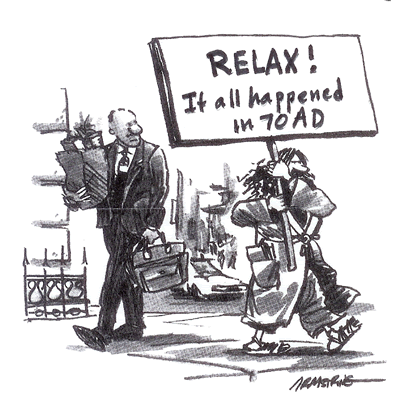 I'm not one (at least not right now) but Virgil (who is one and is proud of it) facebooked this link to everything you wanted to know about Preterism but were afraid to ask.
Technorati Tags: eschatology
Sunday, April 19, 2009
don't stop believing
I'm beginning Michael Wittmer's Don't Stop Believing. I already love the introduction:
How sadly true. We looked at Luke 15, the parable of the Prodigal Son, this morning.Each time I read this, the rebellion and sinfulness of both sons but more strikingly evident. I imagine more clearly the scene. The younger son taunts and pokes at the meaningless and ultimate futility of the weight of the rules induced by the old son. He sees the older trapped in rules and regulations and empty of real relationship with the father. He sees the hypocrisy and contradiction. At the same time the older son beside himself due to the brazenness of the younger son who imagines himself as free thinking and above the older ... all along not realizing he is an immature child having a tantrum by throwing out all that is good along with the evil that he rightly saw in the older. He even forgets that the older brother was also once young and that he himself hasn't found anything new. Both are wrong. They have lost sight of the their true relationship with the father. Both are rebellious placing themselves and their imaginations above the father.
And here we sit today with the same drama taking place. The evangelical side leaning toward the older brother and the postmodern/emergent side leaning toward the younger. The older making it difficult for the younger to stay in the family and the younger imagining they have found some new freedom that generations before them somehow missed ... [sigh] ...
I'm caught in the middle. On my right are some conservative Christians who demand lockstep allegiance to their narrow doctrinal statements. Even though I agree with many of their conclusions, they are not satisfied unless I hold all of their beliefs with tenacity and certainty. They interpret doubts, questions, or even appreciation for the other side as the first signs of a long slide toward liberalism.
On my left are some postmodern Christians who attempt to pry open the minds of conservatives by questioning many of their traditional assumptions. But the way they often go about it - offering new and unusual interpretations of key biblical texts, poking holes in conservative views while only vaguely hinting at their own positions, and brushing aside difficult questions as unworthy of their attention - discredits their arguments.
It's not surprising that the dialogue between these two camps tends to drive them further apart.
How sadly true. We looked at Luke 15, the parable of the Prodigal Son, this morning.Each time I read this, the rebellion and sinfulness of both sons but more strikingly evident. I imagine more clearly the scene. The younger son taunts and pokes at the meaningless and ultimate futility of the weight of the rules induced by the old son. He sees the older trapped in rules and regulations and empty of real relationship with the father. He sees the hypocrisy and contradiction. At the same time the older son beside himself due to the brazenness of the younger son who imagines himself as free thinking and above the older ... all along not realizing he is an immature child having a tantrum by throwing out all that is good along with the evil that he rightly saw in the older. He even forgets that the older brother was also once young and that he himself hasn't found anything new. Both are wrong. They have lost sight of the their true relationship with the father. Both are rebellious placing themselves and their imaginations above the father.
And here we sit today with the same drama taking place. The evangelical side leaning toward the older brother and the postmodern/emergent side leaning toward the younger. The older making it difficult for the younger to stay in the family and the younger imagining they have found some new freedom that generations before them somehow missed ... [sigh] ...
Technorati Tags: Emerging Church
bible contradictions
Bart Ehrman and Stephen Colbert ... brace yourself ...
HT:VV
| The Colbert Report | Mon - Thurs 11:30pm / 10:30c | |||
| Bart Ehrman | ||||
| ||||
HT:VV
Subscribe to:
Posts (Atom)