Sunday, February 11, 2007

the kingdom in community

Jonathan Campbell on community,

In our current cultural crisis, the most powerful demonstration of the reality of the gospel is a community embodying the way, the truth, and the life of Jesus. Healthy community is the life of Jesus in us and through us. For community to last, our love for one another must be surpassed only by our love for Jesus. If the relationships are grounded on anything other than Jesus, the community will fall - and the sooner the better!
The Church is a people not a place. It is 24X7. The Kingdom of God is found within her and flows from her. Service and global stewardship stem from that. All individuals participate in the missional life.

I love it.

Technorati Tags: ,

emergents and the bible

In Scripture reading, differing modern and postmodern scriptural interpretations offer a sharp contrast.
I'm thinking, "oh oh, where are the authors of Emerging Churches going with this?"

Under modernity, evangelicals defended the authority of the Bible primarily by arguing for its inner consistency and for the fact that Jesus upheld the inspiration of Hebrew Scriptures. The Bible was considered a book authored by God that gave answers to life's problems. The various books, incidents, and propositional statements provided the pieces of a jigsaw that if fitted together correctly would present a complete picture. The problem was that there seemed to be pieces missing and pieces that did not fit, no matter how hard one tried.
Ok - I'm getting ready to jump on the "Emergents are heretics" bandwagon.

The Bible was a book to be defended against all detractors. The combatants came out of their respective corners for an intellectual boxing match, each opponent seeking to score points against the other. After each round, they returned to the protection of their respective corners for encouragement, advice, and refreshment. Under postmodernity, however, the "ring" became a circle with no secure corners in which to retire.
Argh - at first reading I think they are saying we ought not defend truth. By the fourth reading I am relating to what they are saying. It's not that the Bible isn't true but where do we get off attacking each other as if we hold the market on truth. It's sickening to read some of the stuff out there and then the comments from like minded people patting their hero on the back after delivering what they perceived as a thrashing to the opponent. Sadder yet, the opponent is a fellow believer doing the same. Definitely not the picture Scripture paints of the Church.

Emerging churches became increasingly dissatisfied with using the Bible in a modern way. ... Once enlightened, you can never go back, because certainty is such a warm blanket to wrap yourself.
Oh no ... now I'm nervous again. But then they make a stab at redeeming that.

[Emergents] are looking to the Bible afresh without the presuppositions and restricted vision of modernity. ... The Bible is an invitation to share in the excitement, commitment, and risk of a journey of a lifetime rather than a book providing answers and a safe place.
Yes and no. I like the journey of a lifetime. However, as we penetrate its richness, we find answers. And in those answers, ultimately a safe place - certainly a place of comfort and rest in the journey. So if we handle it as revealed truth for our journey, I disagree with the Emergent position. If the authors are simply attempting to counter the use of Scripture as a weapon to beat up fellow sojourners, than I accept their point.

[The Bible] is not a jigsaw but a painting that has exquisite detail and rich colors in some areas yet is sketchy in others. It is a finished product in the sense that we are not going to get any more, and we have to live with what we've got. But it will be complete in our eyes only when we are in the presence of the Lord at the fulfillment of human history. We are not at liberty to treat it as a paint-by-numbers canvas or to paint over what has been given either because we do not like it or because we insist on details being included out of our own imaginings or under the claim of new revelations.
Ok - I'm back with them now. I don't see the heresy here. It seems Biblical and edifying "to those with ears".

Technorati Tags: ,

worship defined

Gary Parrett on worship, "our faithful response to god's gracious revelation."

All worship involves these two things in a dynamic relationship, revelation and response. To say that more fully, worship is initiated by God, who graciously reveals Himself to us and we respond in faithful ways. So, worship is the revelation of a gracious God, the initiator of the worship experience, and the faithful response of grateful and obedient worshipers. Worship always involves revelation and response. If we go back to the definition that we offered a moment ago for worship, saying worship is bowing all that we are before all that God is, that definition itself has built into it this idea of revelation-response. So, bowing down is our response. Bowing down what, part of us? No, bowing down all that we are. That is our faithful response to all that God is as He has revealed Himself to us—His person, His deeds, His will for our lives. All that God has revealed to us we must faithfully respond to. So, perhaps another way to define worship would be to say, worship is our faithful response to God’s gracious revelation. These are definitions of worship that are, of course, a little bit idealized. This is what worship ought to be, not necessarily a description of where we are in our present experiences of worship but where we ought to be, faithfully responding to God’s gracious revelation, bowing all that we are before all that God is. (Deuteronomy 6:4-5, Romans 12:1, Isaiah 6:1-8)

Technorati Tags:

is the gospel about life after death?

Dallas Willard, The Divine Conspiracy:
[In the church, we find] the gospel is informing how we die. Instead, the gospel ought to be about how we live! ... [Some people’s] belief is that they try to believe in Jesus so that when they die they get to go to heaven. [They think] populating heaven is the main part of the gospel. Instead, the gospel is about being increasingly alive to God in the world. It is concerned with bringing heaven to earth.
While the Gospel is clear, it's depths are yet to be fully understood. It saddens me because much of the Church, for fear of heresy, have become heretics themselves by limiting the clear scope of what Jesus said and did in Holy Scripture.

Jesus said, Repent, the Kingdom of God is here!!! It includes future participation in a new Heaven and a new Earth, but it is here now. Enter in.

Eddie Gibbs and Ryan Bolger in Emerging Churches,
The kingdom, or the reign of God, is about our life here and now, and it is concerned not just with individual needs and aspirations but also with the well-being and mission of the community of Christ’s representatives. It is directed beyond the present membership of the body of believers to encompass the world that Jesus came to save from the consequences of its rebellion by turning it in a radically different direction. The gospel ... is not confined to personal salvation. It is social transformation arising from the presence and permeation of the reign of Christ.
Amen! The Gospel should turn the world upside down. The Gospel is radical!

Technorati Tags: ,

Saturday, February 10, 2007

online first aid guide

Have you ever been surfing the internet and suffered a puncture wound? If so, here's what you do for puncture wound first aid. Thank the folks at Mayo Clinic for bringing us this great online first aid resource. It covers everything from anaphylaxis to toothaches (apparently if you suffer an injury higher in the alphabet, you should go to the hospital).

Unless you suffer from prefrontal brain damage, your sarcasm sensor should be flashing right now.

Technorati Tags: ,

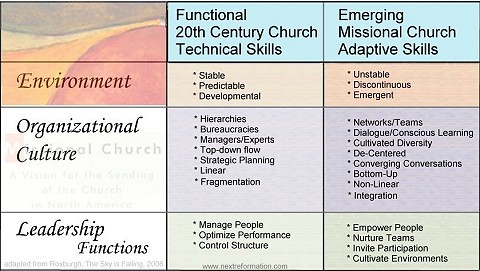
emerging missional church adaptive skills

The post title is a mouthful. Len at Next Reformation attempts to unpack leadership in today's environment.
385637790 5Ab81E2056

Technorati Tags:

i'm linux

I don't get it ...

385511390 189Fbefc17

Technorati Tags: ,

who are you trying to please?

I was trolling David Hayward's blog this morning and found a lot of good stuff. Some of it so good that I just have to post here in hopes that more of the world will benefit from the insight.

In regard to pleasing everybody, Hayward quotes Alexander Liberman from The Artists In His Studio ...

An artist, as Malraux said of Goya, ‘discovers his genius the day he dares not to please'.
I share Hayward's insight that working to please people results in disaster. I've led the path to disaster far too many times in my life. I am just beginning the path of learning from this.

Clearly my life and my effectiveness in the Kingdom improves as I recognize that my sole love, God Almighty, is the One whom I need to focus on. True genius is found when we learn not to please others save God. In serving Him, the natural outcome is to serve His creation - people, animals, the earth.

I was reflecting on that as I prepare this morning (with temperatures in the low 20's °F) to go to our weekly service project. I suppose we will be outside most of the time and it will be real cold. I wonder if those that we are serving will appreciate what we intend to do for them today? I hope so. But I don't do this for me, for the others serving with us, or even for those being served. When a creation of God humbles themselves to place others first, we honor God by reflecting Christ. When a creation of God is edified and built-up by another, God is honored because one of His creations is cared for. Both sides of this activity brings God glory.

I've noted in previous posts that I'm not into PETA, nor do I buy into Global Warming, etc.. Yet at the same time, every creature and all of creation is God's and we were given dominion not to destroy but to care for His creation. It is the role of Satan to destroy. Ours is to build up and care for.

The same is true in our personal relations, our "church work", etc.. This attitude is what will prevent the coffee pot debates.

If we keep our focus on pleasing God, I think all things come into place. Only when we elevate someone or something above Him - or, when we get so busy we just don't see God - does disaster result. Lord, let me see your Kingdom today. I don't want to do anything You are not doing.

Technorati Tags:

god and silence

Cartoon from the always interesting David Haward ... not so interesting comment, me ...

375503689 17E633Dff2
While I believe God doesn't always answer, and many times the answer is not what we want to hear nor in the form we expect, I post this for those that long for the silence of God (you know who you are).

Technorati Tags: ,

ice water and global warming

Stantis

I have to admit I'm one of the holdouts to the global warming theory. I still see it as part of the normal cycle of history. A colleague just asked me, if I have a glass full of ice and water and the ice melts, will the glass overflow? Answer - No! It's hard for me to understand the science behind the ice caps are melting and the oceans are rising.

But I'm just not as bright as some ...

Technorati Tags: ,

tony jones on emergent

From an "emergent's" perspective, Tony Jones shares the coming together of pastors and theologians. I think I went to the church that had the coffee pot debate.

HB at Exhibiting The Value of Knowing God links that to Braveheart.

Robert the Bruce: I'm not a coward. I want what you want, but we need the nobles.
William Wallace: We need them?
Robert the Bruce: Aye.
William Wallace: Nobles. Now tell me, what does that mean to be noble? Your title gives you claim to the throne of our country, but men don't follow titles, they follow courage. Now our people know you. Noble, and common they respect you. And if you would just lead them to freedom they'd follow you. And so would I.

HT: SB

Technorati Tags:

Friday, February 09, 2007

blogger blog backup

If you're using Blogger and you want to back up your blog, it's as easy as pie.

Technorati Tags:

charismatic authority

Hobbes posted a short but excellent piece on charismatic authority. Pop over to his blog and give him a read.

If our faith in Jesus is founded merely upon his charismatic authority - in his eloquence, his miracles, and the strength of his personality - then there is always a danger that our faith would transfer to whoever we think inspires more loyalty, through a greater “demonstration of extraordinary insight and accomplishment”. This is exactly why some Christians, whose first-love was Jesus Christ, are enticed by leaders of heretical cults. Our faith in Jesus must primarily be based upon his identity as the Son of God, for therein lies the true basis of his authority. Any charismatic authority that Jesus displays is simply the human manifestation of his identity as God incarnate.

Technorati Tags: ,

jesus and domitian

If you have a couple of hours, Rob Bell speaks at Willow Creek about Jesus and Domitian to encourage us in the faith.

HT: Iggy and Eric and ...

Technorati Tags:

inward revolutions

David Hayward, The Naked Pastor, posts this excellent quote from Inward Revolutions by Krishnamurti,

If you have a talent, beware of it, because it gives you an opportunity to develop your own desire for power, position, prestige. You have noticed it, haven’t you? A man who has a talent, a gift, whether on the piano, or with words, or in politics, or whatever it is, uses that talent to become somebody. Haven’t you noticed all these things? If a man is tremendously well-known because he is a violinist, and you remove that violin, he is nobody. So a person who would find what truth is must be very aware of his talent and not misuse it. He must use that talent with great humility. Humility is never to climb the ladder of success, never to be ’somebody’ in this world. When you have that humility, then talent is not a danger.
And then there's the old adage, "Our greatest strengths are often our greatest weaknesses." So it's good to not have any talent or strengths ... not.

PS - if you like good photography, original cartoons, and thought provoking writing, I highly recommend Hayward's blog. I also wonder how many hits he gets just because of the title.

Technorati Tags:

longing for the silence of god

My friend Robert Ivy has been silent on his blog as well as in the Pyromaniac comment gallery (since they are on hiatus). But that doesn't mean he hasn't spoken. In fact, he has been aggressively crossing "Swords" with John MacArthur in Pulpit Magazine - most recently in MacArthur's post, Prophecy and the Closed Canon (Part 3).

MacArthur is about 2000 years after his time. He longs for the inter-Testament period where we see the sad fulfillment of Psalm 74:9 upon Israel: "We do not see our signs; there is no longer any prophet, and there is none among us who knows how long."

Or perhaps he would like to take the Church back to the times of Eli, "... the word of the Lord was rare in those days; there was no frequent vision." - 1 Sam 3.1. In Amos 8.11; "'Behold, the days are coming,' declares the Lord God, 'when I will send a famine on the land— not a famine of bread, nor a thirst for water, but of hearing the words of the Lord.'" This was not a good thing.

He has locked into God not speaking in such a way that he wouldn't hear God it if He did speak. And worse, based on the decades of repeating the same argument, I don't think he hears other people either.

In his latest post at Pulpit Magazine, he continues to confuse the notion that one can prophecy without being equal to Scripture just as one can teach without being equal to Scripture. He continues to insist that any new revelation is as binding as Scripture. That's as ignorant as saying any teaching is a binding as Scripture. I'm not sure why he quotes in this post one of the greatest proof texts supporting the continuance of prophecy and how prophecy ultimately brings us back to Scripture and to God Himself - "New Testament believers are also urged to test the spirits and judge all supposed prophecies, shunning false prophets and heretics (1 John 4:1; 1 Cor. 14:29)."

In spite of his youthfulness, Ivy is more mature than I. Here is his excellent response to MacArthur.

It seems that John MacArthur is dealing with two separate issues here. The first is the tendency of charismatics to not study the Bible for all its worth and the second (surely related to it) is the relationship between prophecy and the canon of Scripture, and the apparent contradiction between the Canon being closed and inerrant revelation being open.

I lament with John MacArthur the tendency of charismatics to be doctrinally shallow and loose in their handling of the Word of God. The object of people like me in being a “Reformed Charismatic” or “Charismatic Calvinist” is to counteract this sloppiness and disregard for the Word of God, while still holding (what we believe is) a Biblical view of the charismatic gifts of the Spirit.

Which brings us to our second dilemma, if inerrant prophecy can still occur today, then doesn’t that pose a problem for the authority of Scripture? Short answer: no.

Scripture itself teaches that it is unique among all God’s revelation... It is not simply inerrant, authoritative prophecy to be interpreted by and understood in light of other prophecy of the same nature. The Bible is distinct in that it carries a specific story line and is a sufficient revelation of God’s will for all people everywhere at all times. To equate Scripture with all inerrant communication is a grave mistake for it is not, according to itself, merely a volume of every inerrant, infallible, authoritative word from God (John 21:25, with plenty more examples).

Scripture actually makes it clear that it is above inerrant prophecy. 1 Cor 14:37 says, “If anyone thinks that he is a prophet, or spiritual, he should acknowledge that the things I am writing to you are a command of the Lord.”

Those who think they are prophets of course include those who are actually prophets. And Paul tells these inspired prophets to “acknowledge that the things I am writing (a.k.a. Scripture)… are a command of the Lord.”

Scripture itself then is no mere prophecy - it is the command of the Lord for all prophets, clearly putting prophecy in its proper place, and even more powerfully, putting Scripture into its own exalted category.

This is further supported by the fact that nowhere in Scripture is the writing of Scripture talked about as a gift from the Lord or said to be an equivalent to prophecy. Of course certain prophecies are recorded, but even then, the author of Scripture had to have a different level of authority to include certain prophecies and drop others.

I hope that makes sense and clears up some of the cessationists’ problems with the charismatic position on modern-day revelation.
Thank you Robert.

Technorati Tags: , ,

peterson's prayer

At the National Pastors Convention, Eugene Peterson spoke of the prayer he begins every day with. It is Zechariah's prophecy recorded in Luke 1.

68 “Blessed be the Lord God of Israel,
for
he has visited and redeemed his people
69 and has raised up a horn of salvation for us
in the house of his servant David,
70 as he spoke by the mouth of his holy prophets from of old,
71 that we should be saved from our enemies
and from the hand of all who hate us;
72 to show the mercy promised to our fathers
and to remember his holy covenant,
73 the oath that he swore to our father Abraham, to grant us
74 that we, being delivered from the hand of our enemies,
might serve him without fear,
75 in holiness and righteousness before him all our days.
76 And you, child, will be called the
prophet of the Most High;
for you will go before the Lord to prepare his ways,
77 to give knowledge of salvation to his people
in the forgiveness of their sins,
78 because of the tender mercy of our God,
whereby the sunrise shall visit us from on high
79 to give light to those who sit in darkness and in the shadow of death,
to guide our feet into the way of peace.”


Here are 10 verbs in which God is the object. It is about what He does in the world. There is only 1 verb where man (John) is the object. John will go to prepare the way of the Lord.

To quote Peterson, "I live in a world dominated by the verbs of God. I only get to serve."

Too many are making "I" or "me" the object. God is at work in the world. Our role is to serve Him first and others as the result of that.

Technorati Tags: ,

Thursday, February 08, 2007

spiritual birthline

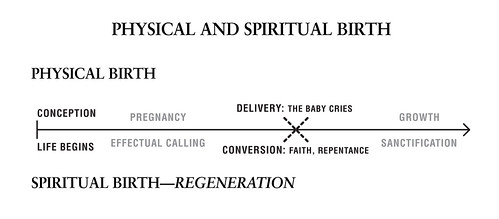
Justin Taylor has an interesting interview with Stephen Smallman in which Smallman explains a helpful analogy from his book Spiritual Birthline.

384083104 00B51E7096


... a way to understand spiritual birth was to reflect on our physical birth--which is certainly what Jesus caused Nicodemus to do. If physical birth is really a process, marked by an event when the unborn baby goes public, doesn't that help us understand the process of spiritual birth?

... the parallel of physical and spiritual birth makes it clear that they both should be thought of in terms of process rather than event. I present this by first walking through the familiar experience of physical birth. If there is a key moment, it has to be the point of conception, which is private and virtually invisible. Over time that new life grows until it inevitably "goes public." We don't speak of life as beginning at the time of delivery, but now the child begins a new phase of growth--through infancy, childhood, and adulthood. I suggest that helps to explain the process of spiritual birth: it begins when God sovereignly begins a new life in our dead souls. Jesus made it clear (John 3) this was a work of the Holy Spirit, and in fact "born again" can be properly translated "begotten again," or "begotten from above." But rather than instantly appearing, the new life grows like a spiritual pregnancy until we are compelled, in one form or another, to "go public," and we "call on the name of the Lord." This is the experience we commonly label as conversion--it is our response to the inward calling/convicting work of the Spirit when the truth of the gospel burns itself more and more into our consciousness. Reformed theologians typically speak of this season of spiritual pilgrimage as "effectual calling," and Paul frequently reminds believers in the beginning of his epistles of their calling to Christ (Rom. 1:6; 1 Cor. 1:2, 9). The Westminster Shorter Catechism (#31) explains that the work of effectual calling by the Spirit brings us to the point where we "embrace Jesus Christ freely offered to us in the gospel." I represent that "embrace" or conversion with a dotted X. At first I simply drew it as an X on the timeline, but as that helped people to think through their actual experience of conversion I began to appreciate the remarkable variety of ways people came to the place of actually expressing faith. In the end we can only say that when the Spirit calls us it will bring us to surrender to Jesus, but the form or time that takes cannot be confined to a moment or a formula.

Finally, what the birthline makes clear is that the process begun by the Spirit will continue into what we typically define as sanctification. There tends to be so much focus on the conversion experience in our evangelical culture that spiritual growth is viewed as a good thing, but not necessarily present with all converts. But a biblical understanding of salvation assumes that those whom the Lord calls to himself will continue in that calling, and I try to reflect this in the idea of the birthline.

I should add that I use the birthline as a helpful tool to explain the invisible, supernatural work of the Spirit; what Jesus referred to as the "wind blowing where it wills." We are in the presence of divine mystery in the work of God in the soul, and there is no final way to describe it.
The whole piece is worth the time.

why we have language

I love this one from Lily Tomlin ...

"Man invented language to satisfy his deep need to complain."

Technorati Tags:

what's the deal with democrats

I do not believe that the GOP is the party of God and I do not see George Bush as the messiah. On the other hand, I'm confused by Christian supporters of the Democratic party. I know and love some of them so this in not a nasty attitude thing, I'm simply confused. The party as a whole seems antagonistic to our faith (as opposed to the Republicans who are just screwed up).

The trigger this time was the news that Husham al-Husainy - an extremist who has a long record of support for prominent Islamists at war with America and Israel - led the invocation at the DNC winter meeting last week. These guys are waging a holy war against us and they are invited to lead us in prayer? And, Democrats whom presumably were Christians, joined in? In the old days we called that sin, syncretism, mingling worship of false gods with worship of the true God.

Perhaps the Dems would like to go the way of Canada where they are actually considering deportation of an ex-terrorist for speaking out against Islamic terrorism.

Technorati Tags: ,

reftagger