Sunday, April 30, 2006

pope fiction

From WuzzaDem.com ...

Pope Fiction (Scene From)

_pulp_fiction_best

An old gas guzzling, dirty, white 1974 Chevy Nova barrels down a stretch of road in Italy. In the front seat are two men -- one white, one black -- both wearing cheap black suits with thin black ties. Their names are Vincent Vega and Jules Winnfield.

Having just left a life of crime, Vincent and Jules are looking for redemption, so they're "shopping around" for the right religion. This week they're examining Catholicism, and are en route to Vatican City. [continue]

Technorati Tags: , ,

Saturday, April 29, 2006

brokeback to the future

Brokeback Mountain caused quite a buzz in the Christian blogshere - I wonder what the release of Brokeback to the Future will do?

the pope pod

Apparently the Pope is now using an iPod. But I'm suspicious, this guy reminded me of MC Hammer.

HT: A

Technorati Tags: , ,

does god repent?

James Spurgeon does an excellent job of handling an apparent contradiction in Scripture regarding the topic of God repenting. Based on Ex 32.7-14, can we really say that God changes His mind? Read here for more.

Technorati Tags:

Tuesday, April 25, 2006

apologetics on the other side

In The Church on the Other Side, Brian McLaren argues that much of what passes for apologetics today is ineffectual. Here are his supporting points:

Circular Reasoning – McLaren reasons that the argument to defend the Bible by saying, “the Bible says” just doesn’t work. I agree yet I want to be careful not to jettison the Bible. Without it we will be caught up by false doctrines and teaching that follow the imaginations of evil men. We must also be careful (as Randy B. has warned) not to find Scriptures that fit our stories.

So what are we to do? We are to show up in the lives of others with power and we are to explain this amazing power with stories. The stories we tell, may be direct from Scripture, they may be our life stories, or they may be parables. In all cases we need to not teach more than the Bible teaches and ultimately, point to God and His Word.

Defensiveness – the issue here is that our apologetics are defensive. And worse, too often the only visible use of apologetic is to argue theological details with other believers. We need to get out of our buildings and into the streets with a cause for people to come to Christ.

Combativeness – this flows from the above. We see people as enemies rather than students, clients, or patients. So in addition to sitting back and being on the defensive, we react as if attacked (although there are times that we are attacked). Our objective toward the opponent is to either beat them into submission or increase the space between us. If we saw them as a partner rather than an opponent, then we would more likely come along side of them and help them in their journey.

Worldliness – I like this one. In this age we tend to handle the Bible as a textbook or some sort of encyclopedia. While it is certainly worthy of dissection and study that fills a lifetime, we often forget its nature. It is letters and stories and poems and … much of it is to be read as a whole rather than the verse by verse analysis we make of it. I think we underestimate its power when we relegate it to textbook status.

Distraction – McLaren states that, “apologetics got distracted from hunting tigers to chasing field mice.” As we work through the truth of God’s Word, we must remember to always keep our compass toward Christ. In Becoming a Contagious Christian, we are reminded to watch out for smoke screens. That is, we are to be prepared to answer real life questions but to ensure we always ultimately come back to the purpose of our conversation. It is too easy to get caught in argument for argument’s sake.

Dishonesty – do not exaggerate the claims. I agree that we should not exaggerate the claims but if we stick with what Jesus said, I don’t see that as a risk.

Technorati Tags: ,

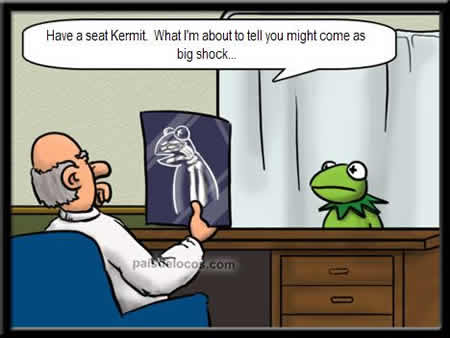
more kermit

You know, I am still laughing at that Kermit picture. The doctor's line should be the opening line to any course on the doctrine of election:

"Have a seat. What I'm about to tell you might come as big shock."

It's the old, "on one side of the door is written, 'whosoever will' and on the other side, 'chosen from the foundations of the world'."

Why is it that the guy on the second side pointing out that particular sign takes such a beating?

get your community's attention

In the Pastors.com article, How to Get Your Community's Attention, Rick Warren writes;
It didn’t used to be this hard. In the earlier part of last century, this wasn’t as much of a problem for churches. The church was usually the biggest building in town, the pastor was often the most educated and prominent person in town, and the church program was the social calendar of the community. You automatically had everyone’s attention.
I agree. Times have changed and the method for presenting the Gospel has changed. BUT - there's more to this. The method has changed from that which was employed by those described above. For me, the above was not right for that time either. The change, then and now, is to present the power of the Gospel as Christ and the Apostles did. Not based on earthly credentials but based on heavenly power.

The Kingdom of God is the power to change lives. It is only in this that the message can be seen and heard.

Warren continues;
Written into the bylaws of Saddleback Church is this sentence: "This church exists to benefit the residents of the Saddleback Valley by providing for their spiritual, physical, emotional, intellectual, and social needs.” Our objective is to minister to the total person. We do not limit our ministry to so-called “spiritual” needs only. People cannot be compartmentalized. Their needs spill over onto each other. And we believe God cares about every part of a person’s life.
Again I say an "Amen" and a "But". The above is absolutely right if it results in a power Gospel and not a social gospel - start meeting the needs of people and they will want to know the source of that healing. If it is from human "goodness", then we can give them nothing. If it is from God above, we can point them to the Giver of Life.
People are ... looking for freedom from fear, guilt, worry, resentment, discouragement, and loneliness. … If your church is meeting these kinds of needs, you won’t have to worry about pressuring people to attend.
When the Kingdom of God is at work people will show up. Ultimately it will be to join or to persecute - but they will show up.

Monday, April 24, 2006

worldviews


At first I thought, "hmmm, aside from some of the uglier stereotypes, that looks pretty accurate." At least an accurate reflection of how I think the average American sees the world. I was tempted not to post this due to some of the cruder stereotypes but then I saw some things in here that explain some other things going on in the world and thought it would be worth it.

Note the spelling of "civilisation" - it's wrong. So clearly this is a non-American trying to stir up trouble. It's people like this that make it tough for us all to get along.

Then note that there is no Middle East. I think this part is a true reflection of the typical American worldview (at least prior to 9/11) and that view fuels the reasons why we have failed policies there (wherever "there" is).

Do you see anything else in this that I am missing?

Technorati Tags: ,

bad news for kermit


And I thought I was having a tough time...

Oh - I guess I should explain I found this in some "ice breakers" for teaching on the Doctrine of Election.

Technorati Tags: , ,

solitude

A. writes in Four Short Thoughts;
Solitude: If solitude means only to be alone, then it is of only a little use to us. To be of great use to us, solitude must mean to be alone with God. For many of us, this being alone, either with ourselves or with God, may not come naturally, it must be learned. Learning how to be alone with oneself may be difficult, but learning how to be alone with God...this may be the process of a lifetime. And I have to believe that it is worth every effort made.
And then expands on that in A Thought From Solitude...

Technorati Tags:

more predestined than you might like

In the course of leading us through an excellent study on 2 Pet 3, Sergey reminded us at small group last night about a text that is often partially quoted but rarely completed, Pr 16.4, The Lord has made everything for its purpose, even the wicked for the day of trouble.

The following is mostly excerpted from RC Sproul's Essential Truths of the Christian Faith.

The Reformed view holds that, left to himself, no fallen person would ever choose God. Fallen people still have a will and are able to choose what they desire. But the problem is that we have no desire for God and will not choose Christ unless first regenerated. Faith is a gift that comes out of rebirth. Only those who are elect will ever respond to the gospel in faith.

The elect choose Christ, but only because they were first chosen by God. As in the case of Jacob and Esau, the elect are chosen solely on the basis of the sovereign good pleasure of God and not on the basis of anything they have done or will do (Ro 9.10-12, 16). This leaves us with the frustrating point of predestination, i.e., God does not choose or elect to save everybody. He reserves the right to have mercy upon whom He will have mercy. Some of fallen humanity receive the grace and mercy of election. The rest God passes over, leaving them in their sin. The nonelect receive justice. The elect receive mercy. No one receives injustice. God is not obligated to be merciful to any or to all alike. It is His decision how merciful He chooses to be. Yet He is never guilty of being unrighteous toward anyone (Ro 9:14-15).

God declared that He loved Jacob but hated Esau. Predestination is double. The only way to avoid the doctrine of double predestination is to either affirm that God predestinates everybody to election or that He predestinates no one to either election or reprobation. Since the Bible clearly teaches predestination to election and denies universal salvation, we must conclude that predestination is double. It includes both election and reprobation. Double predestination is unavoidable if we take Scripture seriously. What is crucial, however, is how double predestination is understood.

Some have viewed double predestination as a matter of equal causation, where God is equally responsible for causing the reprobate not to believe as He is for causing the elect to believe. This is called a positive-positive view of predestination.

The positive-positive view of predestination teaches that God positively and actively intervenes in the lives of the elect to work grace in their hearts and bring them to faith. Likewise, in the case of the reprobates, He works evil in the hearts of the reprobate and actively prevents them from coming to faith. This view has often been called “hyper-Calvinism” because it goes beyond the view of Calvin, Luther, and the other Reformers.

The Reformed view of double predestination follows a positive-negative schema. In the case of the elect, God intervenes to positively and actively work grace in their souls and bring them to saving faith. He unilaterally regenerates the elect and insures their salvation. In the case of the reprobate He does not work evil in them or prevent them from coming to faith. Rather, He passes over them, leaving them to their own sinful devices. In this view there is no symmetry of divine action. God’s activity is asymmetrical between the elect and the reprobate. There is, however, a kind of equal ultimacy. The reprobate, who are passed over by God, are ultimately doomed, and their damnation is as certain and sure as the ultimate salvation of the elect.

The problem is linked to biblical statements such as those regarding God’s hardening of Pharaoh’s heart. That the Bible says God hardened Pharaoh’s heart is beyond dispute. The question remains, how did God harden Pharaoh? Luther argued for a passive rather than an active hardening. That is, God did not create fresh evil in Pharaoh’s heart. There was already enough evil present in Pharaoh’s heart to incline him to resist the will of God at every turn. All God ever has to do to harden anybody is to remove His restraining grace from them and give them over to their own evil impulses. This is precisely what God does to the damned in hell. He abandons them to their own wickedness.

In what sense did God “hate” Esau? Two different explanations are offered to solve this problem. The first explains it by defining hate not as a negative passion directed toward Esau but as simply the absence of redemptive love. That God “loved” Jacob simply means that He made Jacob the recipient of His unmerited grace. He gave Jacob a benefit that Jacob did not deserve. Esau did not receive the same benefit and in that sense was hated by God.

The first explanation sounds a bit like special pleading to get God off the hook for hating somebody. The second explanation gives more strength to the word hate. It says simply that God did in fact hate Esau. Esau was odious in the sight of God. There was nothing in Esau for God to love. Esau was a vessel fit for destruction and altogether worthy of God’s wrath and holy hatred.

You can decide which explanation you prefer but in the end, God is Sovereign - He has made everything for its purpose even the wicked. But thank God that for us, He is patient and does not want any to perish. Let us move to repentance and live lives worthy of His call, i.e, making our salvation sure (2 Pe 3.8-9, Phil 3.12, 2 Pe 1.10).
Technorati Tags: , ,

Saturday, April 22, 2006

antique shopping

Big day today - Barb and I went antique shopping near Kaiserslautern (Euro Antiques, Ramstein Antik-Centre, Luc's Antiques, and Freddy's Antiques) . We had a great time, saw some cool stuff, and managed not to spend anything ... well almost, we got a small amount of Polish pottery (collecting that stuff is like a cult for the American women here).

I needed the time with her. She brings refreshing into my life. I have been feeling very frustrated lately. If you read this blog, you know we are preparing to move to the US at the end of June. Last week we went to the US for some house hunting. It was successful in terms of finding a house but I am tired both physically and emotionally from the trip. We looked 30+ houses, tons of furniture, cars, etc.. It was just a bit overwhelming to make a large purchase decision like that compounded by the time zone effect on our sleep.

Anyway, the house is great but of course it is at the upper end of our price range. I got back this past week to find that the interest rates had gone up. Then yesterday our landlord went through our current place and is claiming a large amount of damages. Some were caused by us and I was prepared for that but most were pre-existing or a result of poor quality materials/workmanship in the building leading to early failure. So there's that to deal with...

I also had a work surprise this week. One of the guys working for me is going out of work effective immediately for an indefinite period of time so I have to come up with a plan to cover his work (high travel type of work).

On top of all of this, I have to support some items at church that frankly my heart just isn't behind. I suppose they are right to do but I would have pursued a different path if I was staying here longer. Now the effort is one that I'm not really aligned to and because of the above, I simply do not have the time for.

I feel I need some cheese to go with all of this whining. So where is this going, ah yes, it was really good to have some time with my best friend today. She is special and can make me smile in any circumstance. I am blessed to have such a wonderful life partner.

So now I am off to thank God for her. I also need to read 2 Peter. My friend Sergei will be leading our small group Bible study tomorrow and he has high standards when discussing the Bible. I love him for that.

It's the last one for Julie and him before they move to Pennsylvania. We will miss them greatly. Fine ... now I'm getting sad again ... I better go read and pray.

another canadian blog

My friend Shannon now has her own blog. I like her so I'm sure I will like her blog. Pay her a visit and make a comment.

Now I just have to get my dad and Wince's dad to make a blog. My dad because he is an email forwarding junkie - one of those guys that likes to email everything that he finds interesting on the internet (those of you that know someone like this understands what I'm talking about) and Wince's dad because he is one of those guys trolling the blogs of others and commenting like a mad man - as opposed to just blogging like a mad man.

Technorati Tags: ,

Wednesday, April 19, 2006

rapture index

This is too good. If Randy B. ever gets his own blog, I'm sure he will want to reference this regularly.

The Rapture Index has dropped by one point today to 155. While oil supply/price is up, volcano and drought activity are both down a point. But for you pre-tribbers, a 155 index is still well above the required 145 for a "fasten your seat belts" rating. Get ready folks!

Technorati Tags: , , ,

randy b blog

At risk of providing extra-biblical revelation, Randy B. - GET YOUR OWN BLOG.

Technorati Tags:

witnessing to the world

Hemant, the eBay atheist, writes why he is addicted to Christian media. The summary:
Christianity works best for non-believers when we hear stories that sound like something we would see or do. Joel [Olsteen] tells me to not be dishonest by telling a story from his college days (Hey, I went to college, too!) and then supports his message with a story from the Bible. Dobson tells me I shouldn’t be dishonest because Proverbs 6:16-19 says so (as he does in the April issue of Charisma). Period. Who would I be more inclined to listen to?
Punkt! We should ever compromise the integrity and truth of the God's Word. We should not apologize for speaking of it nor shy away from it. Yet we best communicate via stories - Jesus did. Truth should be woven into the fabric of our communication and we should always be pointing toward Christ. Compassion should mark our lives and yet we should stand out as different and as one upholding a new covenant standard. Storytelling in this manner and purpose is powerful.

Hemant's summary continues:
On a similar note, the conference advertising and the Christian TV shows show people who seem so contrived and *not* like the people I’d see on a regular basis (Can anyone else imagine Benny Hinn or Jan Crouch at your workplace?)… It’s a different world. And if you want me to join you, you have to appeal to me. That’s not even close to happening.
Reinforcing that we do not need to be different just for the sake of being different but that the difference should be "Christ and Christ alone". I'm sure the Hinn/Crouch approach works for some. I personally have trouble getting over the style differences. But if that's who they genuinely are, then God bless them - so long as they stay true to God's leading in their lives.

Being an ambassador for Christ should on one hand change every aspect of our being yet on the other hand, I am still who I am - perfectly designed for the purpose, place, and time that God has placed me. I desire to be all things to all men but only as God leads. I want to do all this for the sake of the Gospel.
For though I am free from all, I have made myself a servant to all, that I might win more of them. To the Jews I became as a Jew, in order to win Jews. To those under the law I became as one under the law (though not being myself under the law) that I might win those under the law. To those outside the law I became mas one outside the law (not being outside the law of God but nunder the law of Christ) that I might win those outside the law. To the weak I became weak, that I might win the weak. I have become all things to all people, that by all means I might save some. I do it all for the sake of the gospel, that I may share with them in its blessings. (1 Co 9.19-23 ESV)
Technorati Tags: , ,

Monday, April 17, 2006

centered sets

I referenced the centered set in the previous post so I thought that should come with some explanation. And as always, if someone else has already said it better, I feel no need to rewrite it. This is from Bill Jackson's The Quest for the Radical Middle:
1. Fuzzy sets describe groups that have no organizational center. A group of little league parents might perceive themselves as a group in that they have a common interest, but no core values define their existence.

2. Centered sets describe groups that have joined together a common center articulated by core values. People in a centered set want to go the same place and generally agree on how they will get there and who will lead them. There is a lot of latitude for collegial disagreement on non-core issues and flexibility in forms.

3. Bounded sets describe groups that not only have banded together around a common center, but that have also clearly defined rules about beliefs and practices. The number of people who can get in the group becomes narrower because the parameters are more defined.

John (Wimber) explained that from the beginning he intended that the Vineyard be a centered set of like-minded churches... John also taught that historically groups couldn't remain in centered sets forever because the rules that determine the insiders and outsiders will eventually have to be defined. His desire, however, was to keep the Vineyard a centered set movement for as long as he could.

In order to evaluate trends and views emerging in the movement, (Wimber) generally chose to let them alone until they could be studied biblically and examined for long-term fruit. In describing this philosophy he used the analogy of growing a bush. It is a temptation to trim a bush back too soon before a gardener knows what he has. This means letting the thing go for awhile, thus having to endure a period when the bush looks messy and untrimmed. Then, when the course the branches are taking is clear, that which is unwanted is trimmed back. This allows for more growth in the rest of the plant.
In Anthropological Reflections on Missiological Issues, Paul Hiebert contrasts bounded sets with sharp boundaries to centered sets that have boundaries but the emphasis is placed on that which centers the set rather than the boundaries around it.

Characteristics of bounded sets are:
  1. The category is created by listing the essential characteristics an object must have in itself to belong to the set.
  2. The category is defined by a clear boundary...The central question, therefore, is whether an object is inside or outside the category.
  3. Objects within a bounded set are uniform in their essential characteristics - they constitute a homogeneous group.
  4. Bounded sets are essentially static sets.Bounded sets, as we use them in the West, are ontological sets. They have to do with the ultimate, changeless structure of reality, which is defined in terms of unchanging, universal, abstract categories.
  5. Emphasis is placed on determining who's in and who's out of the clearly bounded set. In contrast to bounded sets, centered sets are a groupings of things "on the basis of how they relate to other things, not what they are in and of themselves".
Characteristics of centered sets are:
  1. A centered set is created by defining a center or reference point and the relationship to that center.
  2. Centered sets do not have sharp boundaries that separate the set from those outside it. The boundary emerges automatically by the relationship of the object to the center.
  3. The variables of centered sets are membership and distance from the center.
  4. Things headed away from the center can shift and turn toward or away from the center.

trading up history

In The Church on the Other Side, Brian McLaren argues that we will be "trading up history".
We will trade in our private histories for one grand, shared history.
I don't think I agree. Or more precisely, that may or may not come true but I do not agree that it is a good thing. I believe McLaren is saying that it is good.

Christians should be story tellers. Each believer should be able to tell His story, ones own story, and our story. Each of these would be long or short depending on the context of the conversation. The longer version of His story would include the Church. The "our story" would be the story of a specific community of believers.

McLaren properly sees the strengths and weaknesses of the myriad of denominations and groups and is suggesting that we should focus on the larger narrative and celebrate the richness of the whole. I agree but I would tell about that in His story. I would not jettison the benefit of the local community's story. It seems that we are sharing these stories to draw someone into the Kingdom. If they are already "in", then we are telling the stories to move them closer to the center of a given community. Since I am coming from a centered set perspective, I do not intend that to mean at the exclusion of others. I simply mean that to better see the future, it is helpful to understand the past. I believe that having vision for the future will increase ownership and involvement. I do not think this will work well if the vision is too nebulous, i.e., the larger Church rather than the local community.

Sunday, April 16, 2006

rapture letter

I'll just let this one speak for itself ... for all you eschatology nuts, this should provide a lot of fun ...

Rapture Letters

Technorati Tags: ,

every decision is his

If you are still confused ... Proverbs 16.33
  • The lot is cast into the lap, but its every decision is from the Lord - English Standard Version
  • The lot is cast into the lap, but its every decision is from the LORD - New International Version
  • تُلْقَى الْقُرْعَةُ فِي الْحِضْنِ، وَلَكِنَّ الْقَرَارَ مَرْهُونٌ كُلُّهُ لأَمْرِ الرَّبّ - Arabic Life Application Bible
  • Жребието се хвърля в скута, Но решението чрез него е от Господа - Bulgarian Bible
  • Moun tire kat pou yo konnen sa pou yo fè. Men, desizyon an se nan men Bondye li ye - Haitian Creole Version
  • I Brystfolden rystes Loddet, det falder, som HERREN vil - Dette er Biblen pÃ¥ dansk
  • Im Gewandbausch schüttelt man das Los, aber all seine Entscheidung kommt vom HERRN - Elberfelder
  • Make your motions and cast your votes, but GOD has the final say - The Message
  • The lot is cast into the lap, but the decision is wholly of the Lord [even the events that seem accidental are really ordered by Him] - Amplified Bible
  • The lot is cast into the lap; but the whole disposing thereof is of the LORD - King James Version (the one used by Jesus)
  • The lot is cast into the lap; But the whole disposing thereof is of Jehovah - American Standard Version
  • La suerte se echa en el regazo; Mas de Jehová es la decisión de ella - Reina-Valera 1960
  • On jette le sort dans le pan de la robe, Mais toute décision vient de l'Éternel - Louis Segond
  • בַּ֭חֵיק יוּטַ֣ל אֶת־הַגֹּורָ֑ל וּ֝מֵיְהוָ֗ה כָּל־מִשְׁפָּטֹֽו׃ - The Westminster Leningrad Codex
  • Az [ember] kebelében vetnek sorsot; de az Úrtól van annak minden ítélete - Hungarian Károli
  • Í skikkjufellingum eru teningarnir hristir, en Drottinn ræður, hvað upp kemur - Icelandic Bible
  • Si getta la sorte nel grembo, ma ogni decisione dipende dall'Eterno La Nuova Diodati
  • 사람이 제비는 뽑으나 일을 작정하기는 여호와께 있느니라 - Korean Bible
  • E maka ana te rota ki roto ki te kokorutanga o te kakahu; kei a Ihowa ia te tikanga katoa - Mairi Bible
  • Het lot wordt weliswaar ongezien geworpen, maar de HERE bepaalt hoe het valt Het Boek
  • I kappens fold rystes loddet, men avgjørelsen kommer alltid fra Herren - Det Norsk Bibelselskap 1930
  • Se aruncă sorţul în poala hainei, dar orice hotărîre vine dela Domnul - Romanian
  • В полу бросается жребий, но все решение его--от Господа - Russian Synodal Version
  • Shorti hidhet që në barkun e nënës, por çdo veprim varet nga Zoti - Albanian Bible
  • Vi singlar ofta slant, men det är Herren som avgör om det blir krona eller klave - Levande Bibeln
  • Người ta bẻ thăm trong vạt áo; Song sự nhứt định do nơi Đức Giê-hô-va mà đến - 1934 Vietnamese Bible
  • 籤 放 在 懷 裡 , 定 事 由 耶 和 華 - Chinese Union Version
Got it?

Technorati Tags:

reftagger