John Calvin comments on 1 Peter 5:5:
We are to imagine that; God has two hands; the one, which like a hammer beats down and breaks in pieces those who raise up themselves; and the other, which raises up the humble who willingly let down themselves, and is like a firm prop to sustain them. Were we really convinced of this, and had it deeply fixed in our minds, who of us would dare by pride to urge war with God?
Taken from Calvin's Commentaries.
HT:JE

Friday, April 29, 2011


doctrine wins
 Richard Lints writes:
With all of the furor surrounding Rob Bell’s recent book, Love Wins (HaperOne 2011) it may seem counterintuitive to say that interest in the book (as evidenced by the Time Magazine cover article on it) owes more to the enduring interest in Christian doctrine rather than to the ambiguity of belief so characteristic of Bell’s thesis. The fact that people still care about the doctrinal outlines of the Christian belief in heaven and hell is testimony that at the end of the day, doctrine wins. It does matter what one believes. It matters because doctrine shapes life and deep down most of us know this.
David Brooks, the New York Times OpEd columinist recently wrote, “Many Americans have always admired the style of belief that is spiritual but not doctrinal, pluralistic and not exclusive, which offers tools for serving the greater good but is not marred by intolerant theological judgments. The only problem is that [this view] is not quite true. Vague, uplifting, nondoctrinal religiosity doesn’t actually last. The religions that grow, succor and motivate people to perform heroic acts of service are usually theologically rigorous, arduous in practice and definite in their convictions about what is True and False” (New York Times, April 22, 2011).
When David Brooks, a nominal Jew, understands this, it seems all the more surprising that many evangelicals still seem predisposed to soften the edges of doctrinal conviction in order to be more acceptable to the wider culture. Doctrine wins because Truth matters to life. Would not the “living” nature of Biblical truth be a sufficient reminder of this?
HT:PC
Thursday, April 28, 2011
read the book - why?
It's amazing to me that the standard defense of Rob Bell's error is "you cannot critique it/him if you haven't read the book." I think if I wanted to defend Bell I'd steer people away from Love Wins.
Does Bell think only some will be saved and the rest damned? He writes in regard to God condemning some to hell, “Can God do this, or even allow this, and still claim to be a loving God?”
But in another place he writes a somewhat Calvinistic thought, “Will all people be saved, or will God not get what God wants? Does this magnificent, mighty, marvelous God fail in the end?”
Later however he's a little Arminian, “Although God is powerful and mighty, when it comes to the human heart God has to play by the same rules we do. God has to respect our freedom to choose to the very end, even at the risk of the relationship itself.”
What does Bell believe? Well if you've read the book, he believes the first and uses the other two to support his real thinking. In the end, he is as Bertrand Russel who wrote in Why I am not a Christian, "There is one very serious defect to my mind in Christ’s moral character, and that is that He believed in hell. I do not myself feel that any person who is really profoundly humane can believe in everlasting punishment.”
Bell is actually quite clear in his error on pages 173-175 where he reveals his true heart - he cannot accept the God of the Bible and uses minor distortions that we bring to the party as his justification:
Millions have been taught that if they don’t believe, if they don’t accept in the right way, that is, the way the person telling them the gospel does, and they were hit by a car and died later that same day, God would have no choice but to punish them forever in conscious torment in hell. God would, in essence, become a fundamentally different being to them in that moment of death, a different being to them forever. A loving heavenly father who will go to extraordinary lengths to have a relationship with them would, in the blink of an eye, become a cruel, mean, vicious tormenter who would ensure that they had no escape from an endless future of agony.So Bell reinvents God in his imagine to make Him more agreeable. This is error.
If there was an earthly father who was like that, we would call the authorities.
If there was an actual human dad who was that volatile, we would contact child protection services immediately.
If God can switch gears like that, switch entire modes of being that quickly, that raises a thousand questions about whether being like this could ever be trusted, let alone be good.
Loving one moment, vicious the next.
Kind and compassionate, only to become cruel and relentless in the blink of an eye. Does God become somebody totally different the moment you die? That kind of God is simply devastating. Psychologically crushing. We can’t bear it. No one can.
And that is the secret deep in the heart of many people, especially Christians: they don’t love God. They can’t, because the God they’ve been presented with and taught about can’t be loved. That God is terrifying and traumatizing and unbearable.
Because if something is wrong with your God, if your God is loving one second and cruel the next, if your God will punish people for all of eternity for sins committed in a few short years, no amount of clever marketing or compelling language or good music or great coffee will be able to disguise that one, true, glaring, untenable, unacceptable, awful reality
Sometimes the reason people have a problem accepting “the gospel” is that they sense that the God lurking behind Jesus isn’t safe, loving, or good. It doesn’t make sense, it can’t be reconciled, and so they say no. They don’t want anything to do with Jesus, because they don’t want anything to do with that God.
Wednesday, April 27, 2011
bell continues to fail
In Love Wins, Rob Bell writes:
“No one can resist God’s pursuit forever because God’s love will eventually melt even the hardest hearts”It is clear that Bell posits this as one of several views through history. On the other hand, he not only does not speak of it as an erroneous view, he words his questions in a way that lead the reader into error. To deny this is disingenuous and I'm saddened by many who do not see that.
Is God our friend, our provider, our protector, our father – or is God the kind of judge who may in the end declare that we deserve to spend forever separated from our Father?Longing that no one will spend eternity in hell is not that same as what Bell is doing here. He confuses and misleads in a way that does damage to God's Word.
Is God like the characters in a story Jesus would tell, old ladies who keep searching for the lost coin until they find it, shepherds who don’t rest until that one sheep is back in the fold, fathers who rush out to greet and embrace their returning son, or, in the end, will God give up?
Will “all the ends of the earth” come, as God has decided, or only some? Will all feast as it’s promised in Psalm 22, or only a few? Will everybody be given a new heart, or only a limited number of people? Will God, in the end, settle, saying: “Well, I tried, I gave it my best shot, and sometimes you just have to be okay with failure”? Will God shrug God-size shoulders and say, “You can’t always get what you want”?
…
Could God say to someone truly humbled, broken, and desperate for reconciliation, “Sorry, too late?”
…
Which is stronger and more powerful, the hardness of the human heart or God’s unrelenting, infinite, expansive love?
on heretics and schismatics
Interesting quotes from Martin Downes on heretics verses schismatics ...
Augustine eventually came to define heretics as those who "in holding false opinions regarding God, do injury to the faith itself," as distinguished from schismatics, who "in wicked separations break off from brotherly charity, although they may believe just what we believe."
Basil's distinction was only slightly different: heretics were "men who were altogether broken off and alienated in matters relating to the actual faith," and schismatics were "men who had separated for some ecclesiastical reasons and questions capable of mutual solution."
Pelikan, The Emergence of the Catholic Tradition, p. 69
Technorati Tags: heresy
Tuesday, April 26, 2011
more on false teaching
 From the New Topical Textbook on false teaching ...
Destructive to faith. 2Ti 2:18.
Hateful to God. Re 2:14,15.
Unprofitable and vain. Tit 3:9; Heb 13:9.
Should be avoided by
- Ministers. 1Ti 1:4; 6:20.
- Saints. Eph 4:14; Col 2:8.
- All men. Jer 23:16; 29:8.
The wicked love. 2Ti 4:3,4.
The wicked given up to believe. 2Th 2:11.
Teachers of
- Not to be countenanced. 2Jo 1:10.
- Should be avoided. Ro 16:17,18.
- Bring reproach on religion. 2Pe 2:2.
- Speak perverse things. Ac 20:30.
- Attract many. 2Pe 2:2.
- Deceive many. Mt 24:5.
- Shall abound in the latter days. 1Ti 4:1.
- Pervert the gospel of Christ. Ga 1:6,7.
- Shall be exposed. 2Ti 3:9.
Teachers of, are described as
- Cruel. Ac 20:29.
- Deceitful. 2Co 11:13.
- Covetous. Tit 1:11; 2Pe 2:3.
- Ungodly. Jdj 1:4,8.
- Proud and ignorant. 1Ti 6:3,4.
- Corrupt and reprobate. 2Ti 3:8.
Try, by Scripture. Isa 8:20; 1Jo 4:1.
Curse on those who teach. Ga 1:8,9.
Punishment on those who teach. Mic 3:6,7; 2Pe 2:1,3.
false teachers
 False teachings according to the Zondervan Bible Dictionary:
Scripture repeatedly warns against false teachings, which deny or distort some aspect of the gospel. The origin of such teachings is attributed either to human error or to demonic inspiration.
Examples of false teachings
Rev 2:14-15 See also Mt 5:19; 2Th 2:1-2; 1Ti 4:1-3; Rev 2:20
Qualities of false teachings
They are valueless Mt 15:9 pp Mk 7:7 See also Isa 29:13; Eph 5:6; Col 2:20-23; 1Ti 1:3-7
They are destructive in their nature 2Pe 2:1 See also Mt 7:15; Ac 20:29-30; Tit 1:10-11
They have the capacity to lead people astray Ac 20:30 See also Eph 4:14; 1Ti 6:20-21; Heb 13:9; 2Pe 2:14-15; 1Jn 2:26
They may be popular 2Pe 2:2 See also Mt 24:4-5 pp Mk 13:5-6; 2Ti 4:3; 2Pe 2:18-19; 1Jn 4:1-5
They may be accompanied by miraculous signs Mt 24:24 pp Mk 13:22 See also 2Th 2:9-10; Rev 13:11-15
The origin of false teachings
Demonic inspiration 1Ti 4:1-2 See also 2Co 11:3-4; 1Jn 4:1-3; Rev 16:13-14
Human error 2Pe 2:3 See also Col 2:8; 1Ti 6:20-21
Discerning false teachings
By their content 1Jn 4:2-3 See also 1Co 12:3; 1Jn 2:20-23; 2Jn 7-11
By the teacher’s lifestyle Mt 7:15-20 See also 2Co 11:20; 1Jn 3:7-10; Jude 4
By their effects 1Ti 6:3-5 See also 1Ti 1:3-4; 2Ti 2:16-18; Rev 2:20
The antidote to false teachings
Holding fast to the true gospel 1Jn 2:24 See also Gal 1:6-9; 1Ti 1:18-20; 2Ti 1:13-14
Shunning false teachers Ro 16:17-18 See also 2Ti 3:1-9; Tit 3:9-11; 2Jn 9-11
Monday, April 25, 2011
be warned
"Both our Lord and His apostles told us plainly that we would need to defend the faith against false prophets, vicious wolves in sheep's clothing (Matthew 7:15), minions of Satan disguised as angels of light (2 Corinthians 11:13-14), and corrupters of doctrine who arise within the church (Acts 20:29)." ~ Phil Johnson
Technorati Tags: heresy
forgiveness has meaning
Let's build on a right notion of forgiveness and not on the popular confusing way. First, read and re-read Chris Brauns' Unpacking Forgiveness. Then note that Rob Bell gets this, like many things, wrong. The only out I see is that Bell has is that he has redefined the terms such that we cannot know what he is really saying ... or should I say asking?
"Hell is full of forgiven people God loves, whom Jesus died for." (Bell, Velvet Elvis, page 146).
I agree with Brauns in that this is a very problematic statement. "The idea that someone can be forgiven by God, yet still go to hell, eviscerates forgiveness of any biblical meaning."
Further quoting Brauns referring to Bell;
In Love Wins (188-189), Bell has taken the next step when he argues that on the Cross, Jesus granted unconditional forgiveness apart from repentance or faith on the part of those who crucified Him. "Jesus forgives them all, without their asking for it. Done. Taken care of. Before we could be good enough or right enough, before we could even believe the right things. Forgiveness is unilateral. God isn’t waiting for us to get it together, to clean up, shape up, get up – - God has already done it."Don't believe it. This is incorrect (Jn 3.36). Bottom line, whatever it is Bell is thinking, saying, suggesting, or asking, it isn't consistent with simple Scripture.
Sunday, April 24, 2011
that's my king
I could listen to this over and over again ... That's My King by S.M. Lockridge ...
Do you know Him?
Here's John Piper on the Theology of Resurrection.
He is risen! And O the overflow of that single event. It was the cosmic Yes! from God the Father that the death had done all it was meant to do. And it was the beginning of the eternal existence of the God-Man in a glorious new body in which he would finally reign on the earth forever. And so much more.
There is a whole theology of the resurrection and its achievements in 1 Corinthians 15. Here’s a summary. Let each of these sink in. Savor each one. Then start your new week (the rest of your life) abounding in the work God calls you to “knowing that in the Lord your labor is not in vain.”
1. Christ died for us and rose again.
Christ died for our sins according to the Scriptures, and . . . He was buried, and . . . He was raised on the third day according to the Scriptures. (1 Corinthians 15:3-4)
2. He verified his resurrection by large public appearances.
After that He appeared to more than five hundred brethren at one time, most of whom remain until now, but some have fallen asleep. (1 Corinthians 15:6)
3. Because Christ has risen, we are not still in our sins.
If Christ has not been raised, your faith is worthless; you are still in your sins. (1 Corinthians 15:17)
4. Because Christ has risen, our afflicted lives are not pitiable.
If we have hoped in Christ in this life only, we are of all men most to be pitied. (1 Corinthians 15:19)
5. We who trust Christ will be raised from the dead at Christ's second coming.
For as in Adam all [his posterity] die, so also in Christ all will [his posterity] be made alive. But each in his own order: Christ the first fruits, after that those who are Christ's at His coming. (1 Corinthians 15:22-23)
6. Christ now reigns invincibly over the universe.
For He must reign until He has put all His enemies under His feet. The last enemy that will be abolished is death. (1 Corinthians 15:25-26)
7. Our resurrection body will be imperishable, glorious, powerful, and spiritual.
[Our resurrection body] is sown a perishable body, it is raised an imperishable body; it is sown in dishonor, it is raised in glory; it is sown in weakness, it is raised in power; it is sown a natural body, it is raised a spiritual body. (1 Corinthians 15:42-44)
8. Living or dead, we shall be given new bodies in an instant at Christ's coming.
Behold, I tell you a mystery; we will not all sleep, but we will all be changed in a moment, in the twinkling of an eye, at the last trumpet. (1 Corinthians 15:51-52)
9. Death now has no sting and will be swallowed up in victory.
But when this perishable will have put on the imperishable, and this mortal will have put on immortality, then will come about the saying that is written, "Death is swallowed up in victory. Death, where is your victory? O death, where is your sting?" (1 Corinthians 15:54-55)
10. Christ suffered for sin and satisfied the law for us.
The sting of death is sin, and the power of sin is the law; but thanks be to God, who gives us the victory through our Lord Jesus Christ. (1 Corinthians 15:56-57)
11. Therefore, do huge amounts of Christ-exalting work because none of it is in vain.
Therefore, my beloved brethren, be steadfast, immovable, always abounding in the work of the Lord, knowing that your toil is not in vain in the Lord. (1 Corinthians 15:58)
he is risen
 "We need not wonder that so much importance is attached to our Lord’s resurrection. It is the seal and memorial stone of the great work of redemption, which He came to do. It is the crowning proof that He has paid the debt He undertook to pay on our behalf, won the battle He fought to deliver us from hell, and is accepted as our guarantee and our substitute by our Father in heaven. Had He never come forth from the prison of the grave, how could we ever have been sure that our ransom had been fully paid (1 Corinthians 15:17)? Had He never risen from His conflict with the last enemy, how could we have felt confident that He has overcome death – and him that had the power of death, that is the devil (Hebrews 2:14)? But thanks be unto God, we are not left in doubt. The Lord Jesus really rose again for our justification." ~ J.C. Ryle, Expository Thoughts on the Gospels: Matthew
HT:Erik
Friday, April 22, 2011
critique of the apostle paul
 I think this is great ... a satire written by Justin Taylor and Jared Wilson ... I posted it in its entirety here ...
Exclusive: In an exciting example of scholarly cross-collaboration and interdisciplinary research, textual critics and archaeologists have just published a translation of a recently discovered first-century letter, apparently authentic, written to the Apostle Paul himself. Scholars believe it was likely written in the late AD 40s or early 50s. The parchment was remarkably well preserved in a jar buried in a cave on the island of Satiricus. It is surmised that the author of the letter, Parodios, was an elder who had met Paul on one of his missionary journeys.
The translation, published here for the first time, reads as follows:
Parodios, a servant of the Lord Jesus Christ, to our brother Paulos.It is unknown whether the Apostle Paul actually received and read this letter, and history has left no record of a response.
Grace to you and peace from God our Father and the Lord Jesus Christ.
Our church recently received a copy of the letter that you sent to the church of Galatia. We hope you will not mind hearing our humble concerns. In the past we have noticed you are more interested in confronting people rather than conversing with them, but we hope you will receive this letter as an invitation to further dialogue.
First of all, we are uncomfortable with your tone throughout the correspondence. We know it is difficult sometimes to discern tone of voice from written communication, but you should keep this in mind as well. One could gather from your careless use of words that you are losing your temper. You certainly sound angry. This is unbecoming a spokesperson for the faith. As you say yourself, one of the manifest fruit of God’s Spirit is gentleness.
Aren’t you being a hypocrite to preach grace but not show it to our Judaizer brothers? They may not worship as you do or emphasize the same teachings you do, but our Lord has “sheep not of this fold,” and there is certainly room within the broader Way for these brothers. Their methodology may differ from yours, but certainly their hearts are in the right place.
You yourself know that our Lord required personal contact when we have a grievance against another. Have you personally contacted any of these men? Have you sat down to reason with them personally? Have you issued a personal invitation? Some of them may even reconsider their viewpoints if you had taken a different tack. We know that your position is likely that public teaching is open to public criticism, but we can do better than what is expected, can’t we?
In one portion of your letter, you indicate you don’t even know these persons! “Whoever he is,” you write. Our dear Paulos, how can you rightly criticize them when you don’t know them? It’s clear you haven’t even read their material, because you never quote them. We implore you to see that they are plainly within the tradition of Moses and of the Prophets. They understand the context of the covenant in ways you appear deaf to.
Similarly, we find your tone and resorting to harsh language not in keeping with the love of Christ. “Foolish Galatians.” “Let him be accursed.” “Emasculate themselves.” Really? Can you not hear yourself? You think this is Christlike? Does this sound like something our Lord would say? Do you think this flippant, outrageous, personal, vindictive manner of speech speaks well of God’s love or the church? It is clear you are taking this way too personally. Indeed, you ask the Galatians if you are now their enemy. Does everything have to be so black and white to you?
Paulos, what will unbelievers think when they read this letter? Do you think this will commend the gospel to them? This kind of harsh language just makes us look like a bunch of angry people. They see we can’t even love each other, and over what? Circumcision? This is a terrible advertisement for God’s love to an unbelieving world. You have given plenty of people permission now to disregard Jesus, if this is what his mouthpieces sound like.
We hope you will reconsider your approach. We know that you catch much more flies with honey than with vinegar. We are concerned that your ill-worded letter signals a divisiveness that threatens to fracture the church. We beg you to reconsider how important these minor issues are, and how in the future you may speak in ways that better reflect God’s love.
The grace—and the love!—of our Lord Jesus Christ be with your spirit, brother.
But we think we can make at least two observations.
First, Paul’s words to the Galatians were not inappropriate. They were true words, and they were loving words. Even if it runs contrary to our presuppositions and expectations, they were an example of “speaking the truth in love.” These words were inspired by the Holy Spirit, so that to critique Paul and his language is ultimately to critique God himself.
Second, this language was not Paul’s default. He did not respond to every controversy in the same way. He would be appalled if people took this letter to the Galatians and made it the norm for Christian discourse. Christians should seek to guard their tongue, using gracious speech seasoned with salt, delivered in love, and designed for edification (Col. 4:6;Eph. 4:15, 25, 29). But false doctrine and false teachers can infiltrate the church, and when the gospel is at stake, the means of being loving, edifying, salt-flavored, grace-filled may require harsh words in order to protect the flock, the church for whom Christ died.
May God give us much wisdom in how to speak the truth in love, especially when we have to call a spade a spade.
imitators of god
Josh Etter writes:
In Ephesians 5:1 Paul tells us to be "imitators of God". How can we obey such a holy commandment? William Temple writes: "It is no good giving me a play like Hamlet or King Lear, and telling me to write a play like that. Shakespeare could do it — I can’t. And it is no good showing me a life like the life of Jesus and telling me to live a life like that. Jesus could do it — I can’t. But if the genius of Shakespeare could come and live in me, then I could write plays like this. And if the Spirit could come into me, then I could live a life like his."He then refers to John Piper's excellent message "I Act the Miracle."
Thursday, April 21, 2011
stott on forgiveness
 Martin Downes posts the following today.
Four voices. Only one of them resembles the tone and accent of the Master.
Faustus Socinus (1578)
As we saw elsewhere Paul likewise instructs us to be imitators of God: just as he forgave our sins through Christ, we should forgive each other, but if God so forgave our sins through Christ, that he yet demanded the punishment of them from Christ itself, what prevents us from seeking satisfaction for ourselves for the offenses of our neighbours?Brian McLaren (2006)
The traditional understanding says that God asks of us something that God is incapable of Himself. God asks us to forgive people. But God is incapable of forgiving. God can’t forgive unless He punishes somebody in place of the person He was going to forgive. God doesn’t say things to you—Forgive your wife, and then go kick the dog to vent your anger. God asks you to actually forgive. And there’s a certain sense that, a common understanding of the atonement presents a God who is incapable of forgiving. Unless He kicks somebody else.Steve Chalke (2004)
Is it not strange for Jesus (God incarnate) on the one hand to say ‘do not return evil for evil’ while still looking for retribution himself? Similarly wouldn’t it be inconsistent for God to warn us not to be angry with each other and yet burn with wrath himself, or tell us to ‘love our enemies’ when he obviously couldn’t quite bring himself to do the same without demanding massive appeasement? If these things are true, what does it mean to ‘be perfect…as your heavenly Father is perfect’ (Matt 5:48)? If it is true that Jesus is ‘the Word of God’ then how can his message be inconsistent with his nature? If the cross has anything to do with penal substitution then Jesus teaching becomes a divine case of ‘do as I say, not as I do’. I, for one, believe that God practices what he preaches!John Stott (1986)
'Why should our forgiveness depend on Christ's death?'...'Why does God not simply forgive us, without the necessity of the cross?'...'After all', the objector may continue, 'if we sin against another, we are required to forgive one another. We are even warned of dire consequences if we refuse. Why can't God practise what he preaches and be equally generous? Nobody's death is necessary before we forgive each other. Why then does God make such a fuss about forgiving us and even declare it impossible without his Son's "sacrifice for sin"?'
For us to argue, 'We forgive each other unconditionally, let God do the same to us', betrays not sophistication but shallowness, since it overlooks the elementary fact that we are not God. We are private individuals, and other people's misdemeanours are personal injuries. God is not a private individual, however, nor is sin just a personal injury. On the contrary, God himself is the maker of the laws we break, and sin is rebellion against him.
The reason why many people give the wrong answers to questions about the cross, and even ask the wrong questions, is that they have carefully considered neither the seriousness of sin nor the majesty of God.
debtors
 "We are all by nature debtors. We owe to our holy Maker ten thousand talents, and are not able to pay. We cannot atone for our own transgressions, for we are weak and frail, and only adding to our debts every day. But, blessed be God! what we could not do, Christ came into the world to do for us. What we could not pay, He undertook to pay for us. To pay it He died for us upon the cross. “He offered himself to God” (Heb. 9:14). “He suffered for sin, the just for the unjust, that He might bring us to God.” (1 Peter 3:18). Never let us forget this!" ~ J.C. Ryle, Expository Thoughts on the Gospels: Matthew
HT:Erik
Wednesday, April 20, 2011
flattening crowns
Tim Stoner writes another great one! Read it all here.
"The glory of Rob’s heaven is man at peace not God praised."
watts on hell
In The World to Come, Isaac Watts in 1745 to Rob Bell and others ...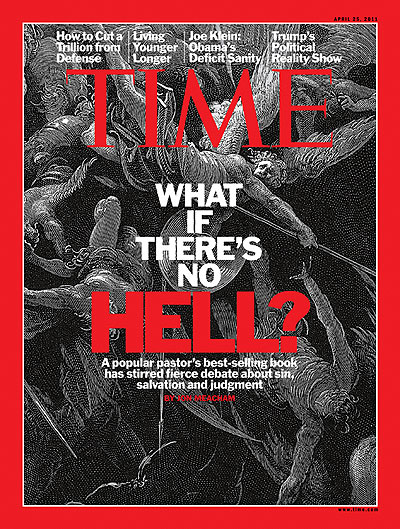
I hope that the whole of these sermons, by the blessing of God, will be made happily useful to Christians, to awaken and warn them, against the danger of being seized by death in a state unprepared for the presence of God, and the happiness of heaven, and to raise the comforts and joys of many pious souls in the lively expectation of future blessedness.HT:RA
The last discourses of this book, especially the “eternity of the punishments of hell,” have been in latter and former years made a matter of dispute; and were I to pursue my enquiries into this doctrine, only by the aids of the light of nature and reason, I fear my natural tenderness might warp me aside from the rules and the demands of strict justice, and the wise and holy government of the great God.
But as I confine myself almost entirely to the revelation of Scripture in all my searches into the things of revealed religion and Christianity, I am constrained to forget or to lay aside that softness and tenderness of animal nature which might lead me astray, and to follow the unerring dictates of the word of God.
The Scripture frequently, and in the plainest and strongest manner, asserts the everlasting punishment of sinners in hell; and that by all the methods of expression which are used in Scripture to signify, an everlasting continuance.
God’s utter hatred and aversion to sin, in this perpetual punishment of it, are manifested many ways:
(1.) By the just and severe threatening: of the wise and righteous Governor of the world, which are scattered up and down in his Word.
(2.) By the veracity of God in his intimations or narratives of past events, as Jude v. 7. “Sodom and Gomorrah suffering the vengeance of eternal fire.”
(3.) By his express predictions (Matthew 25:46). “These shall go away into everlasting punishment” (2 Thessalonians 1:9). “Who shall be punished with everlasting destruction;” and I might add,
(4.) by the veracity and truth of all his holy Prophets and Apostles, and his Son Jesus Christ at the head of them, whom he has sent to acquaint mankind with the rules of their duty, and the certain judgment of God in a holy correspondence therewith, and that in such words as seem to admit of no way of escape, or of hope for the condemned criminals.
I must confess here, if it were possible for the great and blessed God any other way to vindicate his own eternal and unchangeable hatred of sin, the inflexible justice of his government, the wisdom of his severe threatenings, and the veracity of his predictions, if it were also possible for him, without this terrible execution, to vindicate the veracity, sincerity, and wisdom of the Prophets and Apostles, and Jesus Christ his Son, the greatest and chiefest of his divine messengers; and then, if the blessed God should at any time, in a consistence with his glorious and incomprehensible perfections, release those wretched creatures from their acute pains and long imprisonment in hell, either with a design of the utter destruction of their’ beings by annihilation, or to put them into some unknown world, upon a new foot of trial, I think I ought cheerfully and joyfully to accept this appointment of God, for the good of millions of my fellow-creatures, and add my joys and praises to all the song: and triumphs of the heavenly world in the day, of such a divine and glorious release of these prisoners.
But I feel myself under a necessity of confessing, that I am utterly unable to solve these difficulties according to the discoveries of the New Testament, which must be my constant rule of faith, and hope, and expectation, with regard to myself and others. I have read the strongest and best writers on the other side, yet after all my studies I have not been able to find any way how these difficulties may be removed, and how the divine perfections, and the conduct of God in his Word, may be fairly vindicated without the establishment of this doctrine, as awful and formidable as it is.
Tuesday, April 19, 2011
what the cross was not
 From John Stott, The Cross of Christ:
We strongly reject, therefore, every explanation of the death of Christ which does not have at its centre the principle of ‘satisfaction through substitution’, indeed divine self-satisfaction through divine self-substitution.
The cross was not:
- a commercial bargain with the devil, let alone one which tricked and trapped him;
- nor an exact equivalent, a quid pro quo to satisfy a code of honour or technical point of law;
- nor a compulsory submission by God to some moral authority above him from which he could not otherwise escape;
- nor a punishment of a meek Christ by a harsh and punitive Father;
- nor a procurement of salvation by a loving Christ from a mean and reluctant Father;
- nor an action of the Father which bypassed Christ as Mediator.
The theological words ‘satisfaction’ and ‘substitution’ need to be carefully defined and safeguarded, but they cannot in any circumstance be given up. The biblical gospel of atonement is of God satisfying himself by substituting himself for us.
HT:DGB
Monday, April 18, 2011
gospel in a pluralistic society
Leslie Newbigin in The Gospel in a Pluralistic Society:
“[The gospel is] exclusive in the sense of affirming the unique truth in the revelation of Jesus Christ, but not in the sense of denying the possibility of salvation to those outside the Christian faith; inclusive in the sense of refusing to limit the saving grace of God to Christians, but not in the sense of viewing other religions as salvific; pluralist in the sense of acknowledging the gracious work of God in the lives of all human beings, but not in the sense of denying the unique and decisive nature of what God has done in Jesus Christ.”
HT:Len
Subscribe to:
Posts (Atom)