Tuesday, December 29, 2009

cheap grace

"Cheap grace is not the kind of forgiveness of sin which frees us from the toils of sin. Cheap grace is the grace we bestow on ourselves. Cheap grace is the preaching of forgiveness without requiring repentance, baptism without church discipline, Communion without confession, absolution without personal confession.

Cheap grace is grace without discipleship, grace without the cross, grace without Jesus Christ, living and incarnate."

-- Dietrich Bonhoeffer, The Cost of Discipleship

Technorati Tags:

wrath in a tolerant age

In Preaching Hell in a Tolerant Age Tim Keller writes:

People ask, "What kind of loving God is filled with wrath?" But any loving person is often filled with wrath. In Hope Has Its Reasons, Becky Pippert writes, "Think how we feel when we see someone we love ravaged by unwise actions or relationships. Do we respond with benign tolerance as we might toward strangers? Far from it… . Anger isn't the opposite of love. Hate is, and the final form of hate is indifference." Pippert then quotes E. H. Gifford, "Human love here offers a true analogy: the more a father loves his son, the more he hates in him the drunkard, the liar, the traitor." She concludes: "If I, a flawed, narcissistic, sinful woman, can feel this much pain and anger over someone's condition, how much more a morally perfect God who made them? God's wrath is not a cranky explosion, but his settled opposition to the cancer of sin which is eating out the insides of the human race he loves with his whole being."

In Exclusion and Embrace: A Theological Exploration of Identity, Otherness, and Reconciliation (Abingdon, 1996), pp. 303-04, Miroslav Volf writes:

If God were not angry at injustice and deception and did not make a final end to violence—that God would not be worthy of worship…. The only means of prohibiting all recourse to violence by ourselves is to insist that violence is legitimate only it comes from God… My thesis that the practice of non-violence requires a belief in divine vengeance will be unpopular with many… in the West…. [But] it takes the quiet of a suburban home for the birth of the thesis that human non-violence [results from the belief in] God’s refusal to judge. In a sun-scorched land, soaked in the blood of the innocent, it will invariably die… [with] other pleasant captivities of the liberal mind.

That is, it is the lack of belief in a God of vengeance that secretly nourishes violence.

what we need

"...There is nothing that our generation needs more than to hear the Word of God -- and this at a time of biblical illiteracy rising at an astonishing rate. Moreover it needs to hear Christian leaders personally submitting to Scripture, personally reading and teaching Scripture -- not in veiled ways that merely assume some sort of heritage of Christian teaching while actually focusing on just about anything else, but in ways that are reverent, exemplary, comprehensive, insistent, persistent. Nothing, nothing at all, is more urgent."

-- D.A. Carson (commenting on 2 Chron. 34) in "For the Love of God" reading for December 29 (Crossway: 1998)

HT:BEW

Technorati Tags:

sanctity of human life

January 24 is Sanctity of Human Life Sunday. The below video shows the nature of the enemy we are dealing with.


Technorati Tags:

one bible

The more I read it the more amazed I am with its unity. The Bible is an amazing revelation of the one true God. I posted recently about it not being a divided book. Yesterday, Tullian Tchividjian reminded us "the Bible tells one story and points to one figure: it tell it tells the story of how God rescues a broken world and points to Christ who accomplishes this."

Sally Lloyd-Jones, author of The Jesus Storybook Bible, writes in the Introduction of that book:

Now, some people think the Bible is a book of rules, telling you what you should and shouldn’t do. The Bible certainly does have some rules in it. They show you how life works best. But the Bible isn’t mainly about you and what you should be doing. It’s about God and what he has done.

Other people think the Bible is a book of heroes, showing you people you should copy. The Bible does have some heroes in it, but (as you’ll soon find out) most of the people in the Bible aren’t heroes at all. They make some big mistakes (sometimes on purpose), they get afraid and run away. At times, they’re downright mean.

No, the Bible isn’t a book of rules, or a book of heroes. The Bible is most of all a Story. It’s an adventure story about a young Hero who comes from a far country to win back his lost treasure. It’s a love story about a brave Prince who leaves his palace, his throne–everything–to rescues the ones he loves. It’s like the most wonderful of fairy tales that has come true in real life!

You see, the best thing about this Story is–it’s true.

There are lots of stories in the Bible, but all the stories are telling on Big Story. The Story of how God loves his children and comes to rescue them.
It takes the whole Bible to tell this Story. And at the center of the Story, there is a baby. Every story in the Bible whispers his name. He is like the missing piece in the puzzle–the piece that makes all the other pieces fit together, and suddenly you can see a beautiful picture.

chividjian concludes, "My hope and prayer for all of you this upcoming year is that you would come to a bigger, better, deeper, and brighter understanding of this remarkable Story and its infallible Hero!"

Technorati Tags:

Monday, December 28, 2009

bonhoeffer on suffering

"It is not a religious act that makes the Christian, but participation in the sufferings of God in the secular life. That is metanonia [repentance]: not in the first place thinking about one's own needs, problems, sins, and fears, but allowing oneself to be caught up in the way of Jesus Christ. ... Pain is a holy angel. ... Through him men have become greater than through all the joys of the world. ... The pain of longing, which often can be felt physically, must be there, and we shall not and need not talk it away. But it needs to be overcome every time, and that there is an even holier angel than the one of pain, that is the one of joy in God." - Dietrich Bonhoeffer, Letters and Papers from Prison, p. 418

Technorati Tags:

Saturday, December 26, 2009

healthcare flaws

From Mike Shedlock: The Healthcare Bill does not open up competition between states; the Senate version of the bill does not provide for group bargaining of drugs by Medicare and that is what will likely pass, it does not allow drug imports in from Canada, drugmakers won a 12-year period of exclusive sales for brand-name drugs before facing competition from generic rivals which benefits companies like Amgen and Genentech while driving up costs for consumers (Obama wanted a 5-7 year period), it will hurt struggling small business owners who already are reluctant to hire, it allows states to opt out of paying for abortions but that's folly given the huge ongoing costs of unwanted births, and the senate bill granted special favors to senators from several states to buy their vote.

Arguably, one of the few good things in the bill is coverage of preexisting conditions. The rest looks like rancid sausage. The biggest problem is there is not a single thing in the bill guaranteed to lower health care costs. We have to take it on faith that the plan will save money. It won't. However, when your goal is to get something (anything) passed it should be no surprise that the package is as flawed as it is.

Still many Americans are proud {sigh}.

Technorati Tags: ,

Tuesday, December 22, 2009

quality of mercy

The quality of mercy is not strain'd,
It droppeth as the gentle rain from heaven
Upon the place beneath. It is twice blest:
It blesseth him that gives and him that takes.

Shakespeare, The Merchant Of Venice Act 4, scene 1, 180–187

Technorati Tags:

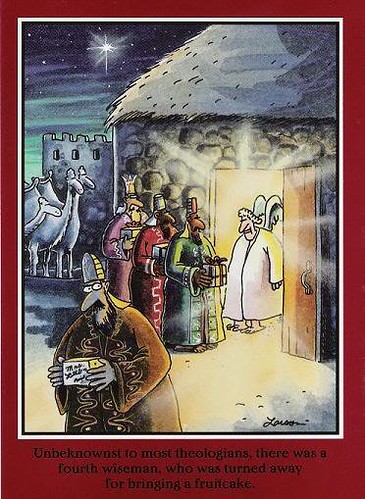
fruitcake wise man

4206428860 F951C8C419
"Unbeknownst to most theologians, there was a fourth wise man, who was turned away for bringing a fruitcake."

Technorati Tags:

Sunday, December 20, 2009

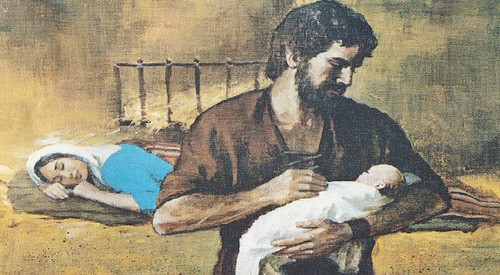
joseph holding jesus ... again

Well, it's that time of year, time to post the Joseph Holding Jesus painting ... enjoy. Merry Christmas!


324287084 97377E63Ea

Thursday, December 17, 2009

parachutes, fish, and freedom

I've told the parachute analogy many times before. Two guys jump out of an airplane; one has a parachute and one does not. The one without the parachute mocks to the other bragging that he is free from the encumbrance of the parachute. Which man is really free? Which one understands the laws of gravity and physics? Which one is truly free to enjoy the event with the assuredness of safety in the end?

The point of course is disciplines and constraints actually liberate us when (and only when) they fit with the reality of our nature and capacities.

So I enjoyed reading Tim Keller's fish story. A fish, because it absorbs oxygen from the water rather than the air, is only free if it is restricted and limited to water. If we put it out on the grass, its freedom to move and even live is not enhanced, but destroyed. The fish dies if we do not honor the reality of its nature.

"Freedom is not so much the absence of restrictions as finding the right ones, the liberating restrictions. Those that fit with the reality of our nature and the world produce greater power and scope for our abilities and a deeper joy and fulfillment." Keller concludes, "Instead of insisting on freedom to create spiritual reality, shouldn't we be seeking to discover it and disciplining ourselves to live according to it?"

It is the love of Christ that constrains us (2 Cor 5.14).

no christian culture

Andrew Walls in The Expansion of Christianity:

One must conclude, I think, that there is a certain vulnerability, a fragility, at the heart of Christianity. You might say that this is the vulnerability of the cross. Perhaps the chief theological point is that nobody owns the Christian faith. That is, there is no "Christian civilization" or "Christian culture" in the way that there is an "Islamic culture," which you can recognize from Pakistan to Tunisia to Morocco. ... [C]ultural diversity was built into the Christian faith with that first great decision by the Council in Jerusalem, recorded in Acts 15, which declared that the new gentile Christians didn’t have to enter Jewish religious culture. ... [C]onverts had to work out, under the guidance of the Holy Spilt, a Hellenistic way of being Christian.

archaeology of repentence

Ray Ortlund posted this timely (for me) reminder regarding the archaeology of repentance.

In a sermon preached during the First Great Awakening, George Whitefield laid bare the four archaeological layers always uncovered in true repentance. Preaching on “They have healed the wound of my people lightly, saying, ‘Peace, peace,’ when there is no peace” (Jeremiah 6:14), Whitefield said that before we can speak peace to our hearts:

One, “You must be made to see, made to feel, made to weep over, made to bewail, your actual transgressions against the law of God.” The dawning of non-denial. Realism. Honesty. Brokenhearted self-awareness. “Was ever the remembrance of your sins grievous to you? Was the burden of your sins intolerable to your thoughts? Did ever any such thing as this pass between God and your soul? If not, for Jesus Christ’s sake, do not call yourselves Christians.”

Two, “You must be convinced of the foundation of all your transgressions. And what is that? I mean original sin.” We realize that, even when we haven’t acted on our impulses, the very fact that our hearts rise up against God is itself damning. All self-hope stripped away. “When the sinner is first awakened, he begins to wonder, ‘How came I to be so wicked?’ The Spirit of God then strikes in and shows that he has no good thing in him by nature.”

Three, “You must be troubled for the sins of your best duties and performances.” Our righteous self-images start to deconstruct, our excuses, our rationalizations, our entitlements. Every false refuge gives way. “You must be brought to see that God may damn you for the best prayer you ever put up. Our best duties are so many splendid sins. There must be a deep conviction before you can be brought out of your self-righteousness; it is the last idol taken out of the heart.”

Four, “There is one particular sin you must be greatly troubled for, and yet I fear there are few of you think what it is. It is the reigning, the damning sin of the Christian world, and yet the Christian world seldom or never thinks of it. And pray what is that? It is what most of you think you are not guilty of, and that is the sin of unbelief.” Treating God as unreal at a functional level in our hearts and lives and churches and strategies. “Most of you have not so much faith in the Lord Jesus Christ as the devil himself. I am persuaded the devil believes more of the Bible than most of you do.”

“One more then. Before you can speak peace to your heart, you must not only be convinced of your actual and original sin, the sins of your own righteousness, the sin of unbelief, but you must be enabled to lay hold upon the perfect righteousness, the all-sufficient righteousness, of the Lord Jesus Christ. Then you shall have peace.”

Select Sermons of George Whitefield, pages 75-95.

Technorati Tags:

Wednesday, December 16, 2009

common message

Matt Dabbs posted a great reminder today, i.e., there is unity in Scripture. The Old and the New Testament are not separated books about a God with two different histories with man. The Old being about law keeping and little to do with love and grace as opposed to the New being all about love and grace. There is not a scary old judge in the sky God in the OT with a kind, gentle Jesus in the NT.

Instead, as Dabbs points out, the unity in both Testaments is "God created us, loves us, liberates us ... and seeks to bring restoration to the world and that we respond in a way that is fitting with those godly priorities and objectives." He reminds of Jesus' challenge in John 14.15, 21; i.e., love and obedience go hand-in-hand.

Kim Riddlebarger helped me see this truth with greater clarity than I had before back in October 2008. I think I've sensed this for some time but he helped me get my mind more clearly wrapped around it. This is an important concept. I know far too many Christians who miss a fuller understanding of God because of their view of Scripture as separate books. One postmodern even recently summarized the OT as (1) humanity realizes something untrue and dies and (2) humanity invents religion and the law to solve the problem. This guy flat missed the big picture. Too bad.

the indicative

John Piper gets it ... the indicatives of the Gospel.


  • the gospel is a plan, i.e., it was predetermined and foretold by God
  • the gospel is an event in history, i.e., Christ died
  • the gospel is an achievement in and through that event, i.e., sins were paid for and righteousness was completed
  • the gospel is the achievement is extended to the world and it is free
  • the gospel is the application of the achievement, i.e., we are forgiven and justified
  • the gospel is we are forgiven and justified to bring us to God, i.e., He is the end, not simply our forgiveness and justification
I love that. We must understand the indicative before we can move to the imperative. Sadly, the conservative (some in the evangelical world) and the liberal (some in the emergent world) to exactly that. They see and live only the imperative. For the conservative, the result is works (confess this document, get baptized this way rather than that, pray this way rather than that, wear this rather than that, preach in this style rather than that, etc.) - hard cold legalism built on tradition and law - and all without a true knowledge of God. For the liberal, the result is works (care for the environment, embrace and promote the homosexual life, learn faith from other faiths, etc.) - squishy borderless inclusivism - and all without a true knowledge of God.

Both land in the world of works and both end far from the true knowledge of the living God. So to Piper's indicative I only add, only on that base, go, love, live.

the nature of love

“Love is not the upward ascent of our souls that sublimates us into union with the deity. Rather, love is the descent of God’s royal grace that conquers our rebellion, atones for our guilt, and draws us into sonship.” - Edmund P. Clowney, Christian Meditation

HT:JH

law as a storm

"The law is a storm which wrecks your hopes of self-salvation, but washes you upon the Rock of Ages." - Spurgeon

HT:
Philip

Tuesday, December 15, 2009

error in community

It is my perception that many in the Christian community have done harm toward those outside (and even inside) that community. As a reaction to that, the postmodern innovator has rightly reacted. But sadly in doing so, instead of bringing correction into the community, they have brought error into it. That is, rather than helping us live more rightly among those in need of redemption, they have embraced the faith of the fallen.

In The Reason for God, Tim Keller writes:

Any community that did not hold its members accountable for specific beliefs and practices would have no corporate identity and would not really be a community at all. We cannot consider a group exclusive simply because it has standards for its members. Is that then no way to judge whether a community is open and caring rather than narrow and oppressive? Yes, there is. Here is a far better set of tests: Which community has beliefs that lead its members to treat persons in other communities with love and respect – to serve them and meet their needs? Which community’s beliefs lead it to demonize and attack those who violate their boundaries rather than treating them with kindness, humility, and winsomeness? We should criticize Christians when they are condemning and ungracious to unbelievers. But we should not criticize churches when they maintain standards for membership in accord with their beliefs. Every community must do the same.

Volf writes in Exclusion and Embrace:

Radical indeterminacy … is correlate of a consistent drive toward inclusion that levels all boundaries that divide. [But does this] … not determine from within the idea of inclusion, however? Without boundaries we will be able to know only what we are fighting against but not what we are fighting for. Intelligent struggle against exclusion demands categories and normative criteria that enable us to distinguish between repressive … practices … and nonrepressive ones … “No boundaries” means … neither happiness nor pleasure, neither freedom nor justice, could be identified.

Technorati Tags:

reftagger