If you don't believe in mixing the arts and theology, skip this. If you like that sort of thing, you'll enjoy this skit done to the song Everything by Lifehouse. It's a little slow at first but for me it was worth watching through.

Wednesday, October 17, 2007


csn&y - down by the river
I still like that classic rock-n-roll ... Crosby, Stills, Nash and Young - Down by the River ...
Technorati Tags: music
opting out
I'm not sure if this is ok for a Christian but I'm opting out of everything.
Technorati Tags: technical
Tuesday, October 16, 2007
the kingdom of god - seeds and weeds
Mt 13.24-30; 36-43 - [Jesus] put another parable before them, saying, “The kingdom of heaven may be compared to a man who sowed good seed in his field, but while his men were sleeping, his enemy came and sowed weeds among the wheat and went away. So when the plants came up and bore grain, then the weeds appeared also. And the servants of the master of the house came and said to him, ‘Master, did you not sow good seed in your field? How then does it have weeds?’ He said to them, ‘An enemy has done this.’ So the servants said to him, ‘Then do you want us to go and gather them?’ But he said, ‘No, lest in gathering the weeds you root up the wheat along with them. Let both grow together until the harvest, and at harvest time I will tell the reapers, Gather the weeds first and bind them in bundles to be burned, but gather the wheat into my barn.’”
Then he left the crowds and went into the house. And his disciples came to him, saying, “Explain to us the parable of the weeds of the field.”He answered, “The one who sows the good seed is the Son of Man. The field is the world, and the good seed is the sons of the kingdom. The weeds are the sons of the evil one, and the enemy who sowed them is the devil. The harvest is the close of the age, and the reapers are angels. Just as the weeds are gathered and burned with fire, so will it be at the close of the age. The Son of Man will send his angels, and they will gather out of his kingdom all causes of sin and all law-breakers, and throw them into the fiery furnace. In that place there will be weeping and gnashing of teeth. Then the righteous will shine like the sun in the kingdom of their Father. He who has ears, let him hear.
I love this and the parable of the sower for many reasons. First of all, the sower is not us. Many take these parables to mean that we are sowing God's Word liberally as one going about scattering seed. I see it very differently. I see we are dying where God plants us and through our death, life is given and if it is healthy life, it eventually bears fruit - which of course yields more seed to be planted yet again. This deserves more development but this is a blog not a sermon.
The second thing I see is that we are not the reapers and that the reaping doesn't come until the end of the age. This continues in the theme of my friend Iggy in that we are contenders not defenders. Our role is to not go about pulling out weeds. Our role is to grow strong in the Kingdom bearing fruit for His Name's sake.
And finally, this deals with the eschatology of the Kingdom. We should not expect that the Kingdom will gradually take over the world nor that the world as a whole will stop being a broken field with mixed crops. In fact, the children of the Kingdom of God will co-exist with the children of the kingdom of Satan until the end of the age.
Then he left the crowds and went into the house. And his disciples came to him, saying, “Explain to us the parable of the weeds of the field.”He answered, “The one who sows the good seed is the Son of Man. The field is the world, and the good seed is the sons of the kingdom. The weeds are the sons of the evil one, and the enemy who sowed them is the devil. The harvest is the close of the age, and the reapers are angels. Just as the weeds are gathered and burned with fire, so will it be at the close of the age. The Son of Man will send his angels, and they will gather out of his kingdom all causes of sin and all law-breakers, and throw them into the fiery furnace. In that place there will be weeping and gnashing of teeth. Then the righteous will shine like the sun in the kingdom of their Father. He who has ears, let him hear.
I love this and the parable of the sower for many reasons. First of all, the sower is not us. Many take these parables to mean that we are sowing God's Word liberally as one going about scattering seed. I see it very differently. I see we are dying where God plants us and through our death, life is given and if it is healthy life, it eventually bears fruit - which of course yields more seed to be planted yet again. This deserves more development but this is a blog not a sermon.
The second thing I see is that we are not the reapers and that the reaping doesn't come until the end of the age. This continues in the theme of my friend Iggy in that we are contenders not defenders. Our role is to not go about pulling out weeds. Our role is to grow strong in the Kingdom bearing fruit for His Name's sake.
And finally, this deals with the eschatology of the Kingdom. We should not expect that the Kingdom will gradually take over the world nor that the world as a whole will stop being a broken field with mixed crops. In fact, the children of the Kingdom of God will co-exist with the children of the kingdom of Satan until the end of the age.
Technorati Tags: eschatology, Kingdom of God
Monday, October 15, 2007
calvinists love the kingdom of god
If you are a Calvinist, or more precise, if you hold to the doctrine of election, and you like that Kingdom of God stuff, then this verse surely brings a smile to your face.
And he answered them, “To you it has been given to know the secrets of the kingdom of heaven, but to them it has not been given. - Mt 13.11
I don't know what an Arminian makes of it but please feel free to enlighten me.
And he answered them, “To you it has been given to know the secrets of the kingdom of heaven, but to them it has not been given. - Mt 13.11
I don't know what an Arminian makes of it but please feel free to enlighten me.
Technorati Tags: Calvinism, Kingdom of God
there's a new deal in town
In Matthew 11 we learn that the age of the Law and the prophets has come to an end and a new age has begun. We call this the Church age or more precisely it is the beginning of the Kingdom of God. But that is not to say that the Kingdom of God is new. It is simply that the thrust of history is different. The greatest in the prior age, i.e., John the Baptist, is now as the least in this new age. There has been a change, the Kingdom is now coming in a new (or renewed) power.
Jesus has come and set up a powerful movement that is now working mightily in mankind. This new movement demands a powerful reaction. Until now the rabbis taught the yoke of the Kingdom was to accept the Law as the norm. Jesus is now saying that this is not enough. He is teaching freedom and He is teaching it with authority and power. The only proper reaction to this is radical repentance. Entering into this Kingdom is no passive act, it is violent. It turns all that you know or did on its head.
What are the signs (or symptoms) of this Kingdom? Go and tell John what you hear and see: the blind receive their sight and the lame walk, lepers are cleansed and the deaf hear, and the dead are raised up, and the poor have good news preached to them.
Jesus wants use to now take on His yoke. In it we become lowly and humble but not as one weighed down but as one truly set free. In this Kingdom, every thing is turned upside down. The low and humble will be the greatest. The oppressed will be set free. The ruler of the earth is destroyed!
Jesus has come and set up a powerful movement that is now working mightily in mankind. This new movement demands a powerful reaction. Until now the rabbis taught the yoke of the Kingdom was to accept the Law as the norm. Jesus is now saying that this is not enough. He is teaching freedom and He is teaching it with authority and power. The only proper reaction to this is radical repentance. Entering into this Kingdom is no passive act, it is violent. It turns all that you know or did on its head.
What are the signs (or symptoms) of this Kingdom? Go and tell John what you hear and see: the blind receive their sight and the lame walk, lepers are cleansed and the deaf hear, and the dead are raised up, and the poor have good news preached to them.
Jesus wants use to now take on His yoke. In it we become lowly and humble but not as one weighed down but as one truly set free. In this Kingdom, every thing is turned upside down. The low and humble will be the greatest. The oppressed will be set free. The ruler of the earth is destroyed!
Technorati Tags: Kingdom of God
Sunday, October 14, 2007
what are we to do?
What is our role as ambassadors for the King, i.e., as disciples of Jesus? Is it to sort out some form for Sunday morning gatherings? Is it to blog or write books to confront those that are doing something we arbitrarily define as church but since they don't do it the same as us they are wrong? Is it to confront those guys that are confronting those other guys? Is it to build buildings? Protect the environment? Fight abortion? Whatever????
Jesus told His disciples (Mt 10) to first of all, go out. Then to proclaim as they go, that the kingdom of heaven is at hand. Then He told them to demonstrate that by healing the sick, raising the dead, cleansing lepers, and casting out demons. They should do this without pay because this is what they received without paying.
I guess that's why we need to work so hard ... it's really hard to create a program that matches that stuff [heavy sarcasm].
Bottom line - have you seen Kingdom of God? Then enter in ... no program needed.
Jesus told His disciples (Mt 10) to first of all, go out. Then to proclaim as they go, that the kingdom of heaven is at hand. Then He told them to demonstrate that by healing the sick, raising the dead, cleansing lepers, and casting out demons. They should do this without pay because this is what they received without paying.
I guess that's why we need to work so hard ... it's really hard to create a program that matches that stuff [heavy sarcasm].
Bottom line - have you seen Kingdom of God? Then enter in ... no program needed.
Technorati Tags: Kingdom of God
what does it take to get into the kingdom of god?
If you want to be great in the the Kingdom of God, you have to do and teach (there's that full Gospel thing again) all the God commands (Mt5.19) - that's a tall order. But more, to even enter the Kingdom of God according to Mt 5.20, your righteousness needs to exceed that of the scribes and Pharisees (in today's vernacular, other bloggers).
In fact, many will be more than these teachers, they will also be doers and claim to know the Lord, but even they will not be recognized by Him (Mt 7.21). Apparently the fruit is what matters and to have proper fruit one must have a proper heart (Mt 7.15-20).
The Good News is that in spite of these difficulties, many will enter from quite a diverse background (Mt 8.11).
In fact, many will be more than these teachers, they will also be doers and claim to know the Lord, but even they will not be recognized by Him (Mt 7.21). Apparently the fruit is what matters and to have proper fruit one must have a proper heart (Mt 7.15-20).
The Good News is that in spite of these difficulties, many will enter from quite a diverse background (Mt 8.11).
Technorati Tags: Kingdom of God
what the kingdom of god promises
Mt 5.2-11 - And he opened his mouth and taught them, saying: “Blessed are the poor in spirit, for theirs is the kingdom of heaven. Blessed are those who mourn, for they shall be comforted. Blessed are the meek, for they shall inherit the earth. Blessed are those who hunger and thirst for righteousness, for they shall be satisfied. Blessed are the merciful, for they shall receive mercy. Blessed are the pure in heart, for they shall see God. Blessed are the peacemakers, for they shall be called sons of God. Blessed are those who are persecuted for righteousness' sake, for theirs is the kingdom of heaven. Blessed are you when others revile you and persecute you and utter all kinds of evil against you falsely on my account. Rejoice and be glad, for your reward is great in heaven, for so they persecuted the prophets who were before you."
John Piper explains:
John Piper explains:
Notice that all of these are promises for the future. "They shall be comforted . . . They shall inherit the earth . . . They shall be satisfied . . . " And so on. But the promise of the first and last beatitude in verses 3 and 10 seems to relate to the present: the disciples are assured that "theirs is the kingdom of heaven."
By sandwiching six promises in between two assurances that such people have the kingdom of heaven, I think Jesus means to tell us that these six promises are blessings of the kingdom. In other words, these six things are what you can count on when you are a part of God's kingdom. This is what the kingdom brings: comfort, earth ownership, satisfied righteousness, mercy, a vision of God, and the awesome title, son of God. You don't have to pick and choose among these promises. They all belong to the kingdom. That is the first implication I see in the fact that Jesus begins with the assurance, "Theirs is the kingdom of heaven," and ends with the assurance, "Theirs is the kingdom of heaven," with six promises sandwiched in between.
Technorati Tags: Kingdom of God
what did jesus preach
What was Jesus' message?
From that time [after the temptation in the wilderness] Jesus began to preach, saying, “Repent, for the kingdom of heaven is at hand.” - Mt 4.17
From that time [after the temptation in the wilderness] Jesus began to preach, saying, “Repent, for the kingdom of heaven is at hand.” - Mt 4.17
Technorati Tags: Kingdom of God
Saturday, October 13, 2007
discipleship, the gospel, and stuff ...
My friend Geoff Matheson pulls together some excellent quotes and then asks the tough question. The first is from Jonathan Brink on Jesus and Leadership Structure (I'll use a larger excerpt from Brink's post than Matheson did because it is so good).
Matheson then pulls this piece from Alan Hirsch.
Finally Matheson hits us with the big question: "What does Jesus' model of discipleship best look like in contemporary culture?" I like that. It's an excellent question. I think the answer is that it looks the same as it did 2000 years ago, i.e., it looks like the Kingdom of God.
Many wrestle with what that looks like but more and more I thinking our wrestling is inappropriate. Jesus said, as recorded in Matthew 4, "To you has been given the secret of the kingdom of God, but for those outside everything is in parables."
Jacob Hantla quotes Mark Dever on the Gospel.
Now I'm no Mark Dever. Although I have never met him, heard him speak, nor read much of his writings, I have the perception that he is a godly man. But I have to say this particular definition while good, falls a little short. Jesus went around teaching, proclaiming the gospel of the kingdom, and healing, i.e., demonstrating the gospel of the kingdom (Mt 4.23; 9.35). The Gospel is what Dever stated and more. And it is this more that is the answer to Matheson's question. If we seek first the Kingdom of God, all the rest comes together (Mt 6.33).
When Jesus said the provocative words, “Come follow me,” there must have been a chill that ran up the spine of the disciple’s backs. Imagine the moment. Ordinary people being called by an extraordinary man. This was the man who healed people, restoring their dignity and inviting them out of oppression. He touched lepers without harm, turned water into wine and caused the fish to flood the nets. To follow Him was an epic call, a moment to be part of something good. What did He see that they didn’t? His very invitation invited them into a larger mission of restoration.
But imagine for a second, after calling his disciples to follow him, he proceeded to invite them to come to the local synagogue on Sunday morning for a couple of hours and Wednesday night for another couple of hours. Forget following him around and watching Him do things. And when they got to there, he sat them down and led them through a couple of songs. Everyone sat in the same direction facing Jesus as they listened to him speak from behind a small upright box. The message was on average an hour long, tightly scripted with an introductory joke to arouse the crowd and was primarily about how to “not sin”. It usually included three points, a story from His personal life, and a summary to wrap it all up. He always finished with a challenge to his disciples to do better and closed with another song. At some point in the process he passed a large basket around expecting them to put a little something in to pay the rent and help build a larger meeting place. The reality was that those in setup were tired of unpacking and packing up each time they met in this rented building. A new, obviously larger building just made sense. As long as those in the crowd showed up, the disciples were good. Invite their friend and they were better. Serve on a committee and they were golden. Under this scenario you have to imagine the original call to “Come follow me” seems to lose its impact, doesn’t it?
Matheson then pulls this piece from Alan Hirsch.
We are all familiar with the gospel stories where Jesus selects a band of disciples, lives his life with them, ministers with them, and mentors them. This approach to the formation of followers was common in the Israel of Jesus’ day. Most rabbis would initiate and develop their schools of thought through similar means. It was this life-on-life phenomenon that facilitated the transfer of information and ideas into concrete historical situations.
Finally Matheson hits us with the big question: "What does Jesus' model of discipleship best look like in contemporary culture?" I like that. It's an excellent question. I think the answer is that it looks the same as it did 2000 years ago, i.e., it looks like the Kingdom of God.
Many wrestle with what that looks like but more and more I thinking our wrestling is inappropriate. Jesus said, as recorded in Matthew 4, "To you has been given the secret of the kingdom of God, but for those outside everything is in parables."
Jacob Hantla quotes Mark Dever on the Gospel.
The good news is that the one and only God, who is holy, made us in his image to know him. But we sinned and cut ourselves off from him. In his great love, God became a man in Jesus, lived a perfect life, and died on the cross, thus fulfilling the law himself and taking on himself the punishment for the sins of all those who would ever turn and trust in him. He rose again from the dead, showing that God accepted Christ's sacrifice and that God's wrath against us had been exhausted. He now calls us to repent of our sins and trust in Christ alone for our forgiveness. If we repent of our sins and trust in Christ, we are born again into a new life, an eternal life with God.
Now I'm no Mark Dever. Although I have never met him, heard him speak, nor read much of his writings, I have the perception that he is a godly man. But I have to say this particular definition while good, falls a little short. Jesus went around teaching, proclaiming the gospel of the kingdom, and healing, i.e., demonstrating the gospel of the kingdom (Mt 4.23; 9.35). The Gospel is what Dever stated and more. And it is this more that is the answer to Matheson's question. If we seek first the Kingdom of God, all the rest comes together (Mt 6.33).
Technorati Tags: discipleship, Kingdom of God
kingdom of god and repentance
Repent, for the kingdom of heaven is at hand. - Mt 3.2
Turn! Turn from your way of thinking and your way of life. The Kingdom of God is at hand. It's time for a new paradigm. This new thinking will drive new behavior.
Turn! Turn from your way of thinking and your way of life. The Kingdom of God is at hand. It's time for a new paradigm. This new thinking will drive new behavior.
Technorati Tags: Kingdom of God
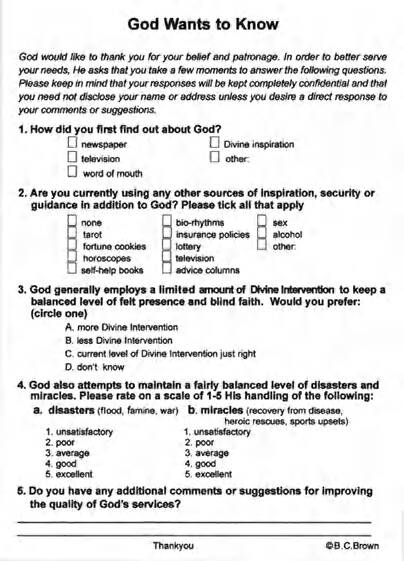
god's customer service survey
I don't know where he found it but Mike Clawson posts this interesting survey from God.
Technorati Tags: humor
Friday, October 12, 2007
the full gospel
Dan Edelen posted a great piece Two Halves of the Whole Gospel.
Edelen uses Ephesians 2:8-10 to illustrate "two-halves" of the same Gospel.
v. 8 For by grace you have been saved through faith. And this is not your own doing; it is the gift of God, 9 not a result of works, so that no one may boast. 10 For we are his workmanship, created in Christ Jesus for good works, which God prepared beforehand, that we should walk in them.
He describes verses 8-9 as the half loved by the Elect.
He contrasts that to verse 10 which is favored by the Fieldworkers.
Edelen then does a nice job of describing how each half can tend to "bash" the other half because of course, the other half's version of the Gospel falls short. The issue of course isn't that either side is wrong. It's that each side is in fact true, but they are half of the truth. He makes the following wonderful conclusion.
Edelen uses Ephesians 2:8-10 to illustrate "two-halves" of the same Gospel.
v. 8 For by grace you have been saved through faith. And this is not your own doing; it is the gift of God, 9 not a result of works, so that no one may boast. 10 For we are his workmanship, created in Christ Jesus for good works, which God prepared beforehand, that we should walk in them.
He describes verses 8-9 as the half loved by the Elect.
They obsess about doctrine, detest even a whiff of works righteousness, and are enormously concerned with getting people saved. They got their marching orders at the Reformation and consider it the high point in modern history. And heaven help anyone who’s not in total agreement with them.
He contrasts that to verse 10 which is favored by the Fieldworkers.
They obsess about helping those in need, detest the hypocrisy of not walking the talk, and are enormously concerned with bettering the lives of everyone around them. They can’t point to any one point in time for their marching orders, but earnestly believe that we need a new Reformation. And heaven help anyone who’s not in total agreement with them.
Edelen then does a nice job of describing how each half can tend to "bash" the other half because of course, the other half's version of the Gospel falls short. The issue of course isn't that either side is wrong. It's that each side is in fact true, but they are half of the truth. He makes the following wonderful conclusion.
The whole Gospel contains both the power to raise the dead in spirit to spiritual life in the name of Jesus AND the power to tenderize the human heart toward the service of others in the name of Jesus.
The whole Gospel is the whole Gospel. If we’re not concerned with seeing people saved through hearing the message of salvation, maintaining the integrity of our doctrine, and preaching that we can’t earn our way to heaven, then we’re blowing it. If we’re not concerned about taking care of those in need, living out the love of Christ in practical ways, and fighting for the betterment of everyone we meet, then we’re blowing it.
Technorati Tags: Kingdom of God
the trinity
A guy in our small group was recently asking about the Trinity and 'coincidentally' Justin Taylor just posted a simple yet excellent article on the topic.
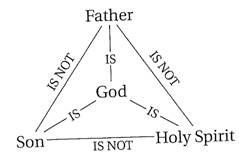
Wayne Grudem’s Systematic Theology defines the Trinity as follows: “God eternally exists as three persons, Father, Son, and Holy Spirit, and each person is fully God, and there is one God” (p. 226).
Broken down, this amounts to three propositions:
* God is three persons.
* Each person is fully God.
* There is one God.
In addition, it’s helpful to elaborate on the fact that when we say “God is three persons,” we mean that he is not just one person, and that the persons of the Trinity are not to be confused. So we can also say:
* The Father is God.
* The Son is God.
* The Holy Spirit is God.
* The Father is not the Holy Spirit, and the Holy Spirit is not the Father.
* The Holy Spirit is not the Son, and the Son is not the Holy Spirit.
* The Son is not the Father, and the Father is not the Son.
If your head is starting to spin—then perhaps this little diagram can help give you a snapshot of what we’ve been saying:
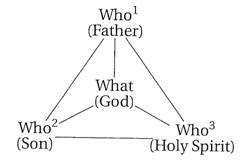
Theologians have typically described God as being of “one essence” but “three persons.” But what exactly do we mean by “essence” and “person”? In its simplest terms, essence answers the question, “What are you?” Person answers the question, “Who are you?”
So when we say that the Trinity entails “one essence” (God) and “three persons” (Father, Son, and Spirit), we are saying that the Trinity has one What and three Who’s. We can draw this as follows:
computer illiterate
I just wanted the world to know that I am completely computer illiterate - in addition to not being that smart.
The background is that I've been having trouble with the distance on my home wireless network. I called the support folks for Apple even though it was a problem with my Belkin router not my Macs. They gave me some good advice but because it wasn't an Apple problem, I just took notes and worked on it later.
You can imagine how embarrassed I felt when I realized I needed to change the router cast rate not castrate.
The background is that I've been having trouble with the distance on my home wireless network. I called the support folks for Apple even though it was a problem with my Belkin router not my Macs. They gave me some good advice but because it wasn't an Apple problem, I just took notes and worked on it later.
You can imagine how embarrassed I felt when I realized I needed to change the router cast rate not castrate.
Technorati Tags: technical
Thursday, October 11, 2007
to defend or contend, that is the question
I like Iggy's take on the defending the truth issue. I haven't spent a lot of time to decide if I agree with every detail of his post but in principle, I'm there. Are you a contender for the faith or a defender of truth - or worse, a defender of your own version of truth?
Tuesday, October 09, 2007
rc sproul on the kingdom of god
Essential Truth 99 (at least in RC Sproul's Essential Truths of the Christian Faith).
World history has witnessed a multitude of divergent forms of government. The most common types have been dictatorships ruled by military strength, republics ruled by law, democracies ruled by majority vote, and two types of monarchies—constitutional monarchies (in which the monarch’s powers are limited) and absolute monarchies (in which the monarch’s word is law).
The kingdom of God is an absolute monarchy. God has no external constitution to bind Him. He needs no consent from the governed to rule over them. He is not limited by referenda or by majority vote. His word is law; His rule is absolutely sovereign.
In any monarchy, the virtues of honor and loyalty to the throne are exceedingly important. There is no monarchy where these elements are more vital than in God’s kingdom. Yet the fundamental sin of the human race is grounded in our refusal to honor God as God (Romans 1:21) and in our disloyalty to the King of Kings.
The theme of the kingdom of God is a central motif that runs as a thread through both Old and New Testaments. The theme accents God’s reign over His people. The coming Messiah is announced as God’s anointed King who will be enthroned in heaven as the King of Kings and Lord of Lords.
The Old Testament points to the kingdom as coming in the future. The New Testament opens with the announcement of John the Baptist that “the kingdom of heaven is at hand” (Matthew 3:2). The historical situation is described in images such as “the ax is laid to the root of the trees” (Matthew 3:10) and “His winnowing fan is in His hand” (Matthew 3:12), both indicating radical nearness. It was the breakthrough into history of God’s kingdom that heralded the New Testament gospel. John’s message that “the King is coming” signaled the urgency of the times.
The accent of Jesus’ own preaching also falls on the announcement of the gospel of the kingdom. He declares that the kingdom has come with power and is in the midst of His people. At His ascension, Jesus commanded His disciples to be His witnesses in the world. They are to witness to the reign of Jesus as King of Kings. Jesus’ current status as cosmic King is invisible. The world is either ignorant of His sovereignty or denies it. It is the task of the church to give visible witness to the invisible kingdom.
Jesus inaugurated the kingdom of God. He has already been enthroned in heaven. But it is as though He is a King in exile with few loyal subjects. At His return He will fully consummate His reign.
The New Testament indicates that the kingdom of God is both present and future. There is an “already” and a “not yet” to the kingdom. Both aspects must be understood and embraced by Christians. To view the kingdom either as already totally realized or as totally futuristic is to do violence to the message of the New Testament. We serve a King who has already been enthroned. Yet we await His triumphal return in glory when every knee will bow before Him.
Summary:
1. God’s kingdom is by absolute rule.
2. The theme of God’s kingdom links the Old and New Testaments.
3. The New Testament announces the inauguration of the kingdom of God with Jesus’ appearance and subsequent enthronement.
4. The kingdom of God exists already but will be fully consummated at His glorious return.
Biblical passages for reflection:
Psalm 10:16-18
Psalm 22:27-31
Daniel 2:44
John 18:36
Hebrews 1:8-14
World history has witnessed a multitude of divergent forms of government. The most common types have been dictatorships ruled by military strength, republics ruled by law, democracies ruled by majority vote, and two types of monarchies—constitutional monarchies (in which the monarch’s powers are limited) and absolute monarchies (in which the monarch’s word is law).
The kingdom of God is an absolute monarchy. God has no external constitution to bind Him. He needs no consent from the governed to rule over them. He is not limited by referenda or by majority vote. His word is law; His rule is absolutely sovereign.
In any monarchy, the virtues of honor and loyalty to the throne are exceedingly important. There is no monarchy where these elements are more vital than in God’s kingdom. Yet the fundamental sin of the human race is grounded in our refusal to honor God as God (Romans 1:21) and in our disloyalty to the King of Kings.
The theme of the kingdom of God is a central motif that runs as a thread through both Old and New Testaments. The theme accents God’s reign over His people. The coming Messiah is announced as God’s anointed King who will be enthroned in heaven as the King of Kings and Lord of Lords.
The Old Testament points to the kingdom as coming in the future. The New Testament opens with the announcement of John the Baptist that “the kingdom of heaven is at hand” (Matthew 3:2). The historical situation is described in images such as “the ax is laid to the root of the trees” (Matthew 3:10) and “His winnowing fan is in His hand” (Matthew 3:12), both indicating radical nearness. It was the breakthrough into history of God’s kingdom that heralded the New Testament gospel. John’s message that “the King is coming” signaled the urgency of the times.
The accent of Jesus’ own preaching also falls on the announcement of the gospel of the kingdom. He declares that the kingdom has come with power and is in the midst of His people. At His ascension, Jesus commanded His disciples to be His witnesses in the world. They are to witness to the reign of Jesus as King of Kings. Jesus’ current status as cosmic King is invisible. The world is either ignorant of His sovereignty or denies it. It is the task of the church to give visible witness to the invisible kingdom.
Jesus inaugurated the kingdom of God. He has already been enthroned in heaven. But it is as though He is a King in exile with few loyal subjects. At His return He will fully consummate His reign.
The New Testament indicates that the kingdom of God is both present and future. There is an “already” and a “not yet” to the kingdom. Both aspects must be understood and embraced by Christians. To view the kingdom either as already totally realized or as totally futuristic is to do violence to the message of the New Testament. We serve a King who has already been enthroned. Yet we await His triumphal return in glory when every knee will bow before Him.
Summary:
1. God’s kingdom is by absolute rule.
2. The theme of God’s kingdom links the Old and New Testaments.
3. The New Testament announces the inauguration of the kingdom of God with Jesus’ appearance and subsequent enthronement.
4. The kingdom of God exists already but will be fully consummated at His glorious return.
Biblical passages for reflection:
Psalm 10:16-18
Psalm 22:27-31
Daniel 2:44
John 18:36
Hebrews 1:8-14
Technorati Tags: Kingdom of God
Subscribe to:
Posts (Atom)