Friday, July 17, 2009

what we need to believe

In A Heretic's Guide to Eternity Spencer Burke tries to promote the idea that right beliefs are unnecessary for salvation.

For most of my Christian life, I have heard people say that it is not enough to do good works or care for the world. There has to be faith in Jesus - which usually means assent to a set of presuppositions. But actually, the apostle Paul said it is good works without love - not good works without a belief system - that are empty and worthless.

I'm saddened for people like Burke. I can only presume this kind of thinking stems from hardened heart that has only interacted with a pharisaical type of Church. That is, I see Burke's thinking as an equally wrong over-reaction to an opposite wrong. As a believer in love with Christ and His Church I see where people (and especially organizations) have missed the mark but I cannot conclude that belief is unnecessary (Jn 14.6).

I like Michael Wittmer's diagram here for thinking about what is necessary, what cannot be rejected, and what is simply beneficial.

Dsb,+What+Christians+Believe
  • Sinners need Regeneration
  • Regeneration requires the Holy Spirit
  • The Holy Spirit uses Truth
In the Institutes of Christian Religion, John Calvin wrote:

For by a kind of mutual bond the Lord has joined together the certainty of his Word and of his Spirit so that the perfect religion of the Word may abide in our minds when the Spirit, who causes us to contemplate God's face, shines; and that we in turn may embrace the Spirit with no fear of being deceived when we recognize him in his own image, namely, in the Word. ... Therefore the Spirit ... has not the task of inventing new and unheard of revelations, or of forging a new kind of doctrine ... but of sealing our minds with that very doctrine which is commended by the gospel.

Wittmer writes:

Contrary to what some postmodern innovators believe, those who reject these foundational doctrines of Christian faith cannot be saved, no matter how swell they are and how well they behave. Being good is not good enough. We must know and believe something - the basic fact about salvation - to be saved.

He is exactly right. Postmodern innovators, in a reaction to the legalist pharisees of our day, have over-reacted so far in the opposite direction that they have come full circle and ended back in a works based heresy.

Technorati Tags:

you are favorable

“God has declared in the gospel that whenever we come to him, we are to call upon him freely and openly as our Father, who has adopted us as his children. If we do not have this assurance, the thought of serving God will make us grind our teeth.

If, however, we are persuaded that God looks upon us favourably; if, though we are weak and can do nothing worthy of his approval, he accepts us in the name of the Lord Jesus Christ, then we will surely be filled with courage.

We will be like a ship’s sail that has been stretched and filled by the breeze! Thus, our hearts will run to obey him, like a ship driven along by its sail, when we know that God delights in us and accepts our works, not wanting us to be compelled into servitude. He is happy for us to be his children, and that we desire to obey him.”

- John Calvin, Sermons on Galatians

HT:OFI

Tuesday, July 14, 2009

tolerance

I need to be careful that I do not copy all of Michael Wittmer's Don't Stop Believing here - you should go buy a copy yourself, it is excellent - but I cannot resist. Here is an interesting analogy regarding how much tolerance is the right amount.

When mechanics tighten the nut on a wheel bearing, they back off the nut a quarter turn to allow grease to lubricate the bearing. The mechanic who forgets to back off the nut and allow for a grease tolerance is like some conservative Christians. They insist that every belief is important and do not give others room to breathe, to differ even on minor issues. Lacking sufficient grace to lubricate their lives, metal grinds on meal until their wheels overheat and eventually seize up, crippling their faith. ...

If conservatives sometimes lack enough tolerance, some postmodern Christians seem like the mechanic who backs off the wheel nut too far. These postmodern innovators seem so tolerant that what they are driving no longer resembles historic Christianity. They permit so much play that their wheels wobble from the beginning and, when they hit a pothole, may quickly fall off and disable their faith.

still more sola scriptura

"My conscience is captive to the Word of God. Thus I cannot and will not recant, because acting against one's conscience is neither safe nor sound. God help me. Amen." ~ Martin Luther

"Evangelical Christians tend to turn Luther's cherished sola scriptura (Scripture alone) into nuda scriptura (naked Scripture), so that Scripture becomes our only rather than final authority. ~ Michael Wittmer

Technorati Tags:

the word in light of culture

He who marries the present culture becomes a window in the next. At the same time, as Michael Wittmer explains, the more we learn about God's world, the more accurately we can interpret God's Word. Wittmer provides the following illustrations:

Science. Copernicus's discovery that the earth revolves around the sun enables us to properly interpret Psa 31.9: "The world is firmly established; it cannot be moved." In Copernicus's day, most Christians took this as proof that the earth is the stationary center of the universe. Even Martin Luther criticized Copernicus for allowing his newfangled view of the world to contradict Scripture. While a few such dinosaurs exist, most Christians today rightly read Psa 31.9 not as a scientific description of the earths immovability but as a poetic promise of God's provision for his creation.

Politics. Many nineteenth-century Americans used Paul's commands that slaves should obey their masters as biblical suppor for slavery. But now, in part due to our country's emphasis on democracy and human rights, no one outside of an occasional white supremacist uses the Bible to condone slavery.

History. Until recently most theologians believed that God is impassible, meaning that he does not experience emotions (a sign of weakness for an omnipotent and extremely rational God). Typical is Anselm, who, in an eleventh-century prayer to God, wrote that we may "feel the effect of Your mercy, but You do not experience the feeling ... You do not experience any feeling of compassion for misery." Try preaching that! In part because we have just past through the bloodiest century in history - from the Holocaust to Hiroshima to Hotel Rwanda - Christians are rediscovering the first verse they every memorized: "Jesus wept." We have learned from very painful experience that we not only need a God who is strong, but also a God who weeps and suffers with us.

Society. Not that long ago and still every now and again, various conservatives cite Genesis 1.28 in the King James Version to justify their right to "dominate" the rest of creation. Thankfully, society's increasing concern for the environment leads most Christians to interpret God's command to "have dominion" as his call to responsible stewardship rather than wasteful abuse of his world.

global warming settled

There's no longer a need to debate global warming. The G8 have agreed to stop the world from getting too warm.

Technorati Tags: ,

Monday, July 13, 2009

postmodern innovators

I am just now re-beginning Michael Wittmer's Don't Stop Believing and immediately I'm loving it. Rather than getting hung up on broad, volatile terms whose definition feel like a moving target, e.g., emergent, Wittmer starts right off with an excellent grid depicting modernity v. post-modernity and conservative v. liberal.

3716992501 0697A1D6F4

Wittmer then gives this timeless warning, the "quest to correct the abuses of previous generations must not lead ... to err on the opposite extreme."

What we seek is Truth and right practice based on that. Wittmer states;

Authentic Christianity demands our head, heart, and hands. Our labor for Christ flows from our love for him, which can arise only when we know and think rightly about him. Genuine Christians never stop serving, because they never stop loving, and they never stop loving, because they never stop believing.

In light of that, Wittmer continues his analysis of today's weltgeist.

It is one thing to jettison a former generation's additions to the Christian tradition; it is quite another to question foundational elements of that tradition. We must do the former to own and embody the gospel for our day. We must avoid the latter, or we will lose the very gospel we are attempting to apply.


More to come later ...

sola scriptura

I like this because it addresses the false notion of what Sola Scriptura is and it is this false notion that most unwittingly reject and then boast how they toppled another block of the reformed house.


HT:Melinda

Technorati Tags:

the concern of preaching

“Puritan preaching revolved around ‘Christ, and him crucified’ – for this is the hub of the Bible. The preachers’ commission is to declare the whole counsel of God; but the cross is the center of that counsel, and the Puritans knew that the traveler through the Bible landscape misses the way as soon as he loses sight of the hill called Calvary.”

– J.I. Packer

HT:EK via PC

our concern

“The holiest Christians are not those most concerned about holiness as such, but whose minds and hearts and goals and purposes and love and hope are most fully focused on our Lord Jesus Christ.”

- J.I. Packer, Keep in Step with the Spirit

HT:OFI

Sunday, July 12, 2009

binding satan

In The Dark Side of the Millennium, Arthur Lewis writes this excellent summary on the "binding of Satan".

When Jesus drove out the demons, He actually proclaimed His authority over Satan and the arrival of His Kingdom. He said, "How can one enter a strong man's house unless he first binds the strong man?" (Matt 12.29).

As the disciples also found success in casting out demons, the Lord exclaimed, "I saw Satan fall like lightning out of heaven" (Luke 10.18). This was a metaphoric way of saying that the devil's power had been overcome by the king's envoys. We know that Satan was cast down when Christ was lifted up (John 12.31); thus it was Calvary's victory that broke the grip of the devil on men and nations. the Gospels clearly teach that the devil's control and power over the peoples of the world has been weakened since the first advent of Christ (cf. Heb 2.14).

Technorati Tags: , , ,

rude piano

Jordan Rudess plays this amazing piano solo ...


Technorati Tags:

evangelical distinctives

RC Sproul on evangelical distinctives in Faith Alone.

Evangelicals are called Evangelicals for a reason. That reason may change as words undergo a fluid evolution through variations of usage over time and in various cultural settings. Language changes. Words undergo sometimes radical, sometimes subtle changes in nuance and meaning. The science of lexicography is cognizant of such change. Lexicographers pay attention chiefly to two factors in the process of defining words. The first is etymology or derivation. We search for the original roots of words and their historic meanings to gain insight into present usage. Since words and their meanings can and often do change, however, it is not enough merely to examine a word’s root to discover its current meaning. Philosopher Ludwig Wittgenstein, chief architect of Linguistic Analysis, argued that words must be understood in terms of their contemporary or “customary” usage.

Words are a part of the customs of a people. Words change their meanings as the people change. Take, for example, the word scan. If I tell my students to scan the textbook, what would they understand their assignment to be? Most would understand that they need only skim lightly over the material.

Historically the word scan meant to examine closely with fixed attention to detail. The word still carries that idea with respect to the task of air-traffic controllers. The radar scan is not a loose skimming of planes in the air. A brain scan done by a physician is likewise not a casual, “once over” viewing.

The word scan sounds enough like the word skim for people to begin confusing the two. In this confusion the term scan began to be used to refer to a process that means the very opposite of the word’s original meaning. So what is the correct “meaning” of scan? Most modern lexicographers, because of the confusion in the term’s contemporary usage, would probably cite both meanings.

I labor the point of language because the meaning of the word evangelical is not immune from such fluid development, change, and confusion. The etymology of evangelical is simple. It comes from the Greek word euangelion, or “evangel,” which is the New Testament word for gospel. Historically the term evangelical meant literally “gospeler.” It was a term used by Protestants who identified with the Reformation doctrine of justification by faith alone.

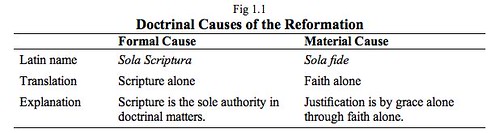
If the Reformation had two chief causes, a formal and a ma terial cause, historic Evangelicalism has the same two causes. The formal cause of the Reformation was declared in the formula sola Scriptura, meaning that the only source of special written revelation that has the authority to bind the conscience absolutely is the Bible. The material cause was declared by the formula sola fide, meaning that justification is by faith alone.

3712198851 Acfcaf3701

Over the centuries Evangelicalism became manifest in a wide variety of forms. Manifold denominations emerged with individual doctrinal distinctives. Protestants were divided over a host of theological points, including the sacraments, church government, and worship. We have seen divergent views of soteriology and eschatology—Arminianism, Calvinism, Lutheranism, dispensationalism, and many other “isms”—all flying under the generic banner of Evangelicalism.

The term evangelical served as a unifying genus to capture under one heading a wide assortment of species. The two prominent doctrines that served as the cohesive forces of evangelical unity were the authority of the Bible and justification by faith alone. Though Protestants historically were divided over many issues, they were united on these two points as well as in their affirmation of the main tenets found in such ecumenical creeds as the Apostles’ Creed, the Nicene Creed, and the formulas of Chalcedon.

Technorati Tags:

Saturday, July 11, 2009

warren

This is rather sad ... "how can we can we actually work together, maintaining our separating traditions, maintaining our convictions without compromise, working together for the greater good?" Ouch. Sorry Rick, you dropped the ball.

what's available?

“Jesus gives his bride full liberty to take all that He has to be their own; He loves them to help themselves freely to His treasure and appropriate as much as they can possibly carry. The boundless fullness of His all-sufficiency is as free to the believer as the air he breathes.”

- Charles Spurgeon, Morning by Morning

HT:OFI

Monday, July 06, 2009

climate change change

Slowly but surely public and political opinion is reversing regarding global warming as a result of human activity. I intentionally left off scientific opinion because I was never fully convinced which way science was pointing on this issue - it seemed to me that it was heavily influenced by public and political opinion rather than true science.

Anyway, it seems I read more and more these days about real concerns with the theory and a slowing of the mad press forward to fix this before we really understand if there is something to fix. While that pleases me, I pray Christians would realize that we are not to mindlessly destroy the creation that Our Creator has graciously given us dominion over.

Friday, July 03, 2009

kevin skinner

God uses all sorts of ways to speak. Here he revealed to me how quick we judge based on our own grid. Kevin Skinner, on America's Got Talent, fools me. First, along with most others, I judged much about the man. I mean come on, "I'm not a math ... real good at math." And then he plays this song. Amazing! Beautiful! Wow, now we all regret how we assessed him. But pay attention, now that we realize our miss, Sharon Osbourne can some how see that he is a "good man".

Why do we do this?

That aside, if you like good music (and for me that doesn't normally include country), enjoy this.

our king

“In our vision of ultimate reality, who is occupying the throne today? Are we authentic New Testament Christians, whose vision is filled with Christ crucified, risen and reigning? Is guilt still reigning, and death? Or is grace reigning, and life?

To be sure, sin and Satan may seem to be reigning still, since many continue to bow down to them. But their reign is an illusion, a bluff. For at the cross they were decisively defeated, dethroned and disarmed.

Now Christ reigns, exalted to the Father’s right hand, with all things under his feet, welcoming the nations, and waiting for his remaining enemies to be made his footstool.”

—John Stott, The Message of Romans

HT:OFI

Thursday, July 02, 2009

false apostles

This excellent word of wisdom comes from Phil Ryken's commentary on Galatians in the Reformed Expository Commentary series by way of Martin Downes.

We cannot simply assume that we have the gospel. Unless we keep the gospel at the center of the church, we are always in danger of shoving it off to one side and letting something else take its place.

Martin Luther rightly warned that "there is a clear and present danger that the devil may take away from us the pure doctrine of faith and may substitute for it the doctrines of works and of human traditions..." The good news of the cross and resurrection must be preached, believed, and lived. Otherwise it will be lost.

The church's greatest danger is not the anti-gospel outside the church; it is the counterfeit gospel inside the church. The Judaizers did not walk around Pisidian Antioch wearing T-shirts that said, "Hug me, I'm a false apostle."

What made them so dangerous was that they knew how to talk the way that Christians talk. They used all the right terminology. They talked about how they "got saved." They told people to "trust in Christ." They "presented the gospel." Only they did not have the gospel after all.

We should expect, therefore, that the most serious threat to the one true gospel is something that is also called the gospel. The most dangerous teachers are the ones who preach a different Christ but still call him "Jesus."

coffee

1285147549 C673964229

Technorati Tags:

reftagger