The children of God are rather different from the children of men. We have been reborn by a sovereign God. They have not. We have been redeemed by a sovereign God. They have not. We are being remade by a sovereign God. They are not. Despite these things that distinguish us, that set us apart, there are yet ways where we are very much like those outside the kingdom. We, both inside and outside the kingdom, have drunk deeply of the modernist conceit that we are defined by what we know. Thus, we think the difference between us and them, between sheep and goats, is a matter of knowledge. We are those who have been blessed to have the truth revealed to us. Once those outside the kingdom have the truth revealed to them, we seem to think, they will become just like us. Jesus, of course, dispelled this nonsense...
Now, inside the kingdom of God, among His children, there are still differences. We who are Reformed, or Calvinists, know that we have been reborn from above. Others affirm that they were reborn from within. We know that we have been sovereignly redeemed. Others affirm that they cooperate with God in their salvation. We know that we are being sovereignly sanctified. Others affirm that they determine themselves how, and even if, they will grow in grace. But once again, we who are Reformed make the mistake of thinking that it is what we think that separates us from our less-than-Reformed brothers. We think it is because we know that God is sovereign and that if they will but be so informed, they will join us.
This too is nonsense...
If our consuming zeal is to see the kingdom come in its fullness, if we are about the business of seeking first His kingdom, and if we know that He will indeed bring all things under subjection, what could we possibly have to fear, save the King Himself? This, in the end, is why we are more than conquerors, why we not only have the courage of a lion, but have the courage of the Lion of the tribe of Judah. Should we not be of good cheer, knowing that He has already overcome the world? And He has made us His own, just as the psalmist describes (Psa 46:8–11) ...

Thursday, January 21, 2010
be still
Wise words from RC Sproul Jr. (excerpts only - read the rest here) ...


Tuesday, January 19, 2010
holy, blameless, and perfect
In Why Jesus Came To Die, John Piper writes [I added some emphasis]:
One of the greatest heartaches in the Christian life is the slowness of our change. We hear the summons of God to love him with all our heart and soul and mind and strength (Mark 12:30). But do we ever rise to that totality of affection and devotion? We cry out regularly with the apostle Paul, “Wretched man that I am! Who will deliver me from this body of death?” (Romans 7:24). We groan even as we take fresh resolves: “Not that I have already obtained this or am already perfect, but I press on to make it my own, because Christ Jesus has made me his own” (Philippians 3:12).
That very statement is the key to endurance and joy. “Christ Jesus has made me his own.” All my reaching and yearning and striving is not to belong to Christ (which has already happened), but to complete what is lacking in my likeness to him.
One of the greatest sources of joy and endurance for the Christian is knowing that in the imperfection of our progress we have already been perfected—and that this is owing to the suffering and death of Christ. “For by a single offering [namely, himself!] he has perfected for all time those who are being sanctified” (Hebrews 10:14). This is amazing! In the same sentence he says we are “being sanctified” and we are already “perfected.”
Being sanctified means that we are imperfect and in process. We are becoming holy—but are not yet fully holy. And it is precisely these—and only these—who are already perfected. The joyful encouragement here is that the evidence of our perfection before God is not our experienced perfection, but our experienced progress. The good news is that being on the way is proof that we have arrived.
The Bible pictures this again in the old language of dough and leaven (yeast). In the picture, leaven is evil. We are the lump of dough. It says, “Cleanse out the old leaven that you may be a new lump, as you really are unleavened. For Christ, our Passover lamb, has been sacrificed” (1 Corinthians 5:7). Christians are “unleavened.” There is no leaven—no evil. We are perfected. For this reason we are to “cleanse out the old leaven.” We have been made unleavened in Christ. So we should now become unleavened in practice. In other words, we should become what we are.
The basis of all this? “For Christ, our Passover lamb, has been sacrificed.” The suffering of Christ secures our perfection so firmly that it is already now a reality. Therefore, we fight against our sin not simply to become perfect, but because we are. The death of Jesus is the key to battling our imperfections on the firm foundation of our perfection.
Technorati Tags: justification, sanctification
misery
“The meaning of all misery in the world is that sin is horrific. All natural evil is a statement about the horror of moral evil. If you see a suffering in the world that is unspeakably horrible, let it make you shudder at how unspeakably horrible sin is against an infinitely holy God. The meaning of futility and the meaning of corruption and the meaning of our groaning is that sin — falling short of the glory of God — is ghastly, hideous, repulsive beyond imagination.
Unless you have some sense of the infinite holiness of God and the unspeakable outrage of sin against this God, you will inevitably see the futility and suffering of the universe as an overreaction. But in fact the point of our miseries, our futility, our corruption, our groaning is to teach us the horror of sin. And the preciousness of redemption and hope.”
- John Piper, “Subjected to Futility in Hope, Part 1” (sermon preached at Bethlehem Baptist Church on April 22, 2002)
HT:OFI
Unless you have some sense of the infinite holiness of God and the unspeakable outrage of sin against this God, you will inevitably see the futility and suffering of the universe as an overreaction. But in fact the point of our miseries, our futility, our corruption, our groaning is to teach us the horror of sin. And the preciousness of redemption and hope.”
- John Piper, “Subjected to Futility in Hope, Part 1” (sermon preached at Bethlehem Baptist Church on April 22, 2002)
HT:OFI
saint or sinner
Dr Martyn Lloyd-Jones wrote, "A new principle of life has been put into the Christian. He has a new disposition – the life of God in the soul of man! That is Christianity!"
Back in November Terry Virgo had a two part post on Defending My Right To Be A Sinner. As with all of his stuff, it's worth the read.
HT:DB
Back in November Terry Virgo had a two part post on Defending My Right To Be A Sinner. As with all of his stuff, it's worth the read.
HT:DB
Technorati Tags: justification, sanctification
Sunday, January 17, 2010
child-like
In Matthew 18.1-4, I don't think Jesus was teaching to enter the Kingdom of God one must have the innocence of a child. Children are not innocent in the sense that they are not affected by the power of sin. Instead, I speculate that because children were to be both unseen and unheard in formal gatherings, His implication was we should not seek status. Additionally children are dependent on their parents.
It seems to me Jesus, given the context of addressing the disciples' desire for greatness, was instructing to not seek to be the center and to rely fully on God to do the exalting (rather than through their own strength or wisdom).
It seems to me Jesus, given the context of addressing the disciples' desire for greatness, was instructing to not seek to be the center and to rely fully on God to do the exalting (rather than through their own strength or wisdom).
works
From Peter Cockrell on facebook ...
"God doesn't need your good works. Your neighbour does!" - Michael Horton
"God doesn't need your good works. Your neighbour does!" - Michael Horton
words v. action
I get the point behind phrases such as, “Preach the gospel; if necessary use words.” There are clearly too many married to their doctrine rather than to Christ and who fail to demonstrate their faith through works. At the same time, the liberals, as usual, have taken that much needed correction too far. So it was refreshing to read the following at Justin Taylor's blog.
Saying “Preach the gospel; if necessary use words” is like saying “Tell me your phone number; if necessary use digits.”
punishment
As postmodern innovators continue to redefine God in there own image, going so far to say it is sick to think God punishes sin, it is refreshing to read real defenders of the faith explain that while our God is a jealous, righteous, just, etc. God, He is also a God of mercy and grace. These things do not conflict except in the minds of those that live under the law and can only see the former attributes as unloving.
Here Al Mohler writes about Air Conditioning Hell. Here is the article in it's entirety {emphasis mine} ...
Theological liberals do not intend to destroy Christianity, but to save it. As a matter of fact, theological liberalism is motivated by what might be described as an apologetic motivation. The pattern of theological liberalism is all too clear. Theological liberals are absolutely certain that Christianity must be saved…from itself.
LIBERALISM: SAVING CHRISTIANITY FROM ITSELF
The classic liberals of the early twentieth century, often known as modernists, pointed to a vast intellectual change in the society and asserted that Christianity would have to change or die. As historian William R. Hutchison explains, "The hallmark of modernism is the insistence that theology must adopt a sympathetic attitude toward secular culture and must consciously strive to come to terms with it."[1]
This coming to terms with secular culture is deeply rooted in the sense of intellectual liberation that began in the Enlightenment. Protestant liberalism can be traced to European sources, but it arrived very early in America—far earlier than most of today's evangelicals are probably aware. Liberal theology held sway where Unitarianism dominated and in many parts beyond.
Soon after the American Revolution, more organized forms of liberal theology emerged, fueled by a sense of revolution and intellectual liberty. Theologians and preachers began to question the doctrines of orthodox Christianity, claiming that doctrines such as original sin, total depravity, divine sovereignty, and substitutionary atonement violated the moral senses. William Ellery Channing, an influential Unitarian, spoke for many in his generation when he described "the shock given to my moral nature" by the teachings of orthodox Christianity.[2]
Though any number of central beliefs and core doctrines were subjected to liberal revision or outright rejection, the doctrine of hell was often the object of greatest protest and denial.
Considering hell and its related doctrines, Congregationalist pastor Washington Gladden declared: "To teach such a doctrine as this about God is to inflict upon religion a terrible injury and to subvert the very foundations of morality."[3]
Though hell had been a fixture of Christian theology since the New Testament, it became an odium theologium—a doctrine considered repugnant by the larger culture and now retained and defended only by those who saw themselves as self-consciously orthodox in theological commitment.
Novelist David Lodge dated the final demise of hell to the decade of the 1960s. "At some point in the nineteen-sixties, Hell disappeared. No one could say for certain when this happened. First it was there, then it wasn't." University of Chicago historian Martin Marty saw the transition as simple and, by the time it actually occurred, hardly observed. "Hell disappeared. No one noticed," he asserted.[4]
The liberal theologians and preachers who so conveniently discarded hell did so without denying that the Bible clearly teaches the doctrine. They simply asserted the higher authority of the culture's sense of morality. In order to save Christianity from the moral and intellectual damage done by the doctrine, hell simply had to go. Many rejected the doctrine with gusto, claiming the mandate to update the faith in a new intellectual age. Others simply let the doctrine go dormant, never to be mentioned in polite company.
What of today's evangelicals? Though some lampoon the stereotypical "hell-fire and brimstone" preaching of an older evangelical generation, the fact is that most church members may never have heard a sermon on hell—even in an evangelical congregation. Has hell gone dormant among evangelicals as well?
REVISING HELL: A TEST CASE FOR THE SLIDE INTO LIBERALISM
Interestingly, the doctrine of hell serves very well as a test case for the slide into theological liberalism. The pattern of this slide looks something like this.
First, a doctrine simply falls from mention. Over time, it is simply never discussed or presented from the pulpit. Most congregants do not even miss the mention of the doctrine. Those who do become fewer over time. The doctrine is not so much denied as ignored and kept at a distance. Yes, it is admitted, that doctrine has been believed by Christians, but it is no longer a necessary matter of emphasis.
Second, a doctrine is revised and retained in reduced form. There must have been some good reason that Christians historically believed in hell. Some theologians and pastors will then affirm that there is a core affirmation of morality to be preserved, perhaps something like what C. S. Lewis affirmed as "The Tao."[5] The doctrine is reduced.
Third, a doctrine is subjected to a form of ridicule. Robert Schuller of the Crystal Cathedral, known for his message of "Possibility Thinking," once described his motivation for theological reformulation in terms of refocusing theology on "generating trust and positive hope."[6] His method is to point to salvation and the need "to become positive thinkers."[7] Positive thinking does not emphasize escape from hell, "whatever that means and wherever that is."[8]
That statement ridicules hell by dismissing it in terms of "whatever that means and wherever it is." Just don't worry about hell, Schuller suggests. Though few evangelicals are likely to join in the same form of ridicule, many will invent softer forms of marginalizing the doctrine.
Fourth, a doctrine is reformulated in order to remove its intellectual and moral offensiveness. Evangelicals have subjected the doctrine of hell to this strategy for many years now. Some deny that hell is everlasting, arguing for a form of annihilationism or conditional immortality. Others will deny hell as a state of actual torment. John Wenham simply states, "Unending torment speaks to me of sadism, not justice."[9] Some argue that God does not send anyone to hell, and that hell is simply the sum total of human decisions made during earthly lives. God is not really a judge who decides, but a referee who makes certain that rules are followed.
Tulsa pastor Ed Gungor recently wrote that "people are not sent to hell, they go there."[10] In other words, God just respects human freedom to the degree that he will reluctantly let humans determined to go to hell have their wish.
APOLOGIZING FOR HELL: THE NEW EVANGELICAL EVASION
In recent years, a new pattern of evangelical evasion has surfaced. The Protestant liberals and modernists of the twentieth century simply dismissed the doctrine of hell, having already rejected the truthfulness of Scripture. Thus, they did not enter into elaborate attempts to argue that the Bible did not teach the doctrine—they simply dismissed it.
Though this pattern is found among some who would claim to be evangelicals, this is not the most common evangelical pattern of compromise. A new apologetic move is now evident among some theologians and preachers who do affirm the inerrancy of the Bible and the essential truthfulness of the New Testament doctrine of hell. This new move is more subtle, to be sure. In this move the preacher simply says something like this:
"I regret to tell you that the doctrine of hell is taught in the Bible. I believe it. I believe it because it is revealed in the Bible. It is not up for renegotiation. We just have to receive it and believe it. I do believe it. I wish it could be otherwise but it is not."
Statements like this reveal a very great deal. The authority of the Bible is clearly affirmed. The speaker affirms what the Bible reveals and rejects accommodation. So far, so good. The problem is in how the affirmation is introduced and explained. In an apologetic gesture, the doctrine is essentially lamented.
What does this say about God? What does this imply about God's truth? Can a truth clearly revealed in the Bible be anything less than good for us? The Bible presents the knowledge of hell just as it presents the knowledge of sin and judgment: these are things we had better know. God reveals these things to us for our good and for our redemption. In this light, the knowledge of these things is grace to us. Apologizing for a doctrine is tantamount to impugning the character of God.
Do we believe that hell is a part of the perfection of God's justice? If not, we have far greater theological problems than those localized to hell.
Several years ago, someone wisely suggested that a good many modern Christians wanted to "air condition hell."[11] The effort continues.
Remember that the liberals and the modernists operated out of an apologetic motivation. They wanted to save Christianity as a relevant message in the modern world and to remove the odious obstacle of what were seen as repugnant and unnecessary doctrines. They wanted to save Christianity from itself.
Today, some in movements such as the emerging church commend the same agenda, and for the same reason. Are we embarrassed by the biblical doctrine of hell?
If so, this generation of evangelicals will face no shortage of embarrassments. The current intellectual context allows virtually no respect for Christian affirmations of the exclusivity of the gospel, the true nature of human sin, the Bible's teachings regarding human sexuality, and any number of other doctrines revealed in the Bible. The lesson of theological liberalism is clear—embarrassment is the gateway drug for theological accommodation and denial.
Be sure of this: it will not stop with the air conditioning of hell.
R. Albert Mohler, Jr. is President of the Southern Baptist Theological Seminary, where he also serves as Joseph Emerson Brown Professor of Christian Theology. 1 William R. Hutchison, ed., American Protestant Thought in the Liberal Era (Lanham, MD: University Press of America, 1968), p. 4. 2 Gary Dorrien, The Making of American Liberal Theology: Imagining Progressive Religion, 1805-1900 (Louisville: Westminster/John Knox Press, 2001), p. 18. 3 Dorrien, p, 275. 4 Martin E. Marty, "Hell Disappeared. No One Noticed. A Civic Argument," Harvard Theological Review, 78 (1985), 381-398. 5 See C. S. Lewis, The Abolition of Man (San Francisco: HarperOne, 2001 [1948]). 6 Robert Schuller, My Journey (San Francisco: HarperCollins, 2001), p. 127. 7 Schuller, p. 127-128. 8 Schuller, p. 127-128. 9 John Wenhan, Facing Hell: An Autobiography (London: Paternoster Press, 1998)., p. 254. 10 Ed Gungor, What Bothers Me Most About Christianity (New York: Howard Books, 2009), p. 196. 11 See "Hell Air Conditioned," New Oxford Review, 58 (June 3, 1998), p. 4.
Here Al Mohler writes about Air Conditioning Hell. Here is the article in it's entirety {emphasis mine} ...
Theological liberals do not intend to destroy Christianity, but to save it. As a matter of fact, theological liberalism is motivated by what might be described as an apologetic motivation. The pattern of theological liberalism is all too clear. Theological liberals are absolutely certain that Christianity must be saved…from itself.
LIBERALISM: SAVING CHRISTIANITY FROM ITSELF
The classic liberals of the early twentieth century, often known as modernists, pointed to a vast intellectual change in the society and asserted that Christianity would have to change or die. As historian William R. Hutchison explains, "The hallmark of modernism is the insistence that theology must adopt a sympathetic attitude toward secular culture and must consciously strive to come to terms with it."[1]
This coming to terms with secular culture is deeply rooted in the sense of intellectual liberation that began in the Enlightenment. Protestant liberalism can be traced to European sources, but it arrived very early in America—far earlier than most of today's evangelicals are probably aware. Liberal theology held sway where Unitarianism dominated and in many parts beyond.
Soon after the American Revolution, more organized forms of liberal theology emerged, fueled by a sense of revolution and intellectual liberty. Theologians and preachers began to question the doctrines of orthodox Christianity, claiming that doctrines such as original sin, total depravity, divine sovereignty, and substitutionary atonement violated the moral senses. William Ellery Channing, an influential Unitarian, spoke for many in his generation when he described "the shock given to my moral nature" by the teachings of orthodox Christianity.[2]
Though any number of central beliefs and core doctrines were subjected to liberal revision or outright rejection, the doctrine of hell was often the object of greatest protest and denial.
Considering hell and its related doctrines, Congregationalist pastor Washington Gladden declared: "To teach such a doctrine as this about God is to inflict upon religion a terrible injury and to subvert the very foundations of morality."[3]
Though hell had been a fixture of Christian theology since the New Testament, it became an odium theologium—a doctrine considered repugnant by the larger culture and now retained and defended only by those who saw themselves as self-consciously orthodox in theological commitment.
Novelist David Lodge dated the final demise of hell to the decade of the 1960s. "At some point in the nineteen-sixties, Hell disappeared. No one could say for certain when this happened. First it was there, then it wasn't." University of Chicago historian Martin Marty saw the transition as simple and, by the time it actually occurred, hardly observed. "Hell disappeared. No one noticed," he asserted.[4]
The liberal theologians and preachers who so conveniently discarded hell did so without denying that the Bible clearly teaches the doctrine. They simply asserted the higher authority of the culture's sense of morality. In order to save Christianity from the moral and intellectual damage done by the doctrine, hell simply had to go. Many rejected the doctrine with gusto, claiming the mandate to update the faith in a new intellectual age. Others simply let the doctrine go dormant, never to be mentioned in polite company.
What of today's evangelicals? Though some lampoon the stereotypical "hell-fire and brimstone" preaching of an older evangelical generation, the fact is that most church members may never have heard a sermon on hell—even in an evangelical congregation. Has hell gone dormant among evangelicals as well?
REVISING HELL: A TEST CASE FOR THE SLIDE INTO LIBERALISM
Interestingly, the doctrine of hell serves very well as a test case for the slide into theological liberalism. The pattern of this slide looks something like this.
First, a doctrine simply falls from mention. Over time, it is simply never discussed or presented from the pulpit. Most congregants do not even miss the mention of the doctrine. Those who do become fewer over time. The doctrine is not so much denied as ignored and kept at a distance. Yes, it is admitted, that doctrine has been believed by Christians, but it is no longer a necessary matter of emphasis.
Second, a doctrine is revised and retained in reduced form. There must have been some good reason that Christians historically believed in hell. Some theologians and pastors will then affirm that there is a core affirmation of morality to be preserved, perhaps something like what C. S. Lewis affirmed as "The Tao."[5] The doctrine is reduced.
Third, a doctrine is subjected to a form of ridicule. Robert Schuller of the Crystal Cathedral, known for his message of "Possibility Thinking," once described his motivation for theological reformulation in terms of refocusing theology on "generating trust and positive hope."[6] His method is to point to salvation and the need "to become positive thinkers."[7] Positive thinking does not emphasize escape from hell, "whatever that means and wherever that is."[8]
That statement ridicules hell by dismissing it in terms of "whatever that means and wherever it is." Just don't worry about hell, Schuller suggests. Though few evangelicals are likely to join in the same form of ridicule, many will invent softer forms of marginalizing the doctrine.
Fourth, a doctrine is reformulated in order to remove its intellectual and moral offensiveness. Evangelicals have subjected the doctrine of hell to this strategy for many years now. Some deny that hell is everlasting, arguing for a form of annihilationism or conditional immortality. Others will deny hell as a state of actual torment. John Wenham simply states, "Unending torment speaks to me of sadism, not justice."[9] Some argue that God does not send anyone to hell, and that hell is simply the sum total of human decisions made during earthly lives. God is not really a judge who decides, but a referee who makes certain that rules are followed.
Tulsa pastor Ed Gungor recently wrote that "people are not sent to hell, they go there."[10] In other words, God just respects human freedom to the degree that he will reluctantly let humans determined to go to hell have their wish.
APOLOGIZING FOR HELL: THE NEW EVANGELICAL EVASION
In recent years, a new pattern of evangelical evasion has surfaced. The Protestant liberals and modernists of the twentieth century simply dismissed the doctrine of hell, having already rejected the truthfulness of Scripture. Thus, they did not enter into elaborate attempts to argue that the Bible did not teach the doctrine—they simply dismissed it.
Though this pattern is found among some who would claim to be evangelicals, this is not the most common evangelical pattern of compromise. A new apologetic move is now evident among some theologians and preachers who do affirm the inerrancy of the Bible and the essential truthfulness of the New Testament doctrine of hell. This new move is more subtle, to be sure. In this move the preacher simply says something like this:
"I regret to tell you that the doctrine of hell is taught in the Bible. I believe it. I believe it because it is revealed in the Bible. It is not up for renegotiation. We just have to receive it and believe it. I do believe it. I wish it could be otherwise but it is not."
Statements like this reveal a very great deal. The authority of the Bible is clearly affirmed. The speaker affirms what the Bible reveals and rejects accommodation. So far, so good. The problem is in how the affirmation is introduced and explained. In an apologetic gesture, the doctrine is essentially lamented.
What does this say about God? What does this imply about God's truth? Can a truth clearly revealed in the Bible be anything less than good for us? The Bible presents the knowledge of hell just as it presents the knowledge of sin and judgment: these are things we had better know. God reveals these things to us for our good and for our redemption. In this light, the knowledge of these things is grace to us. Apologizing for a doctrine is tantamount to impugning the character of God.
Do we believe that hell is a part of the perfection of God's justice? If not, we have far greater theological problems than those localized to hell.
Several years ago, someone wisely suggested that a good many modern Christians wanted to "air condition hell."[11] The effort continues.
Remember that the liberals and the modernists operated out of an apologetic motivation. They wanted to save Christianity as a relevant message in the modern world and to remove the odious obstacle of what were seen as repugnant and unnecessary doctrines. They wanted to save Christianity from itself.
Today, some in movements such as the emerging church commend the same agenda, and for the same reason. Are we embarrassed by the biblical doctrine of hell?
If so, this generation of evangelicals will face no shortage of embarrassments. The current intellectual context allows virtually no respect for Christian affirmations of the exclusivity of the gospel, the true nature of human sin, the Bible's teachings regarding human sexuality, and any number of other doctrines revealed in the Bible. The lesson of theological liberalism is clear—embarrassment is the gateway drug for theological accommodation and denial.
Be sure of this: it will not stop with the air conditioning of hell.
R. Albert Mohler, Jr. is President of the Southern Baptist Theological Seminary, where he also serves as Joseph Emerson Brown Professor of Christian Theology. 1 William R. Hutchison, ed., American Protestant Thought in the Liberal Era (Lanham, MD: University Press of America, 1968), p. 4. 2 Gary Dorrien, The Making of American Liberal Theology: Imagining Progressive Religion, 1805-1900 (Louisville: Westminster/John Knox Press, 2001), p. 18. 3 Dorrien, p, 275. 4 Martin E. Marty, "Hell Disappeared. No One Noticed. A Civic Argument," Harvard Theological Review, 78 (1985), 381-398. 5 See C. S. Lewis, The Abolition of Man (San Francisco: HarperOne, 2001 [1948]). 6 Robert Schuller, My Journey (San Francisco: HarperCollins, 2001), p. 127. 7 Schuller, p. 127-128. 8 Schuller, p. 127-128. 9 John Wenhan, Facing Hell: An Autobiography (London: Paternoster Press, 1998)., p. 254. 10 Ed Gungor, What Bothers Me Most About Christianity (New York: Howard Books, 2009), p. 196. 11 See "Hell Air Conditioned," New Oxford Review, 58 (June 3, 1998), p. 4.
glory in the cross
Let us glory in the cross of Christ ... this from RC Sproul ...
The apostle Paul wasn’t even present at the crucifixion of Christ, yet he declared that this act was an act of cosmic and supernatural proportions. This was a real drama of theological redemption. Here the curse of God’s law was visited on a man who bore the sins of His people. For Paul, the crucifixion was the pivotal point of all history. Paul was not satisfied to give an account of the event. While affirming the historicity of the crucifixion, Paul added the apostolic interpretation of the meaning of the event. He set forth propositions about the death of Christ.
The issue before the church is this: Is the apostolic propositional interpretation of the cross correct or not? Is Paul’s view merely a first-century Jewish scholar’s speculation on the matter, or is it a view inspired by God Himself?
What difference does it make? This is not a trifling matter or a pedantic point of Christian doctrine. Here nothing less than salvation is at stake. To reject the biblical view of atonement is to reject the atonement itself. To reject the atonement is to reject Christ. To reject Christ is to perish in your sin.
Please let us not soften this with an appeasing dance. Let us be clear. Those teachers in the church who deny that the death of Christ was a supernatural act of atonement are simply not Christians. They are enemies of Christ who trample Jesus underfoot and crucify Him afresh.
Coram Deo: Make this declaration: “Heavenly Father, I accept without reservation the supernatural atonement of Jesus Christ on the cross.”
Galatians 6:14: “But God forbid that I should glory except in the cross of our Lord Jesus Christ, by whom the world has been crucified to me, and I to the world.”
John 3:16–17: “For God so loved that world that He gave His only begotten Son, that whoever believes in Him should not perish but have everlasting life. For God did not send His Son into the world to condemn the world, but that the world through Him might be saved.”
Saturday, January 16, 2010
obama on pants on the ground
President Obama takes a stand regarding the pants on the ground crisis.
Technorati Tags: current events, humor
the necessary
“The ability to simplify means to eliminate the unnecessary so that the necessary may speak.” ~ Hans Hofmann quotes (German Painter, 1880-1966)
Technorati Tags: communication
climate change whackos
People thought Pat Robertson was a nut-job ... here Danny Glover does a fine job representing AGW zealots by blaming the Haiti earthquake on our failure to respond as he'd like in Copenhagen.
To quote him, ”When we see what we did at the climate summit in Copenhagen, this is the response, this is what happens, you know what I’m sayin’?”
To quote him, ”When we see what we did at the climate summit in Copenhagen, this is the response, this is what happens, you know what I’m sayin’?”
Technorati Tags: current events
forgiveness and sanctification
To continue build on the springboard of proper sanctification, Ray Ortlund offers this great reminder from JC Ryle.
“A sense of having our sins forgiven is the mainspring and life-blood of love to Christ. . . . Would the Pharisee know why this woman showed so much love? It was because she felt much forgiven. Would he know why he himself had shown his guest so little love? It was because he felt under no obligation, had no consciousness of having obtained forgiveness, had no sense of debt to Christ. . . . The only way to make men holy is to teach and preach free and full forgiveness through Jesus Christ. The secret of being holy ourselves is to know and feel that Christ has pardoned our sins. Peace with God is the only root that will bear the fruit of holiness. Forgiveness must go before sanctification.”
J. C. Ryle, Expository Thoughts on the Gospels, on Luke 7:36-50.
“A sense of having our sins forgiven is the mainspring and life-blood of love to Christ. . . . Would the Pharisee know why this woman showed so much love? It was because she felt much forgiven. Would he know why he himself had shown his guest so little love? It was because he felt under no obligation, had no consciousness of having obtained forgiveness, had no sense of debt to Christ. . . . The only way to make men holy is to teach and preach free and full forgiveness through Jesus Christ. The secret of being holy ourselves is to know and feel that Christ has pardoned our sins. Peace with God is the only root that will bear the fruit of holiness. Forgiveness must go before sanctification.”
J. C. Ryle, Expository Thoughts on the Gospels, on Luke 7:36-50.
Technorati Tags: forgiveness
Friday, January 15, 2010
more on haiti
Here's Randy Alcorn's perspective on Haiti ... excellent.
The earthquake is a reminder that all of us live only by God’s mercy. Though God judged both individuals and nations as recorded in Scripture, we know this only because he revealed it, NOT because of the terrible things that happened. Job’s friends wrongly stated Job suffered because God was judging him for sin, while God called Job blameless. Jesus said the man wasn’t blind because of any sin committed by him or his father, but that God might be glorified in him. And check out Luke 13:1-5:
Now there were some present at that time who told Jesus about the Galileans whose blood Pilate had mixed with their sacrifices. Jesus answered, "Do you think that these Galileans were worse sinners than all the other Galileans because they suffered this way? I tell you, no! But unless you repent, you too will all perish. Or those eighteen who died when the tower in Siloam fell on them—do you think they were more guilty than all the others living in Jerusalem? I tell you, no! But unless you repent, you too will all perish."
This is no time to declare that Haiti as a nation is being judged. We don’t know that, because God has not revealed it, and it is just speculation. We do know that we ALL deserve God’s judgment, and we all live by his mercy. Does Haiti deserve worse judgment than America does for our slaughter of 50 million unborn children and our exportation of glorified sexual immorality to every corner of the world? We should humbly and generously be the hands and feet of Jesus to serve and help the poor people of Haiti, in the name of our Savior, no stranger to poverty and suffering. (To Robertson’s credit, by the way, he did say we should reach out and help the people of Haiti.)
Technorati Tags: current events
Thursday, January 14, 2010
balance
This post by Al Mohler says what I thought Pat Robertson was trying to say but with words that convey more grace, balance, and meekness. I personally appreciated Mohler's compassion as he extolled God's righteousness and holiness together with God's mercy and grace.
Technorati Tags: current events
pat robertson on haiti
Among all of the anger at Pat Robertson, I don't get it. I think he lacks good timing, etc. but I don't see the things folks accuse him of. They say he is angry, sounds compassionate to me. They say he serves an angry god, sounds like the God of the Bible to me. They say he is speaking for God, sounds like he is merely making a suggestion not speaking in absolutes.
In the end, I wish he would not have said this now but I don't get the anger toward him except for what it speaks about some of those that are angry themselves. I like Lance Ford's take on it ...
In the end, I wish he would not have said this now but I don't get the anger toward him except for what it speaks about some of those that are angry themselves. I like Lance Ford's take on it ...
It’s not the time for analyzing and “supposing” as to the reason of such a tragedy…just jump in and rescue. If you come upon a car accident and victims laid in the middle of the road the first thing to do is not to say, “If you hadn’t been drinking your spleen wouldn’t be laying on your kneecap.”
Technorati Tags: current events
got problems
Chris Brauns gives some good advice based on Zec 4.6 for resolving problems ...
- Are you consistently praying about this area? I recommend that you start a prayer journal in which you journal your prayers. Also, be sure and pray with other believers. When was the last time you were on your knees praying with others? It is not enough to “go it alone.”
- Are you memorizing relevant Scripture? God works powerfully through His Word. When God speaks, the Red Sea parts. Wear a rut in your mind with the truth of God’s Word and you will be amazed at the results.
Technorati Tags: faith
all for good
“We know that all things work together for good, to those who love God, to those who are called according to His purpose.” (Romans 8:28)
“All the afflictions, and all the temptations, and all the oppressions, and all the oppositions, and all the persecutions which befall a godly man, shall work for his good. Every cross, and every loss, and every disease which befall the holy man, shall work for his good. Every device, every snare, every deceit, every stratagem, and every enterprise of Satan against the holy man, shall work for his good. Every prosperity and every adversity; every storm and every calm; every bitter and every sweet; every cross and every comfort—shall work for the holy man’s good.
When God gives a mercy—that shall work for his good. When God takes away a mercy—that shall work for his good.
O Christian! What though friends and relations frown upon you, what though enemies are plotting and conspiring against you, what though needs, like armed men, are breaking in upon you, what though men rage, and devils roar against you, what though sickness is devastating your family, what though death stands every day at your elbow—yet there is no reason for you to fear nor faint, because all these things shall work for your good!”
—Thomas Brooks, “The Crown and Glory of Christianity, or, Holiness, the Only Way to Happiness“
HT:Bart
“All the afflictions, and all the temptations, and all the oppressions, and all the oppositions, and all the persecutions which befall a godly man, shall work for his good. Every cross, and every loss, and every disease which befall the holy man, shall work for his good. Every device, every snare, every deceit, every stratagem, and every enterprise of Satan against the holy man, shall work for his good. Every prosperity and every adversity; every storm and every calm; every bitter and every sweet; every cross and every comfort—shall work for the holy man’s good.
When God gives a mercy—that shall work for his good. When God takes away a mercy—that shall work for his good.
O Christian! What though friends and relations frown upon you, what though enemies are plotting and conspiring against you, what though needs, like armed men, are breaking in upon you, what though men rage, and devils roar against you, what though sickness is devastating your family, what though death stands every day at your elbow—yet there is no reason for you to fear nor faint, because all these things shall work for your good!”
—Thomas Brooks, “The Crown and Glory of Christianity, or, Holiness, the Only Way to Happiness“
HT:Bart
Wednesday, January 13, 2010
larry platt
Larry Platt singing Pants on the Ground on American Idol ...
Sure hope you aren't lookin' like a fool with your pants on the ground ...
Sure hope you aren't lookin' like a fool with your pants on the ground ...
Technorati Tags: humor
doritos mcmanus
Some people hate this but I love it ... I have no issue with Christians being involved in living in our culture ... in fact, it seems necessary. Now don't get me wrong about what Johnson has to say about McManus, I don't know much about him but on the basis of this commercial, I have no issue.
calvinism can go either way
I agree with Darryl Dash's observation regarding the insight of this statement found in "An Essay on the Genius and Writings of Jonathan Edwards" regarding Calvinism.
[The doctrine of moral necessity] seems far better calculated to cherish humility, to subdue pride, to bring us more immediately into contact with God, to teach us more effectually our dependence on him, than the opposite doctrine. This remark, indeed, applies to all the peculiarities of Calvinism; if abused, they will lead to more awful and terrible perversions of the gospel, than any other system; but if not abused…they are, we sincerely believe, calculated to produce the most ardent and elevated piety, by bringing the soul into more constant communion with God with and with eternal virtues, than the opposite opinions.
Technorati Tags: Calvinism
Tuesday, January 12, 2010
injustice on god's part?
Great explanation at Ligonier Ministries ...
In his note on Romans 9:14 in The Reformation Study Bible, Dr. Sinclair Ferguson writes:
Paul recognizes that his previous statement, 'Jacob I loved, but Esau I hated,' cannot be allowed to pass without further comment. Could the distinguishing sovereign purpose of God throw into jeopardy His attribute of perfect righteousness? The idea is clearly unthinkable — 'By no means!' (Rom. 6:2, 5; 7:7). Paul explains why by citing two biblical texts (Ex. 33:19; 9:16) in vv. 15, 17, from which he concludes that God is righteous in showing mercy to some while He hardens the hearts of others. When God shows mercy it is not a person receiving a reward earned by one's own efforts, but God's sovereign free grace extended to persons who are morally incapable of any acceptable effort (Rom. 1:18-3:20). God owes mercy to none, so there is no injustice when mercy is not shown. Mercy is a divine prerogative; it rests on God's good pleasure. When God 'hardens' Pharaoh's heart (Rom. 9:18), He does not create fresh evil in it, but gives Pharaoh over to his already evil desires as an act of judgment, resulting eventually in God's display of 'power' (Rom. 9:22) in the destruction of Pharaoh's army (Ex. 14:17, 18, 23-28).
the kingdom
Now this from The World Race looks interesting ...
Here is the Youtube Channel.
Here is the Youtube Channel.
Technorati Tags: Kingdom of God
answered prayer
The following is an excerpt from our NSV newsletter ... I love it ...
A few years ago I got a call from someone in our community who was living out of his car in a Wal-Mart parking lot. To avoid using his real name, we‟ll call him Jim. Jim was in his late twenties and needed help with food. We had him come out to some of our Saturday Morning Missions to serve with us and earn some free food. He was more than happy to help. He eventually jumped into the Northstar community, even bringing his girlfriend, (well call her…) Natalie with him. Unable to live with his girlfriend, Jim was taken in by a family at Northstar that had room for Jim in their home. This Northstar family was in a mission group at the time, and someone else in their mission group heard about Jim‟s situation and offered Jim a job. Things were working out. Sure, ups and down followed, but more folks in the mission group jumped into the mission of loving Jim and Natalie. Even when they moved down to Kentucky, the mission group was there to help.
So…years of friendship followed that one phone call that Jim made to Nothstar. But for what? For a job and temporary shelter? Was it all just for those few days that mission group helped him and Natalie move to Kentucky? Not at all. It was for much more. A month ago, Natalie, having recently given birth to hers and Jim's first child, came down with flu-like conditions. It got bad and Natalie was in the hospital.
She was in a coma, on a respirator, and the doctor‟s said at one point that she had only 12 hours to live. Things had gone terribly wrong.
The Northstar mission group was in Jim and Natalie's life for this very moment. Jim and Natalie have always had reservations about God. But now, it was clear that God was the only hope Jim had in saving Natalie. The mission group took on the task of communicating this to Jim during the desperate time. Day after day during the Christmas break, and even on Christmas day, the mission group got together to pray for Natalie.
Those 12 hours eventually passed. And another. And another.
The doctors had been wrong. Natalie pulled through. She was going to live. Jim, stunned, found himself with something new moving in his heart and head. It was hope, belief, and a little bit of faith, growing more every second.
There's a miracle within every answered prayer. And within this story, there's an amazing mission group that should really be proud of themselves. I wish I had the time to tell you everything about this story and the people who have faithfully followed the Lord during this journey with Jim and Natalie. The ridiculous love that moves mountains can also save lives, bring hope, and restore the light to the darkest caverns we crawl. And what inspires me the most about this mission group is that they were willing to crawl anywhere with Jim and Natalie, all to honor the Lord.
why and how to preach
Eight reasons for biblical preaching by Sam Storms:
- We must preach because of the power of the Word of God to change human lives and to transform the experience of the church.
- We must preach because preaching is God's ordained means for making himself known to us.
- We must preach because preaching not only communicates truth about God, it also mediates the very person and power of God.
- We must preach because preaching (aside from reading) is the most effective means for transmitting the truths of Holy Scripture.
- We must preach because preaching is the fuel for worship. Preaching fans the flames of passion for Jesus.
- We must preach because preaching is not simply the fuel for worship, preaching is worship.
- We must preach because preaching is the catalyst for church growth, renewal, and revival.
- We must preach because preaching is the means by which the glory of God is revealed and imparted to those who listen with faith.
Technorati Tags: preaching
performance based
“From start to finish, the whole Christian life is by grace through faith. A new life in Christ commences with faith, continues by faith, and will be completed through faith. To put this another way, the Gospel is for Christians just as much as it is for non-Christians.
We never advance beyond the good news of the cross and the empty tomb… Therefore, the Christian always looks back to the Gospel and never to the law as the basis for his righteousness before God… There is no such thing as performance-based Christianity… Justification is a doctrine for the whole Christian life from start to finish. It is not simply a doctrine for coming to Christ in the first place… Justification is a doctrine to live by each and every moment.”
- Philip Ryken, Commentary on Galatians, p90-92
HT:JF via OFI
We never advance beyond the good news of the cross and the empty tomb… Therefore, the Christian always looks back to the Gospel and never to the law as the basis for his righteousness before God… There is no such thing as performance-based Christianity… Justification is a doctrine for the whole Christian life from start to finish. It is not simply a doctrine for coming to Christ in the first place… Justification is a doctrine to live by each and every moment.”
- Philip Ryken, Commentary on Galatians, p90-92
HT:JF via OFI
Monday, January 11, 2010
missional fad
I like what Steve Addison has to say here regarding missional fad versus missional movements. I especially like point 6 - we have enough theorists, we're in need of fathers and grandfathers and arguably only the latter matter.
And don't miss his thoughts of some gaps in the emerging church. He saw these four years ago and I think the gap has gotten larger over time. These are: "a loss of confidence in the gospel; a blurring of the distinction between the church and world; a redefining of mission away from evangelism towards social and political agendas."
1. Missionaries without borders - Has anyone read the Matt 28:18-20 lately? You’re not a movement if you’re only interested in reaching your tribe.
2. Making disciples - Missionary movements teach the newest believers to follow Jesus in obedience. It begins with simple commands of Jesus like: repent and believe, be baptized, love one another, be generous, make disciples, celebrate the Lord’s supper. True discipleship always leads to church formation.
3. Paying their own way - Where’s the money coming from? Some denominations have millions of dollars to splash around for “missional initiatives” that are not sustainable. Missionary movements take responsibility to generate their own funds rather than remaining dependent on mom and dad.
4. Gospel faithfulness - Movements are not known for the vagueness when it comes to their message and mission. Putting a “missional” label on it may just be a smokescreen for the reality that we not sure anymore about what we really believe. Movements return to the heart of the gospel and at the same time find relevant and effective ways to make the gospel known in new contexts.
5. Vision validated by action - Movements turn dissatisfaction into vision, and vision into action. There was a time for critique and vision casting. That time is over. The emerging/missional groups that have a future are already implementing a positive agenda for making disciples.
6. Children and grandchildren. Everywhere. - This is everything. This is the end of the bigger vs smaller debate. You can be five or five thousand. It doesn’t matter. What matters is that you have descendants. Produce some great great grandchildren, and we might even call you a movement.
7. Out on the fringe - The breakthroughs always occur on the fringe. I’m not expecting to find leaders of dynamic movements in denominational bureaucracies, or theological seminaries, or on Christian television. Look for the leaders who follow the example of Jesus and Paul, and all the great movement leaders through the ages. They are close to the action. They hang out with people: preaching, teaching, healing, confronting, mobilizing, and pioneering.
And don't miss his thoughts of some gaps in the emerging church. He saw these four years ago and I think the gap has gotten larger over time. These are: "a loss of confidence in the gospel; a blurring of the distinction between the church and world; a redefining of mission away from evangelism towards social and political agendas."
Technorati Tags: Emerging Church, missional
ev demise
If you've read my blog you know I'm not a fan of TeamPyro, I find some of their theology and a lot of their practice lacking. On the other hand, they have a knack of hitting the nail on the head. This post by Phil Johnson demonstrates both what I like and dislike. Johnson rightly outlines and celebrates the demise of the Emergent Village ... it couldn't come soon enough ... I just hate it when he uses phrases like "Village Idiots" ... oh well ...
life itself
“To the Greeks the ‘logos’ was the purpose or meaning of existence. To the Jews the ‘logos’ was God’s Word — the truth or moral absolutes at the foundation of all reality. In the beginning of his gospel John addresses both world-views when he speaks of a divine ‘Word’ that was the source and foundation of all creation. But then he says something that floods the banks and bursts the boundaries of all human categories. He tells Jews that the truth and self-expression of God has become human. He tells Greeks that the meaning of life and all existence has become human. Therefore, only if you know this human being will you find what you hoped to find in philosophy or even in the God of the Bible. The difference [between any other great figure and Jesus] is the difference between an example of living and one who is the life itself.”
– Charles Williams, quoted by Timothy Keller in Gospel Christianity, Course 1 (Redeemer Presbyterian Church, 2003), 49-50.
HT:FE
– Charles Williams, quoted by Timothy Keller in Gospel Christianity, Course 1 (Redeemer Presbyterian Church, 2003), 49-50.
HT:FE
why oh why
Martin Downes asks and answers, "Why do heresies persist?"
Church history tells the story of the battle between truth and error. Heresies arise, gain a following, are opposed and refuted from Scripture, and then the Church moves on and advances in the truth. Because of this we have great statements like the Nicene Creed and the Definition of Chalcedon.
But if these errors have been dealt with in the past why do they come back again and again? Why do people today believe old heresies? There are three reasons.
1. The devil still deceives people into believing heresies by using human instruments to promote attractive and plausible teaching. He will continue to do this until Christ returns in glory.
2. The warnings and lessons from history are ignored or unknown. If we are ignorant of the past we will fail to see that heresies that today appear new, innovative and interesting are as old as dirt. Many of the errors finding a home in evangelicalism today were tried and found wanting by our great-great-grandfathers in the faith at the bar of Scripture.
3. Throughout history those who deny the truth and choose a different gospel are limited in the options available to them.
In his study of heresies Harold Brown concluded that “over and over again, in widely separated cultures, in different centuries, the same basic misunderstandings and misinterpretations of the person and work of Christ and his message reappear. The persistence of the same stimulus, so to speak, repeatedly produces the same or similar reactions.”
Technorati Tags: heresy
Sunday, January 10, 2010
living sacrifices
Too many, in proper reaction to abuses have over-stepped (1 Cor 5.1-1-2) and have done a full on embrace of sin. They sadden me in their inability understand that we can expect ourselves and others to live holy lives (Rom 12.1). They fail to recognize that for those in sin and for themselves now condoning it, they must repent. Sin is crouching at the door. Its desire is for us but we must rule over it (Gen 4.5-8). Not embrace and excuse it under a false notion of love.
Technorati Tags: homosexuality
adapting christ's attitude
From RC Sproul:
“Each of you should look not only to your own interests but also to the interests of others. Your attitude should be the same as that of Christ Jesus: Who, being in very nature God, did not consider equality with God something to be grasped, but made himself nothing, taking the very nature of a servant, being made in human likeness. And being found in appearance as a man, he humbled Himself and became obedient to death—even death on the cross!” (Phil. 2:4–8, NIV).
Here the attribute of glory is ascribed to all three members of the Trinity. This glory is then confirmed as a glory that is eternal. It is not something added to or acquired by Jesus at some point in His earthly life and ministry. He held this glory at the beginning and will possess it for eternity:
“Therefore God exalted Him to the highest place and gave Him the name that is above every name, that at the name of Jesus every knee should bow, in heaven and on earth and under the earth, and every tongue confess that Jesus Christ is Lord, to the glory of God the Father” (Phil. 2:9–11, NIV).
Though the form of servanthood covered Jesus and His life was marked by a willing humiliation, nevertheless there were moments in His ministry where the glory of His deity burst through. It was these moments that provoked John to write, “And we beheld His glory” (John 1:14).
Coram Deo: Ask God for an ever-increasing revelation of His glory.
Philippians 2:5–9: “Let this mind be in you which was also in Christ Jesus, who, being in the form of God, did not consider it robbery to be equal with God, but made Himself of no reputation, taking the form of a servant, and coming in the likeness of men. And being found in appearance as a man, He humbled Himself and became obedient to the point of death, even the death of the cross. Therefore God also has highly exalted Him and given Him the name which is above every name.”
freedom
"There are two freedoms; The false, where man is free to do what he likes; The true, where man is free to do what he ought.” - Charles Kingsley
Friday, January 08, 2010
put to death
As some debate can one be saved and still sin, Ray Ortlund posts this simple reminder of our real focus from John Owen based on Rom 8.13, "But if by the Spirit you put to death the deeds of the body, you will live." I remain amazed at the number of believers coming to the defense of others' desire to sin.
“Men look upon it as an easy task and as that which will be carried on with a little diligence and ordinary attendance. But do we think it is for nothing that the Holy Spirit expresses the duty of opposing sin and weakening its power by mortification, killing or putting to death? Is there not something special in this, beyond any other act or duty of our lives? . . . Everything will do its utmost to preserve its life and being. So will sin too; and if it is not constantly pursued with diligence and holy violence, it will escape our assaults. Let no man think he can kill sin with few, easy or gentle strokes.”
- John Owen, Works (Edinburgh, 1981 reprint), III:546.
“Men look upon it as an easy task and as that which will be carried on with a little diligence and ordinary attendance. But do we think it is for nothing that the Holy Spirit expresses the duty of opposing sin and weakening its power by mortification, killing or putting to death? Is there not something special in this, beyond any other act or duty of our lives? . . . Everything will do its utmost to preserve its life and being. So will sin too; and if it is not constantly pursued with diligence and holy violence, it will escape our assaults. Let no man think he can kill sin with few, easy or gentle strokes.”
- John Owen, Works (Edinburgh, 1981 reprint), III:546.
Thursday, January 07, 2010
do we have a right to know?
I just read Sandy Rios' Do We Have a Right to Know If Candidates Are Gay? and I think I agree. When my rebellious liberal friends become ecstatic at the election of a homosexual (without mention of any qualifications) or rejoice at the exposing of failings of those that represent the status quo, they belie their true nature - they also are fallen. We should not rejoice in anyone's succumbing to the temptation of sin nor rejoice in promoting what Scripture clearly calls evil.
So because I think character matters, I don't want to put every minute of a person's life under a microscope but I would like to know if they are reveling in the practice of sin before I cast my vote. And if I find they are in sin, I sure don't want to be gleeful about it ... I hope I display the sobriety of Brit Hume.
So because I think character matters, I don't want to put every minute of a person's life under a microscope but I would like to know if they are reveling in the practice of sin before I cast my vote. And if I find they are in sin, I sure don't want to be gleeful about it ... I hope I display the sobriety of Brit Hume.
Technorati Tags: current events
tsk
As he did years ago, TSK gets it. He was and still is an honest man asking honest questions and challenging the status quo with serious yet respectful questions. Others have taken that much needed "youthfulness" and "innocence" and turned it to license for rebellion and liberalism. TSK is moving on. It would be good for the others to realize they are following the sin of those they rebel against - as has all liberal rebels over the generations - they are not new and refreshing. Time to wake-up and grow-up.
Technorati Tags: Emerging Church
Tuesday, January 05, 2010
can homosexuals be christian
Michael Patton posted what I thought at first was a great article, Can Homosexuals Be Christian? Clearly, homosexuality is sin (Lev. 18:22, 20:13; Rom. 1:27; 1 Cor. 6:9-11, 18; 1 Tim. 1:9-11). In Scripture, all positive references to marriage are in the context of a man and woman - never is homosexuality mentioned in a positive light.
In his post, Patton rightly places the emphasis in how we run the race rather than how often or hard we fall during it (Heb 12.1-2). In that sense, I find what and how he wrote helpful.
However - I think it's a wrong question. Can an adulterer be a Christian (1 Cor 6.9)? What if he just thinks about it but doesn't do it (Mt 5.28)? What if he is divorced, remarried and faithful to his new bride (Mt 19.9)?
The key point is if we go on sinning, we are not Christ's and actually spurn Him (Heb 10.26-29). To make a practice of sin is lawlessness and is of the devil (1 Jn 3.4-10). And WOE be to the ones who support and allow these evils in the fellowship of saints (1 Cor 5).
The problem is that we fail to confront in grace and stir one anther to love and good works (Heb 10.24). We heap on extra rules and regulations rather than remembering it is by grace we are saved (Gal 3.2; 5.1, 4; Col 2.20-23).
Sadly, on the other extreme we re-imagine God in our image. We dream that love is all inclusive. We deny the atonement, we do not believe we can love and still address sin. We soften God's holy rule and requirement to obey Him. We fail to see that if we love him we will do exactly that (1 Pet 1.14; Rom 6.17). And if we love each other, we will not rejoice in wrongdoing (1 Cor 13.6).
The point is that it is not important to answer this question. In fact, I'm concerned with those that would ask it. What's important is that homosexuality is sin and as such, we should strive to run from it rather than to understand how much it might be embraced. Like any sin, there are infinite practical considerations as we walk with those dealing with this. That's why we need the Holy Spirit (Gal 5.18) but that doesn't make it less of a sin and as such, there is only one remedy, Christ Jesus.
Technorati Tags: homosexuality
tj & ec meltdown
Tony Jones and his segment of the Emergent Church are losing it ... the meltdown, a product of their prideful rebellion (here among other things), is accelerating ...
Technorati Tags: Emerging Church
go brit
Brit Hume ... “You speak the name Jesus Christ, and I don’t mean to make a pun here, but all hell breaks loose ..."
Technorati Tags: current events
Monday, January 04, 2010
forgiveness weirdness
On page 146 of Velvet Elvis Rob Bell writes, "Heaven is full of forgiven people. Hell is full of forgiven people. Heaven is full of people God loves, whom Jesus died for. Hell is full of forgiven people God loves, whom Jesus died for. The difference is how we choose to live, which story we choose to live in, which version of reality we trust. Ours or God's."
I'm not sure what Bell means by this but in my mind, forgiven means excused for a fault or offense; absolved from payment.
I have not read this book but two people who have read and loved it explained to me what they thought Bell meant. Their explanations were similar and they agreed it was a proper understanding of Scripture. I do not.
One wrote, "though one can make a decision and believe the right things, if one does nothing to expand the Kingdom but works still to bring hell on earth, they may not be saved." I don't understand that. Even the demons believe (James 2.19). Who would construe that they are forgiven? And worse, is this statement promoting salvation by works? If he means belief as a function of faith resulting in obedience to Christ, then yes they are forgiven - but they are also not in hell. One can neither see or enter into the Kingdom unless they are born again (John 3.3-6). Whoever believes in Christ in this manner is not condemned and receives eternal life (John 3.16-21). They can be identified because they are those that come to the light and hate wickedness. Others may claim belief but if they love the darkness then they are not children of the living God. These are the ones who inherit eternal suffering. Those in the light will not enter hell.
My friend continues to explain that forgiveness means, "one is reconciled ... which simply means the books are cleared ... but nothing has been added. So one stands with a clear slate without yet receiving all that is imputed and imparted to them through Jesus Christ. [In other words] they have not received Christs life to live eternally, nor Christ righteousness to be made righteous ..." Yikes! I think he is saying there is a two step imputation going-on. Based on the work of the cross the sin of all (as in every individual) men are imputed to Christ and they are forgive - even without repentance. Separately, Christ's righteousness is imputed to us only after we live right.
To ensure I'm not confused, he further clarifies, "These live in a state of believism but have no life ... they have a form of godliness but lack the power ... So we can have our slate cleared .... the debt removed, but if one does not recieve the Life they are forgiven dead men. So like the servant who is not faithfully doing as the Master commanded him to do in Matt 24, those who say the believe yet do not do as is commanded, and beat and abuse the other servants will be tossed out. Forgiven as they are servants ... or as the servant who was forgiven a great debt in Matt 18 who did not forgive others their debt, one may be forgiven yet if they do not do likewise, they will end up in hell.
We are to be both hearers and doers ... we are to believe and receive ... believe and do ..."
This is very wrong. How do we see the wicked servant in Mt 24.48 as forgiven? I do not.
So I get my friend's issue with those that say they have faith but do not live it. But those I would not call forgiven, only falsely professing faith and not having it. In a later post I will say more about forgiveness and its conditions.
I'm not sure what Bell means by this but in my mind, forgiven means excused for a fault or offense; absolved from payment.
I have not read this book but two people who have read and loved it explained to me what they thought Bell meant. Their explanations were similar and they agreed it was a proper understanding of Scripture. I do not.
One wrote, "though one can make a decision and believe the right things, if one does nothing to expand the Kingdom but works still to bring hell on earth, they may not be saved." I don't understand that. Even the demons believe (James 2.19). Who would construe that they are forgiven? And worse, is this statement promoting salvation by works? If he means belief as a function of faith resulting in obedience to Christ, then yes they are forgiven - but they are also not in hell. One can neither see or enter into the Kingdom unless they are born again (John 3.3-6). Whoever believes in Christ in this manner is not condemned and receives eternal life (John 3.16-21). They can be identified because they are those that come to the light and hate wickedness. Others may claim belief but if they love the darkness then they are not children of the living God. These are the ones who inherit eternal suffering. Those in the light will not enter hell.
My friend continues to explain that forgiveness means, "one is reconciled ... which simply means the books are cleared ... but nothing has been added. So one stands with a clear slate without yet receiving all that is imputed and imparted to them through Jesus Christ. [In other words] they have not received Christs life to live eternally, nor Christ righteousness to be made righteous ..." Yikes! I think he is saying there is a two step imputation going-on. Based on the work of the cross the sin of all (as in every individual) men are imputed to Christ and they are forgive - even without repentance. Separately, Christ's righteousness is imputed to us only after we live right.
To ensure I'm not confused, he further clarifies, "These live in a state of believism but have no life ... they have a form of godliness but lack the power ... So we can have our slate cleared .... the debt removed, but if one does not recieve the Life they are forgiven dead men. So like the servant who is not faithfully doing as the Master commanded him to do in Matt 24, those who say the believe yet do not do as is commanded, and beat and abuse the other servants will be tossed out. Forgiven as they are servants ... or as the servant who was forgiven a great debt in Matt 18 who did not forgive others their debt, one may be forgiven yet if they do not do likewise, they will end up in hell.
We are to be both hearers and doers ... we are to believe and receive ... believe and do ..."
This is very wrong. How do we see the wicked servant in Mt 24.48 as forgiven? I do not.
So I get my friend's issue with those that say they have faith but do not live it. But those I would not call forgiven, only falsely professing faith and not having it. In a later post I will say more about forgiveness and its conditions.
knowledge not works
"Since we are justified by faith alone, it is clear that the inner person cannot be justified, freed or saved by any external work or act, and such works, whatever they may be, having nothing to do with the inner person. Therefore, only ungodliness and unbelief of the heart make a person a condemned servant of sin — this cannot be caused by any external work or act of sin. It follows that it ought to be the primary goal of every Christian to put aside confidence in works and grow stronger in the belief that we are saved by faith alone. Through this faith the Christian should increase in knowledge not of works but of Christ Jesus and the benefits of his death and resurrection.”
Martin Luther, The Freedom of the Christian (Minneapolis, 2008), page 55.
HT:RO
Martin Luther, The Freedom of the Christian (Minneapolis, 2008), page 55.
HT:RO

forgiveness oversimplified
I intend to think (and subsequently post) about forgiveness this week since I've recently heard some bizarre understandings of the concept. In the midst of that weirdness, it was refreshing (but not coincidental) to get this clear thinking from John Piper today.
One of the strangest things about the book of Job is how the three “friends” (Eliphaz, Bildad, and Zophar) are restored to Job and to God. It is very round-about and teaches us surprising lessons about prayer.
After the LORD had spoken these words to Job, the LORD said to Eliphaz the Temanite: “My anger burns against you and against your two friends, for you have not spoken of me what is right, as my servant Job has. Now therefore take seven bulls and seven rams and go to my servant Job and offer up a burnt offering for yourselves. And my servant Job shall pray for you, for I will accept his prayer not to deal with you according to your folly.” (Job 42:7-8)
In verse 7 God says that his wrath is kindled against Eliphaz and his two friends “for you have not spoken of me what is right.” How then shall they be restored to God's fellowship and escape his wrath?
God says that they must ask Job to pray for them as they offer up for themselves a burnt offering, “for I will accept his prayer not to deal with you according to your folly.” So they do this. “And the Lord accepted Job's prayer” (v. 9).
All of this happened not just for the three friends’ sake, but for Job’s. When he had prayed forthem, everything changed for him. "The Lord restored the fortunes of Job, when he had prayed for his friends" (v. 10).
So it appears that the condition for Job's friends to be restored to God was Job's forgiving intercession for them. And it appears also that the condition for God's restoring Job's fortunes was the same.
It is remarkable that God would not simply accept the repentant prayers of these three friends for themselves. They had to get Job to pray for them. God would hear Job's prayer not theirs.
Perhaps the reason for this is that it is God's way of demanding (along the lines of Matt. 5:18-23) that there be reconciliation before there be acceptance of worship and forgiveness.
The Lord's prayer says, "Forgive us our sins as we forgive those who sin against us." Job needed forgiveness. He also needed to forgive. His enemies also needed God’s forgiveness. So God brought them to Job, seeking his intercession on their behalf, and that is exactly the kind of love Jesus commands—“pray for those who persecute you.”
And the three friends needed to seek forgiveness from Job before their prayers could be heard because Job's animosity toward them was their fault in large measure. If your brother has anything against you, go and be reconciled to your brother.
But the text does not say that God will hear their prayers when they patch things up with Job. It says that Job's prayer for them will be heard. So the dynamic here is not simply human forgiveness opening the way for the three to be heard in heaven. The dynamic is that God ordains that the prayers of some people will be received for the guilt of others.
Part of the reconciling process is the vertical intervention of Job on behalf of the three adversaries, not just the horizontal reconciliation with them. The prayer of Job for these three was essential for God not to "deal with them according to their folly."
What we learn is that God wills to do some things in answer to prayer that he wants to do, but will not otherwise do. And we should be diligent to pray for others whose prayers for themselves may not be accepted for reasons we do not know. It means we may be the appointed means of someone escaping the consequences of their folly, which they may be able to escape in no other way.
Technorati Tags: forgiveness
not all sin is equal
Back in September Michael Patton wrote a good article rejecting the notion that All Sins Are Equal in God's Sight ... here's his outline of examples he offers. I agree with him.
- Christ tells Pilate that the Jewish leaders have committed a worse sin than him, saying, “He who has handed me over to you has committed the greater sin” (Jn. 19:11, emphasis mine).
- Certain sins in the law are distinguished in a particular context as an abomination to God, implying that others are not as severe (e.g. Lev. 18:22; Deut. 7:25, Deut. 23:18,Isa. 41:24).
- Blasphemy of the Holy Spirit is set apart as a more severe sin than blasphemy of the Son (Matt. 12:31)
- Proverbs 6:16-19 lists particular sins in such a way as to single them out because of their depraved nature, separating them from others.
- There are degrees of punishment in Hell depending on the severity of the offense (Lk. 12:47-48).
- Christ often evaluates the sin of the Pharisees as greater than the sins of others. You strain out a gnat while you swallow a camel (Matt. 23:24). If all sins are equal, Christ’s rebuke does not make any sense. (See also Lk. 20:46-47)
- Similarly, Christ also talked about the “weightier things of the law” (Matt. 23:23). If all sins are equal, there is no law (or violation of that law) that is “weightier than others.” They are all the same weight.
- Unforgiveness is continually referred to as a particularly heinous sin (Matt. 6:14-15; 18:23-35).
Technorati Tags: sin
Sunday, January 03, 2010
brit on tiger
All I can say in regard to Brit Hume's statement is "amen". Too much Tiger talk in all directions that ultimately don't matter. Brit hit the nail on the head.
Technorati Tags: current events
christian universalism
Too many people I know seem bent on rejecting traditional teaching. In part I don't blame them because contrary to Scripture (Gal 2.14; 3.3; 4.10, 21; 5.2), we still create a lot of baggage. At the same time, these friends develop disdain for all things traditional and embark on paths that seem bent on invention. In doing so they often miss the clarity and simplicity of Scripture - sadly some even take pride (becoming like those they are rebelling against) in their new found error.
One example is in regard to the atonement. I've posted a number of times regarding how some postmodern innovators reject this wonderful yet basic doctrine. Catholic Nick did a relatively good job pointing out that proponents of penal substitution have overstepped and stretched Scripture to fit the view but he is a long way from putting any final nails in the coffin. He caught our excess but hasn't explained the lion-share of Scriptural support. The post modern has gone too far in referring to the atonement as some sort of "cosmic child abuse". The result is to not only miss the truth regarding atonement but to also layer other false doctrines on top of their rebellious foundation.
Scot McKnight has done a fair job to prompt unbiased and open conversation regarding one of these aberrations, namely Christian Universalism, i.e., that hell is some sort of purgatory from which sinners can still see their error, repent, and become fully reconciled to God through Christ. A key point is that in the end, all will do so. McKnight sees the fallacy of this argument which has heavy reliance on the all in Ro 5.18-21 and 1 Cor 15.20-28 to mean each person in particular rather than all peoples. I find it interesting that those who lean toward universalism reject Calvinism because they think God wouldn't coerce people; yet they leave no room in their theology for someone to reject God. That aside, the innovator is giddy that the conversation is happening and excited to find a new definition for atonement. I think it reinforces the deception they have embraced.
I love the words of William Childs Robinson:
That wrath is eternal judgement in hell. There are no further chances. But none of this is really why I make this post. I've been thinking of an error that is new to me, i.e., that there are forgiven people in hell and that this is due to some two-stage idea of imputation. More on that another time.
One example is in regard to the atonement. I've posted a number of times regarding how some postmodern innovators reject this wonderful yet basic doctrine. Catholic Nick did a relatively good job pointing out that proponents of penal substitution have overstepped and stretched Scripture to fit the view but he is a long way from putting any final nails in the coffin. He caught our excess but hasn't explained the lion-share of Scriptural support. The post modern has gone too far in referring to the atonement as some sort of "cosmic child abuse". The result is to not only miss the truth regarding atonement but to also layer other false doctrines on top of their rebellious foundation.
Scot McKnight has done a fair job to prompt unbiased and open conversation regarding one of these aberrations, namely Christian Universalism, i.e., that hell is some sort of purgatory from which sinners can still see their error, repent, and become fully reconciled to God through Christ. A key point is that in the end, all will do so. McKnight sees the fallacy of this argument which has heavy reliance on the all in Ro 5.18-21 and 1 Cor 15.20-28 to mean each person in particular rather than all peoples. I find it interesting that those who lean toward universalism reject Calvinism because they think God wouldn't coerce people; yet they leave no room in their theology for someone to reject God. That aside, the innovator is giddy that the conversation is happening and excited to find a new definition for atonement. I think it reinforces the deception they have embraced.
I love the words of William Childs Robinson:
Man’s rebellious enmity against God (Colossians 1:12; Romans 8:7f) has called forth his holy enmity against evil (1 Corinthians 15:25f; Romans 11:28; James 4:4); his wrath (Romans 1:18; 2:5, 8–9; Ephesians 2:3, 5; Colossians. 3:6); his judgments (Romans 1:24–32; 2:3, 16; 3:6, 19; 2 Corinthians 5:10); his vengeance (Romans 12:19; 2 Thessalonians 2:8); and the curse of the broken law (Galatians 3:10). The wrath of God in the final judgment stands in immediate connection with the enmity which is removed by the reconciliation (Romans 5:9–10). Thus God so acted in giving his Son to be made sin and a curse for us that his wrath was averted and his righteousness made manifest even in forgiving believers (Romans 3:25–26). The grace of the Lord Jesus Christ assures them that the sentence of condemnation is no longer against them.
That wrath is eternal judgement in hell. There are no further chances. But none of this is really why I make this post. I've been thinking of an error that is new to me, i.e., that there are forgiven people in hell and that this is due to some two-stage idea of imputation. More on that another time.
Saturday, January 02, 2010
humility
"No subject of contemplation will tend more to humble the mind, than thoughts of God." - Charles Spurgeon, The Immutability of God
Wednesday, December 30, 2009
unpacking forgiveness review
Chapter 5 of Chris Brauns' Unpacking Forgiveness begins with a handy summary of the book thus far.
- Christians accept Jesus' invitation to find rest by actively taking his yoke upon themselves and learning from him. If you are burdened with the baggage of broken relationships, then know this: rest will be found when, in an ongoing process, you immerse yourself in the Word, involve yourself in a local church, pray, and worship. Forgiveness is unpacked by following Jesus.
- The basic motivation for unpacking forgiveness is to glorify our God and maximize our joy. Don't approach living out Christian forgiveness with a sense of dread. God will be most glorified in you when you are most satisfied in him. Be excited to live for Christ. There is nothing better.
- The foundational principle for understanding forgiveness is that Christians are call to forgive others as God forgave them. God's forgiveness is a commitment by the one true God to pardon graciously those who repent and believe so that they are reconciled to him, although not all consequences are eliminated.
- Therefore Christian forgiveness is a commitment by the offended to pardon graciously the repentant from moral liability and to be reconciled to that person, although not all consequences are necessarily eliminated. Christian forgiveness must be gracious, but it is not automatic. Christian forgiveness values reconciliation, but it does not negate the reality of consequences.
Technorati Tags: forgiveness
christianity is exclusive
I like Tim Keller's reply to the argument that Christianity and in particular the concept of hell is exclusive as compared to other more tolerant perspectives.
Nothing is more characteristic of the modern mindset than the statement: "I think Christ is fine, but I believe a devout Muslim or Buddhist or even a good atheist will certainly find God." A slightly different version is: "I don't think God would send a person who lives a good life to hell just for holding the wrong belief." This approach is seen as more inclusive.
In preaching about hell, then, I need to counter this argument:
The universal religion of humankind is: We develop a good record and give it to God, and then he owes us. The gospel is: God develops a good record and gives it to us, then we owe him (Romans 1:17). In short, to say a good person, not just Christians, can find God is to say good works are enough to find God. You can believe that faith in Christ is not necessary or you can believe that we are saved by grace, but you cannot believe in both at once. So the apparently inclusive approach is really quite exclusive. It says, "The good people can find God, and the bad people do not." But what about us moral failures? We are excluded. The gospel says, "The people who know they aren't good can find God, and the people who think they are good do not." Then what about non-Christians, all of whom must, by definition, believe their moral efforts help them reach God? They are excluded. So both approaches are exclusive, but the gospel's is the more inclusive exclusivity. It says joyfully, "It doesn't matter who you are or what you've done. It doesn't matter if you've been at the gates of hell. You can be welcomed and embraced fully and instantly through Christ."
Tuesday, December 29, 2009
cheap grace
"Cheap grace is not the kind of forgiveness of sin which frees us from the toils of sin. Cheap grace is the grace we bestow on ourselves. Cheap grace is the preaching of forgiveness without requiring repentance, baptism without church discipline, Communion without confession, absolution without personal confession.
Cheap grace is grace without discipleship, grace without the cross, grace without Jesus Christ, living and incarnate."
-- Dietrich Bonhoeffer, The Cost of Discipleship
Cheap grace is grace without discipleship, grace without the cross, grace without Jesus Christ, living and incarnate."
-- Dietrich Bonhoeffer, The Cost of Discipleship
Technorati Tags: grace
wrath in a tolerant age
In Preaching Hell in a Tolerant Age Tim Keller writes:
In Exclusion and Embrace: A Theological Exploration of Identity, Otherness, and Reconciliation (Abingdon, 1996), pp. 303-04, Miroslav Volf writes:
That is, it is the lack of belief in a God of vengeance that secretly nourishes violence.
People ask, "What kind of loving God is filled with wrath?" But any loving person is often filled with wrath. In Hope Has Its Reasons, Becky Pippert writes, "Think how we feel when we see someone we love ravaged by unwise actions or relationships. Do we respond with benign tolerance as we might toward strangers? Far from it… . Anger isn't the opposite of love. Hate is, and the final form of hate is indifference." Pippert then quotes E. H. Gifford, "Human love here offers a true analogy: the more a father loves his son, the more he hates in him the drunkard, the liar, the traitor." She concludes: "If I, a flawed, narcissistic, sinful woman, can feel this much pain and anger over someone's condition, how much more a morally perfect God who made them? God's wrath is not a cranky explosion, but his settled opposition to the cancer of sin which is eating out the insides of the human race he loves with his whole being."
In Exclusion and Embrace: A Theological Exploration of Identity, Otherness, and Reconciliation (Abingdon, 1996), pp. 303-04, Miroslav Volf writes:
If God were not angry at injustice and deception and did not make a final end to violence—that God would not be worthy of worship…. The only means of prohibiting all recourse to violence by ourselves is to insist that violence is legitimate only it comes from God… My thesis that the practice of non-violence requires a belief in divine vengeance will be unpopular with many… in the West…. [But] it takes the quiet of a suburban home for the birth of the thesis that human non-violence [results from the belief in] God’s refusal to judge. In a sun-scorched land, soaked in the blood of the innocent, it will invariably die… [with] other pleasant captivities of the liberal mind.
That is, it is the lack of belief in a God of vengeance that secretly nourishes violence.
what we need
"...There is nothing that our generation needs more than to hear the Word of God -- and this at a time of biblical illiteracy rising at an astonishing rate. Moreover it needs to hear Christian leaders personally submitting to Scripture, personally reading and teaching Scripture -- not in veiled ways that merely assume some sort of heritage of Christian teaching while actually focusing on just about anything else, but in ways that are reverent, exemplary, comprehensive, insistent, persistent. Nothing, nothing at all, is more urgent."
-- D.A. Carson (commenting on 2 Chron. 34) in "For the Love of God" reading for December 29 (Crossway: 1998)
HT:BEW
-- D.A. Carson (commenting on 2 Chron. 34) in "For the Love of God" reading for December 29 (Crossway: 1998)
HT:BEW
Technorati Tags: Scripture
sanctity of human life
January 24 is Sanctity of Human Life Sunday. The below video shows the nature of the enemy we are dealing with.
Technorati Tags: abortion
one bible
The more I read it the more amazed I am with its unity. The Bible is an amazing revelation of the one true God. I posted recently about it not being a divided book. Yesterday, Tullian Tchividjian reminded us "the Bible tells one story and points to one figure: it tell it tells the story of how God rescues a broken world and points to Christ who accomplishes this."
Sally Lloyd-Jones, author of The Jesus Storybook Bible, writes in the Introduction of that book:
chividjian concludes, "My hope and prayer for all of you this upcoming year is that you would come to a bigger, better, deeper, and brighter understanding of this remarkable Story and its infallible Hero!"
Sally Lloyd-Jones, author of The Jesus Storybook Bible, writes in the Introduction of that book:
Now, some people think the Bible is a book of rules, telling you what you should and shouldn’t do. The Bible certainly does have some rules in it. They show you how life works best. But the Bible isn’t mainly about you and what you should be doing. It’s about God and what he has done.
Other people think the Bible is a book of heroes, showing you people you should copy. The Bible does have some heroes in it, but (as you’ll soon find out) most of the people in the Bible aren’t heroes at all. They make some big mistakes (sometimes on purpose), they get afraid and run away. At times, they’re downright mean.
No, the Bible isn’t a book of rules, or a book of heroes. The Bible is most of all a Story. It’s an adventure story about a young Hero who comes from a far country to win back his lost treasure. It’s a love story about a brave Prince who leaves his palace, his throne–everything–to rescues the ones he loves. It’s like the most wonderful of fairy tales that has come true in real life!
You see, the best thing about this Story is–it’s true.
There are lots of stories in the Bible, but all the stories are telling on Big Story. The Story of how God loves his children and comes to rescue them.
It takes the whole Bible to tell this Story. And at the center of the Story, there is a baby. Every story in the Bible whispers his name. He is like the missing piece in the puzzle–the piece that makes all the other pieces fit together, and suddenly you can see a beautiful picture.
chividjian concludes, "My hope and prayer for all of you this upcoming year is that you would come to a bigger, better, deeper, and brighter understanding of this remarkable Story and its infallible Hero!"
Technorati Tags: Scripture
Monday, December 28, 2009
bonhoeffer on suffering
"It is not a religious act that makes the Christian, but participation in the sufferings of God in the secular life. That is metanonia [repentance]: not in the first place thinking about one's own needs, problems, sins, and fears, but allowing oneself to be caught up in the way of Jesus Christ. ... Pain is a holy angel. ... Through him men have become greater than through all the joys of the world. ... The pain of longing, which often can be felt physically, must be there, and we shall not and need not talk it away. But it needs to be overcome every time, and that there is an even holier angel than the one of pain, that is the one of joy in God." - Dietrich Bonhoeffer, Letters and Papers from Prison, p. 418
Technorati Tags: suffering
Saturday, December 26, 2009
healthcare flaws
From Mike Shedlock: The Healthcare Bill does not open up competition between states; the Senate version of the bill does not provide for group bargaining of drugs by Medicare and that is what will likely pass, it does not allow drug imports in from Canada, drugmakers won a 12-year period of exclusive sales for brand-name drugs before facing competition from generic rivals which benefits companies like Amgen and Genentech while driving up costs for consumers (Obama wanted a 5-7 year period), it will hurt struggling small business owners who already are reluctant to hire, it allows states to opt out of paying for abortions but that's folly given the huge ongoing costs of unwanted births, and the senate bill granted special favors to senators from several states to buy their vote.
Arguably, one of the few good things in the bill is coverage of preexisting conditions. The rest looks like rancid sausage. The biggest problem is there is not a single thing in the bill guaranteed to lower health care costs. We have to take it on faith that the plan will save money. It won't. However, when your goal is to get something (anything) passed it should be no surprise that the package is as flawed as it is.
Still many Americans are proud {sigh}.
Arguably, one of the few good things in the bill is coverage of preexisting conditions. The rest looks like rancid sausage. The biggest problem is there is not a single thing in the bill guaranteed to lower health care costs. We have to take it on faith that the plan will save money. It won't. However, when your goal is to get something (anything) passed it should be no surprise that the package is as flawed as it is.
Still many Americans are proud {sigh}.
Technorati Tags: current events, politics
Tuesday, December 22, 2009
quality of mercy
The quality of mercy is not strain'd,
It droppeth as the gentle rain from heaven
Upon the place beneath. It is twice blest:
It blesseth him that gives and him that takes.
Shakespeare, The Merchant Of Venice Act 4, scene 1, 180–187
Shakespeare, The Merchant Of Venice Act 4, scene 1, 180–187
Technorati Tags: grace
fruitcake wise man
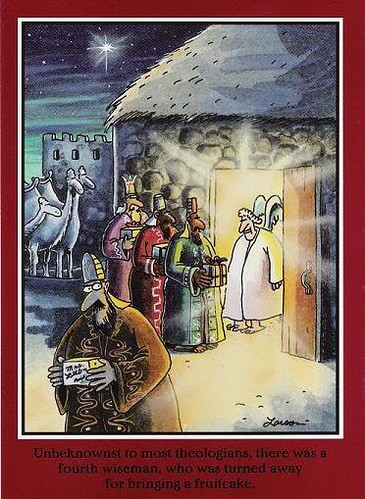
"Unbeknownst to most theologians, there was a fourth wise man, who was turned away for bringing a fruitcake."
Technorati Tags: humor
Sunday, December 20, 2009
joseph holding jesus ... again
Well, it's that time of year, time to post the Joseph Holding Jesus painting ... enjoy. Merry Christmas!

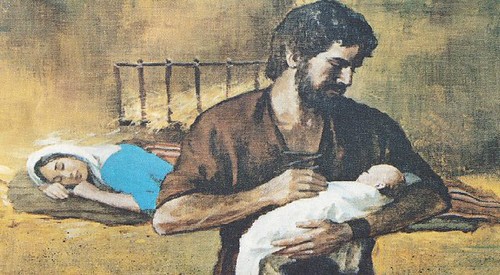
Saturday, December 19, 2009
Thursday, December 17, 2009
parachutes, fish, and freedom
I've told the parachute analogy many times before. Two guys jump out of an airplane; one has a parachute and one does not. The one without the parachute mocks to the other bragging that he is free from the encumbrance of the parachute. Which man is really free? Which one understands the laws of gravity and physics? Which one is truly free to enjoy the event with the assuredness of safety in the end?
The point of course is disciplines and constraints actually liberate us when (and only when) they fit with the reality of our nature and capacities.
So I enjoyed reading Tim Keller's fish story. A fish, because it absorbs oxygen from the water rather than the air, is only free if it is restricted and limited to water. If we put it out on the grass, its freedom to move and even live is not enhanced, but destroyed. The fish dies if we do not honor the reality of its nature.
"Freedom is not so much the absence of restrictions as finding the right ones, the liberating restrictions. Those that fit with the reality of our nature and the world produce greater power and scope for our abilities and a deeper joy and fulfillment." Keller concludes, "Instead of insisting on freedom to create spiritual reality, shouldn't we be seeking to discover it and disciplining ourselves to live according to it?"
It is the love of Christ that constrains us (2 Cor 5.14).
The point of course is disciplines and constraints actually liberate us when (and only when) they fit with the reality of our nature and capacities.
So I enjoyed reading Tim Keller's fish story. A fish, because it absorbs oxygen from the water rather than the air, is only free if it is restricted and limited to water. If we put it out on the grass, its freedom to move and even live is not enhanced, but destroyed. The fish dies if we do not honor the reality of its nature.
"Freedom is not so much the absence of restrictions as finding the right ones, the liberating restrictions. Those that fit with the reality of our nature and the world produce greater power and scope for our abilities and a deeper joy and fulfillment." Keller concludes, "Instead of insisting on freedom to create spiritual reality, shouldn't we be seeking to discover it and disciplining ourselves to live according to it?"
It is the love of Christ that constrains us (2 Cor 5.14).
no christian culture
Andrew Walls in The Expansion of Christianity:
One must conclude, I think, that there is a certain vulnerability, a fragility, at the heart of Christianity. You might say that this is the vulnerability of the cross. Perhaps the chief theological point is that nobody owns the Christian faith. That is, there is no "Christian civilization" or "Christian culture" in the way that there is an "Islamic culture," which you can recognize from Pakistan to Tunisia to Morocco. ... [C]ultural diversity was built into the Christian faith with that first great decision by the Council in Jerusalem, recorded in Acts 15, which declared that the new gentile Christians didn’t have to enter Jewish religious culture. ... [C]onverts had to work out, under the guidance of the Holy Spilt, a Hellenistic way of being Christian.
Subscribe to:
Posts (Atom)