Saturday, October 24, 2009

relevant missions

Culturally Relevant Mission
By Bert Waggoner, National Director Vineyard USA, Senior Pastor, Sugar Land TX

The church is called to culturally relevant mission. Mission is the objective; cultural relevancy is the process. The purpose of the church is not to be cool, cute, popular, or any other adjective that would indicate we are “in.” When the church makes cultural relevance its priority rather than a way of doing mission, it becomes syncretistic and thus, sells her soul on the altar of cultural relevance. This syncretistic harlotry makes the church what she most fears – irrelevant, because the church is relevant only as she is on mission as salt and light in a spoiling and dark world.

So when The Vineyard places “Culturally Relevant Mission” as one of our core values, the primary term is mission. This is what we are called to. This is what we exist for. Missions is primary; cultural relevancy is secondary.

This is not a new distinctive for the church or missions. The Nicene Creed identifies four “marks” of the church. “Marks” are the things that are essential to the church. You cannot have the church without them. The marks are: One, Holy, Catholic, and Apostolic. I won’t go through each of these marks although eachis very important to our understanding of the church. The one that I will highlight is “apostolic.” An apostle is a person sent by God. An apostolic church is a church that is sent out into the world with the good news of the Kingdom of God. Thus, the true church is a people on mission – sent ones. That is what “apostolic” meansand that is what the church must be.

The church does not just have a mission, it exists only in mission. Some would even say it is mission. As one noted theologian said, “Mission is to the church as fire is to burning.” You can be a group of people - a large group of people whoworship, fellowship, and even share the Word and spiritual experiences and yet not be a church in the New Testament sense. The creative word that creates a church is, “Go.” “Go into all the world.” (Matthew 28:19) The church exists as a sent people – a people on mission.

What is this mission? The mission of the church is to join with God in what He is doing in the world. God is a missionary God who is seeking a people who will worship Him in Spirit and in truth (John 4:23). That is the ultimate purpose – a people worshipping the Triune God. This mission involves the transformation of individuallives, building a community of faith (the body of Christ), bringing justice and freedom to the oppressed, initiating a new creation, and ultimately restoring all things to wholeness and life or as the apostle Paul says, “reconciling all things in heaven and earth to himself” (Colossians 1:20).

The church is designed to be God’s agent to accomplish His mission in the world. The church is the one entity in the world that does not exist for its members. It exists for those on the outside.

This leads me to the “culturally relevant” aspect of our Core Vineyard Value. To be culturally relevant is simply to follow the model for mission that is provided for us by our Lord Jesus Christ. How does God accomplish his mission? Through incarnation! God becomes a man, a Jew in Israel, two thousand years ago. Jesus as the revelation of God was relevant by virtue of the fact that though He was God He was as the Creed says, “very man of very man.” God in the flesh thrust into a specific culture at a specific time. That is God’s method in his mission. He comes towhere we are in our humanity, in our culture and in our individual lives. He comes to us and embodies his message in terms by which we have learned to understand the world.

This is what we mean by “culturally relevant mission.” The church must be incarnational in its mission. She must understand the culture and the people in thatculture. She must use the symbols of meaning in the culture she is in to communicate the message of the gospel without losing the prophetic role of speaking intothe culture. She must not, in her attempt to be culturally relevant, allow the desire for relevancy to supplant either the priority of her mission, nor the privilege of her message. But she must also understand that to cease to be relevant is to cease to be missional.

Our call to cultural relevance does not address the issue of whether culture is good or bad. That is another question. Richard Niebuhr wrote a book in 1951 entitled Christ and Culture. Niebuhr identified five options: Christ against culture, Christ of culture, Christ above culture, Christ and culture in paradox, and Christ the transformer of culture. Though I would agree with the last option, this option is not a necessary prerequisite for calling the church to culturally relevant mission. Regardless of how we conceive of the relationship between Christ (or the church) andculture, we must do as our Lord did in His mission. We must live in and understand our culture and frame the Gospel message in sensitivity to that culture so that the message can be understood and thus, be relevant to those in our culture.

Cultural relevancy does not necessarily mean that our message will be received with joy. No one in human history was more culturally relevant than Jesus, but it was this relevancy that got Him crucified. Modern culture has no problem with us as longas our message is anemic and fits their little scheme of things. They will even invite us to be their chaplains to give nice little anemic prayers at their events as long as we relent to do it without doing so in the name of Jesus. They even cheer us on when our message is psycho babble and our only message is self help.The problem they have with us is when we clearly say that the only way to the good life is through the cross and that the cross is the power of human transformation. So don’t think that popularity in the world necessarily equates with biblical success, or that when you are culturally relevant you will necessarily be loved by all.

On the other hand, only those who are culturally relevant will see people coming to know Jesus Christ. The New Testament church was relevant and saw five thousand people added to the church in one day. Peter stood at Pentecost and gave a relevant message to first century Jews in Jerusalem. “This is that,” he saidin reference to the promise of Joel’s prophecy and what was happening in Jerusalem on Pentecost. He brought the hope of the Jews into direct contact with the Gospel and the presence of the Holy Spirit. Could there have been a more culturally relevantmessage? So, if you want to be effective in your message, you must be culturally relevant with your message.

This call to cultural relevance is not new. It has long been a matter of central concern to missionaries. What we are saying by making cultural relevance in mission a core value of the Vineyard is that the church is a missionary people and that all of the followers of Jesus Christ must become missionaries wherever God hasplaced us and in whatever we do.

Technorati Tags:

tactics

Rob Craig reminded me of one of the tactics of the Enemy ...

good news in confronting sin

Christ, who became our high priest by His sacrifice on the Cross (Heb 9.26), was tempted in every way as we were (Heb 4.15). I'd argue because He never sinned (Heb 4.15; 1 Pet 2.22-23) that His temptation to do so was even stronger than ours. When we give in to temptation, it never reaches its fullest and longest. Jesus, because He never gave in, endured all temptation known to mankind until the very end.

This my friend is good news.

Many today cannot bring themselves to call sin sin. For some it is a simple rejection of God's truth. For many however it is born out of false compassion and a mistrust that sin can actually be confronted and this lead to life. They see any effort to confront sin as overzealous and Pharisaism. As for me, I can stand with Paul stating clearly that the unrighteous will not inherit the kingdom of God (1 Cor 6.9). I can shout "DO NOT BE DECEIVED", these things are sin, "sexual immorality, idolatry, adultery, homosexuality, thievery, greed, drunkenness, reviling, swindling, etc..." (1 Cor 6.9-10). And I can do it in love because I know that I was counted among them. But I am no longer defined by that. I am now washed, sanctified, and justified by Jesus Christ and by His Spirit (1 Cor 6.11). I don't live in shame. I don't have a need to "get right" first. I don't run from God. But instead I run to God, confessing my sin and repenting thereby receiving His forgiveness and power to live a holy and righteous life (1 John 1.9). I understand that to not confront sin is actually the opposite of love (1 Cor 13.6).

I am particularly bothered these days because of our President's attempt to redefine normal in regard to sexuality and the family.

“While we have come a long way since the Stonewall riots in 1969, we still have a lot of work to do. Too often, the issue of LGBT rights is exploited by those seeking to divide us. But at its core, this issue is about who we are as Americans. It’s about whether this nation is going to live up to its founding promise of equality by treating all its citizens with dignity and respect.” — Barack Obama

"You will see a time in which we as a nation finally recognize relationships between two men or two women as just as real and admirable as relationships between a man and a woman..." — Barack Obama

Some postmodern innovators are right there with him confusing sexual sin with caring for those suffering injustice. They somehow confuse their speaking for sin as analogous to those speaking against sin. They think their social action is parallel with great men of faith who stood up for injustice - speaking out against sin. When God speaks of the cancerous nature of sin in how it brings deception throughout the body, it is clearly to seen in these postmoderns as they make positive references to articles like this and this or eagerly await the of the end of Sola Scriptura so that gay rights can be promoted.

What is sad is that in a wrong minded effort to 'help' they are actually the ones condemning. Any one caught in any kind of sin can be set free. That freedom is only found in Christ through repentance. Not granting permission does not have to equal shame. Not granting permission can result in life. In fact, it is the only way. I encourage those confused by sin to not try to justify their rebellion but rather to repent and find freedom and forgiveness in the arms in a loving father.

Technorati Tags: ,

dialogue

I read this today and will attempt to live it a bit more ...

a gracious answer + knowledge of the issue at hand + common ground questions – pointed questions will often = fruitful dialogue

Technorati Tags:

Friday, October 23, 2009

perfect husband

We need to be so careful ...


Technorati Tags: ,

james 2.1-13

Our small group looked at James 2.1-13 last night. When we have these discussions I'm amazed at how we can so easily read at a high, almost superficial, level. The Word of God is rich and deep.

"In the divine Scriptures, there are shallows and there are deeps; shallows where the lamb may wade, and deeps where the elephant may swim." ~ John Owen

As I reread the text last night, here is my take ... beyond the traditional caring for the poor ...

  • Rich men will come among you. The paradigm is that they are blessed by God for being righteous (Deut 7.6-15). Interestingly I think that in today's society we typically do not look upon the rich in a positive light ... but that's another issue.
  • We, who by the Spirit, ought to see into the hearts of man often assess by outward appearances.
  • Worse, our motives to do so are 'evil', i.e., personal gain, recognition, etc...
  • But God has chosen the poor to be rich. That's ironic right? Well that's because he is speaking in a way that only those who have ears can hear. Before, under the Law of Works, one does good and one is reward physically. Here we are speaking of the Law of Grace. He is not referring to the financially poor, he is speaking to the spiritually bankrupt (which by the way we are all were) and God has made those rich. Clearly the financially poor are not made rich, right? He is reinforcing that when we realize we are dead in sin, only then can we be made alive in Christ and that is by the Spirit, not by works.
  • The point the he is not speaking of financial poor and rich is reinforced with 'heirs of the kingdom' and 'promised to those who love him'.
  • More irony comes however as James turns his attention back to our treatment of the rich. The rich it seems oppress us and drag us into court. They blaspheme the name of God. What does that mean? Well they forgot by what means they became rich. They confused their efforts with God's grace. They thought, based on the Law of Works, that they really earned wealth. And now they intend to continue to benefit by their own means. How many of us lose sight that we first became bankrupt, then by grace were saved, and now for some reason think we have to be good to earn favor ... forgetting that the way on is the same as the way in, i.e., by grace.
  • So they blaspheme God because they fail to recognize Him as their source and they oppress those he loves. They neither honor God in themselves by reflecting His true image nor do they honor God by seeing Him in others.
  • We who are spiritual do the same when we interact with mankind based on external measures rather than by the Spirit peering deep into the heart.
Ok ... 'nough of that ...

Wednesday, October 21, 2009

christ is still the way

“Most preachers approach the text with only one question in mind: What does this text instruct me to tell my people to do? But if we only tell people what to do without leading them to understand their dependence on the Savior to obey, then they will either be led to despair (I cannot do this) or false pride (If I work hard enough, I can do this). No one can serve God apart from Christ. A message full of imperatives (e.g., Be like…a commendable Bible character; Be good…by adopting these moral behaviors; Be disciplined…by diligence in these practices) but devoid of grace is antithetical to the gospel. These “be messages” are not wrong in themselves, but by themselves they are spiritually deadly because they imply that our path to God is made by our works.”

Bryan Chapell, Christ-Centered Preaching

HT:PC

Technorati Tags:

Monday, October 19, 2009

global warming redux

I'm just not smart enough to know the truth on this but I am absolutely astonished when I hear what seem like intelligent people say all of the data is in and man-made global warming is a scientific fact that demands extreme response. I've noted some issues before, most recently here. Now there's questioning of some NASA data. Then there's this movie coming out. I don't know that it proves anything but again, it would seem that those on the 'other side' would be a little less indignant.


And while I cannot say that all of Christopher Monckton's concerns are valid, I can certainly say I share a number of them.


Technorati Tags: ,

are you a pharisee

Derick Dickens posts a pretty decent short list of questions to identify if you are a Pharisee. For me, the answer was far too often yes.

Through the years I have been called both a Pharisee and Libertine (how can I be both?). Some have condemned me for being too conservative and others too liberal. So, in an attempt to learn to be more Biblical, I have developed some tests to keep from being a pharisee. Do you think you can add more?

Here is my list:

1) What is my heart attitude towards those who disagree with me? The heart is deceitful and often I have an attitude that I am better because of some issue or knowledge. Yet, my goal should be first and foremost love but still never compromising on the truth.
2) Am I seeking to rebuke or reason? I have never successfully rebuked anyone, only the Lord has accomplished that task through His Holy Spirit. I, though, have laid out God’s Word clearly so that the Spirit could use that Word to rebuke. Yet, my job is to reason from Scripture and the Spirit’s job is to rebuke. Keep it in that order.
3) Would my attitude be taken by a 5 year old as soft and gentle? Being a father, I have said things in a manner to my children which wounded their heart. I have learned that when talking to my children I needed to lovingly convey my disagreement in a soft and gentle manner. If a child would take my words as wounding, I would believe an adult could too.
4) Is my attitude one of superiority or am I rightly reflecting the idea that I am a recipient of God’s grace? The truth I hold is not one I discovered because I am brilliant but this truth is what God chose to open my eyes to see even though I was blind. Even in the secular world, there are greater minds than my own. The difference is God’s Grace.
5) Am I more condemning of others in their lifestyle, actions, and doctrine or more condemning of myself? When I see others’ sins as more grievous than my own then I have faltered somewhere. My first response to God’s Word should be “Woe is me” not “Woe is them.”
6) Truth is Truth and I cannot waiver from it, but how certain am I that this is God’s Truth? Is this, historically, an issue in the Christian realm places a priority? Is this an issue in the Bible with such priorities?
7) During major issues, do I weep for their soul or do I resort in mere condemnation? A semi-famous Pastor found out another friend left Christianity for a heresy. My friend’s reaction? He wept over the soul, responded in a passionately loving display, and a pleading for the rejection of this heresy.
8) Is my spiritual exercises mostly private or mostly public? Religion is both public and private, but we should first focus on the private which will make the public more beautiful.

So, how do you know if you are a Pharisee? I am a guilty pharisee as my heart has failed in many ways. You, too, are probably a pharisee as I believe most of us are Pharisaical in some manner. May the Lord rid us of this Pharisaical attitude and may the Lord continue to sanctify us from this atrocity.

passionate commitment to the truth

Ok - I'm queasy about the positive reference to non-Christian religions and lack of linkage to Christianity but I could easily extrapolate what was said to be ok. That aside, a lot of very good insight here by Jonathan Haidt regarding the real difference between liberals and conservatives. I would love for more to be able to grasp this message ... and subsequently realize that their sound bites on FaceBook, blogs, even the media will only deepen the divide. We need to develop a greater passion for truth and we need to find better ways to properly use that to influence the world around us.

Sunday, October 18, 2009

the law and the gospel

From John Bunyan ...

Run, John, run, the law commands
But gives us neither feet nor hands,
Far better news the gospel brings:
It bids us fly and gives us wings.

free will

I would have said man does not have free will but with the definition of free offered by Sproul I can align ... the difficult task is to now answer, "What does a man want?" and "Where does that desire come from?"

Does man have a free will? This question is one of the most frequently asked questions of theology. At times, it is not voiced as a question but as an objection to the whole idea of a sovereign God.

At the heart of the problem is the definition of free will. What are we saying when we assert that man has a free will? Stated briefly, free will simply means that man has the ability to choose what he wants. Such ability requires the presence of a mind, a will, and a desire. If these faculties are present and functioning in a man, that man has a free will.

Free will does not mean that man can choose to do anything he pleases and necessarily succeed. We may choose to fly without the aid of mechanical devices. We can fall through the air by ourselves, but we cannot fly through it. We lack the necessary natural equipment (in this case, wings) to fly. This does not mean, however, that we are not free. It does mean that our "freedom" is limited by our natural physical limitations. My will may be outvoted by the will of a majority or by some higher power. Such conflicting power does not eliminate my freedom but may surely impose limits on it.

One of the most important limits on my freedom is myself. If we examine the workings of the will closely we run into a point of irony that is often overlooked in discussions about free will. The point is this: Not only may I choose what I want, I must choose what I want if my choice is really to be free. Choice is made according to desire. Without desire there could be no free choice--certainly no moral choice.

Coram Deo: God gave you a free will to choose. You choose according to your desires. Will your present desires lead to wise choices for the future?

Deuteronomy 30:19: "I call heaven and earth as witnesses today against you, that I have set before you life and death, blessing and cursing; therefore choose life, that both you and your descendants may live."

Joshua 24:15: "And if it seems evil to you to serve the Lord, choose for yourselves this day whom you will serve, whether the gods which your fathers served that were on the other side of the River, or the gods of the Amorites, in whose land you dwell. But as for me and my house, we will serve the Lord."

Psalm 25:12: "Who is the man that fears the Lord? Him shall He teach in the way He chooses."

Technorati Tags:

Friday, October 16, 2009

children see


Children see ... and more important, so does God ...

more climate change

Geoff Matheson is pretty sharp for his youthfulness. While I disagree with his take on man-made global warming, I like his personal, practical, and right-minded concern for the environment. These seem right to do whether you agree man-made global warming is an issue or like me, you do not.

Speaking of the latter, here are two articles I read yesterday. I'm still unclear how some can say the discussion is over.

Technorati Tags: ,

Thursday, October 15, 2009

beyond perfection

“Whoever is not satisfied with Christ alone, strives after something beyond absolute perfection.”

- John Calvin, Commentary on John

HT:OFI

Wednesday, October 14, 2009

wooden spoon trick

Why did I think of how we treat each other at church when I saw this?


Technorati Tags:

Monday, October 12, 2009

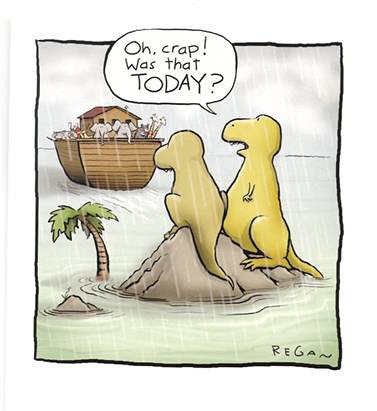
how dinosaurs became extinct

I thought these first two were the best theories but here's a third ...

4006209354 8D3D3D2408

Technorati Tags:

no limits

“Christ turned his back, voluntarily, deliberately, and decisively, upon all that belonged to personal glory, and all that conduced to personal gain. He recognized no limit to the extent to which His obedience to God in self-humbling must go. Whatever he found in himself to be expendable, he spent. While anything was left which could be poured forth, he poured it forth. Nothing was too small to give, or too great. This is the mind and the life which is commended to us by the example of Christ and approved by signal acts of God.”

- Alec Motyer, The Message of Philippians

HT:OFI

Sunday, October 11, 2009

right thinking

In a time when postmodern innovators are having success convincing the faithful that right thinking is unimportant, it is refreshing to hear John Piper, a 'right thinker', clearly articulate the truth. The position he articulates "is biblical" - a phrase some postmodern innovators don't like and are working to tear down. And the result of right thinking is a greater love for an almighty God - a position some postmodern innovators don't want to accept that men like Piper can have because their self-made image of god has no room for truth as found in what's biblical.

That aside, here's the post on right thinking ...

Right thinking about God exists for the sake of right feeling for God. This was the main point of John Piper’s Friday night message, “Think Christ,” at the Hirten Konferenz in Bonn, Germany.

Expanding upon Thursday night’s message, “Feel Christ,” Piper said that being satisfied in God will not glorify God if our satisfaction in God is not based on right thinking.

Piper gave 10 arguments for the indispensable role of right thinking and right knowing in the life of the Christian:

1. It is possible to have strong feelings and be lost if the feelings are not based on knowledge (Romans 10:1-2).
2. God has planned that thinking about the Bible is the means he uses to give understanding (2 Timothy 2:7).
3. Paul is given as an example of reasoning with the Bible (Acts 17:2-3).
4. Jesus assumes and requires that we will use logic in understanding both what is natural and what is spiritual (Luke 12:54-57).
5. Jesus refuses to deal with people who use their reason to conceal truth (Matthew 21:23-27).
6. Thirteen times in Paul’s letters, he asks the question, “Do you not know?” Paul assumes that if his readers knew something, they would see things differently, feel differently, and act differently.
7. The Bible tells us that Christ has given pastors and teachers to the church and tells us that they should be apt to teach—because God intends that the Bible be explained to ordinary folks who don’t have the time or ability to go as deep as God wants them to go. Christ would not have given teachers to the church if he thought they were not needed.
8. The Bible declares that we should proclaim the whole council of God (Acts 20:27). That implies that there is a coherent unified whole, a body of doctrine, that should be given to the church. It is not easy to find this whole council in a book with 1,500 pages! It’s mainly mental labor. Finding the unified biblical theology that the people need to know takes hard thinking.
9. The Bible is a book, which means that it must be read.
10. An example of how thinking and valuing and acting relate to each other is Matthew 7:7-12.

On the final point, John Piper said that thinking is necessary to get meaning from a text and to then present it to others. In particular he pointed to the first word in verse 12.

I read Matthew 7:12 for 25 years before I asked how it relates to the previous verse. Why does verse 12 begin with "so"? Because confidence that God will meet our needs is what frees us to take radical risks in loving other people. "Do unto others . . ." because you know God is going to answer your prayers and take care of you.

God is most glorified in you when you are most satisfied in him. But that satisfaction in God does not glorify him unless it is based on right thinking and right knowing. God is all-satisfying because he’s a Father who gives us everything we truly need. And that kind of deep unshakeable satisfaction in our Father causes us to value things differently than the world. Therefore, we will love our neighbors. Right thinking with right feeling changes our behavior.

out of the mire

Interestingly some of the silliness (for lack of a better word) between postmodern innovators and some evangelicals - and I say silliness because then both sides get to stereotype the other based on concepts that aren't true - is the idea that evangelicals are about "getting to heaven". While this post by R.C. Sproul doesn't deal with that directly, I think it's a good reflection of the heart of a true evangelical in regard to humility, God's work in us, freedom and holiness in Christ, the power of the Word and the Holy Spirit, etc... which confronts the notion of self-reliance, a formula, a ticket to heaven, etc... The self-reliance being an error I sometimes see in postmodern innovators, the formula an error I sometimes see in both camps, and a ticket to heaven the focus some postmoderns wrongly superimpose on all evangelicals.

Our souls cannot climb out of the mire of sin because they are dead. Salvation comes not to those who cry out, "Show me the way to heaven," but to those who cry, "Take me there for I cannot."

Lest we see the sinner's prayer as mere technique, we must remember that Christ raises the dead that they might walk. We do not mumble the magic words and then wait to die. Christianity is about spiritual growth as well. It is about work, the hard work of sanctification. Regeneration is monergistic, God's work alone. Sanctification, the process by which we are made holy, is synergistic, God's work with us.

God's part is easy for Him. He needs no shortcuts because He never tires. We, though, must ever fight the temptation to seek the shortcut. No technique will make us holy. No technique of the Devil's, though, can stop the process of Christ making us into His image. Those whom He calls He sanctifies.

Our sanctification requires the Spirit of God and, because He has so ordered His world, sanctification requires the disciplined and repeated use of the means of grace. Five minutes a day of Bible study smells like technique. Arid, it is sure to fail. We must immerse ourselves in the Word of God. Then, as Jesus promised, we will know the truth and the truth will set us free. Then we will be His disciples (John 8:31-32).

Coram Deo: Remember, God is at work in you. He never tires. Give thanks for the process that is underway.

John 8:31-32: "Then Jesus said to those Jews who believed Him, 'If you abide in My word, you are My disciples indeed. And you shall know the truth, and the truth shall make you free.'"

John 8:36: "Therefore if the Son makes you free, you shall be free indeed."

Psalm 40:2: "He also brought me up out of a horrible pit, out of the miry clay, and set my feet upon a rock, and established my steps."

Saturday, October 10, 2009

just barely enough

Wow - this one made me think ... Francis Chan speaking on Prov 30.7-9 ...


HT:PC

reason #22

John Piper, reason #22 in Why Jesus Came to Die: To Bring Us to God (emphasis mine).

When all is said and done, God is the gospel. Gospel means “good news.” Christianity is not first theology, but news. It is like prisoners of war hearing by hidden radio that the allies have landed and rescue is only a matter of time. The guards wonder why all the rejoicing.

But what is the ultimate good in the good news? It all ends in one thing: God himself. All the words of the gospel lead to him, or they are not gospel. For example, salvation is not good news if it only saves from hell and not for God. Forgiveness is not good news if it only gives relief from guilt and doesn’t open the way to God. Justification is not good news if it only makes us legally acceptable to God but doesn’t bring fellowship with God. Redemption is not good news if it only liberates us from bondage but doesn’t bring us to God. Adoption is not good news if it only puts us in the Father’s family but not in his arms.

This is crucial. Many people seem to embrace the good news without embracing God. There is no sure evidence that we have a new heart just because we want to escape hell. That’s a perfectly natural desire, not a supernatural one. It doesn’t take a new heart to want the psychological relief of forgiveness, or the removal of God’s wrath, or the inheritance of God’s world. All these things are understandable without any spiritual change. You don’t need to be born again to want these things. But the evidence that we have been changed is that we want these things because they bring us to the enjoyment of God. This is the greatest thing Christ died for. “Christ also suffered once for sins, the righteous for the unrighteous, that he might bring us to God” (1 Peter 3:18).

Why is this the essence of the good news? Because we were made to experience full and lasting happiness from seeing and savoring the glory of God. If our best joy comes from something less, we are idolaters and God is dishonored. He created us in such a way that his glory is displayed through our joy in it. The gospel of Christ is the good news that at the cost of his Son’s life, God has done everything necessary to enthrall us with what will make us eternally and ever-increasingly happy, namely, himself.

Long before Christ came, God revealed himself as the source of full and lasting pleasure. “You make known to me the path of life; in your presence there is fullness of joy; at your right hand are pleasures forevermore” (Psalm 16:11). Then he sent Christ to suffer “that he might bring us to God.” This means he sent Christ to bring us to the deepest, longest joy a human can have. Hear then the invitation: Turn from “the fleeting pleasures of sin” (Hebrews 11:25) and come to “pleasures forevermore.” Come to Christ.

repost: jesus at 12 years old

In preparation for the service project this morning I read this old post and thought it was repost worthy ...

When Jesus was 12, his family accidently left Him behind in Jerusalem. When they found him three days later, He said to them, "Why were you looking for me? Did you not know that I must be in my Father's house?" They did not understand. Why?

(1) Jesus referred to Yahweh in a possessive way, i.e., "My Father", thereby shattering the old way of relating to God. Now He is personal and knowable by all.

(2) Jesus never doubted who He was.

(3) Jesus knew what mattered - being with His Father and being about His Father's business.


(careful, this has the "poopy" word in it more than once)

As Christians, the one thing is intimacy with God. All that matters in life flows from that - intimacy with God. When He was older, Jesus repeated the message (recorded in Lk 10.38-42) - only one thing is necessary.

Micah 6.6-8 ~ With what shall I come before the Lord,and bow myself before God on high? Shall I come before him with burnt offerings, with calves a year old? Will the Lord be pleased with thousands of rams, with ten thousands of rivers of oil? Shall I give my firstborn for my transgression, the fruit of my body for the sin of my soul?” He has told you, O man, what is good; and what does the Lord require of you but to do justice, and to love kindness, and to walk humbly with your God?

Ecclesiastes 12.13-14 ~ The end of the matter; all has been heard. Fear God and keep his commandments, for this is the whole duty of man. For God will bring every deed into judgment, with every secret thing, whether good or evil.

amillennialism

What's the deal with Amillennialism? I had been a Christian for nearly 30 years having only heard the word a couple of times and never gave it a second thought. Now, in the span of roughly a year, I've moved into that 'camp' and what's weird, now suddenly there's an overwhelming amount of information out on it ... and by people I've read and respected for years.

But first, my homeboy Iggy posts this video ...


With that out of the way, Kevin DeYoung tries to make sense of the Millennium. In part 1, he asks and answers, when does the Millennium occur? The simple answer, "The millenium occurs before Christ’s second coming, before Christ’s second coming." He then asks and answers, what is the the meaning of Satan being bound for 1000 years? The simple answer is that there are two truths held in tension.

Satan is the one who leads the whole world astray, and yet Satan is bound so that he may no longer deceive the nations. Not the same thing. The world is according to John the lust of the eyes, the pride of life, fleshliness, its corruption. Satan leads the world astray. But he’s bound such that the nations, people groups, countries, missions can be successful. So, he is a deceiver. He is leading astray. But the nations are also coming to Christ.

In part 2, DeYoung deals with "They came to life and reigned with Christ a thousand years” (Rev 20.4)? The short answer, "This is a picture of believers who upon death come to life as disembodied souls and reign with Christ."

So now, with DeYoung's 'primer', you can enjoy this 2 hour video, "An Evening of Eschatology," a conversation about the end times with John Piper, Doug Wilson, Sam Storms, and Jim Hamilton.
Technorati Tags:

Friday, October 09, 2009

this explains it

Today I read a lot of stuff that lowered my opinion of the current state of humanity ... this video helps keep it in perspective ...


Technorati Tags:

imma let you finish

Tumblr Kqdpsdaq7V1Qa3I8Uo1 400

Technorati Tags:

Wednesday, October 07, 2009

Tuesday, October 06, 2009

proper preaching

“I am increasingly convinced that so much in the state of the Christian church today is to be explained chiefly by the fact that for nearly a hundred years the church has been preaching morality and ethics, and not the Christian faith. It is this preaching of the ‘good life’, or being ‘a good little gentleman’, and of viewing religion as ‘morality touched by emotion’, as Matthew Arnold put it, that has been the curse. Such men have shed the doctrines; they dislike any idea of atonement, they dismiss the whole notion of the miraculous and the supernatural, and ridicule talk about re-birth. Christianity to them is that which teaches a man to live a good life (Life in the Spirit, 19).”

HT:PC

Technorati Tags:

Monday, October 05, 2009

our identity

“At the root of the human condition is a struggle for righteousness and identity. We long for a sense of acceptance, approval, security, and significance — because we were designed by God to find these things in him. But sin has separated us from God and created in us a deep sense of alienation. Speaking of the Jewish people in his own day, Paul writes, ‘[T]hey did not know the righteousness that comes from God and sought to establish their own’ (Rom. 10:3). We do the same thing. Theologically speaking, pretending and performing are just two sophisticated ways of establishing our own righteousness. When we pretend, we make ourselves out to be better than we are. When we perform, we are trying to please God by what we do. Pretending and performing reflect our sinful attempts to secure our own righteousness and identity apart from Jesus.

To really experience the deep transformation God promises us in the gospel, we must continually repent of these sinful patterns. Our souls must become deeply rooted in the truth of the gospel so that we anchor our righteousness and identity in Jesus and not in our selves. Specifically, the gospel promises of passive righteousness and adoption must become central to our thinking and living.”

- Bob Thune and Will Walker, The Gospel-Centered Life (World Harvest Mission, 2009), 19.

HT:OFI

the nature of sin

Home run David Wayne, home run!

This is the quote/explanation I have been looking for! In trying to explain the concept of sin to people I've looked for a short explanation which best sums up the nature of sin. I've never been quite happy with the standard explanations of the nature of sin because they usually somehow make their way to the idea that sin is something you do.

In my overeagerness to counter that I have sometimes thought that sin is something you are, not that you do, but that's not right either. We "are" not sin - we are image bearers. So the definition of sin falls somewhere in between or outside of those two things and I think Oswald Chambers nails it here - this is from the October 5 reading in "My Utmost for His Highest."

"The disposition of sin is not immorality and wrong-doing, but the disposition of self realization—I am my own god (italics mine). This disposition may work out in decorous morality or in indecorous immorality, but it has the one basis, my claim to my right to myself. When Our Lord faced men with all the forces of evil in them, and men who were clean living and moral and upright, He did not pay any attention to the moral degradation of.the one or to the moral attainment of the other; He looked at something we do not see, viz., the disposition."

Interestingly, in the rest of the reading for the day I think he is pretty weak on the concept of original sin, but I think he is right on in these words. I've always thought that one of the best bible verses for explaining the concept of sin is Luke 19:14; But his citizens​ hated​​ him and sent a delegation after him, saying, ‘We do not want this man​​ to be king​​ over us!’

In that light I think Chambers nails it.

Friday, October 02, 2009

perilous times

2776934527 De2Ddedb5B
O Lord, grant me the skill to sing your praise, for the bustle of this world is perilous.

- Anonymous, Early Welsh

HT:BR

the gospel alone is freeing

“The gospel gives you psychological freedom to handle the wrong things that you will do. You won’t have to deny, spin, or repress the truth about yourself. These things don’t make it impossible to know who you are.

Only with the support of hearing Jesus say, ‘You are capable of terrible things, but I am absolutely, unconditionally committed to you,’ will you be able to be honest with yourself.”

- Tim Keller, Journal of Biblical Counseling

HT:OFI

Come to Jesus, confess His Truth alone is right in contrast to your actions/thoughts/emotions/etc..., repent, receive forgiveness, and live in true freedom and liberty.

higher mathematics

From Nathan Bingham on mathematics and preaching ...

I was reading a book on preaching this afternoon which included a quote by the French mathematician Jules Henri Poincaré.

"No man knows anything about higher mathematics until he can explain it clearly to the man on the street"

Poincaré's words should arrest every preacher as he prepares and reviews his sermon for the upcoming Lord's Day. Simplicity in preaching is not the sign of a weak preacher; rather it is the sign of a man who has truly understood "high" theology.

Technorati Tags:

Thursday, October 01, 2009

Wednesday, September 30, 2009

can't worship?

This is excellent from Tim Hughes ...

"The church that can't worship must be entertained. And men who can't lead a church to worship must provide the entertainment." A.W. Tozer.

This is quite a challenge - especially as we all prepare to lead worship this Sunday. Are we going to pull out the classics, and try and force people into a time of worship? Are we going to rely on our own strength to make something happen? Or, are we going trust and follow God to lead us in a beautiful, deep and meaningful encounter of worship.

John 6:63
"The Spirit brings life; the flesh counts for nothing."

Perhaps the best thing we could do in terms of our preparation for leading worship is to spend some time in God's presence, seeking Him and asking that He may fill us up with the Holy Spirit and use us in power to bring glory to Him.

Let's go for it. Who wants shallow entertainment when we can give people Jesus!

Technorati Tags:

cops

I liked the message ...

Tuesday, September 29, 2009

racism

Here's the deal - racism is ugly and sinful. At the same time the false accusations of racism are reflective of the same sinfulness. I'd like to see Christians drop this rhetoric and focus on the Kingdom of God. Where injustice is found, we must confront it. But where it is not, we should not sin by calling for emotional support of worldly kingdoms.

I don't Rev. Wayne Perryman or his agenda but this speech made some sense to me.


Technorati Tags:

my daily reminder

The following is a reminder from Ray Ortlund that I need to do more to keep in front of me ...

"Many will say they are loyal friends, but who can find one who is truly reliable?" Proverbs 20:6, NLT

A spirit of self-assurance is a gospel-denying, self-deceiving, friendship-destroying mentality. It is natural to say to ourselves, "I'm doing my part. They should be grateful." It is supernatural to say to ourselves, "I place myself under the judgment of the Word of God. I humble myself. Even if the other person is wrong, that gives me no right to assert myself. No matter what the other person does, no matter how much I am misunderstood and misjudged, I will remain in the fear of the Lord, I will entrust myself to God." True friendship thrives when, before God, each one is more aware of his debts than his rights.

If God has given you reliable friends, and surely he has, hold them close to your heart. Each one is a rare treasure.

Monday, September 28, 2009

piper's reasons

John Piper offers seven reasons for small groups ...
  • The impulse to avoid painful growth by disappearing safely into the crowd in corporate worship is very strong.
  • The tendency toward passivity in listening to a sermon is part of our human weakness.
  • Listeners in a big group can more easily evade redemptive crises. If tears well up in your eyes in a small group, wise friends will gently find out why. But in a large gathering, you can just walk away from it.
  • Listeners in a large group tend to neglect efforts of personal application. The sermon may touch a nerve of conviction, but without someone to press in, it can easily be avoided.
  • Opportunity for questions leading to growth is missing. Sermons are not dialogue. Nor should they be. But asking questions is a key to understanding and growth. Small groups are great occasions for this.
  • Accountability for follow-through on good resolves is missing. But if someone knows what you intended to do, the resolve is stronger.
  • Prayer support for a specific need or conviction or resolve goes wanting. Oh how many blessings we do not have because we are not surrounded by a band of friends who pray for us.

Technorati Tags:

sour wine

Sour wine or wine vinegar, a common drink among the poorer classes (Ruth 2:14), was forbidden to Nazirites (Num. 6:3). The offer of ‘vinegar’ to Jesus on the cross could be understood as a compassionate gesture in Mark 15:36 and Matt. 27:48. However, Ps. 69:21 speaks of ‘poison and vinegar’ given to the suffering righteous by enemies. Both the mocking offer of vinegar in Luke 23:36 and the reference to fulfillment of Scripture in John 19:28-30 suggest this latter context. Therefore I see this as Driscoll describes.

It is a powerful help to understanding the compassion of our dear Lord and Savior.

a day in the life

This is how most of my days seem to cool ... they start off real cool but then somehow I blow it ...


Technorati Tags:

proof

One picture with a simple question ... your response will reveal a lot about you.

Missmeyet

Technorati Tags: ,

Sunday, September 27, 2009

obama care questions

ObamaI thought this online attempt to list key questions regarding President Obama's Health Care plan was interesting. Some of these strike me as not so important and some seem redundant but as I listen to pundits rail against emotionalism, distortions, etc..., it seems this is a pretty fair list to try to deal with specifics. Some of my online network friends have decried the right as being parrots or big insurance, as being racist and simply against anything from Obama, as being manipulated by the Republican Party machine, etc... Alright then, he's a few concerns, can you address these?

I'd much rather hear thoughts centered on these or other concerns than read the overwhelming number of disparaging remarks flying back and forth between the camps. It seems to me that it is the people engaged in that rhetoric that has us stuck with no forward progress.

  • The health care reform bill currently pending before the Senate Finance Committee includes over $100 billion in cuts to Medicare. The Administration promises that the cuts to Medicare will not reduce health care benefits to seniors. The head of the nonpartisan Congressional Budget Office recently told senators that the cuts in the bill WILL reduce health care benefits to seniors. Why should seniors trust the Administration more than the nonpartisan C.B.O. on this point? Related Article
  • Mississippi has adopted lawsuit abuse reform (tort) in their state and has reduced their healthcare premiums by 92% in the last year due to this reform. Gov. Barbour estimates America can save almost 100-200 billion dollars a year implementing just this one reform. Other than the fact that Tort Attorneys and their groups donate heavily to the DNC and did to the Obama campaign, is there a good reason or explanation you can give the American people as to why you have put the Tort attorneys' interests ahead of the healthcare interests of the citizens of this country?
  • The Administration has repeatedly represented to the American people that the proposed health care reform plan will be deficit-neutral. Referring to the Administration's plan, the Congressional Budget Office Director recently said "We do not see the sort of fundamental changes that would be necessary to reduce the trajectory of federal health spending by a significant amount." Official CBO estimates for the Administration's proposals have, in fact, indicated additional deficits of hundreds of billions of dollars over 10 years. Why should the American people trust the Administration's numbers rather than those of the C.B.O. on this point? Related Article
  • You have said you will pay for healthcare by savings through "waste and fraud". By this statement then you are indicating that if you are able to quantify the amount in order to turn it into savings, you must be able to identify where it is. If that is true, why aren't you stopping the waste and fraud now since you can identify it instead of waiting until some unknown deadline? Don't you think this would engender some trust from the American people that you are making an effort to save money or that you know how to?
  • The Administration has repeatedly claimed that its health care reform plan will not cover illegal aliens. The Congressional Research Service recently issued a report contradicting the Administration's position, stating "H.R. 3200 does not contain any restrictions on non-citizens whether legally or illegally present, or in the United States temporarily or permanently participating in the Exchange." Is the Congressional Research Service in error? If so, where is the error? Related Article
  • Why won't government employees and elected officials be covered under a nationwide health care plan? Your employer, the American taxpayers, would like to drop your family's existing coverage and force you into the public option that you so energetically endorse.
  • The Administration's health care reform plan relies heavily on the idea of generating health care savings by means of increased preventative care including mammograms and colonoscopies. On this point, the nonpartisan Congressional Budget Office recently wrote "The evidence suggests that for most preventive services, expanded utilization leads to higher, not lower, medical spending overall." Why should Americans trust the Administration's representations more than those of the nonpartisan C.B.O. on this point? Related Article
  • You have accused the opponents of this Healthcare plan of using "lies" and "scare tactics" and spreading "disinformation." During your speech on Sept 9, you state that "One man from Illinois lost his coverage in the middle of chemotherapy because his insurer found that he hand't reported gallstones that he didn't even know about. They delayed his treatment, AND HE DIED BECAUSE OF IT". In truth, the man, Otto Raddatz, began chemo and was preparing for a stem cell transplant. During a routine review by the insurer, it was found that he had not disclosed having gallstones and an anuerysm. Mr. Raddatz had never been told about the gallstones or been urged to treat them. His sister, appealed to the Attorney General, who reversed the decision within two weeks and Mr. Raddatz had the transplant and lived another 3 and half years. -an indication that the company's decision to rescind his treatment didn't cause his death. Mr. Raddatz didn't die from being denied treatment, but your speech stated so. How can you accuse critics of creating lies about the healthcare proposal when on several occasions your own words have been found to be untruthful?
  • The Administration argues for a government-funded health insurance plan on the grounds that more competition is necessary in order to reduce health care costs. In response to a question from CNN's Wolf Blitzer as to why the Administration's health care reform plan does not include also interstate competition as a means to reduce costs, David Axelrod responded that "[Interstate competition] is not endemic to the kind of reforms that we're proposing" At least one study has concluded that interstate competition would be likely to reduce health care costs and reduce the number of uninsured. If competition can be expected to reduce costs and increase coverage, why is interstate competition not 'endemic' to the Administration's proposed reforms? Related Article Related Article
  • You indicated in your interview with George Stephanpolus that if people did not buy insurance that they would be fined a penalty fee but you insisted that it is not a tax. However, on page 29 of the Senate bill that Mr. Stephanopoulus refers to, it states that the fee will be an "excise TAX." How do you expect Americans to believe you have a grasp and knowlege of the healthcare legislation and are able to run it, when it is apparent that you had not even read the bill? Not even 29 pages of it.
  • A WhiteHouse.gov hypothetical question on health care rationing states the following : "What if I want [certain] tests and what if they detect something that could save my life?" The White House response states, in relevant part : "We want reform that rewards quality of care not quantity of procedures. Having dozens of procedures doesn't necessarily make you better. In fact they can make you worse." Q: Which procedures or tests would be reduced or eliminated under the proposed health care reform plan, and what evidence is available that the quality of care would not be impaired by their reduction or elimination? Related Article
  • At one time, the Administration claimed that there are as many as 47 million uninsured Americans. More recently, the Administration has claimed that there are closer to 30 million uninsured Americans. What are the sources for these numbers, and how many of the 30 million are unable to purchase health insurance because of the cost of health care insurance? Related Article
  • On September 23, 2009, the head of the Congressional Budget Office (CBO) stated that, if implemented, the legislation will lead to $100 billion in cuts to Medicare Advantage services. Specifically what services will be cut under your legislation?
  • At a town hall meeting in Raleigh, North Carolina on July 29 you said " I will be available to answer any question that members of Congress have. If they want to come over to the White House and go over line by line what's going on, I will be happy to do that." A month ago, Congressman Phil Roe sent you two letters asking you for a time and place to conduct this line by line review. You've not responded to him. Do you intend to honor your promise and sit down with Congressman Roe and hold a serious line by line review of proposed health care legislation or was your July 29 statement merely an insincere political gesture ?
  • During the debate on the so-called stimulus package, your estimates on future unemployment and economic recovery proved to be wildly off-base. Why should Americans now believe you that they will not be forced out of the private coverage they enjoy, as basic economics would dictate?
  • Despite your assertions that health care reform will save money, the reality is that plans proposed by Democrats would cost taxpayers between $1 trillion and $2 trillion. How does this save money and how will you pay for this?
  • If, as you claim, a government-run option is essential to maintaining honest competition in the health insurance market, why is it not also true that we need a government-run competitor in the fast food industry, neighborhood babysitting, or Major League Baseball?
  • Proponents of a government-run option, you included, claim that it will compete on a level playing field with private insurance providers. In that case, will your government-run plan operate as a for-profit model and be forced to pay all applicable state, federal, and local taxes?
  • How do you expect to meet the growing need for physicians and medical professionals if the government-run plan pays lower than market rates to physicians while forcing them to participate or lose a majority of their patients and their livelihood?
  • If the government mandates that all Americans purchase health insurance, it must also define what qualifies as health insurance. Can you provide us your definition (with details please) and explain how this definition will not limit innovation and choice in health care?
  • According to the House Democrats. plan, a family of four with an income of $88,200 (four times the federal poverty level) would qualify for health insurance subsidies. In your view, is this a subsidy for low-income Americans or an effort to use taxpayers to put more health care under the purview of the federal government?
  • The new Federal Coordinating Council for Comparative Effectiveness Research is charged with determining what treatments should be offered to patients. Do you believe that these personal medical decisions should be made by patients in consultation with their doctors, or by unaccountable bureaucrats?
  • Why are there no actively practicing physicians included in the membership of the Council for Comparative Effectiveness Research?
  • If the final reform proposal is controversial enough that it will not receive the necessary 60 votes in the Senate, Democrats have left open the possibility of using a procedural move to pass it with only 51 votes. Do you believe massive changes to such a vital area of American life should be pushed through in this manner with only 51 votes?
  • Pro-choice groups NARAL and Planned Parenthood are demanding that the healthcare reform bill cover abortion, paid for by the TAXPAYER. Will you sign a healthcare reform bill that uses taxpayer dollars to pay for abortions?
  • HR3200 requires 500 billion in cuts in Medicare and Medicaid. How can these cuts be made without limiting access to healthcare or medicines recommended by my doctor?
  • According to Politifact.com, Obama's budget represents 11 trillion in debt in five years and 17 trillion in 10 years. Specifics for paying for the program are outlined as: $544 billion from a new income tax surcharge on single people making $280,000 a year and households making $350,000 and above; $37 billion in other tax adjustments. About $500 billion in cuts to Medicare and Medicaid. About $200 billion from penalties paid by individuals (2.5% of income) and employers (8% of payroll) who don't obtain coverage. [Note: These penalties are not in existence now, why should the American public impose a penalty upon themselves?] How will the $500 billion in Medicare cuts affect the elderly? Shouldn't we be reducing the budget instead of inflating it?
  • In a recent New York Post column, Betsy McCaughey, a former lieutenant governor of New York and health care expert, wrote: "One troubling provision of the House bill compels seniors to submit to a counseling session every five years (and more often if they become sick or go into a nursing home) about alternatives for end-of-life care (House bill, p. 425-430). The sessions cover highly sensitive matters such as whether to receive antibiotics and 'the use of artificially administered nutrition and hydration.' This mandate invites abuse, and seniors could easily be pushed to refuse care." Will you sign a healthcare reform bill that in any way promotes euthanasia.
  • According to the plan, every new insurance policy will have to comply with government mandates, and any policy changes . "altering co-pays, deductibles, or even switching coverage for this or that drug" . invalidates your previous coverage and forces you to choose a government "qualified" plan. In addition, the House plan mandates coverage for every individual. If you are self-employed or choose not buy insurance for whatever reason, the bill imposes a "healthcare tax" of 2.5% of your income. Why do you believe bureaucrats can make better decisions than me about what kind of health insurance I should have? And will you guarantee that any healthcare reform bill passed by Congress will always allow me to choose my own doctor?
  • A number of experts have opined that insured individuals will end up having their health insurance plan changed under the Administration plan as proposed. Employers pick health plans, not employees, and if the new law puts forward a cheap 'government option/public plan,' employers will dump employees into it and pocket the savings as smart business people will do when given such a choice. Do you guarantee that I get to keep the plan I have and the doctor I have? If so, how are the experts wrong?
  • Will the law require Members of Congress and federal employees to be enrolled in the "government option/public plan," and if not, why not?
  • Will seniors be guaranteed joint replacements, stents, and the chemotherapy they need, or will they be forced to accept less-costly and less-effective alternatives?
  • If seniors will be allowed the expensive but most effective treatments, how will costs be controlled?
  • Will seniors have to wait longer for their treatments than they do now?
  • Will doctors see their payment schedules drop?
  • If their payments fall and they make less money, won't there be fewer doctors practicing medicine?
  • Doesn't Canada have long lines for important surgeries? How will making our system more like Canada's not mean longer lines and longer waits here?
  • Have you read the bill well enough to be interviewed about it on the radio by a conservative talk show host? ("C'mon. Of course I haven't and of course I won't. Have you seen even one extended interview with even one Member of Congress about the specifics of the bill with even a moderately skeptical journalist?").
  • Your plan includes a reduction of $500 billion in Medicare. Why should Medicare recipients believe that $500 billion can be cut from Medicare without affecting the level of care they will receive? Has such a thing ever been accomplished previously?
  • Your plan includes savings of $500 billion in Medicare by the elimination of 'waste, fraud and abuse.' What portion of the $500 billion figure is specifically attributable to fraud? How many new federal investigators and prosecutors will need to be hired in order to investigate the doctors and hospitals accepting Medicare reimbursements? Won't this new round of investigations interfere substantially with the operations of ongoing practices and their ability to treat their patients?
  • In your speeches, you have repeatedly emphasized that you that you are there to listen, that your door is always open and that you continue to seek common ground. Which ideas, if any, have you incorporated into your health care plan in order to find common ground with Blue Dog Democrats and/or Republicans?
  • You have repeatedly accused the critics of your plan of engaging in 'lies" and 'scare tactics.' Do you believe that none of the criticisms of your plan are good faith criticisms? If any of the criticisms are good faith criticisms, which ones?
  • In earlier speeches, you promised the American people that they would be able to keep their health insurance under your plan. More recently, you have chenged the rhetoric to express only that nothing explicitly in the plan will force Americans to change their health insurance. Is it not true that, according to objective third-party analyses, millions of Americans would likely be forced to change their health insurance under your plan? Is there an objective third-party analysis showing that most Americans will continue to have the same options they have today? If so, which ones, and why are they more credible than the analyses coming to a contrary conclusion?
  • You have promised that your plan will not expand the deficit. Certain objective third-party analyses, including the official analysis of the Congressional Budget Office, have indicated that your plan will expand the deficit considerably. Which objective third-party analyses, if any, have shown that your plan will not expand the deficit, and why should those analyses be trusted instead of the official estimate of the CBO?
  • You claim that hundreds of billions of dollars of 'waste, fraud and abuse' can be cleared out of the Medicare system. Can you cite to a historical example wherein hundreds of billions of dollars of waste, fraud and abuse have ever been eliminated from a federal government program?
  • Has a cleanup of Medicare waste, fraud and abuse ever been attempted before? If so, what were the results?
  • Assuming that a crackdown on Medicare waste, fraud and abuse has been tried before and failed to generate hundreds of billions of dollars in savings, why should the American people believe that this Administration will be the first Administration to succeed where others have failed?

Technorati Tags: ,

seeking glory

I want to take your word and shine it all around.
But first help me to just, live it Lord.
And when I'm doing well, help me to never seek a crown.
For my reward is giving glory to you.

~ Keith Green

Saturday, September 26, 2009

bickering

I continue to allow myself to be drawn into political bickering. I'm not sure why I choose to do that knowing (1) the fruitlessness of it and (2) that I am part of a Kingdom that far surpasses the subject of those debates.

I was reading 2 Peter 2 today and this really caught my attention, "For whatever overcomes a person, to that he is enslaved." (2 Pet 2.19). While the text is about false prophets and teachers, I cannot help but see the analogy to our politicians and certainly to some number of the Christians on both sides of the many debates they incite.

Rather than renewing ourselves in Gods truth and being transformed by it (Rom 12.2), we seem bent on trying to transform the kingdoms of this age. But this age is evil and its kingdoms established - they are not going away (well, not until Jesus returns - Maranatha!) and we are not going to be taken from them. Instead, we will live in the midst of them yet be kept from the evil one (John 17.15). And still, with that knowledge, we allow ourselves to be caught up in the wisdom of the perishing rather than that of the redeemed (1 Cor 3.18-23).

Rather than debating politics, we should be displaying the light of Christ (2 Cor 4.4). This is not to say we shouldn't influence governments but clearly many of us are so caught up in this that it appears we represent a political party rather than a completely different and more glorious Kingdom. I want to be known as one who preached Christ (1 Cor 1.23-24) and not one who posted the most political zingers on facebook.

The ruler of this world has been cast down (John 12.31) and soon he will be bound forever (Rev 20.7-10 ). Let us be found with those who persevered (Jude 1.17-25) and overcame (Rom 12.21; Gal 5.22-23).

contribution and commitment

"Always remember the distinction between contribution and commitment. Take the matter of bacon and eggs: The chicken makes a contribution – the pig makes a commitment." ~ John Mack Carter

Friday, September 25, 2009

the bible says it

I will admit it, at one point in my Christian walk I was very proud of myself because I knew that the bumper sticker, "the Bible says it, I believe it, therefore it's true" wasn't right. I would say, ""the Bible says it, therefore it's true - period". Well since then, and especially with the small group I'm in now, I have to recant on that also. I have to constantly remind the folks in the group that just because it is in the Bible doesn't make it something the Bible is teaching.

Michael Patton does a better job of clarifying that (as always). Below is his post in its entirety.

Just because the Bible says something, this does not make it true. We follow the Bible in what it teaches, but not everything it records is intended to be teaching in the proper sense. Our goal as Christians is to be good interpreters of the Bible, being able to discern when something is being taught or when something is being told.

Here are five ways that we can mistakenly believe that the Bible is teaching truth or principles when it is not.

1. Some parts of the Bible are incidental to the bigger picture, not intending to teach any principle.

Be careful that you don’t try to find a principle in every passage. Not every verse or chapter of the Bible has an “application” in the traditional sense. For example, the chronologies of Matthew and Luke are not intending to teach a principle in and of themselves. They are simply attempting to give necessary background material so that Christ as the Messiah can be substantiated.

2. You have to distinguish between prescriptive and descriptive passages.

This is related to the previous and is especially relevant to narrative books such as Acts. We must be very careful with narratives since their primary purpose is to tell a story that is relevant to the bigger picture of redemption, not to give us prescriptive commands to live by. For example, in Acts chapter 1 we are told that the Apostles “cast lots” to discover who God wanted to replace Judas among the twelve. This is not giving principles on how to elect a pastor! It is simply saying this is what happened, nothing more, nothing less.

Another example (although not narrative) appears in Paul’s second letter to Timothy. Paul tells Timothy to “bring him his cloak” (2 Tim 4:13). There is no abiding theological principle saying that Christians are to bring people coats! It is simply teaching us that Paul asked Timothy to bring him his cloak. Paul was cold! Nothing profound.

3. Different types of literature have different types of truth.

You cannot interpret a Psalm the same way you do a Proverb. And you can’t interpret a Proverb the same you you do an epistle (letter). And you can’t interpret an epistle the same way you do apocalyptic material. They all follow different rules. And the truths that they communicate will be understood according to those rules. For example, a Proverb is a general truth of wisdom that does not necessarily apply or hold in every situation. Just because the Bible has proverbs does not mean that we are to sanctify the way we interpret the proverb. In other words, just because it is in the Bible does not mean that it is a truth that does necessarily apply in every situation. Psalms are songs and need to be understood under such imagery. Epistles are letters and need to be understood under the “rules” that apply to a letter. And then there is Ecclesiastes…don’t get me started there!

4. Sometimes the author does not want you to take him literally.

Authors can exaggerate, speak candidly, be sarcastic, or be in bad moods. This will effect the way we are to interpret them. This will also effect the “truth” that they are teaching. For example, Paul says that “all Cretans are liars” (Tit. 1:12). Does this mean, since it is in the Bible, that at the time Paul wrote this every individual who lived in Crete continually lied? No. We use exaggeration as rhetoric all the time. We don’t intend people to take us literally.

Another example is in Paul’s first letter to Timothy. He says about false teachers: “If anyone advocates a different doctrine and does not agree with sound words, those of our Lord Jesus Christ, and with the doctrine conforming to godliness, he is conceited and understands nothing” (1Ti 6:3-4). The Greek word used for “nothing” is meden. It means “no thing” or “nothing.” (Wow!) Does this mean that in order to be faithful to the truthfulness of Scripture, we have to take Paul literally here? Does this mean that the false teachers did not understand what 2+2 is? Of course not. The meden is limited to what Paul is talking about. It is a rhetorical overstatement—hyperbole—that Paul uses for effect. The false teachers did not understand anything with regard to the doctrines which they were teaching.

5. Sometimes the Bible records falsehood.

I was at a website the other day that had a daily Scripture at the top of the page. This particular day it had Matt. 4:9 “All of this I will give to you if you will worship me.” Out of context, that looks fine. God will give us many blessings if we worship him. The problem is that this is a quotation from Satan when he tempted Christ! This verse is in the Bible, but it is not true. We need to be careful that we are mindful of who is talking, when, and how their words are to be understood. I hear people quoting Job’s friends all the time as evidence for certain characteristics of God. But Job’s friends are not presented in a positive light. Some of what they say is true, but much is wrong—even if it is in the Bible.

When interpreted correctly, I believe that the Bible always speaks the truth. But when interpreted incorrectly, it goes without saying that the incorrect interpretation does not represent the truth. If the Bible says it, this simply means that God wanted whatever it says to be included. We believe that the Bible is true in whatever it teaches, but whatever it says is not always meant to teach in the way we often assume. Be careful with God’s word. It is the most wonderful book in the world, but it is also the most dangerous.

he's everything

Wow! Bart has really found some nuggets of gold ... this is some good stuff from John Piper.

“Jesus Christ is not merely the means of our rescue from damnation; he is the goal of our salvation. If he is not satisfying to be with, there is no salvation.

He is not merely the rope that pulls us from the threatening waves; he is the solid beach under our feet, the air in our lungs, and the beat of our heart, and the warm sun on our skin, and the song in our ears, and the arms of our beloved.”

- John Piper, Taste and See

Thursday, September 24, 2009

righteousness

“One day as I was passing into the field, this sentence fell upon my soul: ‘Thy righteousness is in heaven.’ And with the eyes of my soul I saw Jesus at the Father’s right hand. ‘There,’ I said, ‘is my righteousness!’ So that wherever I was or whatever I was doing, God could not say to me, ‘Where is your righteousness?’ For it is always right before him.

I saw that it is not my good frame of heart that made my righteousness better, nor yet my bad frame that made my righteousness worse, for my righteousness IS Christ. Now my chains fell off indeed. My temptations fled away, and I lived sweetly at peace with God.

Now I could look from myself to him and could reckon that all my character was like the coins a rich man carries in his pocket when all his gold is safe in a trunk at home. Oh I saw that my gold was indeed in a trunk at home, in Christ my Lord. Now Christ was all: my righteousness, sanctification, redemption.”

- John Bunyan, Grace Abounding to the Chief of Sinners

HT:Bart

Wednesday, September 23, 2009

eternity

I struggle with those calling themselves believers, especially those not new in the faith, who challenge or are confused by the basic concepts of heaven and hell. I'm not hung up with the 'logistics', i.e., where is heaven physically or is there literally a fire burning in hell or whatever. I'm concerned with those that just don't seem to get that we are all created for eternity (Eccl 3.11). We will live forever. What that will be like and who qualifies for which kind of eternity is not unclear.

Jesus suffered and died that we may have eternal life with the knowable God (John 17.3). And this life with him is beyond our imagination (1 Cor 2.9). But note, it is for those that love him ... not for all.

There is a place for those who remain rebel sinners that Jesus calls hell and it is the opposite of the Kingdom of God (Mk 9.47-48). It is not for the righteous (Mt 25.46) but a place of eternal wrath for those that reject him (John 3.36).

desparate

Are we desparate enough to turn to Jesus? The following from Ray Ortlund ...

"And everyone who was in distress, and everyone who was in debt, and everyone who was bitter in soul, gathered to him. And he became captain over them." 1 Samuel 22:2

David attracted desperate men, men who were passionate for change, men who longed for a better future. The empowered and the privileged did not gather to him. They had too much to lose. But the distressed, the debtors and the fed-up rallied to him. And under his leadership, this rabble launched a new era in the history of God's people.

If your heart is at rest with the state of the world, the state of the church, you have little incentive for all-out commitment to Jesus. You will probably just get in the way. But if you are in distress, if you are in debt, if you are bitter in soul, there is a mighty Captain who is not ashamed to have you in his army. He turns no one away, no one who is desperate for change on his terms.

Tuesday, September 22, 2009

trinity

"God did not create in order to be loved, but rather, created out of the overflow of the perfect love that had always existed among Father, Son, and Holy Spirit who ever live in perfect and mutual relationship and delight." See DeYoung, Restless, and Reformed for the full story.

reftagger