Christ is not only head of those who recognize Him as such and submit to Him. He is Lord of all...The world is still God's world. He is not only interested in the saved but also in the unsaved. He has put bounds to sin and government is one of the ways in which He does it. There is common grace as well as special grace...We must be concerned about the world and not only about salvation...The difference between the Christian and the non-Christian in these things is that the Christian will never pin his faith on them as a means to bring ultimate and complete salvation to the race... (Iaian Murray's biography, volume 2)

Wednesday, July 09, 2008
get green ... kinda
Darryl Dash posted this helpful quote of Martyn Lloyd-Jones:


christ's sufficiency
A Sense of Christ’s Sufficiency
Read more ...
The glorious sufficiency of Christ’s sacrifice is a golden theme woven by God throughout the New Testament. The list of passages rejoicing in this sufficiency—and warning us not to forget it—is a lengthy list. A small sampling of my favorite passages would include Gal. 1:6-9, 2:16, 21, 5:2-4, 6:14, 1 Cor. 2:1-2, Col. 2:5-19, 3:1-4, Heb. 7:11, 10:1-14, Rev. 5:1-14.
Rather than some optional, ornate fixture hung on Christianity, understanding of the sufficiency of Christ’s work is very central to saving faith. At the most fundamental level “there is salvation in no one else” (Acts 4:12). Not Abraham, not angels, not the Mosaic Law, not the blood of bulls and goats, not the merits of Mary, nowhere but in Christ do we find hope of justification before our holy Father and freedom from the clutches of death.
Read more ...
speaking of racism ...
Turkey shooting: Six dead in US consulate attack in Istanbul
Three gunmen stormed a guard post near the main entrance of the high-walled compound, reportedly shooting a Turkish police officer in the head.
Read more ...
Osama Bin Laden's son calls for Britain to be wiped out on terror web film
The son of terrorist leader Osama Bin Laden has appeared on a terrorist film on the internet calling for Britain and its allies to be wiped out.
Read more ...
Three gunmen stormed a guard post near the main entrance of the high-walled compound, reportedly shooting a Turkish police officer in the head.
Read more ...
Osama Bin Laden's son calls for Britain to be wiped out on terror web film
The son of terrorist leader Osama Bin Laden has appeared on a terrorist film on the internet calling for Britain and its allies to be wiped out.
Read more ...
Technorati Tags: current events
it never ends ...
Dallas County meeting turns racial
I hate racism but come on ...
A special meeting about Dallas County traffic tickets turned tense and bizarre this afternoon.
County commissioners were discussing problems with the central collections office that is used to process traffic ticket payments and handle other paperwork normally done by the JP Courts.
Commissioner Kenneth Mayfield, who is white, said it seemed that central collections "has become a black hole" because paperwork reportedly has become lost in the office.
Commissioner John Wiley Price, who is black, interrupted him with a loud "Excuse me!" He then corrected his colleague, saying the office has become a "white hole."
That prompted Judge Thomas Jones, who is black, to demand an apology from Mayfield for his racially insensitive analogy.
Mayfield shot back that it was a figure of speech and a science term. A black hole, according to Webster's, is perhaps "the invisible remains of a collapsed star, with an intense gravitational field from which neither light nor matter can escape."
Other county officials quickly interceded to break it up and get the meeting back on track. TV news cameras were rolling, after all.
I hate racism but come on ...
Technorati Tags: current events
pagan christianity
I too have not read Pagan Christianity although I have a copy. I have read several of Viola's other books. I agreed with some of his points, disagreed with most, and generally didn't benefit a lot from the time invested. But with that, I haven't grown to hate the man. In his Facebook profile page he links to this funny video. I like that he did that and I benefited from some of the thinking the video promoted.
driscoll on charismatics
Adrian Warnock posts some of Mark Driscoll's comments on the Doctrine of the Holy Spirit in Luke and Acts. Here are the toplines:
Problems with Charismatics
Roles of the Holy Spirit
Problems with Charismatics
- Sometimes charismatics focus on the wrong person
- Sometimes charismatics focus on the wrong event
- Some who love the Spirit have been corrupted by the view that it is all about prosperity
- Sometimes charismatics focus on the wrong person as the definition of what it is to be Spirit-filled and Spirit-led
- Sometimes charismatics are insufficiently missional
Roles of the Holy Spirit
- The Spirit fills people
- Spirit-filled ministry includes miracles
- Spirit-filled ministry includes prayer
- Spirit-filled ministry includes prophecy
- One of the ministries of Jesus is to baptize us with the Holy Spirit and fire for mission
- The Spirit leads us sometimes into hardship, testing, and temptation
- Spirit-anointed ministry includes preaching
- Spirit-anointed ministry includes justice for the poor
- Spirit-filled ministry includes joy in God
- The Spirit is given to us by the Father
- The Spirit teaches us what to say
- Spirit-filled ministry results in repentance
- Spirit-filled ministry brings conversion
- Spirit-filled ministry brings devotion to one another and awe towards God
Technorati Tags: charismata
piper on the gospel
The gospel is not just a sequence of steps (say, the 'Four Laws' of Campus Crusade or the 'Six Biblical Truths' of Quest For Joy). Those are essential. But what makes the gospel 'good news' is that it connects a person with the 'unsearchable riches of Christ.' The gospel is the good news that the everlasting and ever-increasing joy of the never-boring, ever-satisfying Christ is ours freely and eternally by faith in the sin-forgiving death and hope-giving resurrection of Jesus Christ. ~ John Piper, Taste and See
perichoresis
I really like the concept of today's theological word of the day ...
perichoresis
Gk. peri “around” + choreio “dance”
Refers to the mutual indwelling and relationship of the members of the Trinity. This concept is emphasized more by Eastern Christianity, but is affirmed by all orthodox branches of Trinitarian Christianity. St John of Damascus defines it such: “The subsistences [i.e., the three Persons] dwell and are established firmly in one another. For they are inseparable and cannot part from one another, but keep to their separate courses within one another, without coalescing or mingling, but cleaving to each other. For the Son is in the Father and the Spirit: and the Spirit in the Father and the Son: and the Father in the Son and the Spirit, but there is no coalescence or commingling or confusion. And there is one and the same motion: for there is one impulse and one motion of the three subsistences, which is not to be observed in any created nature” (The Orthodox Faith, 1.14).
perichoresis
Gk. peri “around” + choreio “dance”
Refers to the mutual indwelling and relationship of the members of the Trinity. This concept is emphasized more by Eastern Christianity, but is affirmed by all orthodox branches of Trinitarian Christianity. St John of Damascus defines it such: “The subsistences [i.e., the three Persons] dwell and are established firmly in one another. For they are inseparable and cannot part from one another, but keep to their separate courses within one another, without coalescing or mingling, but cleaving to each other. For the Son is in the Father and the Spirit: and the Spirit in the Father and the Son: and the Father in the Son and the Spirit, but there is no coalescence or commingling or confusion. And there is one and the same motion: for there is one impulse and one motion of the three subsistences, which is not to be observed in any created nature” (The Orthodox Faith, 1.14).
Tuesday, July 08, 2008

john piper is the reason i'll go to hell
Wow - while I'm not keen on the dramatization, I really like this message on Make War by John Piper. He is exactly right, we are too often lackadaisical when it comes to dealing with sin in our lives. We need to wage war against that which attempts to control us. We need to make a stand against sin and take captive every thought that sets itself up against the knowledge of God.
The title is a play on the topic, if I were to go to hell it would because of Rick Ianniello, not John Piper or Satan.
My biggest enemy is not Satan. My biggest enemy is John Piper and he is the only reason I'll go to hell, not Satan.
The title is a play on the topic, if I were to go to hell it would because of Rick Ianniello, not John Piper or Satan.
the club
Some of you will literally hate this and some will think this is great. I've had both reactions to this sort of thing over the years so feel free to express your thoughts/feelings - let's see if you can surprise me.
I've mentioned the Solomon Program run at NSV before. We are now floating a similar idea for teens called The Club. Here's how it works ... again, feel free to respond.
The Club: ‘The Club' is a working title for a potential ongoing Solomon Program type empowerment program for Jr. High (6-8 grade) and Sr. High students. Jr. High and Sr. High students are in separate groups within the overall program. The program goes last six months every year. If a student makes it to 20 of the 24 ‘club' gatherings and meet all other requirements, the idea is that they would get $1000 deposited into a college fund that they can use for college only after high school. If a sixth grader enters the program and does it every year up until high school graduation, they will have $7000 dollars toward college, plus interest.
If a 9th grader enters the program, and does the program only their 9th grade and 12th grade years, they will then only have $2000 plus interest toward college upon graduation. (1000 per year)
Again, this is just the initial idea.
Requirements to complete a year of The Club: Kids will have to make 20-24 gatherings. Meet with a 1 on 1 mentor. Do a final project at the end of each year. Participate in outreach project.
What do the gatherings look like? Bible discussion. (with modern twists) Life courses. (sex, money, future career, friends) Fun: special events, games, etc. Service: outreach events
Timetable: the idea is that both Jr. and Sr. High meet every week from Sept-Nov. Then take a break. Continue Jan-Mar.
Money for each year? We're talking about doing an adoption program where the church and people within the church share the cost of a child's 1000 dollars for the year. Someone (or a family) within the church adopts one child for $500 a year and a church matches the 500 to give the yearly 1000 dollar total. Multiple churches would be involved in this program, not just NSV. Again, just the idea at this point.
Application Process: Parents and kids both sign off on application. Take all kids.
Who teaches classes and mentors? Split classes and mentors between participating churches. Each church has director over their mentors and teachers. Mentors and teachers can be same people. Directors meet together to stay on same page.
Potential Class and Event Examples: "Am I in the Matrix?" "Sex, is it a good thing?" "Big Give Outreach Event." "Movie Night." "Christian Concert." "How many gods are there?" "Beer, drugs and all that's in between."
As you can see, this is a big goal to shoot for and we'll need a lot of people to help. ... Since we are still in the brainstorming stage, we'd love to hear any ideas or feedback that you have. There is no guarantee this program will happen or that there will even be any money to do so ...
PS - Here's a brief on the Solomon Program.
The Solomon Program: The Solomon Program is a six month empowerment program for individuals in our community who have been marginalized and need a little extra help. It runs from February to July every year. The participants go through 12 bible classes, 12 life courses, 24 hours of community service, 12 hours with their mentors, and do a final project. At the end, they get 3000 dollars toward education, housing, or transportation if they complete the requirements.
I've mentioned the Solomon Program run at NSV before. We are now floating a similar idea for teens called The Club. Here's how it works ... again, feel free to respond.
The Club: ‘The Club' is a working title for a potential ongoing Solomon Program type empowerment program for Jr. High (6-8 grade) and Sr. High students. Jr. High and Sr. High students are in separate groups within the overall program. The program goes last six months every year. If a student makes it to 20 of the 24 ‘club' gatherings and meet all other requirements, the idea is that they would get $1000 deposited into a college fund that they can use for college only after high school. If a sixth grader enters the program and does it every year up until high school graduation, they will have $7000 dollars toward college, plus interest.
If a 9th grader enters the program, and does the program only their 9th grade and 12th grade years, they will then only have $2000 plus interest toward college upon graduation. (1000 per year)
Again, this is just the initial idea.
Requirements to complete a year of The Club: Kids will have to make 20-24 gatherings. Meet with a 1 on 1 mentor. Do a final project at the end of each year. Participate in outreach project.
What do the gatherings look like? Bible discussion. (with modern twists) Life courses. (sex, money, future career, friends) Fun: special events, games, etc. Service: outreach events
Timetable: the idea is that both Jr. and Sr. High meet every week from Sept-Nov. Then take a break. Continue Jan-Mar.
Money for each year? We're talking about doing an adoption program where the church and people within the church share the cost of a child's 1000 dollars for the year. Someone (or a family) within the church adopts one child for $500 a year and a church matches the 500 to give the yearly 1000 dollar total. Multiple churches would be involved in this program, not just NSV. Again, just the idea at this point.
Application Process: Parents and kids both sign off on application. Take all kids.
Who teaches classes and mentors? Split classes and mentors between participating churches. Each church has director over their mentors and teachers. Mentors and teachers can be same people. Directors meet together to stay on same page.
Potential Class and Event Examples: "Am I in the Matrix?" "Sex, is it a good thing?" "Big Give Outreach Event." "Movie Night." "Christian Concert." "How many gods are there?" "Beer, drugs and all that's in between."
As you can see, this is a big goal to shoot for and we'll need a lot of people to help. ... Since we are still in the brainstorming stage, we'd love to hear any ideas or feedback that you have. There is no guarantee this program will happen or that there will even be any money to do so ...
PS - Here's a brief on the Solomon Program.
The Solomon Program: The Solomon Program is a six month empowerment program for individuals in our community who have been marginalized and need a little extra help. It runs from February to July every year. The participants go through 12 bible classes, 12 life courses, 24 hours of community service, 12 hours with their mentors, and do a final project. At the end, they get 3000 dollars toward education, housing, or transportation if they complete the requirements.
speaking of sola
Today's theological word of the day ...
Sola Fide
Latin “faith alone”
The historic Protestant doctrine that the only instrumental cause of justification, from the human perspective, is faith. While God is the ultimate cause of justification, Protestants believe that faith in Christ through the message of the Gospel is necessary. There are no works, no matter how meritorious they may seem, that can add to justification (Eph. 2:8-9). This doctrine, according to Protestants, finds its roots in the teachings of Paul but was obscured in the middle ages and restored during the Reformation. Many Protestants would be quick to point out that it is not the doctrine itself that saves, but the reality that the doctrine represents. In other words, one is saved by faith alone, not by belief in the doctrine of faith alone. As well, most Protestants would say that “it is faith alone that saves, but the faith that saves will not be alone.” This doctrine represents a major point of distinction between Protestants and Catholics, Mormons, Jehovah’s Witnesses, and, often, Eastern Orthodox.
Sola Fide
Latin “faith alone”
The historic Protestant doctrine that the only instrumental cause of justification, from the human perspective, is faith. While God is the ultimate cause of justification, Protestants believe that faith in Christ through the message of the Gospel is necessary. There are no works, no matter how meritorious they may seem, that can add to justification (Eph. 2:8-9). This doctrine, according to Protestants, finds its roots in the teachings of Paul but was obscured in the middle ages and restored during the Reformation. Many Protestants would be quick to point out that it is not the doctrine itself that saves, but the reality that the doctrine represents. In other words, one is saved by faith alone, not by belief in the doctrine of faith alone. As well, most Protestants would say that “it is faith alone that saves, but the faith that saves will not be alone.” This doctrine represents a major point of distinction between Protestants and Catholics, Mormons, Jehovah’s Witnesses, and, often, Eastern Orthodox.
california court recognizes heterosexual marriage
SAN FRANCISCO, CA - In a stunning decision that will have ramifications throughout the nation, the Ninth Circuit Court of Appeals in San Francisco recognized both the existence and the right of heterosexual marriage.
Read more ...
Read more ...
Technorati Tags: current events, humor, marriage
christian living
We conclude, therefore, that a Christian lives not in himself, but in Christ and in his neighbor. Otherwise he is not a Christian. He lives in Christ through faith, in his neighbor through love. By faith he is caught up beyond himself into God. By love he descends beneath himself into his neighbor. ~ Martin Luther, On Christian Liberty
HT:JH
HT:JH
Monday, July 07, 2008
complementarianism
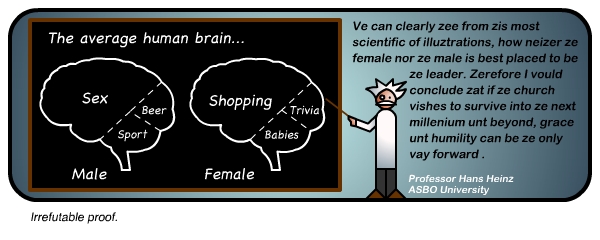
Apparently Mark Heath is a sexist ... well, I don't think so but some others may. He (and I) is a complementarian. Here is his simple yet clear summary of what that means.
But this position leaves him labeled sexist and it bothers him especially in light of the culture that he often finds himself. Ironic.
This position does not seek to deny "equality" between the sexes. On the contrary, it positively affirms that men and women are...
- equally bearers of the image of God
- equal in value or worth
- equal in dignity
- equal in moral responsibility
- equal in salvation (the same "way in" for all)
- equal as recipients of the gift of the Spirit
- (and I would add as a charismatic) equal as recipients of the gifts of the Spirit
However, complementarians also believe that there are differences between male and female, and that these differences are good. They come from God's creative intention. Rather than competing with one another, men and women actually complement one another. One of the ways that complementarians see these differences outworking is in leadership of the local church, specifically the eldership. They believe the New Testament teaches that men are to be called as elders in the church, to serve by exercising authority and taking responsibility for the care and spiritual well-being of those in the congregation.
But this position leaves him labeled sexist and it bothers him especially in light of the culture that he often finds himself. Ironic.
Technorati Tags: women
sola scriptura
Today's theological word of the day ...
Sola Scriptura
(Latin, “the Scripture alone”)
Belief of Protestants that Christian Scripture is the final and only infallible authority for the Christian in matters of faith and practice. Sola Scriptura was coined during the Protestant Reformation of the sixteenth century, but according to Protestants, is found throughout Christian history. The belief in Sola Scriptura contrasts both the Catholic, Mormon, Jehovah’s Witness, and Eastern Orthodox belief that along with Scripture there necessarily exists an infallible authority which either interprets the Scripture with ultimate authority or adds new revelations to supplement the Scripture. Hence, in these traditions, the Scripture is not the final, ultimate, or only infallible authority as there are other authorities equal to that of Scripture. Protestants, on the other hand, while respecting the existence of other authorities (tradition, experience, reason, creation, etc.), do not believe that these are equal to that of Scripture and therefore must always be tested by, and submitted to, Scripture.
Michael Patton offers a 5 part defense at his blog (part 1, 2, 3, 4, 5). I like what he wrote, perhaps you will as well ... regardless, it's worth your time since Patton is the master of the use of charts and you will surely like those.
Update ... part 6, 7
Sola Scriptura
(Latin, “the Scripture alone”)
Belief of Protestants that Christian Scripture is the final and only infallible authority for the Christian in matters of faith and practice. Sola Scriptura was coined during the Protestant Reformation of the sixteenth century, but according to Protestants, is found throughout Christian history. The belief in Sola Scriptura contrasts both the Catholic, Mormon, Jehovah’s Witness, and Eastern Orthodox belief that along with Scripture there necessarily exists an infallible authority which either interprets the Scripture with ultimate authority or adds new revelations to supplement the Scripture. Hence, in these traditions, the Scripture is not the final, ultimate, or only infallible authority as there are other authorities equal to that of Scripture. Protestants, on the other hand, while respecting the existence of other authorities (tradition, experience, reason, creation, etc.), do not believe that these are equal to that of Scripture and therefore must always be tested by, and submitted to, Scripture.
Michael Patton offers a 5 part defense at his blog (part 1, 2, 3, 4, 5). I like what he wrote, perhaps you will as well ... regardless, it's worth your time since Patton is the master of the use of charts and you will surely like those.
Update ... part 6, 7
Sunday, July 06, 2008
bentley and the haters
I've said it before and I'll say it again, I really don't like what I see going on in Lakeland surrounding Todd Bently. I am NOT his defender. But I'll add that I dislike just as much if not more what I see in the detractors exemplified in the likes of Schlueter and Silva.
Here's how their "biblical analysis" runs ...
First - I'm wondering why someone hasn't hunted down this glass-eyeball dude. I don't think that would prove anything overall but it sure would be interesting to find out if this is fact or fiction and if these guys are sincere, easily duped, or flat-out liars.
Then Ingrid Schlueter begins her quite obviously biased analysis. I couldn't help but wonder how easily she could have made the same analysis with Jesus and His followers.
Then Ken Silva makes his sad claim regarding those gold toothed Dutch folks (again it seems like some simple follow-up could be done relative to that). Silva states, "Where exactly do we see gold teeth being popped into people's mouth in Scripture. We don't. ... God doesn't do a new thing that has no bearing in Scripture." What can I say to that? Unbelievable. These guys have such low view of Scripture and the God of the Bible that I am simply at a loss for words.
Jon Sharp then states that this simply repeats the same narrow understanding of God as voiced by Silva. On the other hand, I do like his statement regarding evidence of fruit. I myself would like to see some of this although I'm not sure enough time has passed for that. At this point I am skeptical at best.
Sharp and Silva then respond to Bentley's "violent" methods. Again, I don't like what's going on in Lakeland but I really struggle with the analysis these guys provide. Silva mentions Elijah and says even he didn't do the extreme stuff that Bentley is doing. True. On the other hand it's pretty clear that these guys would not have approved of Elijah either had the stories not been captured in Scripture. Net - they wouldn't accept anyone doing any level of this kind of thing so I find it hypocritical that they are judging Bentley as if he could ever meet their standard.
Schlueter then plays the fruit of the Spirit card which in her analysis could also discredit Our Lord Himself. Net - just plain poor use of Scriptural standards. She claims that the gap is a missing knowledge of the Word of God. Actually I would say these guys have a wrong and limited understanding themselves. They even take this opportunity to poke at the emerging church.
Well I got through 18 minutes of this nonsense and heard enough. They would prefer we simply sit quietly in prayer while reading the Word as a model of Christian living. Sorry, no thanks. I'm glad God offers much more than that.
Oh well ... sin abounds on both sides of this conversation. Me, I'm going to go love God and share that with some others. Bye for now. Let me know if you listened to the rest and learned anything of substance but I pray you also have something better to do.
Here's how their "biblical analysis" runs ...
First - I'm wondering why someone hasn't hunted down this glass-eyeball dude. I don't think that would prove anything overall but it sure would be interesting to find out if this is fact or fiction and if these guys are sincere, easily duped, or flat-out liars.
Then Ingrid Schlueter begins her quite obviously biased analysis. I couldn't help but wonder how easily she could have made the same analysis with Jesus and His followers.
Then Ken Silva makes his sad claim regarding those gold toothed Dutch folks (again it seems like some simple follow-up could be done relative to that). Silva states, "Where exactly do we see gold teeth being popped into people's mouth in Scripture. We don't. ... God doesn't do a new thing that has no bearing in Scripture." What can I say to that? Unbelievable. These guys have such low view of Scripture and the God of the Bible that I am simply at a loss for words.
Jon Sharp then states that this simply repeats the same narrow understanding of God as voiced by Silva. On the other hand, I do like his statement regarding evidence of fruit. I myself would like to see some of this although I'm not sure enough time has passed for that. At this point I am skeptical at best.
Sharp and Silva then respond to Bentley's "violent" methods. Again, I don't like what's going on in Lakeland but I really struggle with the analysis these guys provide. Silva mentions Elijah and says even he didn't do the extreme stuff that Bentley is doing. True. On the other hand it's pretty clear that these guys would not have approved of Elijah either had the stories not been captured in Scripture. Net - they wouldn't accept anyone doing any level of this kind of thing so I find it hypocritical that they are judging Bentley as if he could ever meet their standard.
Schlueter then plays the fruit of the Spirit card which in her analysis could also discredit Our Lord Himself. Net - just plain poor use of Scriptural standards. She claims that the gap is a missing knowledge of the Word of God. Actually I would say these guys have a wrong and limited understanding themselves. They even take this opportunity to poke at the emerging church.
Well I got through 18 minutes of this nonsense and heard enough. They would prefer we simply sit quietly in prayer while reading the Word as a model of Christian living. Sorry, no thanks. I'm glad God offers much more than that.
Oh well ... sin abounds on both sides of this conversation. Me, I'm going to go love God and share that with some others. Bye for now. Let me know if you listened to the rest and learned anything of substance but I pray you also have something better to do.
Technorati Tags: charismata
small groups
I love hanging out with my small group friends ... even if it's just to sit around enjoying God's creation.


Technorati Tags: small groups
remembering the past
The only thing worse than nostalgia is amnesia. ~ Ravi Zacharias, Deliver Us From Evil
radical corruption
Here's just a small example of "radical corruption" as compared with "total depravity". This man is corrupt. Every fiber of his being is affected by Sin. Yet not every fiber of his being does evil continuously.
A bomb-laden van found on a Brooklyn street by a car thief was wired to detonate by remote control, and had likely been sitting there for more than five months, sources said yesterday. ... A thief who broke into the vehicle as it was parked on 53rd Street near Second Avenue saw the explosives, then drove the van from the mostly residential block to a remote location near the waterfront. The thief, who has an arrest record, then phoned a cop he knew from a previous run-in with the law.
Technorati Tags: Calvinism
Saturday, July 05, 2008
the gospel
RC Sproul on the Gospel:
There is no greater message to be heard than that which we call the Gospel. But as important as that is, it is often given to massive distortions or over simplifications. People think they’re preaching the Gospel to you when they tell you, ‘you can have a purpose to your life’, or that ‘you can have meaning to your life’, or that ‘you can have a personal relationship with Jesus.’ All of those things are true, and they’re all important, but they don’t get to the heart of the Gospel.
The Gospel is called the ‘good news’ because it addresses the most serious problem that you and I have as human beings, and that problem is simply this: God is holy and He is just, and I’m not. And at the end of my life, I’m going to stand before a just and holy God, and I’ll be judged. And I’ll be judged either on the basis of my own righteousness – or lack of it – or the righteousness of another. The good news of the Gospel is that Jesus lived a life of perfect righteousness, of perfect obedience to God, not for His own well being but for His people. He has done for me what I couldn’t possibly do for myself. But not only has He lived that life of perfect obedience, He offered Himself as a perfect sacrifice to satisfy the justice and the righteousness of God.
The great misconception in our day is this: that God isn’t concerned to protect His own integrity. He’s a kind of wishy-washy deity, who just waves a wand of forgiveness over everybody. No. For God to forgive you is a very costly matter. It cost the sacrifice of His own Son. So valuable was that sacrifice that God pronounced it valuable by raising Him from the dead – so that Christ died for us, He was raised for our justification. So the Gospel is something objective. It is the message of who Jesus is and what He did. And it also has a subjective dimension. How are the benefits of Jesus subjectively appropriated to us? How do I get it? The Bible makes it clear that we are justified not by our works, not by our efforts, not by our deeds, but by faith – and by faith alone. The only way you can receive the benefit of Christ’s life and death is by putting your trust in Him – and in Him alone. You do that, you’re declared just by God, you’re adopted into His family, you’re forgiven of all of your sins, and you have begun your pilgrimage for eternity.
HT:MR via PC
There is no greater message to be heard than that which we call the Gospel. But as important as that is, it is often given to massive distortions or over simplifications. People think they’re preaching the Gospel to you when they tell you, ‘you can have a purpose to your life’, or that ‘you can have meaning to your life’, or that ‘you can have a personal relationship with Jesus.’ All of those things are true, and they’re all important, but they don’t get to the heart of the Gospel.
The Gospel is called the ‘good news’ because it addresses the most serious problem that you and I have as human beings, and that problem is simply this: God is holy and He is just, and I’m not. And at the end of my life, I’m going to stand before a just and holy God, and I’ll be judged. And I’ll be judged either on the basis of my own righteousness – or lack of it – or the righteousness of another. The good news of the Gospel is that Jesus lived a life of perfect righteousness, of perfect obedience to God, not for His own well being but for His people. He has done for me what I couldn’t possibly do for myself. But not only has He lived that life of perfect obedience, He offered Himself as a perfect sacrifice to satisfy the justice and the righteousness of God.
The great misconception in our day is this: that God isn’t concerned to protect His own integrity. He’s a kind of wishy-washy deity, who just waves a wand of forgiveness over everybody. No. For God to forgive you is a very costly matter. It cost the sacrifice of His own Son. So valuable was that sacrifice that God pronounced it valuable by raising Him from the dead – so that Christ died for us, He was raised for our justification. So the Gospel is something objective. It is the message of who Jesus is and what He did. And it also has a subjective dimension. How are the benefits of Jesus subjectively appropriated to us? How do I get it? The Bible makes it clear that we are justified not by our works, not by our efforts, not by our deeds, but by faith – and by faith alone. The only way you can receive the benefit of Christ’s life and death is by putting your trust in Him – and in Him alone. You do that, you’re declared just by God, you’re adopted into His family, you’re forgiven of all of your sins, and you have begun your pilgrimage for eternity.
HT:MR via PC
love satisfies
In the end, love will satisfy the radical demands of the gospel. Love calls us to poverty. Love calls us to holiness. Without love, poverty becomes an empty and life-draining curse. Without love, holiness degenerates into cold and heartless self-righteousness. ... Is our Christianity radical or fanatical? A fanatic fulfills the radical externals of poverty and holiness but does so without love. Love softens the edge of razor-sharp issues and changes the cutting edge from a sword that kills and maims into a surgical knife that heals. It brings us to a balance between no-compromise and the leniency of wisdom. ~ John Michael Talbot
Technorati Tags: love
Friday, July 04, 2008
amillennialism
I'm thinking of converting to amillennialism ... here's Bobby Grow's primer ...
The Amillennialist affirms that the people of Israel have not been cast off or replaced, but rather, that the Gentiles have now been included among the Jews in God's Covenantal promises. In other words, not replacement but expansion. God's redemptive plan, as first promised to Abraham, was that "all nations" would be blessed through him. Israel is, and always has been, saved the same as any other nation: by the promises to the seed, Christ. Amillennialists, do not believe in a literal 1000 year reign of Christ on earth after His second coming. Rather, they affirm that when Christ returns, the resurrection of both the righteous and wicked will take place simultaneously (see John 5), followed by judgment and and the eternal state where heaven and earth merge and Christ reigns forever.
Strong points of Amillennialism
* It is highly Christocentric: it makes Christ the center of all the biblical covenants (even the “Land” covenant or Siniatic)
* It notes the universal scope of the Abrahamic Covenant (as key) to interpreting the rest of the biblical covenants * It sees salvation history oriented to a person (Christ), instead of a people (the nation of Israel)
* It emphasizes continuity between the “people of God” (Israel and the Church are one in Christ Eph. 2:11ff)
* It provides an ethic that is rooted in creation, and “re-creation” (continuity between God’s redemptive work now, carried over into the eternal state then)
* It emphasizes a trinitarian view of God as it elevates the “person”, Christ Jesus, the second person of the trinity as the point and mediator of all history
* It flows from a hermeneutic that takes seriously the literary character of the Scriptures (esp. the book of Revelation)
HT:JR
Contrary to John McArthur, I may not need to turn in my Calvin Card to make this move ... I hope not.
The Amillennialist affirms that the people of Israel have not been cast off or replaced, but rather, that the Gentiles have now been included among the Jews in God's Covenantal promises. In other words, not replacement but expansion. God's redemptive plan, as first promised to Abraham, was that "all nations" would be blessed through him. Israel is, and always has been, saved the same as any other nation: by the promises to the seed, Christ. Amillennialists, do not believe in a literal 1000 year reign of Christ on earth after His second coming. Rather, they affirm that when Christ returns, the resurrection of both the righteous and wicked will take place simultaneously (see John 5), followed by judgment and and the eternal state where heaven and earth merge and Christ reigns forever.
Strong points of Amillennialism
* It is highly Christocentric: it makes Christ the center of all the biblical covenants (even the “Land” covenant or Siniatic)
* It notes the universal scope of the Abrahamic Covenant (as key) to interpreting the rest of the biblical covenants * It sees salvation history oriented to a person (Christ), instead of a people (the nation of Israel)
* It emphasizes continuity between the “people of God” (Israel and the Church are one in Christ Eph. 2:11ff)
* It provides an ethic that is rooted in creation, and “re-creation” (continuity between God’s redemptive work now, carried over into the eternal state then)
* It emphasizes a trinitarian view of God as it elevates the “person”, Christ Jesus, the second person of the trinity as the point and mediator of all history
* It flows from a hermeneutic that takes seriously the literary character of the Scriptures (esp. the book of Revelation)
HT:JR
Contrary to John McArthur, I may not need to turn in my Calvin Card to make this move ... I hope not.
Technorati Tags: eschatology


tozer on church
All I can say is WOW!!!
One hundred religious persons knit into a unity by careful organization do not constitute a church any more than eleven dead men make a football team. The first requisite is life, always. ~ A.W. Tozer
HT:Philip
One hundred religious persons knit into a unity by careful organization do not constitute a church any more than eleven dead men make a football team. The first requisite is life, always. ~ A.W. Tozer
HT:Philip
Thursday, July 03, 2008
eschatological probabilities
Virgil Vaduva did some excellent work modeling the probability of Jesus' return based on the historic evidence. The results are compelling.


Technorati Tags: eschatology, humor
love love love
Tony Reinke quoted the great C.H. Spurgeon today:
How excellent is that?!?! If you love God, rest assured, it came from Him and you can therefore know that He loves you. Love is a fruit not a root!
Related to that, Dan Goldfinch quotes NT Wright from Simply Christian.
Love is a fruit. We cannot force it. It can only truly come from a heart redeemed by God. In fact, it must come from a heart redeemed by God. And as such, kindness and other behavior indicative of that love will follow. Without this true love, one is left only with a social gospel. The activity may look the same but the value and true effect is worlds apart.
And as Wright describes, this kindness that flows from a heart of love looks like preferring others, sowing into their lives, and not always insisting on our right to be right.
Now what about "living the Gospel"? Like Darryl Dash, I cringe a little when I hear the phrase. Dash notes Graeme Goldsworthy's comment to confirm where that sense comes from:
But as Dash points out, Glenn Kreider counters this well with the following.
Dash's conclusion is excellent! I'm with him on this.
I once knew a good woman who was the subject of many doubts, and when I got to the bottom of her doubt, it was this: she knew she loved Christ, but she was afraid he did not love her. “Oh!” I said, “that is a doubt that will never trouble me; never, by any possibility, because I am sure of this, that the heart is so corrupt, naturally, that love to God never did get there without God’s putting it there.” You may rest quite certain, that if you love God, it is a fruit, and not a root. It is the fruit of God’s love to you, and did not get there by the force of any goodness in you. You may conclude, with absolute certainty, that God loves you if you love God.
How excellent is that?!?! If you love God, rest assured, it came from Him and you can therefore know that He loves you. Love is a fruit not a root!
Related to that, Dan Goldfinch quotes NT Wright from Simply Christian.
The key word, of course, is ‘love,’ and much has been written about that in itself. But I want to draw attention to something else–something often ignored in the clamor for better and clearer rules of Christian behavior: that we should be positively kind to one another. ‘Be kind to one another, tender-hearted, forgiving one another, as God in Christ has forgiven you. Therefore be imitators of God, as beloved children, and live in love, as Christ loved us and gave himself up for us’ (Ephesians 4:32-5:2). The quest for justice all too easily degenerates into the demand for my rights or our rights. The command to kindness asks that we spend our time looking not at ourselves and our needs, our rights, our wrongs-that-need-righting, but at everyone else and their needs, pressures, pains, and joys. Kindness is the primary way of growing up as a human being, of establishing and maintaining the richest and deepest relationships.
Love is a fruit. We cannot force it. It can only truly come from a heart redeemed by God. In fact, it must come from a heart redeemed by God. And as such, kindness and other behavior indicative of that love will follow. Without this true love, one is left only with a social gospel. The activity may look the same but the value and true effect is worlds apart.
And as Wright describes, this kindness that flows from a heart of love looks like preferring others, sowing into their lives, and not always insisting on our right to be right.
Now what about "living the Gospel"? Like Darryl Dash, I cringe a little when I hear the phrase. Dash notes Graeme Goldsworthy's comment to confirm where that sense comes from:
If something is not what God did in and through the historical Jesus two thousand years ago, it is not the gospel...[Christians] can only believe it, proclaim it and seek to live consistently with it. Only Jesus lived (and died) the gospel. It is a once-for-all finished and perfect event done for us by another.
But as Dash points out, Glenn Kreider counters this well with the following.
Certainly the gospel (good news) is grounded in the work of Christ, but it would seem to include the future work of Christ as well (including His return and the new creation), as well as blessing for all believers (Gal. 3:8). Furthermore this limitation seems inconsistent with Goldworthy's definition of the gospel as "the event (or proclamation of that event) of Jesus Christ that begins with his incarnation and earthly life, and concludes with his death, resurrection and ascension to the right hand of the Father" (p. 58). Would not the proclamation of the work of Christ be something that Christians do, and would not that proclamation include living the message as well? In short, how does one separate the verbal and incarnational ministry of the gospel? Did not Paul indicate that Christians do live the gospel when he wrote that "we always carry around in our body the death of Jesus" (2 Cor. 4:10 NIV)? It would seem that one way to understand Paul's testimony in Philippians 3:10-11 is as affirming his desire to live the gospel. "I want to know Christ and the power of his resurrection and the fellowship of his sufferings, becoming like him in his death, and so somehow, to attain to the resurrection of the dead" (NIV). Also, Goldworthy's emphasis on the eschatological trajectory of the biblical story seems difficult to reconcile with the strong limitation of the work of Christ completed in the past. He writes, "God's plan from all creation was the new creation and a people created and redeemed in Christ. The blueprint of creation and of all history is the gospel"
Dash's conclusion is excellent! I'm with him on this.
One of our greatest needs is to keep our definitions of the Gospel centered on the work of God in Christ rather than our own works, but then to include all the work that God did through Christ as good news of what God has done and continues to do.
Technorati Tags: love
preaching can hurt
Bob Hyatt's short post Preaching: This Might Hurt A Little ... was excellent! I have not preached on a regular basis but this little story reminded me of one of my own. First the one Hyatt quotes:
Now mine:
Hyatt tells us:
Here's what I tell small group leaders; we want people to feel safe, BUT we do not want them to feel comfortable. As believers we are to constantly spur each other on to Christ-likeness. That is very often not a comfortable process.
A person emerged from our church a few Sundays ago, saying to me at the door as she left, 'I know you would not intentionally hurt anyone with what you say from the pulpit, but I was hurt by what you said today in your sermon.'
And I thought, 'Where would you have gotten the notion that I would not want to hurt you? I'm a preacher. Some infliction of pain goes with the job! ~ Will Willimon, Pastor
Now mine:
A person emerged from our church a few Sundays ago, saying to me at the door as she left, 'That was one of the best sermons I've ever heard. You are so funny.'
And I thought, 'Ouch!' I went home sad that day.
Hyatt tells us:
I heard plenty of sermons on sexual sin and few if any on the sin of ignoring the poor when I grew up.
But I'm fairly sure the answer to that problem isn't to preach a lot on the sin of ignoring the poor and leave off the messages about sexual sin. It's as easy to preach a sermon on God's heart for the poor in an emerging church as it is to preach on purity in a Baptist one. And that should tell us something.
Here's what I tell small group leaders; we want people to feel safe, BUT we do not want them to feel comfortable. As believers we are to constantly spur each other on to Christ-likeness. That is very often not a comfortable process.
mccain survives shakeup
McCain Survives Campaign Shakeup
by Scott Ott for ScrappleFace
(2008-07-02) — When political campaigns reorganize to revitalize a struggling effort, heads roll. However, aides say Sen. John McCain has survived this week’s shakeup in the McCain for President campaign.
Under new management by Steve Schmidt, a former political operative for George Bush, the GOP presidential campaign was expected to jettison everyone who has failed to consistently, and effectively communicate the conservative message to voters.
While Sen. McCain’s name reportedly showed up on the “short list” he has apparently weathered the most recent round of cuts.
by Scott Ott for ScrappleFace
(2008-07-02) — When political campaigns reorganize to revitalize a struggling effort, heads roll. However, aides say Sen. John McCain has survived this week’s shakeup in the McCain for President campaign.
Under new management by Steve Schmidt, a former political operative for George Bush, the GOP presidential campaign was expected to jettison everyone who has failed to consistently, and effectively communicate the conservative message to voters.
While Sen. McCain’s name reportedly showed up on the “short list” he has apparently weathered the most recent round of cuts.
Technorati Tags: current events, humor, politics
what is salvation
Salvation is not merely an objective reality to be wondered at, a theological dictum to be debated about, a philosophical theory to be speculated about—not even merely a marvelous subject to be preached about.
It is a divine reality entering the human being to transform his fundamental disposition, cleanse him from sin and unrighteousness, redeem him from bondage and corruption, impart to him the nature of God, recreate in him the image of Christ, make him a child of God, a member of the household of God, and qualify him through the gift of the Holy Spirit to live a life of true discipleship in the midst of a world almost destitute of the consciousness of God and eternity.
~ George W. Peters, A Biblical Theology of Missions
HT:Bart
It is a divine reality entering the human being to transform his fundamental disposition, cleanse him from sin and unrighteousness, redeem him from bondage and corruption, impart to him the nature of God, recreate in him the image of Christ, make him a child of God, a member of the household of God, and qualify him through the gift of the Holy Spirit to live a life of true discipleship in the midst of a world almost destitute of the consciousness of God and eternity.
~ George W. Peters, A Biblical Theology of Missions
HT:Bart
love everlasting
The sovereign choice of the Father, by which he elected us unto eternal life, or ever the earth was, is a matter of vast antiquity, since no date can be conceived for it by the mind of man. We were chosen from before the foundations of the world. Everlasting love went with the choice, for it was not a bare act of divine will by which we were set apart, but the divine affections were concerned. The Father loved us in and from the beginning. Here is a theme for daily contemplation. The eternal purpose to redeem us from our foreseen ruin, to cleanse and sanctify us, and at last to glorify us, was of infinite antiquity, and runs side by side with immutable love and absolute sovereignty. ~ C.H. Spurgeon
HT:Philip
HT:Philip
Technorati Tags: love, sovereignty
Wednesday, July 02, 2008
for his glory
[T]herefore it must chiefly consist in giving due respect to that Being to whom most is due; for God is infinitely the most worthy of regard. The worthiness of others is as nothing to his; so that to him belongs all possible respect. To him belongs the whole of the respect that any intelligent being is capable of. To him belongs ALL the heart. Therefore, if moral rectitude of heart consists in paying the respect of the heart which is due, or which fitness or suitableness require, fitness requires infinitely the greatest regard to be paid to God; and the denying of supreme regard here would be a conduct infinitely the most unfit. Hence it will follow, that the moral rectitude of the disposition, inclination, or affection of God CHIEFLY consists in regard to HIMSELF, infinitely above his regard to all other beings; or, in other words, his holiness consists in this. ~ Jonathan Edwards
The rest of the story.
The rest of the story.
one of 8 million
Yep - here it is, my official certificate for being one of over 8 million who participated in Firefox's record breaking download day.

I know ... pretty special ...

I know ... pretty special ...
america the great
I love God and I love America. I am bothered (not equally) by those that criticize either. Today Dr. James Emery White posted Another Revolution Worth Fighting For = a must read! I added the emphasis below.
Another Revolution Worth Fighting For
When America’s second president, John Adams, and America’s third president, Thomas Jefferson, both died on the same day in 1826 – and that day was none other than the Fourth of July – it was seen as a sign of God’s favor on the United States. As historian David McCullough notes in his widely-acclaimed biography of Adams, it “could not be seen as mere coincidence.” It was a ‘visible and palpable’ manifestation of ‘Divine favor,’ wrote John Quincy in his diary that night, “expressing,” McCullough adds, “what was felt and would be said again and again everywhere the news spread.”
The idea of “choseness” and “special blessing” from God has been a constant theme throughout the history of the United States, beginning with the Puritans and their “city on a shining hill.” In more recent times, the vision of a Christian America was popularized in the late 1970’s by Evangelical authors Peter Marshall and David Manuel in The Light and the Glory. Marshall and Manuel held that America was founded as a Christian nation and flourished under the benevolent hand of divine providence, arguing further that America's blessings will remain only as long as America is faithful to God as a nation. In 1989 a team of Evangelical historians (Mark Noll, Nathan Hatch, and George Marsden) attempted to lay this somewhat dubious thesis to rest, but it continued as a popular framework for viewing American history among contemporary American Evangelicals.
Whether we were founded as an explicitly Christian nation or not, to many, the idea of God’s favor being removed from our land seems prescient.
As a recent Associated Press article suggested, “everything seemingly is spinning out of control,” with the article going on to note how Midwestern levees are bursting; polar bears are adrift; gas prices are skyrocketing; home values are abysmal; air fares are beyond reach; wars without end rage in Iraq and Afghanistan.
An Associated Press poll reveals that only 17 percent of Americans believe the country is moving in the right direction (the lowest reading in history since their annual survey began). An ABC News-Washington Post survey put that figure at 14 percent, tying the low in more than three decades of taking soundings of the American mood.
Whether the current national malaise can be attributed to God’s disfavor or not, I am more convinced than ever that American needs to turn to what Christian moorings it once maintained. But not for America’s sake, per se, or even for the sake of Western culture.
But for the Kingdom’s sake.
America is not simply the leader of the modern world, but the principal carrier of globalization and exporter of culture. The ideas which lie at the heart of the West, and particularly the United States, are Judeo-Christian. Yet America is at great spiritual risk, and much of our current despondency is tied to our need for God far more than our need for economic relief. The very values and ideas that shaped us as a nation, and could therefore shape the world, are being lost. This has led some, such as Os Guinness, to call for a “third” mission to the West.
The first mission, of course, was the apostolic mission that eventually resulted in the conversion of the Roman Empire. The second mission followed the fall of Rome as missionaries refounded Western civilization and essentially reconverted the west back to Christianity from paganism, what Thomas Cahill referred to in the title of his book How the Irish Saved Civilization.
A third mission would seek to restore America as the leader of the Western world to her Judeo-Christian roots, ensuring continued vibrancy and influence for years to come.
Not to stave off “curse” and receive “blessing;” but instead to be a blessing to others for the sake of Christ.
And that would be another American Revolution worth fighting for.
Another Revolution Worth Fighting For
When America’s second president, John Adams, and America’s third president, Thomas Jefferson, both died on the same day in 1826 – and that day was none other than the Fourth of July – it was seen as a sign of God’s favor on the United States. As historian David McCullough notes in his widely-acclaimed biography of Adams, it “could not be seen as mere coincidence.” It was a ‘visible and palpable’ manifestation of ‘Divine favor,’ wrote John Quincy in his diary that night, “expressing,” McCullough adds, “what was felt and would be said again and again everywhere the news spread.”
The idea of “choseness” and “special blessing” from God has been a constant theme throughout the history of the United States, beginning with the Puritans and their “city on a shining hill.” In more recent times, the vision of a Christian America was popularized in the late 1970’s by Evangelical authors Peter Marshall and David Manuel in The Light and the Glory. Marshall and Manuel held that America was founded as a Christian nation and flourished under the benevolent hand of divine providence, arguing further that America's blessings will remain only as long as America is faithful to God as a nation. In 1989 a team of Evangelical historians (Mark Noll, Nathan Hatch, and George Marsden) attempted to lay this somewhat dubious thesis to rest, but it continued as a popular framework for viewing American history among contemporary American Evangelicals.
Whether we were founded as an explicitly Christian nation or not, to many, the idea of God’s favor being removed from our land seems prescient.
As a recent Associated Press article suggested, “everything seemingly is spinning out of control,” with the article going on to note how Midwestern levees are bursting; polar bears are adrift; gas prices are skyrocketing; home values are abysmal; air fares are beyond reach; wars without end rage in Iraq and Afghanistan.
An Associated Press poll reveals that only 17 percent of Americans believe the country is moving in the right direction (the lowest reading in history since their annual survey began). An ABC News-Washington Post survey put that figure at 14 percent, tying the low in more than three decades of taking soundings of the American mood.
Whether the current national malaise can be attributed to God’s disfavor or not, I am more convinced than ever that American needs to turn to what Christian moorings it once maintained. But not for America’s sake, per se, or even for the sake of Western culture.
But for the Kingdom’s sake.
America is not simply the leader of the modern world, but the principal carrier of globalization and exporter of culture. The ideas which lie at the heart of the West, and particularly the United States, are Judeo-Christian. Yet America is at great spiritual risk, and much of our current despondency is tied to our need for God far more than our need for economic relief. The very values and ideas that shaped us as a nation, and could therefore shape the world, are being lost. This has led some, such as Os Guinness, to call for a “third” mission to the West.
The first mission, of course, was the apostolic mission that eventually resulted in the conversion of the Roman Empire. The second mission followed the fall of Rome as missionaries refounded Western civilization and essentially reconverted the west back to Christianity from paganism, what Thomas Cahill referred to in the title of his book How the Irish Saved Civilization.
A third mission would seek to restore America as the leader of the Western world to her Judeo-Christian roots, ensuring continued vibrancy and influence for years to come.
Not to stave off “curse” and receive “blessing;” but instead to be a blessing to others for the sake of Christ.
And that would be another American Revolution worth fighting for.
reformed primer
Joe Holland just posted Reformed Theology in One Verse at Symphony of Scripture. This is excellent and is quoted in its entirety below. I added some emphasis.
“He who calls you is faithful; he will surely do it.” (1 Thessalonians 5:24)
“He who calls you…” God initiates relationship with sinners. This is contrary to every other religion that tells you how to seek God. The fallacy of seeking God is that sin has made man incapable and unwilling of seeking God. It is the farthest thing from fallen man’s desire. That is not to say that fallen men and women do not seek gods. They seek, find, and make gods–idols–everywhere. But they want no part of the true God. He is utterly unlovely and undesirable to the fallen mind.
No, God must and does seek sinners. The story of the Bible is of a holy God calling sinful men and women into relationship with himself. His call, made efficacious by the Holy Spirit, changes a man’s nature. That change, made possible by the atoning death of Jesus Christ, makes God utterly beautiful and worthy of worship. But make no mistake, relationship with God is initiated by God.
“…is faithful…” Good relationships die without faithfulness. Whether friendship, business relationship, marriage, or divine covenant, faithfulness must be present. Every other religion touts man’s faithfulness to God as the basis of divine relationship. Man performs; God rewards.
Only this runs contrary to all that we know about ourselves. Humans live in relational carnage. The best and deepest of human relationships are scarred by failed expectations. The experiment of fallen humanity has produced one law: man is unfaithful.
This is the glory of the gospel–of the Reformed variety. It is God who is faithful for both himself and man. Jesus Christ took up man’s place in his incarnation and lived an utterly faithful life to God even unto death. This faithfulness is imputed to Christians by God’s free grace through faith. Man is made faithful in Christ. God–unchangeable by nature–roots the promise of redemption in his own faithful character. True relationship with God is built on God’s faithfulness alone.
“…he will surely do it.” The “it” of this statement is the completed salvation mentioned in the previous verse. Many Christians will claim God’s sovereignty in salvation but vacillate when it comes to God’s sovereignty in Christian living. They end up advocating a “justified by God, sanctified by self” view of Christian life.
What does this look like? The litmus test is easy. Self-sanctification is motivated by guilt. God-sanctification is motivated by grace. Self-sanctification looks at soul depravity and says, “I’m a failure I must do better. I need to read my Bible more, pray more, evangelize more, give more, attend church more. I will surely do it.”
God-sanctification looks at soul depravity and says, “I’m a failure. I must repent of my sins and find Jesus Christ to be my perfect righteousness. Out of thankfulness for free grace and through God’s power, I want to read my Bible more, pray more, evangelize more, give more, attend church more. God will surely do it.”
It is God who works in us to will and to do of his own good pleasure. God’s sovereign grace justifies us. God’s sovereign grace sanctifies us. Jesus Christ is for us our righteousness and sanctification (1 Corinthians 1:30). This is the essence of Reformed Theology, “He who calls you is faithful; he will surely do it.” It stands in contrast to man-centered Theology which says, “I who call upon God am faithful; I will surely do it.”
This is Reformed Theology. But more importantly, this is the Bible’s theology.
“He who calls you is faithful; he will surely do it.” (1 Thessalonians 5:24)
“He who calls you…” God initiates relationship with sinners. This is contrary to every other religion that tells you how to seek God. The fallacy of seeking God is that sin has made man incapable and unwilling of seeking God. It is the farthest thing from fallen man’s desire. That is not to say that fallen men and women do not seek gods. They seek, find, and make gods–idols–everywhere. But they want no part of the true God. He is utterly unlovely and undesirable to the fallen mind.
No, God must and does seek sinners. The story of the Bible is of a holy God calling sinful men and women into relationship with himself. His call, made efficacious by the Holy Spirit, changes a man’s nature. That change, made possible by the atoning death of Jesus Christ, makes God utterly beautiful and worthy of worship. But make no mistake, relationship with God is initiated by God.
“…is faithful…” Good relationships die without faithfulness. Whether friendship, business relationship, marriage, or divine covenant, faithfulness must be present. Every other religion touts man’s faithfulness to God as the basis of divine relationship. Man performs; God rewards.
Only this runs contrary to all that we know about ourselves. Humans live in relational carnage. The best and deepest of human relationships are scarred by failed expectations. The experiment of fallen humanity has produced one law: man is unfaithful.
This is the glory of the gospel–of the Reformed variety. It is God who is faithful for both himself and man. Jesus Christ took up man’s place in his incarnation and lived an utterly faithful life to God even unto death. This faithfulness is imputed to Christians by God’s free grace through faith. Man is made faithful in Christ. God–unchangeable by nature–roots the promise of redemption in his own faithful character. True relationship with God is built on God’s faithfulness alone.
“…he will surely do it.” The “it” of this statement is the completed salvation mentioned in the previous verse. Many Christians will claim God’s sovereignty in salvation but vacillate when it comes to God’s sovereignty in Christian living. They end up advocating a “justified by God, sanctified by self” view of Christian life.
What does this look like? The litmus test is easy. Self-sanctification is motivated by guilt. God-sanctification is motivated by grace. Self-sanctification looks at soul depravity and says, “I’m a failure I must do better. I need to read my Bible more, pray more, evangelize more, give more, attend church more. I will surely do it.”
God-sanctification looks at soul depravity and says, “I’m a failure. I must repent of my sins and find Jesus Christ to be my perfect righteousness. Out of thankfulness for free grace and through God’s power, I want to read my Bible more, pray more, evangelize more, give more, attend church more. God will surely do it.”
It is God who works in us to will and to do of his own good pleasure. God’s sovereign grace justifies us. God’s sovereign grace sanctifies us. Jesus Christ is for us our righteousness and sanctification (1 Corinthians 1:30). This is the essence of Reformed Theology, “He who calls you is faithful; he will surely do it.” It stands in contrast to man-centered Theology which says, “I who call upon God am faithful; I will surely do it.”
- It is God who initiates through his gracious call.
- It is God who alone is faithful for himself by his nature and for us through Christ.
- It is God who accomplishes our salvation through the indwelling Holy Spirit.
This is Reformed Theology. But more importantly, this is the Bible’s theology.
importance of dialogue
Matt Dabbs just posted a quote from Dan Kimball's Emerging Church.
I agree completely with the point. I would only add that, "yep, this is a general truth." That is, this is not only for a theological context, an emerging culture, etc.. This is always true when working with people. Leaders must find ways to help people learn, to think, and to draw their own conclusions. That doesn't mean any conclusion is ok, it means we have to be smart as we guide folks.
We must cultivate a culture that allows dialogue. Evangelicals have been criticized–many times rightly so–for being dogmatic and closed-minded. For too long we have been doing all the talking, without any dialogue. We are now serving new generations that have serious trust issues, and trust is not earned by takling just one-way. We must disarm this criticism and regain trust. We need to encourage, not discourage, people to think, to question, to discover. Why are we so afraid of encouraging people to think for themselves?…At the very least, we need to constantly encourage our listeners to check out our teaching for themselves, measuring them against Scripture. We must avoid, at all costs, giving the impression that we have all the answers and they don’t. We may indeed have answers, but if we appear to be arrogant about it, we’ll lose our voice. We need to encourage people to think. We need to encourage dialogue, even encourage people to challenge what we say. This can disarm people and prompt them to study more to see if what we are saying is true…We must be creative and have dialogue as a core value for how we communicate to and teach emerging generations. This is a huge necessity for being a missional leader in the emerging culture.
I agree completely with the point. I would only add that, "yep, this is a general truth." That is, this is not only for a theological context, an emerging culture, etc.. This is always true when working with people. Leaders must find ways to help people learn, to think, and to draw their own conclusions. That doesn't mean any conclusion is ok, it means we have to be smart as we guide folks.
a.d. am pm
From my friends at Common English Errors ...
A.D.
“A.D.” does not mean “after death,” as many people suppose. “B.C.” stands for the English phrase “before Christ,” but “A.D.” stands confusingly for a Latin phrase: anno domini (“in the year of the Lord”—the year Jesus was born). If the calendar actually changed with Jesus’ death, then what would we do with the years during which he lived? Since Jesus was probably actually born around 6 B.C. or so, the connection of the calendar with him can be misleading.
AM/PM
“AM” stands for the Latin phrase Ante Meridiem —which means “before noon”—and “PM” stands for Post Meridiem : “after noon.” Although digital clocks routinely label noon “12:00 PM” you should avoid this expression not only because it is incorrect, but because many people will imagine you are talking about midnight instead. The same goes for “12:00 AM.” Just say or write “noon” or “midnight” when you mean those precise times.
It is now rare to see periods placed after these abbreviations: “A.M.” , but in formal writing it is still preferable to capitalize them, though the lower-case “am” and “pm” are now so popular they are not likely to get you into trouble.
Occasionally computer programs encourage you to write “AM” and “PM” without a space before them, but others will misread your data if you omit the space. The nonstandard habit of omitting the space is spreading rapidly, and should be avoided in formal writing.
A.D.
“A.D.” does not mean “after death,” as many people suppose. “B.C.” stands for the English phrase “before Christ,” but “A.D.” stands confusingly for a Latin phrase: anno domini (“in the year of the Lord”—the year Jesus was born). If the calendar actually changed with Jesus’ death, then what would we do with the years during which he lived? Since Jesus was probably actually born around 6 B.C. or so, the connection of the calendar with him can be misleading.
AM/PM
“AM” stands for the Latin phrase Ante Meridiem —which means “before noon”—and “PM” stands for Post Meridiem : “after noon.” Although digital clocks routinely label noon “12:00 PM” you should avoid this expression not only because it is incorrect, but because many people will imagine you are talking about midnight instead. The same goes for “12:00 AM.” Just say or write “noon” or “midnight” when you mean those precise times.
It is now rare to see periods placed after these abbreviations: “A.M.” , but in formal writing it is still preferable to capitalize them, though the lower-case “am” and “pm” are now so popular they are not likely to get you into trouble.
Occasionally computer programs encourage you to write “AM” and “PM” without a space before them, but others will misread your data if you omit the space. The nonstandard habit of omitting the space is spreading rapidly, and should be avoided in formal writing.
immanence
The theological word of the day ...
Immanence
Lat. immaneentia “indwelling” or “to remain within”
The theological understanding that God is close to or “within” the natural order, contributing to the world by his active presence. This activity is expressed through his providential control of the universe and through his relational involvement. The doctrine of immanence is to be contrasted but not separated from God’s transcendence (meaning God’s being is independent of the world and all things physical). Christian theism believes that God is both immanent and transcendent at the same time.
Immanence
Lat. immaneentia “indwelling” or “to remain within”
The theological understanding that God is close to or “within” the natural order, contributing to the world by his active presence. This activity is expressed through his providential control of the universe and through his relational involvement. The doctrine of immanence is to be contrasted but not separated from God’s transcendence (meaning God’s being is independent of the world and all things physical). Christian theism believes that God is both immanent and transcendent at the same time.
Tuesday, July 01, 2008
wright on scripture
In other words, the Bible isn’t there simply to be an accurate reference point for people who want to look things up and be sure they’ve got them right. It is there to equip God’s people to carry forward his purposes of new covenant and new creation. It is there to enable people to work for justice, to sustain their spirituality as they do so, to create and enhance relationships at every level, and to produce that new creation which will have about it something of the beauty of God himself. The Bible isn’t like an accurate description of how a car is made. It’s more like the mechanic who helps you fix it, the garage attendant who refuels it, and the guide who tells you how to get where you’re going. And where you’re going is to make God’s new creation happen in his world, not simply to find your own way unscathed through the old creation…The Bible is there to enable God’s people to be equipped to do God’s work in God’s world, not to give them an excuse to sit back smugly, knowing they possess all God’s truth. ~ NT Wright, Simply Christian
HT:DG
HT:DG
Technorati Tags: Scripture
for calvinists only
“A man is not saved because he believes in Christ; he believes in Christ because he is saved.” ~ Loraine Boettner, The Reformed Doctrine of Predestination
HT:JH
HT:JH
knowing christ
"The knowledge of Christ," he argued, "...is not the apprehension of what he is, simply by the intellect, but also a due apprehension of his glory as a divine person arrayed in our nature, and involves not as its consequence merely, but as one of its elements, the corresponding feeling of adoration, delight, desire and complacency." ~ Charles Hodge quoted by Paul Kjoss Helseth in Reclaiming the Center: Confronting Evangelical Accommodation in Postmodern Times
HT:MD
HT:MD
for politicians
Whether your Obama or McCain (or anyone else for that matter) ... John Piper reminds us of these two Scriptures:
Now:
On an appointed day Herod put on his royal robes, took his seat upon the throne, and delivered an oration to them. And the people were shouting, “The voice of a god, and not of a man!” Immediately an angel of the Lord struck him down, because he did not give God the glory, and he was eaten by worms and breathed his last. (Acts 12:21-23)
Or later:
It is better for you to enter the kingdom of God with one eye than with two eyes to be thrown into hell, "where their worm does not die and the fire is not quenched." (Mark 9:47-48)
Now:
On an appointed day Herod put on his royal robes, took his seat upon the throne, and delivered an oration to them. And the people were shouting, “The voice of a god, and not of a man!” Immediately an angel of the Lord struck him down, because he did not give God the glory, and he was eaten by worms and breathed his last. (Acts 12:21-23)
Or later:
It is better for you to enter the kingdom of God with one eye than with two eyes to be thrown into hell, "where their worm does not die and the fire is not quenched." (Mark 9:47-48)
Monday, June 30, 2008
religious tolerance
Here's a big surprise, not everyone who professes to be Christian really is. The New York Times reports that, "although a majority of Americans say religion is very important to them, nearly three-quarters of them say they believe that many faiths besides their own can lead to salvation." The article acknowledges that "many Americans ... hold beliefs that might contradict the doctrines of their professed faiths."
I'm a simple minded man. If one holds beliefs that is in contradiction to the core of what one claims to believe, then it seems to me that one doesn't really believe what is claimed. Or perhaps this person has abandoned absolutes as a possibility leaving us able to claim anything without really meaning it.
The survey concluded that "70 percent of Americans affiliated with a religion or denomination said they agreed that “many religions can lead to eternal life,” including majorities among Protestants and Catholics. Among evangelical Christians, 57 percent agreed with the statement, and among Catholics, 79 percent did. Among minority faiths, more than 80 percent of Jews, Hindus and Buddhists agreed with the statement, and more than half of Muslims did."
Oddly, 20% of those identifying themselves as atheists said they believe in God. Huh?
I see this as just another data point reinforcing the fallenness and deception that has gripped our world. Unorthodoxology thinks this "less exclusive view of God" is "amen" worthy. Perhaps there is a play on words there that was wasted on me but his limited commenters also seem happy with the news.
For those that fit into the category identified in this survey as religiously tolerant, here are some kind words from Francis Schaeffer in A Christian Worldview:
How do we obtain salvation? Salvation is obtained by faith in Christ, plus nothing.
I'm a simple minded man. If one holds beliefs that is in contradiction to the core of what one claims to believe, then it seems to me that one doesn't really believe what is claimed. Or perhaps this person has abandoned absolutes as a possibility leaving us able to claim anything without really meaning it.
The survey concluded that "70 percent of Americans affiliated with a religion or denomination said they agreed that “many religions can lead to eternal life,” including majorities among Protestants and Catholics. Among evangelical Christians, 57 percent agreed with the statement, and among Catholics, 79 percent did. Among minority faiths, more than 80 percent of Jews, Hindus and Buddhists agreed with the statement, and more than half of Muslims did."
Oddly, 20% of those identifying themselves as atheists said they believe in God. Huh?
I see this as just another data point reinforcing the fallenness and deception that has gripped our world. Unorthodoxology thinks this "less exclusive view of God" is "amen" worthy. Perhaps there is a play on words there that was wasted on me but his limited commenters also seem happy with the news.
For those that fit into the category identified in this survey as religiously tolerant, here are some kind words from Francis Schaeffer in A Christian Worldview:
How do we obtain salvation? Salvation is obtained by faith in Christ, plus nothing.
- John 3:15, 16, 18 We have used these verses a number of times, but they are worth looking at again to see how clearly Christ says that salvation is received by faith in Him, plus nothing.
- John 3:36 John the Baptist emphasizes that salvation is through faith plus nothing.
- Romans 3:9-20 By the deeds of the law — that is, by good works — no man is or can be just in the sight of God.
- Isaiah 64:6 Even our best works are not good enough in the sight of the holy God. Even when the outward acts are good, who can completely untangle all the mixed and complex motives which move us?
- Galatians 3:24 God never gave the law (the Ten Commandments, the Sermon on the Mount, or any other commands) as though salvation would come through the keeping of it. As far as salvation goes, each of God’s laws shows us that we need Christ.
- Romans 2:1-3 Men do not even keep their own made-up norms, by which they judge others.
- Acts 16:30-33 Just as moral good works cannot save us, so also religious good works cannot save us. Baptism is a sign of salvation, not the basis for it.
- Romans 4:9-11 It was the same in the Old Testament. Abraham put his faith in God. Circumcision came later. Religious good works cannot save.
- Romans 9:6 Not all the Old Testament Jews were true spiritual Israel. Neither today will church membership in itself save. Salvation is indeed ours only on the basis of faith in Christ, plus nothing.
- Romans 9:30-33 Those Jews who were not true spiritual Israel were those who tried to come to God on the basis of their religious and moral “good works” instead of by faith.
- Galatians 2:16 Salvation is never on the basis of any kind of good works.
- Romans 3:21-26 Good works cannot save us, but faith in Christ will. The word “freely” in 3:24 means “gratis.” There is no cost to us.
- John 8:24 There is only one way of salvation. If we do not accept Christ as our Savior, we remain under the judgment of God.
- John 14:6 There are not many ways of salvation. There is only one way to come to God the Father. There is no way to come to God the Father except through Christ.
- Acts 4:12 It is faith in Christ or nothing.

providence redux
As a Calvinist, I am often approached with the question, "how much control does God have?" I tend to read into that question more of a statement, i.e., "if you only realized that you are saying God had complete control, you would change your mind." Which is interesting because the more I understand just how in control God is, the more convinced it is true and cannot be any other way.
John Piper posted today a list of examples from Scripture of God's providence.
What do you mean by the providence of God? (Question 27)
What advantage is it to us to know that God has created, and by his providence does still uphold all things? (Question 28)
John Piper posted today a list of examples from Scripture of God's providence.
- “I have commanded the ravens to feed you there” (1Kings 17:4)
- “The Lord God appointed a plant and made it come up over Jonah” (Jonah 4:6).
- “God appointed a worm that attacked the plant, so that it withered” (Jonah 4:7).
- “I will send swarms of flies on you and your servants” (Exodus 8:21).
- “He summoned a famine on the land and broke all supply of bread” (Psalms 105:16).
- “He gave them hail for rain” (Psalms 105:32).
- “He spoke, and the locusts came” (Psalms 105:34).
- “The Lord will whistle for . . . the bee that is in the land of Assyria” (Isaiah 7:18).
- “The lot is cast into the lap, but its every decision is from the Lord” (Proverbs 16:33).
- “Even the wind and the sea obey him” (Mark 4:41).
- “He removes kings and sets up kings” (Daniel 2:21).
- “Even the unclean spirits, and they obey him” (Mark 1:27).
- “He upholds the universe by the word of his power” (Hebrews 1:3).
What do you mean by the providence of God? (Question 27)
The almighty and everywhere present power of God; whereby, as it were by his hand, he upholds and governs heaven, earth, and all creatures; so that herbs and grass, rain and drought, fruitful and barren years, meat and drink, health and sickness, riches and poverty, yea, and all things come, not by chance, but by his fatherly hand.
What advantage is it to us to know that God has created, and by his providence does still uphold all things? (Question 28)
That we may be patient in adversity; thankful in prosperity; and that in all things, which may hereafter befall us, we place our firm trust in our faithful God and Father, that nothing shall separate us from his love; since all creatures are so in his hand, that without his will they cannot so much as move.
the cross and sin
"The grace of God reveals One who loves us so much as to have made Calvary possible, but who hates sin so much as to make Calvary necessary." ~ T.S. Mooney
HT:Philip
“Q: Who has truly pondered the weight of sin?
A: The one who has truly pondered the weight of the cross.”
~ Anselm of Canterbury, quoted by Micahel D. Williams in Far as the Curse is Found
HT:OFI
HT:Philip
“Q: Who has truly pondered the weight of sin?
A: The one who has truly pondered the weight of the cross.”
~ Anselm of Canterbury, quoted by Micahel D. Williams in Far as the Curse is Found
HT:OFI
where's brian head welch?
 “Unlike most people, I had a childhood dream to become a rock star that came true. I was able to do what I wanted to do, go where I wanted to go, and buy what I wanted to buy. Unlike most people, I gave all this up - my music, my band, my career, everything - when I had an encounter with God.” ~ Brian ‘Head’ Welch, formerly of KoRn.
Today Brian is living at his orphanage in India. More details available by Paul Del Signore.
Technorati Tags: current events
Sunday, June 29, 2008

proper trusting
The Christian life is built upon the foundation of (1) facing who you really are and (2) trusting who Christ truly is. Everything you do will be shaped by the degree to which you act on the blessings that are yours in Christ.
If you only look at yourself and carry around a load of guilt, you will hide, excuse, blame, rationalize, and cover up your shame rather than enjoy the freedom of confession and the joy of forgiveness. You will not enjoy the lasting fruit that comes from following the wisdom that is already yours in Christ! Instead, you will reduce the Christian life to a simplistic list of rules and behaviors that never touch the real problems, and you will be blind to the gaps in your relationship to Christ. ~ Timothy S. Lane & Paul David Tripp, How People Change
If you only look at yourself and carry around a load of guilt, you will hide, excuse, blame, rationalize, and cover up your shame rather than enjoy the freedom of confession and the joy of forgiveness. You will not enjoy the lasting fruit that comes from following the wisdom that is already yours in Christ! Instead, you will reduce the Christian life to a simplistic list of rules and behaviors that never touch the real problems, and you will be blind to the gaps in your relationship to Christ. ~ Timothy S. Lane & Paul David Tripp, How People Change
Saturday, June 28, 2008
jesse jackson ... oh noooooo ...
“What Barack Obama has accomplished is the single most extraordinary event that has occurred in the 232 years of the nation’s political history. The event itself is so extraordinary that another chapter could be added to the Bible to chronicle its significance,” declared Congressman Jesse Jackson, Jr. of Chicago.
Technorati Tags: politics
360 degrees
From Common Errors in English:
When you turn 360 degrees you’ve completed a circle and are back where you started. So if you want to describe a position that’s diametrically opposed to another, the expression you want is not “360 degrees away” but “180 degrees away.”
When you turn 360 degrees you’ve completed a circle and are back where you started. So if you want to describe a position that’s diametrically opposed to another, the expression you want is not “360 degrees away” but “180 degrees away.”
mahaney on god's holiness
Adrian Warnock recently posted this sermon on The Holiness Of God by CJ Mahaney. The key point is that the "holiness of God has been neglected to our detriment." I didn't relate to much of the joking/story-telling (probably because you "had to be there") but the message is essential.
I found it to be informative, correct, and inspirational. At the same time I want to demonstrate some fairness by saying Mahaney overstepped when he said, "I believe all attributes of God need to be understood in light of the holiness of God. And that the starting point for understanding any attribute of God is the holiness of God. So I don't believe we can just isolate mercy and love and faithfulness on their own. I believe it's a holy mercy. I believe it's a holy love. I believe it's a holy faithfulness. I don't believe we can understand who we are apart from the holiness of God. And I believe the more we understand God's holiness and the more we understand our sinfulness, the more we appreciate the grace and the mercy of God."
I agree with (and love) every aspect of the above except the base premise that holiness (substitute love or any other attribute) should not be singled out above the others. The point that Mahaney makes regarding the need to understand God's attributes in light of holiness could be said for each of His attributes. It is impossible to attain a clearer understanding of God if not considering who He is in light of all He is. As with Mahaney, "I don't believe we can just isolate mercy and love and faithfulness on their own" but nor can we isolate holiness.
That caveat aside, this is a wonderful lesson. He speaks to individuals who are unable to grasp the grace of God but can become secure in the love of God by helping to understand the holiness of God. We can only understand the depth of the grace and of the love of God to the degree that we understand the holiness of God.
I particularly appreciated his comment regarding those that see the meanness of God in the Old Testament but a loving God in the New ... I have some close friends struggling with this very point. Some, as Mahaney notes, have a distorted view seeing Jesus as the friend/lover restraining the judgement of the angry Father.
Alright, enough note taking ... sit back and enjoy.
Warnock extracted the following as Mahaney spoke about God's punishment of Adam.
I found it to be informative, correct, and inspirational. At the same time I want to demonstrate some fairness by saying Mahaney overstepped when he said, "I believe all attributes of God need to be understood in light of the holiness of God. And that the starting point for understanding any attribute of God is the holiness of God. So I don't believe we can just isolate mercy and love and faithfulness on their own. I believe it's a holy mercy. I believe it's a holy love. I believe it's a holy faithfulness. I don't believe we can understand who we are apart from the holiness of God. And I believe the more we understand God's holiness and the more we understand our sinfulness, the more we appreciate the grace and the mercy of God."
I agree with (and love) every aspect of the above except the base premise that holiness (substitute love or any other attribute) should not be singled out above the others. The point that Mahaney makes regarding the need to understand God's attributes in light of holiness could be said for each of His attributes. It is impossible to attain a clearer understanding of God if not considering who He is in light of all He is. As with Mahaney, "I don't believe we can just isolate mercy and love and faithfulness on their own" but nor can we isolate holiness.
That caveat aside, this is a wonderful lesson. He speaks to individuals who are unable to grasp the grace of God but can become secure in the love of God by helping to understand the holiness of God. We can only understand the depth of the grace and of the love of God to the degree that we understand the holiness of God.
I particularly appreciated his comment regarding those that see the meanness of God in the Old Testament but a loving God in the New ... I have some close friends struggling with this very point. Some, as Mahaney notes, have a distorted view seeing Jesus as the friend/lover restraining the judgement of the angry Father.
Alright, enough note taking ... sit back and enjoy.
Warnock extracted the following as Mahaney spoke about God's punishment of Adam.
I don't in any way believe that that was too harsh. He was warned. God made every provision ... When you sin, you forfeit any claim you had to human existence, because the purpose of his life and Eve's life, and our lives was to represent the holiness of God. I don't believe it's unjust for God to take away the gift of life that he gave freely if it wasn't used for the purpose for which he gave it. Because when we sin, what we are saying is—we are not just making a mistake—we are saying no to God's law; we are saying your law is not good; we're saying—God, your law does not cut it, I'm not under your authority; my judgment is superior to yours; I'm defying and opposing you, who in reality I owe everything to.
The amazing thing is not that God has judged people in the Bible; it is that God has not judged everybody.
I have seen some people teach on holiness and they almost seemed happy some people were going to hell.
God does not delight in sending people to hell ... His judgment is not like our temper that flares up in an instant.
As soon as that apple hit Adam's lips and Eve's lips, they should have been wasted immediately, but God was merciful . . . justice was delayed so that grace might enter history.
The issue is not why does God punish sin, but why does he permit the ongoing rebellion of man?
know thyself ... and god
Symphony of Scripture brought my attention to this YouTube video of John Piper on the knowledge of God and of ourself.
“Our wisdom, in so far as it ought to be deemed true and solid Wisdom, consists almost entirely of two parts: the knowledge of God and of ourselves.” ~ John Calvin, Institutes of the Christian Religion
On the topic of knowledge, Piper just posted Knowledge Increases Mystery. While this may seem to be a contradictio, I think it makes a lot of sense. Piper notes that "God is more honored by worship that rises from what we know about him than by worship that rises from what we don’t know about him." He then builds on Jonathan Edwards' Essay on the Trinity to explain that, "the benefit of increasing mystery this way (rather than by means of preserving ignorance) is that what we do know gives direction to what we don’t know. We do not wonder if the mystery contains a sinister God, because what we do know directs us away from that speculation."
“Our wisdom, in so far as it ought to be deemed true and solid Wisdom, consists almost entirely of two parts: the knowledge of God and of ourselves.” ~ John Calvin, Institutes of the Christian Religion
On the topic of knowledge, Piper just posted Knowledge Increases Mystery. While this may seem to be a contradictio, I think it makes a lot of sense. Piper notes that "God is more honored by worship that rises from what we know about him than by worship that rises from what we don’t know about him." He then builds on Jonathan Edwards' Essay on the Trinity to explain that, "the benefit of increasing mystery this way (rather than by means of preserving ignorance) is that what we do know gives direction to what we don’t know. We do not wonder if the mystery contains a sinister God, because what we do know directs us away from that speculation."
Friday, June 27, 2008
english errors 101
I guess because I work in a global environment or perhaps because I happen to be a genius (not) ... but for whatever reason I am often asked about English phrases. Very often I learn something from my foreign friends, e.g., Polish and polish are two words that are pronounced differently and have different meaning solely based on whether or not the first letter is capitalized.
That aside, from time-to-time I will post a "learning" that I find interesting. Most of it will come from Washington State University's website.
Today's lesson FLESH OUT/FLUSH OUT:
To “flesh out” an idea is to give it substance, as a sculptor adds clay flesh to a skeletal armature. To “flush out” a criminal is to drive him or her out into the open. The latter term is derived from bird-hunting, in which one flushes out a covey of quail. If you are trying to develop something further, use “flesh”; but if you are trying to reveal something hitherto concealed, use “flush.”
That aside, from time-to-time I will post a "learning" that I find interesting. Most of it will come from Washington State University's website.
Today's lesson FLESH OUT/FLUSH OUT:
To “flesh out” an idea is to give it substance, as a sculptor adds clay flesh to a skeletal armature. To “flush out” a criminal is to drive him or her out into the open. The latter term is derived from bird-hunting, in which one flushes out a covey of quail. If you are trying to develop something further, use “flesh”; but if you are trying to reveal something hitherto concealed, use “flush.”
Thursday, June 26, 2008
cessationist
Today's theological word of the day ...
Cessationism
(ses-saye-shun-iz-uhm)
The theological position in which the gifts of the spirit have ceased after the apostolic era; gifts such as miraculous healings, tongues, and prophetic revelations. It is to be contrasted with continuationsim (i.e. the gifts are operative after the apostolic age). Though there are some variations in modern views, the consensus agrees that the supernatural elements described in the NT have been done away with in the life of the church.
... I'll add the caveat that most cessationists still believe that God intervenes in creation but not as witnessed in the Apostolic age.
Cessationism
(ses-saye-shun-iz-uhm)
The theological position in which the gifts of the spirit have ceased after the apostolic era; gifts such as miraculous healings, tongues, and prophetic revelations. It is to be contrasted with continuationsim (i.e. the gifts are operative after the apostolic age). Though there are some variations in modern views, the consensus agrees that the supernatural elements described in the NT have been done away with in the life of the church.
... I'll add the caveat that most cessationists still believe that God intervenes in creation but not as witnessed in the Apostolic age.
Technorati Tags: cessationism, charismata
Wednesday, June 25, 2008
christian feedback
I haven't read The Shack (but it's on my wish list). Since it was recommended to me, my eyes/ears were attuned to critique both positive and negative about it. Unfortunately, just as with any other topic Christians discuss, I was impressed with how far we are from the Bride that Christ desires. David Burchett however offers some wonderful advice that while written in regard to critiques of The Shack, these can be refashioned into some really good general principles for all of us.
Each point spoke to me ...
1) Be careful about disparaging The Shack’s author, William P Young. Please be cautious about assigning motive to a person you don’t know from Adam’s and Eve’s first house cat. ... Mr. Young apparently was deeply wounded by Christians who should have protected him. I don’t believe Mr.Young set out to write a book that would rock the evangelical community. Apparently he didn’t even write the book with the thought of being published. It was originally written for family members to help them deal with their pain. It doesn’t seem that he set out with sinister motives to undermine theological orthodoxy. He is a fellow wounded traveler trying to reconcile his woundedness. When his theology goes astray I am suggesting that we gracefully point out those areas and don’t attack Mr. Young. Defending truth with grace is always the most effective tactic. But our passion for truth too often makes grace the first thing we jettison.
2) Be careful how you share your concerns with others. When I read comments like “Are these people just blind to heresy?” I cringe. Because you reinforce the feelings of so many people that are moved by this book. They have experienced a Christianity that is judgmental and sometimes downright mean. If your heart is to be a guardian of truth you will damage that worthy desire by harsh criticism of those who are touched by The Shack.
3) Be prayerful about why this book has connected so surprisingly with millions. I think I know some reasons why this book is resonating with so many. Those of us raised in the desert of legalism are desperate for the cool, refreshing waters of grace. Those of us who have been wounded by other Christians want more than anything to believe that Jesus does love us and our experience is not how it should be in the church. We need guardians of the truth of God’s Word but we also need those guardians to be shepherds that care and not just condemn. Some of the articles have been so stern that I felt like I would be sent to after school detention when the writer was done. That doesn’t help a wounded believer. Jesus said to both feed and take care of His sheep.
4) Dogmatically telling people to not read the book may not be the best approach. If we know one thing about the law it is that telling us not do something generally inflames our sin nature. If someone wants to read the book give them thoughtful cautions and then discuss how they felt about the book later.
5) Don’t automatically decide you won’t read the book. If you don’t want to contribute to Mr. Young’s income then go to the library and check it out. Why should you consider doing that if you believe the book is off base? Because of a principle that I harp on over and over. When people open spiritual doors we should have enough sense to go through them. Instead we tend to slam those doors and then go knock loudly on doors that are closed. Obviously this book is connecting. There is a deep spiritual hunger in America. If a fellow believer or seeker comments on the book it will do little good to look down our spiritual nose and let them know the book is all wrong. The next question will be this one. “Did you read it?” If the answer is no that will be the end of debate for most that are touched by this book. Because it is an emotional book they will disconnect from your concerns if you did not even have enough intellectual curiosity to read the book. Instead I would suggest you read it and then engage the reader. You will be able to get through some pretty intimate doors that this book opens and have a great discussion of truth and grace.
6) Be aware that God is doing just fine. I have seen some pretty dire warnings about this book. One of the critiques that I read often is that the book makes God small. Aren’t we also making God small by being so concerned about the possible damage done by this book? God can, will and is using this book. I agree the theology gets shaky at times. But the truth is that The Shack is causing many people to think about things they have never considered. Some are willing to try again after being deeply wounded. Shouldn’t we be praying that God will use us to come alongside these souls as they search and seek the truth?
7) Acknowledge that there are the things this book does well. When you go negative it causes people to get defensive. It does more harm to make people who feel abandoned or hurt by the church feel “stupid” because they don’t know as much theology as you do. If you know that much theology don’t forget the grace sections. Mr. Challis writes these words about some of the positives in the book. “He affirms the absolute nature of what is good and teaches that evil exists only in relation to what is good; he challenges the reader to understand that God is inherently good and that we can only truly trust God if we believe Him to be good; he acknowledges the human tendency to create our image of God by looking at human qualities and assuming that God is simply the same but more so; he attempts to portray the loving relationships within the Trinity; and so on. For these areas I am grateful as they provided helpful correctives to many false understandings of God.”
8) Recognize the hunger in the body of Christ. While some of the theology in The Shack is askew I would suggest that the theology of millions of people in the church is also deficient. We have done a poor job of teaching (or understanding) some of the key teachings of Scripture. Most of us get salvation. We could not be reconciled to a Holy God on our own. But then it seems to get a bit spotty. Too many of us don’t understand key theological truths like who we are in Christ, who God says we are and who God says He is. We know truth but don’t trust it. What is in our head doesn’t invade our heart. The Shack has touched the hearts of millions. The door is open for a thoughtful and real discussion. I pray that we don’t blow it.
Each point spoke to me ...
smallest small group
Somehow I missed (probably because I lived in Europe at the time) Lark News' 2003 report on the smallest small group.
WESTCHESTER — Stu Clark belongs to what is believed to be the smallest small group in America: himself.
"I meet at my house every week in the living room," he says. "I bring snacks and my Bible, and after some chit-chat I get down to discussing that week's reading, sharing my burdens, my praise reports. Then I pray for myself."
He enjoys the intimacy he has gained with himself over the weeks, he says.
"There was a lot about me I didn't know," he says. "The small group setting brings out those personal details you might not otherwise share."
He has tried larger small groups, but doesn't get as much from them.
"When you have to be social, it detracts from your real heart issues," he says. "Having other people in the picture complicates things. But I can deepen my relationship with myself much better if it's only me. There's a level of closeness you have when it's just one of you."
Stu's pastor has seen a marked difference in the man.
"He's definitely matured in his faith since starting the group," the pastor says. "I guess it's not the group size that matters, but the quality of the people in it."
Technorati Tags: humor, small groups
Monday, June 23, 2008
god does everything for his own glory
This post from John Piper (HT:PC) seems especially timely given my recent discussions regarding God's love.
Why should we emphasize that God loves, forgives, and saves for his own glory?
Two reasons (among others).
1) Because the Bible does.
I, I am he who blots out your transgressions for my own sake, and I will not remember your sins. (Isaiah 43:25)
For your name's sake, O Lord, pardon my guilt, for it is great. (Psalm 25:11)
Help us, O God of our salvation, for the glory of your name; deliver us, and atone for our sins, for your name's sake! (Psalm 79:9)
Though our iniquities testify against us, act, O Lord, for your name's sake; for our backslidings are many; we have sinned against you. (Jeremiah 14:7)
We acknowledge our wickedness, O Lord, and the iniquity of our fathers, for we have sinned against you. Do not spurn us, for your name's sake; do not dishonor your glorious throne. (Jeremiah 14:20-21)
God put [Christ] forward as a propitiation by his blood, to be received by faith. This was to show God's righteousness, because in his divine forbearance he had passed over former sins. It was to show his righteousness at the present time, so that he might be just and the justifier of the one who has faith in Jesus. (Romans 3:25-26)
Your sins are forgiven for his name’s sake. (1 John 2:12)
2) Because it makes clear that God loves us with the greatest love.
Father, I desire that they also, whom you have given me, may be with me where I am, to see my glory. (John 17:24)
God loves us not in a way that makes us supreme, but makes himself supreme. Heaven will not be a hall of mirrors but an increasing vision of infinite greatness. Getting to heaven and finding that we are supreme would be the ultimate let down.
The greatest love makes sure that God does everything in such a way as to uphold and magnify his own supremacy so that when we get there we have something to increase our joy forever—God’s glory.
The greatest love is God’s giving himself to us for our eternal enjoyment for ever, at the cost of his Son’s life (Romans 8:32).
Why should we emphasize that God loves, forgives, and saves for his own glory?
Two reasons (among others).
1) Because the Bible does.
I, I am he who blots out your transgressions for my own sake, and I will not remember your sins. (Isaiah 43:25)
For your name's sake, O Lord, pardon my guilt, for it is great. (Psalm 25:11)
Help us, O God of our salvation, for the glory of your name; deliver us, and atone for our sins, for your name's sake! (Psalm 79:9)
Though our iniquities testify against us, act, O Lord, for your name's sake; for our backslidings are many; we have sinned against you. (Jeremiah 14:7)
We acknowledge our wickedness, O Lord, and the iniquity of our fathers, for we have sinned against you. Do not spurn us, for your name's sake; do not dishonor your glorious throne. (Jeremiah 14:20-21)
God put [Christ] forward as a propitiation by his blood, to be received by faith. This was to show God's righteousness, because in his divine forbearance he had passed over former sins. It was to show his righteousness at the present time, so that he might be just and the justifier of the one who has faith in Jesus. (Romans 3:25-26)
Your sins are forgiven for his name’s sake. (1 John 2:12)
2) Because it makes clear that God loves us with the greatest love.
Father, I desire that they also, whom you have given me, may be with me where I am, to see my glory. (John 17:24)
God loves us not in a way that makes us supreme, but makes himself supreme. Heaven will not be a hall of mirrors but an increasing vision of infinite greatness. Getting to heaven and finding that we are supreme would be the ultimate let down.
The greatest love makes sure that God does everything in such a way as to uphold and magnify his own supremacy so that when we get there we have something to increase our joy forever—God’s glory.
The greatest love is God’s giving himself to us for our eternal enjoyment for ever, at the cost of his Son’s life (Romans 8:32).
zeal
Zeal is a colossal waste of energy if its aim is anything other than Christ. Spirituality is a sham if Christ is not its substance. Passion, no matter how intense or well-intended, is a meaningless vapor in the human soul if it is not awakened by the beauty and splendor of Christ and has for its goal the glory and praise of Christ. There simply is no value in religious activity that is not Christological at its core. ~ Sam Storms
Subscribe to:
Posts (Atom)