Sunday, May 04, 2008

so what is justification

Ok - I know that I get redundant but remember - this blog is for me, if you benefit from it as well, cool, if not, you got what you paid for.

That aside, a few weeks ago I began leading my small group through Search for Significance (well not actually the book but using the key Scriptures outlined in the book for discussion). Yes I also know that some think this book is heresy but what can I say, find me something that hasn't been accused on the internet of heresy and I will be amazed. I plan to take a 4-5 week break to cover some other stuff but I want to post some stuff on what we already reviewed.

The first lie: I must meet certain standards to feel good about myself. That is the Performance Trap, i.e., the fear of failure. God's truth in this regard is justification. Justification is an act of God’s free grace, in which he pardons all our sins, accepts us as righteous in his sight, only for the righteousness of Christ imputed to us, and received by faith alone.

From the Westminster Confession of Faith, XI.1
Those whom God effectually calls, He also freely justifies, not by infusing righteousness into them, but by pardoning their sins, and by accounting and accepting their persons as righteous; not for any thing wrought in them, or done by them, but for Christ’s sake alone; nor by imputing faith itself, the act of believing, or any other evangelical obedience to them, as their righteousness; but by imputing the obedience and satisfaction of Christ unto them, they receiving and resting on Him and His righteousness by faith; which faith they have not of themselves, it is the gift of God.

Justification comes from the law court, where “to justify” is a declarative verb. In its theological sense, justification is the legal declaration of my righteousness before God. This is not on the basis of our own merit, but only on the merit of Jesus Christ. God declared that the righteousness of Christ belongs to the one who has faith in Christ.

My group responded to this concept just as so many before them. Before we come to Christ, Satan works to convince us that we are good enough. Afterward he works to convince us that we are not. The group struggled with (1) that we could really be considered righteous and (2) that their works had no place in that.

To help I used the old "base layer" on a painting analogy. That is that Biblical principles are like a painting. There are some foundational truths that need to be settled and allowed to dry before the rest of the painting can be done. If they aren't there, the picture is incomplete. If they aren't allowed to dry, the picture is blurry. Works is an important element of the Christian life but if I try to paint that in before justification by faith is dried, I have a mess. Many Christians live in that mess.

Technorati Tags:

it's not cool

Christianity, according to Jesus, is not cool. There, I said it. ~ Tullian Tchividjian

Barry Simmons has the rest of this "cool" quote.

gotta love that justification

If there is one thing I love in life, it is the doctrine of justification by grace alone through faith alone in Christ alone. This is the biblical truth that liberates me from the crushing burden of ever having to stand before God on my own merit, but covers me instead with the perfect righteousness of Jesus Christ, the Son of God. ~ Philip Graham Ryken

Technorati Tags:

it's free

We believe that Christ, by his obedience and death, fully discharged the debt of all those who are justified. By his sacrifice, he bore in our stead the punishment due us for our sins, making a proper, real, and full satisfaction to God’s justice on our behalf. By his perfect obedience he satisfied the just demands of God on our behalf, since by faith alone that perfect obedience is credited to all who trust in Christ alone for their acceptance with God. Inasmuch as Christ was given by the Father for us, and his obedience and punishment were accepted in place of our own, freely and not for anything in us, this justification is solely of free grace, in order that both the exact justice and the rich grace of God might be glorified in the justification of sinners. We believe that a zeal for personal and public obedience flows from this free justification. ~ The Gospel Coalition, Foundational Documents, Confessional Statement, Article 8

HT:FE

Technorati Tags:

Saturday, May 03, 2008

TULIP and the "L-word"

All things seem to cycle on the internet and these past days there seems to be renewed energy regarding the Calvinist-Arminian debate. By now you know I'm a Calvinist - well not really, I hold to Reformed Theology which includes the Doctrine of Election (I really don't know much about Calvin himself). I find value in the conversation but I'm amazed at the venom spewed from both sides of this ... and I also find many not engaging in the ugliness but equally wrong not allowing themselves to hear what the other side is saying because it sounds "hateful", "ugly", etc.. Sadly it is too often hateful or ugly but I know many who attribute those characteristics to anyone on the "other side" regardless of how gracious the other attempts to be.

Ok - that aside, here's today's dump ... first Jacob Hantla posts this great quote from Iain Murray's The Cross: The Pulpit of God's Love.
It is necessary for believers to understand the special nature of God's love for them. 'The Son of God loved me and gave himself for me' (Gal 2:20), is not a statement that gives security to all. To deny the special love of God, and to believe that Christ loves all men equally, is to suppose that Christ has done no more for those the Father has given to him than for mankind at large. But if Christians are no more loved than those who will finally be lost, the decisive factor in salvation becomes, not God's grace and love, but something in them, and their perseverance becomes dependent upon themselves. To widen the atonement, and to speak of it only in terms of general love, is to take away its saving power. The believer in Christ needs to know that the love which embraces him is eternal, almighty, and immutable. It does not hang upon his faith for it went before faith.

Then John Piper hits the blogsphere with these videos:
And then John Owen:

To suppose that whatever God requireth of us that we have power of ourselves to do, is to make the cross and grace of Jesus Christ of none effect.

Technorati Tags:

Friday, May 02, 2008

when god ran

I stumbled across Benny Hester's When God Ran while cruisin' youtube today. I haven't heard this song for years. It made me cry today just as it did when I first heard it.


Technorati Tags:

dead orthodoxy

"It is an appalling thought but it is nevertheless true, that there is such a thing as dead orthodoxy". ~ Dr Martyn Lloyd-Jones - Revival

HT:DB

i love the trinity

I love the Trinity and I love worship God! Having a knowledge of the true nature of God increase my sense of awe and response of worship. This article by Bert Waggoner on Leading Trinitarian Worship was helpful. Waggoner recommends the doctrine of perichoresis. Here are his words on the topic.

The term means mutual indwelling or, better, mutual interpenetration and refers to the understanding of both the Trinity and Christology. In the divine perichoresis, each person has “being in each other without coalescence” (John of Damascus ca. 650). The roots of this doctrine are long and deep. Recent Evangelicals that have worked at clearly defining the model include such notables as Millard Erickson, Royce Gordon Gruenler, Gilbert Bilezikian and Miraslav Volf. It is seen most clearly in the passages in John where Jesus speaks of his relationship with the Father:

“But if I do it, even though you do not believe me, believe the miracles, that you may know and understand that the Father is in me, and I in the Father." (John 10:38);

“Jesus answered: "Don't you know me, Philip, even after I have been among you such a long time? Anyone who has seen me has seen the Father. How can you say, 'Show us the Father'? Don't you believe that I am in the Father, and that the Father is in me? The words I say to you are not just my own. Rather, it is the Father, living in me, who is doing his work. Believe me when I say that I am in the Father and the Father is in me; or at least believe on the evidence of the miracles themselves. (John 14:9-11);

“...that all of them may be one, Father, just as you are in me and I am in you. May they also be in us so that the world may believe that you have sent me. (John 17:21)

In no other place in the teachings of Jesus are we provided with such a clear window into the divine relationships. The picture Jesus gives us here is that of an eternal community (of two persons at this stage), totally dwelling in one another, totally interpenetrating each other so much so that when one speaks it can be said that both speak. The Son totally dwells in the Father, and the Father totally dwells in the Son. We do not have a human analogy to divine perichoresis because one human cannot indwell another. The closest we can come to this reality is human empathy.

The dynamic quality of the perichoritic Trinity is symbolically captured in the vision given to the prophet Ezekiel (1:3-28) which pictures a tri-personal being who is full of energy, life, and love. It speaks of mutuality and relationship, of love that is eternal. It has been called the divine dance, the polyphony. It presents the three persons, in perfect harmony, giving without reservation to one another, interdependent, bound together in love, all involved in a celebration of life, love, peace and joy.

Joining the Divine Dance

I have given only a brief introduction to an idea that has captured my heart. I do not have time to develop it further, but I would like to share some implications for worship and worship leaders that I have drawn from my study of the perichoresis. This is not meaningless theological minutia. If it is true, it has tremendous implications for all of life and especially for worship.

1. The perichoresis is already happening when we begin to worship. Worship leaders lead the community of faith into what has always been happening in the divine perichoresis. Worship leaders simply help God’s people join the eternal dance.

2. The perichoresis reminds us that we are not the worship leaders. God is the worship leader. The Son is the one that leads us into worship of the Father. He is the mediator of all worship (see T.F. Torrance, Worship, Community and the Triune God of Grace). But within the divine perichoresis any one of the persons might lead us in glorifying the others (John 17:5).

3. The perichoresis makes clear the distinctness and diversity of persons in the Triune God. Each person who abides in the other, remains uniquely what he is. The Father does not become the Son, the Son not the Father etc. Each has a unique role to play in redemption and should be praised for his unique work. To lead the church in worship, the worship leader must join with the persons of the Triune God in praising them according to their unique glory and work.

4. The perichoresis informs the worship leader that worship is always a corporate activity. True worship is never singular. We do not come to Jesus alone. We come to the Father who is in the Son and to the Son who is in the Father. The object of worship is a divine community.

Technorati Tags:

oh nooooo ...

Obama is emergent. Just kidding but he does represent the ever present portion of the population who feel free to redefine and distort words and in doing so demonstrate the radical nature of the Fall.

“He was never my spiritual adviser, he was never my spiritual mentor ... he was my pastor.” ~ Barach Obama on his pastor Jeremiah Wright

Technorati Tags: ,

a sad state of affairs

As if the US economy doesn't have enough issues, now people are not only forced into foreclosure but some are simply choosing to walk away from mortgages simply because "it doesn't make financial sense". Unbelievable! This will only hurt others not to mention what about personal integrity. We live in a broken world.

Technorati Tags: ,

focus on your strength

Another church moves towards its logical conclusion ...

Church Transforms Into Coffee Chain

DENVER — Connection Metro Church, which used its foyer coffee bars to attract visitors to its eight satellite churches in the Denver area, has decided to abandon ministry altogether to focus on coffee.


"People liked the coffee a lot better than the ministry, according to congregational surveys, so we’re practicing what we preached and focusing on our strengths," says former teaching pastor and now chief marketing officer, Peter Brown.

the rest of the story

Technorati Tags:

Thursday, May 01, 2008

the gift of worship

I love this song ... and the video is cool ... and the point is right on ...


HT:OFT

concepts to challenge your mind

I've had this filed away for some time now but I thought that in light of my last post, it may be appropriate to drag it out. I perceive Brian McLaren (and many others) struggle with some of this specifically and moreover, with the problem of trying to rewrite God's intent to fit our human capacity to understand. I may be wrong on that but I like this list by John Piper regardless.

According to Piper, these are a examples of biblical truths that most fallen minds have no conceptual categories for conceiving.

1. All persons are accountable for their choices, and all their choices are infallibly and decisively ordained by God.
  • [He] works all things according to the counsel of his will. (Ephesians 1:11)
  • On the day of judgment people will give account for every careless word they speak. (Matthew 12:36)
2. It is not sin in God to will that there be sin
  • “As for you, you meant evil against me, but God meant it [the evil acts of Joseph’s brothers] for good. (Genesis 50:20)
3. What God decrees will come to pass is not always the same as what he commands that we do, and may indeed be the opposite.
  • For example, he may command, “Thou shalt not kill,” and decree that his Son be killed: “It was the will of the Lord to crush him” (Isaiah 53:10).
4. God’s ultimate goal is the exaltation and display of his own glory, and this is at the heart of what it means for him to love us.
  • And now, Father, glorify me in your own presence with the glory that I had with you before the world existed.” (John 17:5)
  • Father, I desire that they also, whom you have given me, may be with me where I am, to see my glory.” (John 17:24)
5. Sin is not primarily what hurts man but what belittles God by expressing unbelief or indifference to his superior worth.
  • My people have committed two evils: they have forsaken me, the fountain of living waters, and hewed out cisterns for themselves, broken cisterns that can hold no water. (Jeremiah 2:13)
6. God is perfectly just and orders the complete destruction of the inhabitants of Canaan.
  • Shall not the Judge of all the earth do what is just? (Genesis 18:25)
  • But in the cities of these peoples that the Lord your God is giving you for an inheritance, you shall save alive nothing that breathes. (Deuteronomy 20:16)
7. The key to the Christian life is learning the secret of acting in such a way that our acts are done as the acts of Another.
  • Walk by the Spirit. (Galatians 5:25)
  • Put to death the deeds of the body by the Spirit. (Romans 8:13)
8. Those who belong to Christ have crucified the flesh.
  • And those who belong to Christ Jesus have crucified the flesh with its passions and desires. (Galatians 5:24)
9. “The virgin shall conceive and bear a son.” (Matthew 1:23)

10. “Before Abraham was I am.” (John 8:58)

why does this bother me ...

My friend Randy Noblog prompted me to read David Roach's Baptist Press report on Brian McLaren's comments at Willow Creek last month and in Everything Must Change. I don't know how accurately Roach reflects McLaren's views but this seems consistent with what I've seen elsewhere and among those that read McLaren more than I do ... and it bothers me. It just doesn't seem "Biblical". It seems more pragmatic ... i.e., almost as if McLaren is trying to reason out a way for God to accomplish His goals rather than going with what Scripture seems to say.

My problem is that it has been a long, long time since I studied eschatology and even then I was more than a little unsure of my position. However, I don't remember concluding anything like McLaren seems to be saying and I certainly do not agree with the implications of some of his "accusations".

Roach understands McLaren as arguing that people who believe in hell may be inclined to dominate and take advantage of other people, rather than help them. This comes from the following statement by McLaren:
Many of us have been increasingly critical in recent years of popular American eschatology in general, and conventional views of hell in particular," he wrote. "Simply put, if we believe that God will ultimately enforce his will by forceful domination, and will eternally torture all who resist that domination, then torture and domination become not only permissible but in some way godly.

I don't see McLaren's leap. And even if it were true, I'm not clear how that gives him license to rewrite God's plan. Roach quotes him again:

This eschatological understanding of a violent second coming leads us to believe (as we've said before) that in the end, even God finds it impossible to fix the world apart from violence and coercion; no one should be surprised when those shaped by this theology behave accordingly.

Hmmm ... same point. I don't see it and I don't follow the rewrite which leads to this faulty and what appears to be humanistic conclusion.

The book of Revelation does not actually teach that there will be a new heaven and a new earth, he wrote, but that a new way of living is possible within this universe if humans will follow Jesus' example.

By going to the cross, McLaren argued in his book, Jesus committed an act similar to the Chinese student at Tiananmen Square in the late 1980s -- he placed himself in harm's way to demonstrate the injustice of a society that would harm a peaceful and godly man.

I find this all very sad. While I violently disagree with McLaren on this, he tangles the above with the truth that repentance is not for some future goal but also a change of life today - that the Kingdom of God is at hand and that we are to have a new way of living now. Many of my Evangelical friends miss this great truth because they lump it with the other teaching/thinking from folks like McLaren.

That aside, Roach does a nice job in his subsequent article refuting McLaren's specific errors.
  • “The apostle Paul tells us not to avenge ourselves. Why? Because, he writes, ‘Vengeance is mine, I will repay, says the Lord’ (Romans 12:18-20).
  • “As for domination, the Bible tells us not to dominate one another, precisely because ‘we will all stand before the judgment seat of God’ (Romans 12:10).”
  • Even though McLaren claims to want world peace, his own view is actually the one that leads to violence, Moore said.
  • “When a Christian understands that he does not fight for his own honor, but that justice will be done by God, either through union with Christ and His cross or at the judgment itself, the Christian is freed then to trust God, not his sword or his gun or his fists or his tongue,” he said. “It is McLaren’s vision of a life that consists only of the justice achieved in this era that leads to violence and Darwinian struggle to see that a pound of flesh is exacted.”

it's business time

Flight of the Conchords hit number 3. To celebrate the success of my favorite Kiwi band, here is one of their classics.


Technorati Tags:

staying humble

"Be more amazed that you're saved than that they're lost". ~ John Piper, How Do You Remain Humble? - "Ask Pastor John" - Desiring God Ministries Podcast - April 30, 2008

HT:DB

spam blog

Just in case you are wondering, I have been identified as a spam blog. The documentation seems to indicate it may have to do with frequency of post or something like that. I think it is due to the quality (or lack thereof) of the comments I get.

That combined with my work travel schedule is why there are blocks of time where there are no posts ... that may be good or bad news ... you can decide. But that's my story and I'm sticking with it.

Tuesday, April 29, 2008

"s-bomb" at church

From the good folks at TBNN ...

Pastor in Trouble for Dropping "S-Bomb" in Sermon

AKRON, OHIO - Life was good for Reverend Frank Grant, pastor of Abundant Life United Methodist Church. He and his family had recently relocated from Wheeling, WV in order for him to pastor at Abundant Life. The first five months went very well, with seventeen new people joining the church. The church family seemed to be united, they were reaching out to the community, and even the youth at least looked excited to be in church. Everyone was happy.

Then Rev. Grant shocked everyone, including his wife. During his sermon last Sunday morning, Grant dropped the "S-bomb."

Unlike most pastors, Grant has the habit of preaching through books. He loves the book of Romans. This past Sunday, Grant was preaching out of Romans 9 when he reached the section on Jacob and Esau. That's when it happened. Grant said to his church, "As difficult as it is for us to understand and admit, it sure seems like God is sovereign over this situation."

The audience reportedly just sat there in stunned silence for a few seconds. They tried to take it in. They tried to comprehend what they had just heard from the pulpit. A few were heard to say, "Did he just say what I think he said?" A few mothers quickly ushered their young children back to the nursery. The rumbling in the congregation gradually grew from a whisper to a discussion to a dull roar.

Needless to say, both the sermon and the service came to a quick end. Several of the leaders of the church approached Rev. Grant in confusion and disgust. Sunday School Director Ed Thomas said to Grant, "How could you do that? How could you use the 'S-word' in our church? Just as things were going so well for us, you had to go and ruin everything. I feel so bad for you and us."

Grant did not quite comprehend the gravity of the situation. At least not at first.

Then Philip Simms, a long-time member of Abundant Life, approached Grant, shouting, "I don't ever want to hear that kind of language from this pulpit again. You know better than that - you attended Asbury Seminary. How dare you try to take away my free will?!"

Now Grant understood. He slowly walked back to his office and started packing up his books.

Technorati Tags:

Sunday, April 27, 2008

missional triad

I find this diagram by Steve McCoy helpful in thinking about what our community of believers are about.

Missional Triad 423

McCoy points to this post for detail on the "shapes" and this one for some of the implications. Both are posted by Joe Thorn.

controversy

Controversy - it's everywhere and it surrounds every idea ... The Negative Side of Controversy by Darryl Dash.

In 1740, John Wesley preached a sermon called Free Grace. Wesley debated whether or not to preach the sermon because he knew that it would lead to controversy. He decided to go ahead after casting lots.

Wesley was not irenic in his words. He spoke against predestination, a view held and taught by his friend and mentor George Whitefield. "It is a doctrine full of blasphemy," he said. "This doctrine represents our blessed Lord...as an hypocrite, a deceiver of the people, a man void of common sincerity...You represent God as worse than the devil!"

Whitefield responded in writing a few days later:

"I hear, Honoured Sir, that you are about to print a sermon against predestination. It shocks me to think of it! What will be the consequences but controversy? If people ask my opinion, what shall I do? I have a critical part to act. God enable me to behave aright! Silence on both sides will be best. It is noised abroad already that there is a division between you and me, and my heart within me is grieved."

Later Whitefield wrote again to Wesley, noting that the last part of Martin Luther's life was spent in controversy with Zwingli and others. He encouraged Wesley to focus on preaching Christ and to avoid needless controversy.

"Let this, dear Sir, be a caution to us, I hope it will to me; for by the blessing of God, provoke me to it as much as you please, I do not think ever to enter the lists of controversy with you on the points wherein we differ. Only I pray to God, that the more you judge me, the more I may love you, and learn to desire no one's approbation, but that of my Lord and Master, Jesus Christ...I wish you as much success as your own heart can wish."

A few reflections:

Controversy is damaging. I can understand why many avoid controversy over theological issues. Doctrinal debate is sometimes viewed as destructive, and sometimes it can be. It's sad to see debates like this one divide friends and entire movements. This controversy caused a rift that continues today, hundreds of years later. Controversy may sometimes be necessary, but it should be avoided whenever possible.

Tone matters. I know that tone is subjective, but I wonder if things would have turned out differently if Wesley had chosen less a less confrontational approach.

It's hard to know what's worth fighting over. Wesley believed that predestination was a fighting matter. Whitefield wanted to focus on the message on the gospel and evangelism. The same happens today. We often disagree over what's worth fighting about.

original sin

I am currently in a place of having a lot of fun within the community of believers. Historically I have held positions of "official" leadership related to the organization. For the past 2 years I have had the pleasure of simply being a Christian rather trying fill a role assigned by "the church". It has been great.

One of the activities I participate in within our community is to lead a small group. In the past when I have been involved in small groups the membership was relatively mature in the knowledge of Scripture and highly opinionated in their thinking regarding how "church" should work. This group is different. On average they are relatively new believers and not very informed regarding Scripture. It is a joy to be with them and yet it has its challenges.

This past week we talked about justification and righteousness. One of the group members quickly jumped off to "children are innocent" to which the rest piled on in agreement. I expressed some disagreement but since it was off topic I sacrificed adequately addressing the point. I guess the other reason I let it go was because from the perspective of "how shall we then live?", I find it irrelevant.

Anyway, I was reminded of the conversation by the following piece posted in The Expositor. It is by J.I. Packer in his Concise Theology.

“Surely I was sinful at birth, sinful from the time my mother conceived me” (Ps. 51:5)

Scripture diagnoses sin as a universal deformity of human nature, found at every point in every person (1 Kings 8:46; Rom. 3:9-23; 7:18; 1 John 1:8-10). Both Testaments have names for it that display its ethical character as rebellion against God’s rule, missing the mark God set us to aim at, transgressing God’s law, disobeying God’s directives, offending God’s purity by defiling oneself, and incurring guilt before God the Judge. This moral deformity is dynamic: sin stands revealed as an energy of irrational, negative, and rebellious reaction to God’s call and command, a spirit of fighting God in order to play God. The root of sin is pride and enmity against God, the spirit seen in Adam’s first transgression; and sinful acts always have behind them thoughts, motives, and desires that one way or another express the willful opposition of the fallen heart to God’s claims on our lives.

Sin may be comprehensively defined as lack of conformity to the law of God in act, habit, attitude, outlook, disposition, motivation, and mode of existence. Scriptures that illustrate different aspects of sin include Jeremiah 17:9; Matthew 12:30-37; Mark 7:20-23; Romans 1:18-3:20; 7:7-25; 8:5-8; 14:23 (Luther said that Paul wrote Romans to “magnify sin”); Galatians 5:16-21; Ephesians 2:1-3; 4:17-19; Hebrews 3:12; James 2:10-11; 1 John 3:4; 5:17. Flesh in Paul usually means a human being driven by sinful desire; the niv renders these instances of the word as “sinful nature.” The particular faults and vices (i.e., forms and expression of sin) that Scripture detects and denounces are too numerous to list here.

Original sin, meaning sin derived from our origin, is not a biblical phrase (Augustine coined it), but it is one that brings into fruitful focus the reality of sin in our spiritual system. The assertion of original sin means not that sin belongs to human nature as God made it (God made mankind upright, Eccles. 7:29), nor that sin is involved in the processes of reproduction and birth (the uncleanness connected with menstruation, semen, and childbirth in Leviticus 12 and 15 was typical and ceremonial only, not moral and real), but that (a) sinfulness marks everyone from birth, and is there in the form of a motivationally twisted heart, prior to any actual sins; (b) this inner sinfulness is the root and source of all actual sins; (c) it derives to us in a real though mysterious way from Adam, our first representative before God. The assertion of original sin makes the point that we are not sinners because we sin, but rather we sin because we are sinners, born with a nature enslaved to sin.

The phrase total depravity is commonly used to make explicit the implications of original sin. It signifies a corruption of our moral and spiritual nature that is total not in degree (for no one is as bad as he or she might be) but in extent. It declares that no part of us is untouched by sin, and therefore no action of ours is as good as it should be, and consequently nothing in us or about us ever appears meritorious in God’s eyes. We cannot earn God’s favor, no matter what we do; unless grace saves us, we are lost.

Total depravity entails total inability, that is, the state of not having it in oneself to respond to God and his Word in a sincere and wholehearted way (John 6:44; Rom. 8:7-8). Paul calls this unresponsiveness of the fallen heart a state of death (Eph. 2:1, 5; Col. 2:13), and the Westminster Confession says: “Man by his fall into a state of sin, hath wholly lost all ability of will to any spiritual good accompanying salvation; so as a natural man, being altogether averse from that good, and dead in sin, is not able by his own strength to convert himself, or to prepare himself thereunto” (IX. 3).

Technorati Tags:

texting god

Facetoface

I'm with David.

Saturday, April 26, 2008

wesley as proof of calvinism

As a "Calvinistic" "Charismatic", I found this quote by Martin-Lloyd Jones humorous.

Is there not a real danger of our becoming guilty of a very subtle form of Arminianism if we maintain that correct doctrine and understanding are essential to our being used by the Spirit of God ... I said that John Wesley was to me the greatest proof of Calvinism. Why? Because in spite of his faulty thinking he was greatly used of God to preach the gospel and convert souls! That is the greatest proof of Calvinism, predestination and election.

Dr Lloyd-Jones - "The Puritans: Their Origins and Successors" - Banner of Truth Trust, Edinburgh (1991) - (p297)

HT:DB

Friday, April 25, 2008

prayer joke

Maxine was driving down the street in a sweat because she had an important meeting and couldn't find a parking place. Looking up toward heaven, she said, 'Lord, take pity on me. If you find me a parking place I will go to church every Sunday for the rest of my life and give up sex and wine.'

Miraculously, a parking place appeared.

She looked up again and said, 'Never mind. I found one.'

modern day prophetess

My friend Randy Noblog thought this might be an example of a modern day prophetess.

Wednesday, April 23, 2008

keller humility

The Christian gospel is that I am so flawed that Jesus had to died for me, yet I am so loved and valued that Jesus was glad to die for me. This leads to deep humility and deep confidence at the same time. It undermines both swaggering and sniveling. I cannot feel superior to anyone, and yet I have nothing to prove to anyone. I do not think more of myself nor less of myself. Instead, I think of myself less. ~ Timothy Keller, The Reason For God

HT:JH

Sunday, April 20, 2008

god's sovereignty

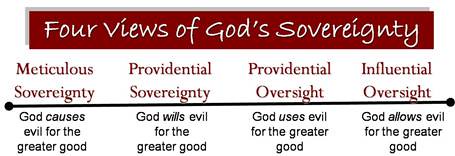
Michael Patton provides the following useful chart regarding views on God's Sovereignty.

2427981628 E87C255A94

He defines these four views as follows.

1. Meticulous sovereignty: God is the instrumental cause behind every action and reaction there has ever been. In other words, you chose white socks instead of the black socks because God caused it to happen. You have an itch on your eyebrow right now because God is actively causing it. In other words, every molecule that bounces into another is a result of God active agency in being the first and instrumental cause to the action.

This position holds little or no tension with regards to the human will and the divine will.

God is actively controlling everything.

Adherents: Hyper-Calvinists and some Calvinists


2. Providential sovereignty: While God is bringing about his will in everything (Eph 1:11), his will is not the instrumental cause of all that happens. God’s will plays a providential role in “causing” all things. In other words, all that happens happens because God did in some sense will it, but secondary causes are usually the instrumental cause behind the action. In the case of your socks, you chose them because you decided to, but it was also part of God’s will. God allows evil as it is part of his imperfect will to bring about a perfect end, but he is not the instrumental cause of evil.

This position holds much tension with regards to human will and divine will.

God is in control of everything.

Adherents: Calvinists and some Arminians


3. Providential oversight: Here God’s sovereignty is more of an oversight. He has a general plan, but is not married to the details. When necessary, God will intervene in the affairs of humanity to bring about his purpose, but this does not necessarily involve an intimate engagement with all that happens. God does not care what color socks you pick unless it somehow effects his meta plan.

This position holds much tension with regards to human will and divine will.

God could control everything, but only controls some things.

Adherents: Arminians and some Calvinists


4. Influential oversight: Here God’s sovereignty is self-limited. God could control things, but to preserve human freedom, he will not intervene in the affairs of men to the degree that the human will is decisively bent in one direction or another. He is hopeful that his influence will be persuasive to change a person’s heart or to guide them to his will, but is not sure if this will happen. Being all-wise, however, God will make strategic moves in people’s lives that will manipulate the situation to his advantage.

This position holds little or no tension with regards to the human will and the divine will.

God could control everything, but decides only to influence.

Adherents: Open Theist Arminians and some Arminians

For reference, I think I fit category 1 but I'm sure God will lead some of you to correct me.

more packer on god speaking

The Bible is not only man’s word, but God’s also; not merely a record of revelation, but a written revelation in its own right, God’s own witness to Himself in the form of human witness to Him. Accordingly, the authority of the Scriptures rests, not simply on their worth as an historical source, a testament of religion, and a means of uplift, real though this is, but primarily and essentially on the fact that they come to us from the mouth of God. Therefore the real task for reason in this connection is not to try to censure and correct the Scriptures, but rather, with God’s help, to try to understand and apply them, so that God may effectively censure and correct us. ~ J.I. Packer, God Has Spoken

Technorati Tags:

power of the gospel

Jonathan Brink brings us this great quote from Pope Benedict XVI:
Only when their faith permeates every aspect of their lives do Christians become truly open to the transforming power of the Gospel.

orthodoxy

n. pron. [or-the-dock-see]

Gr. orthos (right, true) + doxa (opinion, thinking)

Orthodoxy has been widely acknowledged to refer to adhering to the teachings and traditions in an established faith or religion. With respect to Christianity, the concept generally means recognizing and accepting the fundamental teachings and doctrines found in the Bible. All three branches of Christianity (Roman Catholic, Protestant, and Eastern Orthodox) consider the early ecumenical confessions such as the Apostles’ Creed, Athanasian Creed, and Nicean Creed to be their primary sources relating to orthodoxy.

While I want so much to stay orthodox, Tony Jones has suggested that "orthodoxy doesn't 'exist.' Instead, orthodoxy is an event, in the Derridean/Caputoean sense. That is, orthodoxy happens when human beings get together and practice it (talk about God, worship God, pray to God, write books about God, etc.). There's no orthodoxy somewhere out there that one can point to and say, "See that? That's orthodoxy. That's what we're trying to get to."

I've said before that we need orthodoxy, orthopraxy, and orthopathy (right doctrine, right practice, and right motive). John Wimber taught that leaders "need to remain congruent with orthodoxy and orthopraxy, to maintain our focus on the 'main and the plain' in Scripture." If we have right doctrine but it does not manifest itself in right love, it is for naught. On the other hand, we cannot have right love without right doctrine.

you can't teach a sneetch

Doctor Seuss says you can't teach a Sneetch ... but can you teach a Christian?

justification

Justification by Faith does not mean salvation by believing things instead of by doing right. It means pleading the merits of Christ before the throne of grace instead of our own merits. ~ B.B. Warfield, “Justification by Faith: Out of Date?”, The Christian Irishman, May 1911

HT:OFI

Technorati Tags:

Saturday, April 19, 2008

god speaks

If we cannot be sure that what Scripture says, God says, we cannot be sure that He has actually made any of the promises which Scripture ascribes to Him. (Indeed if we deny that revelation is propositional, we make it quite certain that He has not. A God who uses no words cannot make any promises). ~ J. I. Packer, God Has Spoken

HT:MD

whopper v. religion

Apparently the Whopper and Religion have the same kind of following ... and result when no longer served.


Technorati Tags:

more wright worship

It always happens, when people decide to worship Jesus without inhibition - to pour out their valuables, their stories, their dancing, their music, before him just the way they feel like doing - that others, looking on, find the spectacle embarrassing and distasteful…Not everyone is called to pour out expensive ointment over Jesus’ head; but if someone is, the rest should respect it. ~ NT Wright, Mark for Everyone

HT:MD

Technorati Tags:

most beautiful object in south africa

The high speed condom applicator was been named the most beautiful object in South Africa for 2007.

Applicator-2G

For those that prefer video over the above photo, check this out.

where is truth

A friend of mine, Daniel Chew, recently asked why I would quote a heretic, specifically Henry Nouwen? Before I start this post, let me first say that I don't know Nouwen. I'm sure that if I search the internet I will find plenty of bad things about him and some of you will even be tempted to tell me bad things about him here. But all of that would be besides the point. The quote I used was:

When we say, ‘I love Jesus, but I hate the Church,’ we end up losing not only the Church but Jesus too. The challenge is to forgive the Church. This challenge is especially great because the Church seldom asks us for forgiveness.

The question is simply do you agree or not? I do. I believe that to hate the Bride of Christ is to hate Christ Himself and I also believe that that the Bride sadly fails to recognize, confess, repent, and ask forgiveness for Her sins.

So whether or not Nouwen is a heretic, I cannot, nor will not say. What I can say is that I believe he spoke truth.

Bill Walsh recently posted on the concept of accepting the truth wherever it may be found. Walsh quotes John Calvin who may also be a heretic ... or may be a "God-fearing reformer who made some errors along the way" (see the comments between Rick Frueh and Daniel in my post). In Calvin's Institutes we find:

In reading profane authors, the admirable light of truth displayed in them should remind us that the human mind, however fallen and perverted from its original integrity, is still adorned and invested with admirable gifts from the Creator. If we reflect that the Spirit of God is the only fountain of truth, we will be careful, as we should avoid offering insults to Him, not to reject or condemn truth wherever it appears. In despising the gifts we insult the giver.

Walsh then cites the following quote from Hilary Brand and Adrienne Chaplin.

Dualism is a word that can be applied to any split-vision worldview. It separates God’s creation into distinct and opposing realms, one representing good, the other representing evil: holy versus profane, sacred versus secular, material versus spiritual....

[A] truly biblical worldview will not let us get away with such simplistic divides. The Bible frequently speaks in paradox, explaining truths not in terms of either/or by both/and: creation is both gloriously beautiful and tainted by sin; humanity is both made in God’s image and fallen; Jesus is both fully human and fully divine; Christians are both redeemed from the curse and still suffering its consequences.

The problem comes when the line is drawn compartmentally rather than spiritually, putting certain aspects of culture inside the Kingdom of God and others outside. Rather we need to understand that the battle lines between good and evil run across all aspects of culture and every facet of life.

I agree. Can one make "errors along the way" and still be godly? Can one speak or teach a heresy and not be a heretic? Can both blessing and cursing come from the same mouth? I think it ought not be so but I think it can and I think Walsh makes an interesting argument.

So this is how I can quote Nouwen. I first do not judge him either way and then I evaluate his words. At least for these words I find them to be truthful, penetrating, and helpful. I hope that from time to time you might find the same for the words here in this blog.

Friday, April 18, 2008

church hating

When we say, ‘I love Jesus, but I hate the Church,’ we end up losing not only the Church but Jesus too. The challenge is to forgive the Church. This challenge is especially great because the Church seldom asks us for forgiveness. ~ Henri Nouwen

HT:BH

Saturday, April 12, 2008

death of cessationism prophesied

Dan Bowen posts the following:
"I would suggest that cessationism is now on the endangered doctrines list". ~ C Peter Wagner - "Dominion!" - Chosen, Grand Rapids Michigan (2008) - (p99).

I'm not a huge CP Wagner fan nor do I think he is accurate but I like the hope that one day that doctrine would go away. I remember when we visited an International Baptist Church in Germany and the preacher said that cessationism was one of the rare incorrect doctrines but perhaps the evilest thing that Baptists have spread through the Church. I almost fell out of my seat ... no, I wasn't slain in the Spirit.

Thursday, April 10, 2008

i'm emergent

Well it had to happen I guess. I'm a Calvinist (well, really I'm Reformed) and proud of it. I'm Charismatic (well, really I'm a continuationist) and proud of it. I'm Republican (well, really I'm an extreme conservative) and proud of it. But now I find out from Jonathan Brink that I'm Emergent but I don't feel proud of it.

I didn't share any of the top 50 reasons why I may not be Emergent so I assume I am one ... darn! See that - now I'm cursing too. What's next?

Technorati Tags:

Wednesday, April 09, 2008

cmp on capital punishment

Capital punishment - that's a tough one for me. I'm supportive of it but I'm against abortion. I had some friends recently challenge me on my anti-abortion stance. I thought I had good responses but when they asked me how that squared with capital punishment I fell short. I pointed out that their argument was apples and oranges but wasn't able to quickly come up with a case supporting capital punishment. Anyway, Michael Patton just posted the following primer on capital punishment. I copied his post in its entirety, please drop by his site to offer your opinion.

Life is a precious gift of God. Christians see life as something that must be preserved, enjoyed, and celebrated. Yet Christians—evangelical Christians—are often among those who support the death penalty. How can this be? Isn’t there an inconsistency with the Christian witness of life, grace, and mercy and support of the death penalty? Isn’t there an inconsistency when Christians say that they are against abortion but for the death penalty? Possibly.

I want to give a brief primer on the Christian options with regards to the issue of capital punishment. Hopefully this will serves to help people on both sides understand the issue more accurately.

There are essentially two positions that Christians have taken with regards to capital punishment:
  • Rehabilitationalism
  • Retributionalism
Retributionalism: Believes that capital punishment is prescribed by God for all people in order to maintain societal order and retribution.

Rehabilitationalism: Believes that capital punishment is repealed by the New Testament’s command to love one another and let God have final retribution.

Arguments for Capital Punishment (Retributionalism):

1. It is God’s way of punishment instituted at the time of Noah. This seems to suggest a general governmental principle that transcends the situation (i.e. there is no Law or theocracy).

Gen 9:6 - “Whoever sheds man’s blood, By man his blood shall be shed, For in the image of God He made man.”

2. It is continued in the Mosaic Law with further offenses that call for death.

Capital Offenses
  • Murder (Ex. 21:11; Num. 35:30)
  • Cursing or striking parent (Ex. 21:15, 17; Lev. 20:9)
  • Kidnapping (Ex. 21:16)
  • Witchcraft (Ex. 22:18)
  • Bestiality (Ex. 22:19; Lev. 20:16)
  • Idolatry (Ex. 22:20; Lev. 20:2)
  • Negligent Homicide (Ex. 21:29)
  • Work on the Sabbath (Ex. 35:2; Num. 15:32-35)
  • Homosexuality (Lev. 18:22; 20:13)
  • Adultery (Lev. 20:10; Deut. 22:24)
  • Incest (Lev. 20:11-12, 14)
  • Prostitution (Lev.21:9)
  • Blasphemy (Lev. 24:16)
  • False Prophecy (Deut. 13:1-5)
  • Rape (Deut. 22:25)
3. The New Testament does not repeal the penalty with respect to the Government.

4. The New Testament does inform Christians that the Government is part of God’s common grace, given to men in order to keep order in society.

Romans 13:3-4 - “For rulers are not a cause of fear for good behavior, but for evil. Do you want to have no fear of authority? Do what is good and you will have praise from the same; for it is a minister of God to you for good. But if you do what is evil, be afraid; for it does not bear the sword for nothing; for it is a minister of God, an avenger who brings wrath on the one who practices evil.”

The right and responsibility of the government to “bear the sword” definitely implies its strictest use, capital punishment.

5. Paul implicitly accepts and agrees with the government’s authority to use the death penalty in his own life.

Acts 25:11a - “If, then, I am a wrongdoer and have committed anything worthy of death, I do not refuse to die.”

Arguments Against Capital Punishment (Rehabilitationalism)

1. The sixth commandment states that you shall not kill (Ex. 20:13). The death penalty is killing people.

2. While the Mosaic System did demand capital punishment, it was a theocracy that is no longer in effect.

Romans 6:14-15 - “For sin shall not be master over you, for you are not under law but under grace.” (emphasis added)

3. Christ showed by his words and example that the death penalty was no longer in effect.

Matthew 5:38-39 - You have heard that it was said, ‘an eye for an eye and a tooth for a tooth.’ But I say to you, do not resist an evil person; but whoever slaps you on your right cheek, turn the other to him also.”

John 8:3-7 - “The scribes and the Pharisees brought a woman caught in adultery, and having set her in the center of the court, they said to Him, ‘Teacher, this woman has been caught in adultery, in the very act. Now in the Law Moses commanded us to stone such women; what then do You say?’ They were saying this, testing Him, so that they might have grounds for accusing Him. But Jesus stooped down and with His finger wrote on the ground. But when they persisted in asking Him, He straightened up, and said to them, ‘He who is without sin among you, let him be the first to throw a stone at her.’”

4. Paul tells Christians to leave vengeance and retribution to God.

Romans 12:19 - “Never take your own revenge, beloved, but leave room for the wrath of God, for it is written, ‘vengeance is mine; I will repay,’ says the Lord.”

5. Statistics show that death penalty is not much of a deterrent to crime.

My position

I believe that the arguments for the continued use of capital punishment are much stronger. Therefore, I support and encourage the use of capital punishment for heinous crimes.

In response to the arguments against capital punishment, I would offer these observations.

1. The sixth commandment speaks against murder, not killing. There are major inconsistencies make this objection invalid in my opinion. Although there can be a fine line between murder and taking a life for societal order and retribution, their is a definite line. If the death penalty was always a violation of the fifth commandment, why would God have allowed such in the same Law? Notice that the penalty for breaking the sixth commandment is death (21:12). How could the fifth commandment prohibit that which is mandated for a violation of the sixth?

2. It is true that Christians are not under the Mosaic system, but the principles of the system are still good (e.g. Ten Commandments).

3. Christ’s words and example speak to individual retribution, not governmental. Taken to the extreme, there would be no punishment for any crime.

4. Paul’s statement in Romans 12:9 once again seems to speak to individual retribution. God uses government, not individuals, to execute His vengeance (13:4).

5. The statistics concerning the efficacy of capital punishment to deter crime are not consistent. Some statistics do suggest that where the fear of death is truly present, it does act as a deterrent. But even if it does not deter crime, this is not necessarily an argument against it. Its function is also seen as retribution, acting as God’s instrument of wrath.

In the end, I see no inconsistency in being an advocate of the death penalty for certain crimes and being against abortion. The aborted child is innocent, having committed no crime, while the one sentence to capital punishment is guilty of a great offense.

unlimited mercy

What we all desperately need to see is that the love of a holy God is manifested covenantally at the cross. In the sacrifice of the Lamb of God, the Father promises to receive contrite sinners on a daily - no, hourly - basis. The cross says “no matter what your sins, unlimited mercy is available to those who turn to God through Jesus’ merits.

Having satisfied the demands of His own holy law, the Father must open His mighty arms and embrace every returning son. And he must do it every day. He has promised to do it (Luke 15:11-32, 1 John 1:8-10), and God cannot lie (Heb 6:13-20). ~ John Miller, Repentance and the 21st Century Man

worship gone wrong?

You tell me, worship leader faux pas or slain in the spirit? (note: no audio but not needed)


HT:TR


Technorati Tags: ,

so many choices

To simplify things for those of you that love free will, here's a tool that allows you a choice but "woos" you to the Bible that is right for you. Just joking (loosen up) about the free will thing ...

I found this kind of thing, i.e., a Bible picking tool, just a bit odd. You?

Oh, by the way, KJVO guys need not check out the site.

HT:TR

Technorati Tags:

monster truckin' for jesus

Courtesy of Marc Heinrich ...

Jesustruck3

wright worship

The Jewish law begins with worship, with the love of God, because if it’s true that we’re made in God’s image we will find our fullest meaning, our true selves, the more we learn to love and worship the one we are designed to reflect. ~ N.T. Wright, Mark for Everyone, 170

HT:MD

Technorati Tags:

spurgeon on the law

Like the fascination which attracts the gnat to the candle, though it burns its wings, men by nature fly to the law for salvation, and cannot be kept from seeking life by it. The law can do nothing else but reveal sin and pronounce condemnation upon the sinner, and yet we cannot get men away from it, even though we show them how sweetly Jesus stands between them and it. ~ Charles Spurgeon, Christ’s Glorious Achievements

HT:JH

Perhaps it is a wrong assessment on my part but it seems that many who "follow" Spurgeon are guilty of this, i.e., placing themselves and others under the yoke of the law.

Technorati Tags:

Monday, April 07, 2008

naked strikes again

It has been awhile since I've posted a cartoon from my internet friend Nakedpastor ... this one was irresistible.

Doyoumind 3

Technorati Tags:

tesla - thank you

Here is Tesla performing Led Zeppelin's Thank You. I'm posting this for no reason other than I just like music and I consider this good.

Technorati Tags:

one solitary life - jesus

"He was born in an obscure village, the child of a peasant. He grew up in another village, where he worked in a carpenter shop until he was 30. Then, for three years, he was an itinerant preacher.

He never wrote a book. He never held an office. He never had a family or owned a home. He didn't go to college. He never lived in a big city. He never traveled 200 miles from the place where he was born. He did none of the things that usually accompany greatness. He had no credentials but himself.

He was only 33 when the tide of public opinion turned against him. His friends ran away. One of them denied him. He was turned over to his enemies and went through the mockery of a trial. He was nailed to a cross between two thieves. While he was dying, his executioners gambled for his garments, the only property he had on earth. When he was dead, he was laid in a borrowed grave, through the pity of a friend.

Twenty centuries have come and gone, and today he is the central figure of the human race. I am well within the mark when I say that all the armies that ever marched, all the navies that ever sailed, all the parliaments that ever sat, all the kings that ever reigned--put together--have not affected the life of man on this earth as much as that one, solitary life."

Perhaps written by James Allen Francis

church split over ipod

2396180304 8B1D19B1F2Well it finally happened, the love affair of various churches with Emergent Purpose-Driven Charismatic Seeker-Sensitive Contextualization pick what-ever you think is the root of evil in the church today has caused yet another church split. This time it manifested itself over a controversy between Apple's iPod and Zune. TBNN has the full story on the church divided over the iPod versus Zune controversy.2395350611 97B1309435

Saturday, April 05, 2008

rich v. super rich

Thanks to Jonathan Brink for this one. It was funny and speaking as one who is kinda rich, I relate well to the issue here.

In The Know: Are America's Rich Falling Behind The Super-Rich?

wright in jesus

[W]hether we’ve thought of it like this or not, we know in our bones that looking after Number One isn’t where it’s at; that in Jesus Christ we are called not to save ourselves from the world but to bring salvation to the world. We are here because we are committed to the pilgrim way, the way that leads to God’s new Jerusalem, and because we know that on that road there is healing: then shall the eyes of the blind be opened, and the ears of the deaf unstopped; then the lame shall leap like a deer, and the tongue of the speechless sing for joy. New creation has begun in Jesus. ~ NT Wright, The Road to New Creation

the wright kind of heaven

NT Wright, Jesus’ Resurrection and Christian Origins;
What then do the New Testament writers mean when they speak of an inheritance waiting for us in heaven? This has been much misunderstood, with awesome results in traditions of thought, prayer, life and art. The point of such passages, as in 1 Peter 1.4, 2 Corinthians 5.1, Philippians 3.20, and so forth, is not that one must ‘go to heaven’, as in much-popular imagination, in order to enjoy the inheritance there. It is rather that ‘heaven’ is the place where God stores up his plans and purposes for the future.

... When the early Christians speak of a new body in heaven, or an inheritance in heaven, they mean what St John the Divine means in Revelation 21: the new identity which at present is kept safe in heaven will be brought from heaven to earth at the great moment of renewal. Yes: the great majority of Christian expressions of hope through the middle ages, the reformation, and the counter-reformation periods have been misleading. ‘Heaven’ is not the Christian’s ultimate destination. For renewed bodies we need a renewed cosmos, including a renewed earth. That is what the New Testament promises.


Peter Davis, Who Is For the King?;

We need a Kingdom eschatology ... Our King will realize his purposes for this world. He has not given up on his creation. He will resurrect us to live under his leadership on this very planet. The renewal of this world will likely be like the apparent plan for Eden: human beings working under the direction of the Creator to bring to the world the good order that he intends. Thus our life now is a rehearsal for our eventual life. Any life in heaven (should we die before he comes) is a temporary way station where we await the resurrection. This vision for the future is the hope that should drive our lifestyles.

CS Lewis,
Miracles;

The Resurrection is the central theme in every Christian sermon report in the Acts. The Resurrection, and its consequences were the "gospel" or good news which the Christian brought: what we call the 'gospels,' the narratives of Our Lord's life and death, were composed later for the benefit of those who had already accepted the gospel. They were in no sense the basis of Christianity: they were written for those already converted. The miracles of the Resurrection, and the theology of that miracle, comes first: the biography comes later as a comment on it. Nothing could be more unhistorical than to pick out selected sayings of Christ from the gospels and to regard those as the datum and the rest of the New Testament as a construction upon it. The first fact in the history of Christendom is a number of people who say they have seen the Resurrection.

living passionately

David Ruis writes on living passionately.
Look at the great historical example of Mozart and his counterpart, Antonio Salieri, in the movie, Amadeus. I know it’s a bit Hollywood, but here you have Mozart. He had technical ability, but what brought him to impact the popular culture of his day was his passion. Salieri, who some historians say was technically superior to Mozart, was uptight, stressed, competitive, and was so consumed by technical excellence that his zest for life and passion didn't fill his music. Which one of these men do we know about today? We know about Mozart.

wimber on values

Vales affect what we think and, consequently, what we do. Our values are an intrinsic part of us, although we seldom think about them in a conscious fashion. They determine the ideas, principles and concepts a person or group can accept, assimilate, remember and transmit. They can be fallible and must be constantly revised and reviewed in the light of Scripture. ~ John Wimber

These are 10 simple values that Wimber wrote applying to all Christians.

Pursuers of God
The depth of God's relationship with us is inexhaustible (Ps. 41:1; 1 Cor. 2:6£f; Phil. 3:8-10). Therefore, we seek him and wait expectantly for his presence in all that we do (John 4:34; 5:19-20).

The Bible
The Bible is our final authority over opinions, dreams, revelations, visions, and any other authoritative source that we may look to for direction. At our core we are evangelical Christians. Our approach to life and ministry should be shaped by the counsel Scripture gives us (2 Tim. 3:16-17).

Unity
Our brothers and sisters are not our enemies. Therefore we relate to one another honorably, seeking to preserve the bond of peace. We will love what Jesus loves: the whole church. This means we will love those in our local congregation, those in the Association of Vineyard Churches, and Christians across denominational lines (Eph- 4:3-6).

Compassion and Mercy
We desire to accept into our fellowship any sincere believer who is attempting to walk in obedience to God, is repentant of his or her sins, and Is in submission to the authority of the church. God's mercy always triumphs over judgment (James 2:13; John 8:1-11).

Equipping
God calls and enables believers to express the talents, gifts, and ministries that he has set aside for them. The orientation of all ministry is toward the integration of biblical truth into everyday living that impacts our community and beyond not limited to individual improvement or self-fulfillment (Eph. 4:11-13).

Relationship
Caring for people is our highest priority after submission to God, because the purpose of the cross was the redemption of men and women. To the best of our ability we will treat each person with respect, dignity, and loving patience always seeking what is best for his or her life and growth (Rom. 12:9-13; 1 Cor. 13:4-9; Col. 3:12-14).

Family
We deeply value the building up of families and believe in the priority of children, while at the same time embracing and valuing all adult believers who identify with our church family (Matt. 18:1-10; Col. 3:12-15).

Generosity
We are stewards of God's gifts and resources (Matt. 10:8, 39; 13:45-46). This means that when God directs, we will be willing to give away what we have, to risk the security of current success in order to advance the kingdom on earth in greater ways. We do not own our ministries, so they are not ours to keep. We "give to get to give."

Simplicity
We want to be "naturally supernatural," avoiding behavior that draws attention away from God and to ourselves. Simplicity affects our worship style, how we pray for the sick and minister to the poor, cany out discipleship, teach the Bible, and so on (1 Cor. 2:2-5; James 3:13; 1 Thess. 4:11-12).

Risk-taking
We are willing to let people make mistakes as they grow in their giftingWe know that gifting develops in an environment of trial-and-error, so we are willing to be patient with people's weaknesses and failures while they learn (John 21:15-19; Gal. 5:22-3).

wilt on maturing

Dan Wilt tells this short story relating values to maturing.

"My oldest daughter is learning to drive. A teenager behind the wheel of a car can be a frightening thing - for you, for me and of course for her. She is thrilled to learn how to drive, but simply mimicking what she has seen her mother and I do behind a wheel is not enough (nor is it even preferable). She must study, think, remember, practice and not forget certain principles of driving related to roads, signs, values, pedestrians, police and crosswalks. The more practice she gets, the better driver she will be. However, it is the revisiting of every sign, value and situation that will cement her maturing ability to drive."

I find that re-applicable to the whole of Christian life.

worship values

Inside Worship, volume 32, is excellent. I will be quoting from several articles over the next few days. On the inside front page, Casey Corum, Vice President and Chief Creative Officer of Vineyard Music, writes on the three simple values that embody Vineyard (or for that matter all) worship. These are his words on the topic.

Intimacy - This is the hallmark worship value in the Vineyard. This value demands that our worship be self-disclosing and vulnerable to God. My personal believe is that this value is not about musical style nor the volume of our music. We need to be careful, while we hold our values near and dear, that we do not export our ideas of what "intimacy" looks like to other cultures and generations. I'm a believer in "quite intimacy" as well as "loud intimacy". I believe there is room for both at the heart of this value.

Accessibility - Worship leadership assumes that someone is following. The expression of this value involves restraint on the behalf of the worship leader and team, in order to provide access to those who are attempting to worship with us. It is a pastoral approach that is concerned more about the needs of the gathered congregation than with our own personal desire to express ourselves creatively. We lead worship from a position of humility and servanthood.

Authenticity - John 2:24 states that the Father is looking of worshipers who will worship Him in spirit and truth. This value states that our lives and our expressions of worship ought to be in line with one another. Our corporate worship expression is the overflow of our individual lives, lived out minute by minute, in the presence of the Lord. This value asks us to bridge the chasm between the words of our worship and the actions of our daily lives.

inadequate doctrine v. atonement

All inadequate doctrines of the atonement are due to inadequate doctrines of God and man. If we bring God down to our level and raise ourselves to his, then of course we see no need for a radical salvation, let alone for a radical atonement to secure it. When, on the other hand, we have glimpsed the blinding glory of the holiness of God, and have been so convicted of our sin by the Holy Spirit that we tremble before God and acknowledge what we are, namely ‘hell-deserving sinners’, then and only then does the necessity of the cross appear so obvious that we are astonished we never saw it before. ~ John Stott, The Cross of Christ

HT:FE

Friday, April 04, 2008

buckley on reason

We do not abandon reason, we merely recognize its limitations. We reason to the existence of God, it is revealed to us that His Son was also the incarnation, and that such was His love of us that He endured a torture excruciating in pain, and unique in aspect — the God of hosts, mutilated by His own creatures, whom He dies forgiving, loving. Can we do less? Yes, we do less, but we must try to do more, until we die. ~ William F. Buckley, Nearer My God

As a whacko right-winged conservative I always liked National Review and really miss Buckley. Thanks Melinda for this quote.

Wednesday, April 02, 2008

single dude news flash

If you're a single dude looking to increase your probability of meeting single female, look no further. You want the red spots.

the real kingdom by talbot

Gospel Reading: John 3:1-8 by John Michael Talbot.

Flesh begets flesh, Spirit begets spirit.
v.6

Today's reading has Nicodemus at a conversion point, approaching Jesus and acknowledging him as a teacher from God because of the signs and wonders he performed. Jesus' response was both negative and positive. He gave Nicodemus what has become a well-known scripture to us: You must be born again. With this, Jesus emphasized the necessity of a rebirth of the spirit. He also spoke of the importance of the rite of water baptism, used by itinerant preachers of his day, as a sign of renewal.

SIGNS & WONDERS ARE NOT ENOUGH


The negative side of Jesus' response was that he said the signs and wonders Nicodemus cited were not enough. He immediately called Nicodemus deeper, to the invisible things of the Spirit, to things beyond externals, to things that are like the wind.

On the positive side, Jesus encouraged Nicodemus, he did not rebuke him. Nicodemus was on the outside looking in, but at least he was looking! God’s grace touched the life of this Pharisee with a spark of renewal and Jesus fanned the spark into full flame. When all the apostles except John deserted Jesus, Nicodemus and Joseph of Arimathea stood by him at his trial, crucifixion, and burial. Tradition has it they both became disciples in the early church.

LET JESUS TAKE YOU TO THE SOURCE

We need to ask ourselves, do we limit God’s grace to signs and wonders? (Signs and wonders might be any external aspect of Christian or community life we find exciting.)

We must realize that we can do all the externals well and never know the Spirit and the charism. If we have the Spirit, however, we will do all the externals better. Let Jesus call you past the signs of the Spirit to himself as he did with Nicodemus. Let him take you past the stream to the well. Let him take you to the source. Otherwise, you will not be experiencing the real kingdom of God.

proper use of the law

What is the proper use of the Law?
  • It shows the righteousness that God requires.
  • It shows the righteousness that Christ fulfilled as our substitute.
  • It serves as a backdrop by which we can tell if we are walking in the Spirit.
R T Kendall - "Grace" - Charisma House Publications, Florida (2006) - (p65)

HT:DB

emergent amish

Solomon’s Barn quietly launched last December just outside of Columbus, Ohio. Apparently the worship at Solomon’s Barn still reflects Amish traditions, e.g., the men and women are seated separately, but instead of pews, the congregation sits on couches in their worship space–a renovated barn. Thanks to Mark Van Steenwyk for the full story.

Tuesday, April 01, 2008

tough love

I really like this story as reported by Steve Addison. Apparently Mark Driscoll ascribes to the tough love theorem - you know, being honest with those you care about and all that.

Jonathan MacIntosh was one of those young, confident, immature pastors. As a new church planter in 2004, he showed up for an Acts29 boot camp looking for guidance and funding. His church had struggled to grow past 40, despite strong lay leadership. Driscoll asked him why. MacIntosh blamed his over-churched town in Mississippi. Driscoll didn’t buy it.

“Then he looked at my wife and said, ‘Ashley, honey, you tell me what’s going on in your opinion. I want you to be honest with me. Look me in the eyes and tell me the truth,’” MacIntosh recounts. “At first she gave stock answers. But then she completely broke right there. ‘My husband is off doing this church-planting thing. I’m stuck in this job I hate, slaving away to support us. People are in and out of our apartment at all hours of the night. I’m losing my husband to this thing. I’m miserable. It’s sapping my joy for life, my love for God, and my respect for my husband.’”

At that point, MacIntosh was pretty sure Acts29 would not subsidize his church. Then Driscoll unloaded on him. “You’re a good-looking, eloquent, hip, Bible-teaching, Jesus-loving [wimp].” MacIntosh remembers Driscoll telling him. “You think you can lead and love God’s bride when you can’t lead and love your own bride? The issue with your church is you and your marriage. Everyone knows it. You’re photocopying your marriage. That’s your church, and that’s why it’s jacked up. How dare you.”

“Man, it was beautiful,” MacIntosh says.

Driscoll told MacIntosh to take his wife to a nice restaurant, find a hotel room, and send him the bill. Now MacIntosh works for Acts29 and evaluates church planters. When we met at Driscoll’s home, he opened his wallet and showed me a picture of his baby daughter.

“God used that day and that encounter to save my marriage,” he says. “It was a wake-up call from Jesus.”

calvinism debunked

This is it, the last straw, TBNN has reported that a lump of clay has spoken ... Calvinism's last argument has been debunked.

Newsflash: Lump of Clay Tells Potter What To Do

SANTA CRUZ, CA - Mr. Winstead Burns, a retired high school art teacher, has been working with clay all of his life. For twenty-five years, he taught teenagers how to take lumps of clay and form them into beautiful works of art. He informed TBNN, "Whenever we began working with clay, the results were the same. Some of the pieces turned out very nice. When that happened, the kids were very pleased with them. They wanted to show them off, and always took the pieces home with them. Unfortunately, some of the other pieces were always a mess. They looked off-center, crooked, and just a wreck. Those pieces certainly missed the mark. They weren't good for much except to be thrown out. Sometimes we just tossed them back into the kiln until they burned up."

Mr. Burns retired three years ago and opened his own pottery shop near the coast. He enjoys spending his days talking with tourists while he spins his wheel and forms new works of art. His life was moving along uneventfully until last week. That's when a lump of clay spoke to him. According to Mr. Burns, "I pulled out a new lump of clay and was about to toss in onto my spinning wheel. That's when the weird thing happened. It just told me what to do. Its exact words were, 'Make sure you make me for honorable use.' Now that scared me a little bit. But it didn't say anything else, so I just did my best and made a nice vase out of it" (see below).

Mr. Burns told us that he immediately contacted the local university, UCSC, but the art department simply did not believe him. Dr. Evelyn Simpson-Wells-Thomas, head of the UCSC art department, told Mr. Burns, "Science has proven scientifically that things like this just can't scientifically happen. Clay scientifically doesn't speak. Miracles don't happen unless we want them to."

Mr. Burns remains convinced of what he heard. "I know what happened that day. I also know what the bible says about this (click here). However, my experience tells me that the clay spoke. There is no doubt about it. He told me what to do. I've never thought of clay as being alive before, but now I have new respect for what I am working with. It's almost like the clay could decide if he wanted to be something honorable or dishonorable. He seemed to have a free will of his own."

Monday, March 31, 2008

calvin is whack

"If we believe that the Spirit of God is the only fountain of truth, we shall neither reject nor despise the truth itself, wherever it shall appear, unless we wish to insult the Spirit of God…All truth is from God, and consequently if wicked men have said anything that is true and just, we ought not to reject it, for it has come from God." ~ John Calvin, The Institutes II, ii, 15 translated by John Allen. 2 Vols. Philadelphia Presbyterian Board of Publications, 1909 and Commentary on Titus, 1:12; as quoted by David Seamands, Healing Grace, 187)

HT:DG

the spirit in community

"Catholicism increasingly followed the path of the cults in making a rite the center of its activities, and Protestantism followed the path of the synagogue in placing a book at the center of its services - it would be true to say that in most respects it remains no less revolutionary today. Of course the Bible and communion are fundamental to what takes place in church, but church should not be reduced to "word and sacrament." There is more to the Spirit's presence and work than this." ~ Robert Banks, Paul's Idea of Community

reftagger