Tuesday, October 12, 2010

the story

“The kingdom of God is the new and final age that began with the coming of Jesus. His kingdom is not part of the present age — an age where the flesh reigns; where people are divided, relationships are broken, and suspicion and competition dominate; where money, sex, and power are abused; where leaders are first and servants are last; where behavior is controlled by laws, and identity is defined by race, gender, or social standing; and where gifts and resources are used for the advancement of oneself.

Rather, the kingdom of God is the new age. It is the age of the Spirit (Matt 12:28). It is the age of righteousness, peace, and joy in the Holy Spirit (Rom 14:17). The kingdom of God is about the renewal, restoration, and reconciliation of all things, and God has made us a part of this great story of salvation.”

- Neil H. Williams, Gospel Transformation (Jenkintown, Pa.; World Harvest Mission, 2006), iii.

HT:FE


At the same time, the Kingdom has always existed and has been manifest, but an inauguration of sorts happened with the first coming of Christ and it will be completed with the second coming.

Technorati Tags:

a daughter needs a dad

I haven't read the book Why A Daughter Needs A Dad: 100 Reasons but Justin Holcomb recommends it a provides the following points - I love this!!!

A daughter needs a dad...
  • to show her that true love is unconditional
  • to teach her that her value as a person is more than the way she looks
  • to teach her that family is more important than work
  • to show her that a man can be trustworthy
  • to be the safe spot she can always turn to
  • to teach her that a man’s strength is not the force of his hands or his voice, but the kindness of his heart
  • to be the standard against which she will judge all men
  • to help her take risks that will build her confidence
  • to hold her when she cries
  • to teach her she is important by stopping what he is doing to watch her

Sunday, October 10, 2010

the best news

Yes! Amen! I have a new identity!

“The gospel is the best news we could ever hear. The gospel is about Jesus Christ and his power to transform our lives and relationships, communities, and ultimately, the nations. Through this gospel, we are freely given a new identity — an identity not based on race, social class, gender, a theological system, or a system of rules and regulations. Rather it is a new and perfect identity based solely on faith in Jesus — an identity that defines every aspect of our lives. We are now forgiven, righteous, adopted, accepted, free, and heirs to everything that belongs to Christ. So even our sin, weakness, and failures do not define who we are. Because of this good news, we no longer have to hide from our sin and pretend that we have it all together, for God knows and loves us as we are, not as we pretend to be.”

- Neil H. Williams, Gospel Transformation, 2nd ed. (Jenkintown, Pa.; World Harvest Mission, 2006), i.

HT:FE

what is your god

Ray Ortlund challenges us with the following ...

“What is it to have a god? What is God? Answer: A god is that to which we look for all good and in which we find refuge in every time of need. To have a god is nothing else than to trust and believe him with our whole heart. As I have often said, the trust and faith of the heart alone make both God and an idol. If your faith and trust are right, then your God is the true God. On the other hand, if your trust is false and wrong, then you have not the true God. For these two belong together, faith and God. That to which your heart clings and entrusts itself is, I say, really your God.”

Martin Luther, The Large Catechism (Philadelphia, 1959), page 9.

It follows that one can worship a false god, with destructive impact, without intending to or even realizing it. Converting to Christ introduces us not only to him but also to ourselves and the false trusts/gods that lurk in our self-evident thoughts and natural feelings, especially our religious feelings.

resurgence bible reading

Dave Dorr reminds of how not to read the Bible over at Resurgence.

Two opposite errors exist in approaching the Bible. One is not to read it. The other is to know it so well that you miss Jesus. Jesus pointed out this error: “You search the Scriptures because you think that in them you have eternal life; and it is they that bear witness about me, yet you refuse to come to me that you may have life” (John 5:39-40).

Are you surprised to believe this error exists? We constantly talk about reading and studying the Bible as an unqualified good. But clearly, the way we read the Bible is just as important as reading it.

Missing Jesus

So how can you know if you might be reading the Bible, looking for life, but missing Jesus completely? Here are a few clues:

- You read the Bible to reinforce what you believe, not challenge what you believe.
- You imagine yourself as the type of person who believes the things you read about.
- You think the things you read are especially applicable for people you know, but not for you.
- You imagine yourself as the hero of the story, not the person or people who are unbelieving. You frequently ask in your heart, “How could these people be so unbelieving?” For instance, when you read the story of the Israelites wandering in the desert you might say, “How could those Israelites grumble about food and drink when they just saw God part the Red Sea?” But you are completely blind to how you grumble at work or home when you’re afraid of losing something.
- You love the attention garnered from your knowledge of the Bible, but give little thought to how you have applied what you have read.

Maybe the Bible should come with a warning label: “Beware: reading this book incorrectly will make you twice as fit for hell as when you began.”

Don’t miss Jesus. Go to him and find life.

Technorati Tags:

Friday, October 08, 2010

what's needed

For my taste, I prefer Michael Wittmer's simple chart explaining what Christians believe. It provides a simple delineation between what should we believe, what we must not reject, and what we must believe.

Dsb,+What+Christians+Believe
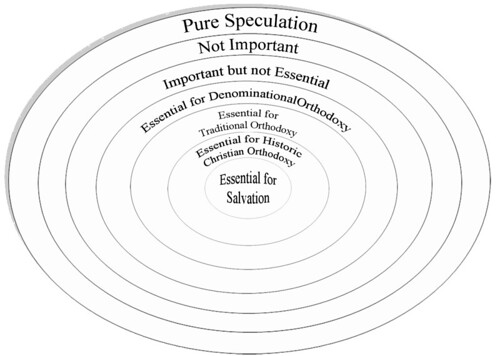
In contrast, Michael Patton's chart, true to his nature, has gotten more complex ... but it's still helpful.

essentials-non-essentials-l
Patton then describes what is essential for salvation:

These are the most essential doctrines of all essentials. This includes what every Christian should always be willing to die for. In essence, if someone does not believe the doctrines that are “essential for salvation,” they are not saved.

- Belief in God (there is no such thing as an atheistic Christian)

Issues pertaining to the person and work of Christ:

- Belief in Christ’s deity and humanity (1 John 4:2-3; Rom. 10:9)
- Belief that you are a sinner in need of God’s mercy (1 John 1:10)
- Belief that Christ died on the cross and rose bodily from the grave (1 Cor 15:3-4)
- Belief that faith in Christ is necessary (John 3:16)

As with all of them, I am sure that there are some ancillary matters that could be included, but this gives you the key doctrines. Without these, you simply don’t have any sense of what it means to be a Christian present.

Then he discusses what is essential for historic Christian orthodoxy:

These include beliefs “essential for salvation” but are broader in that they express what has been believed by the historic Christian church for the last two thousand years, no matter what tradition. This is expressed by the Vincentian Canon (434 A.D.): “that which has been believed everywhere, always and by all.” The exception of fringe movements has never been valid for this canon. It is simply asking, “What have all Christians everywhere always believed?”

- The doctrine of the Trinity as expressed at Nicea
- The doctrine of the Hypostatic Union (Christ is fully man and fully God) as expressed at Chalcedon
- The belief in the future second coming of Christ
- A belief in the inspiration and authority of Scripture
- A belief in eternal punishment for the wicked
- A belief in God’s timeless existence
- Belief that Christ is the only way to the Father

Then comes what is essential for traditional orthodoxy:

Again, these will necessarily include all of those from the two previous categories, but add some distinctives of their own. Essentials here will include all of those that are foundational to one of the three main Christian traditions: Protestantism, Eastern Orthodoxy, and Roman Catholicism. These are beliefs that distinguish one tradition from the next, but are not absolutely essential from the broader Christian worldview expressed above.

Some Protestant distinctives would include:

- General belief in the major pronouncements of the first seven ecumenical councils (325-787 AD)
- Belief in the necessity for a personal relationship with Jesus Christ
- Belief that justification is through faith alone on the basis of Christ alone
- Belief that Scripture alone has ultimate authority on all matters of faith and practice
- The canon of Scripture made up of 66 books (excluding the Deuterocanonical books)

Some Roman Catholic distinctives that would include:

- Belief in transubstantiation (the bread and wine turn into the actual body and blood of Christ)
- Belief that justification is through faith and works
- Belief that both Scripture and unwritten tradition have ultimate authority as they are interpreted by the Magisterium
- Belief in the authority of twenty-one ecumenical councils
- Belief that the Pope is the infallible vicar of Christ
- Belief in the Marian dogmas
- Belief that the canon includes the Deuterocanonical books

Some Eastern Orthodox distinctives that would include:

- Belief in the infallibility of the first seven ecumenical councils (325-787 AD)
- Belief that the liturgy of the Church is part of the Gospel
- Rejection of substitutionary atonement and the imputation of Adam’s sin
- Salvation by grace through faith as God works these out through our unification with Him (theosis)
- Traditional inclusion of the Deuterocanonical book (although there is some debate about this)

Then essential for denominational orthodoxy and so on ...

Wednesday, October 06, 2010

his death is our life

“Christ’s death is the Christian’s life. Christ’s cross is the Christian’s title to heaven. Christ ‘lifted up’ and put to shame on Calvary is the ladder by which Christians ‘enter into the holiest,’ and are at length landed in glory.

It is true that we are sinners–but Christ has suffered for us. It is true that we deserve death–but Christ has died for us. It is true that we are guilty debtors–but Christ has paid our debts with His own blood. This is the real Gospel! This is the good news! On this let us lean while we live. To this let us cling when we die. Christ has been ‘lifted up’ on the cross, and has thrown open the gates of heaven to all believers.”

- J. C. Ryle

HT:OFI

Tuesday, October 05, 2010

don't water it down

In Why We Love The Church, Kevin DeYoung addresses the well-meaning postmodern innovator who would claim that they don’t want “a hijacked Jesus who is an openhearted, never-offending, good moral teacher.” To be sure, and DeYoung acknowledges this, not all liberals set off to water down or sell out the Gospel. At the same time DeYoung points out that this is in fact the untended consequence of many statements employed to reach the nonChristian.

An example he offers of this is to describe Jesus as a “transcendent yet personal God who loves and accepts you perfectly, who wants to shape you and give your life deep meaning and purpose. This is the Jesus I want to describe, even if the actions and attitudes of Christ followers have not always represented this to you.”

What’s wrong with that? DeYoung rightly points out that this idea of God has “shaved off the sharp edges of the Gospel. No one will be offended” by this presentation. And not that we want to offend for the purpose of offending, but this is not the Jesus the apostles preached. While it is true that Jesus is transcendent and personal, it is also true that “He warned of judgment and demanded repentance. He spoke freely of sin, salvation, and the necessity of new birth. The apostles preached Christ dead, buried, and raised for our justification. They preached Christ and Him alone. They told of all that God had accomplished in Christ for miserable sinners. That was there message and the world hated them for it.”

My friends, the liberal message, under any umbrella, emerg*, postmodern, etc… is off track with the message of the Gospel. They have reinvented God and love and what it means to represent Him and live is His Kingdom in their own image. This we must not accept. This is not a message of salvation but one of damnation. We must present the true Gospel and the living Christ.

DeYoung continues with this warning and encoragement:

It would be wrong to wear unpopularity as a sure marker of our faithfulness. But by the same token, we should not assume we failed just because outsiders dislike us.

He then adds this from Andy Crouch:

I’m not eager for us to manage perceptions of Christians, Christianity, or Christ. Jesus, thankfully, doesn’t need our spin control.

Jesus asks us to represent Him in truth. To live by the Spirit, bearing fruit of the Spirit. And thereby being His ambassadors to those who need Him and the life that comes only through Him.

Technorati Tags: ,

Monday, October 04, 2010

nothing new

David Smith reminded us this past Sunday of our Lord's words from Revelation 2.

“To the angel of the church in Ephesus write: ‘The words of him who holds the seven stars in his right hand, who walks among the seven golden lampstands.

“‘I know your works, your toil and your patient endurance, and how you cannot bear with those who are evil, but have tested those who call themselves apostles and are not, and found them to be false. I know you are enduring patiently and bearing up for my name's sake, and you have not grown weary. But I have this against you, that you have abandoned the love you had at first. Remember therefore from where you have fallen; repent, and do the works you did at first. If not, I will come to you and remove your lampstand from its place, unless you repent. Yet this you have: you hate the works of the Nicolaitans, which I also hate. He who has an ear, let him hear what the Spirit says to the churches. To the one who conquers I will grant to eat of the tree of life, which is in the paradise of God.’


Amazingly, the liberal, or in today's vernacular, the emerg* or postmodern, pride themselves on "not judging" or "loving/accepting" all. Of course, to do so they have redefined love (and even God) away from the love/God of the Bible. Interestingly, Jesus clearly states that He hates the works of these. Jesus even commends the church of Ephesus for testing what teachers bring them for consistency with the truth they have been taught and for not bearing with those who are evil. Yet two thousand years later many who claim to be part of the church brag about their openness and accepting of those who embrace a life of sin.

On the other hand, a word to us, we cannot get so caught in the fight against those who rail against truth that in doing so we lose sight of our first love, Christ Jesus Himself. Kevin DeYoung recently quoted J.I. Packer's warning from the New Dictionary of Theology warning of what inerrancy can mistakenly entail.

Some evangelicals who affirm that Scripture is infallible, never misinforming or misleading us, will not call it inerrant because they think that word tainted by association. They see it as committing its users to: 1. rationalistic apologetics that seek to base trust in the Bible on proof of its truth rather than on divine testimony to it; 2. a docetic view of Scripture that obscures its humanity; 3. unscholarly exegesis that lacks semantic soundness and historical precision; 4. unplausible harmonizing, and unscientific guesswork about textual corruption where inconsistencies seem to appear; 5. a theology preoccupied with peripheral details and thus distracted from Christ, who is the Bible’s focal centre. (338)

Let's take care. Scripture is inerrant and infallible. We can us it as a standard by which to live and to judge (2 tim 3.16-17) and while we can love it as God-breathed, it is really not the object of our love. Jesus the Christ is the one who should occupy our affections. Let us set our hearts on Him and use His Word and the power of the Holy Spirit to live rightly and thereby not be guilty of the failing of the church of Ephesus nor the sin of the Nicolaitans of today.

Technorati Tags: ,

Sunday, September 26, 2010

the conjugal view

I appreciate this argument by Shrif Girgis, Robert George, and Ryan Anderson (PDF) supporting the conjugal view of marriage. They begin by defining two views:

Conjugal View: Marriage is the union of a man and a woman who make a permanent and exclusive commitment to each other of the type that is naturally (inherently) fulfilled by bearing and rearing children together. The spouses seal (consummate) and renew their union by conjugal acts—acts that constitute the behavioral part of the process of reproduction, thus uniting them as a reproductive unit. Marriage is valuable in itself, but its inherent orientation to the bearing and rearing of children contributes to its distinctive structure, including norms of monogamy and fidelity. This link to the welfare of children also helps explain why marriage is important to the common good and why the state should recognize and regulate it.

Revisionist View: Marriage is the union of two people (whether of the same sex or of opposite sexes) who commit to romantically loving and caring for each other and to sharing the burdens and benefits of domestic life. It is essentially a union of hearts and minds, enhanced by whatever forms of sexual intimacy both partners find agreeable. The state should recognize and regulate marriage because it has an interest in stable romantic partnerships and in the concrete needs of spouses and any children they may choose to rear.

Read the rest.

HT:Melinda

Technorati Tags: , ,

spiritual dehydration

C.J. Mahaney asks some direct questions in his post, The Causes, Symptoms, and Treatment of Spiritual Dehydration.
  • Do you sense that your affections for the Savior have diminished recently?
  • Has your appetite for Scripture weakened?
  • Does your soul seem dry?
  • Does God seem distant from you?
And then answers how we should respond based on Jude 1.20-21.

To begin with, "keeping ourselves in the love of God." is a command. As Mahaney points out, it is our "responsibility and it requires effort ..." Jude provides guidance to accomplish this. I'm not suggesting this list is comprehensive but it is a good start.

1. Remind yourself of the gospel (“building yourselves up in your most holy faith”). The “most holy faith” is the gospel. And the first way we keep ourselves in the love of God is to grow in our understanding of the gospel and to remind ourselves of the gospel each day. There is no more effective way to keep yourself in the love of God each day than to remind yourself of the gospel.

2. Pray in the Holy Spirit (“praying in the Holy Spirit”). An awareness of God’s love cannot be sustained without prayer. Nor can a relationship with God be maintained or cultivated apart from prayer. So Jude commands us to pray. In dependence upon the Spirit, we pray to God the Father, through the Mediator he has provided in Jesus Christ.

3. Await Christ’s return (“waiting for the mercy of our Lord Jesus Christ that leads to eternal life”). As Christians we wait. But we await the mercy of our Savior that brings eternal life. Think about that! We do not wait for God’s judgment or condemnation. We do no wait for God’s wrath that our sins deserve! No, we are anticipating mercy. We anticipate mercy because Jesus Christ suffered as our substitute, receiving upon himself the wrath we deserve so that we receive mercy—mercy we don’t deserve. That is what we are waiting for.

As we anticipate the future our perspective of present circumstances will be transformed. It will keep us aware of God’s love. On the other hand, "Those who take their eyes off their future hope will find that their love for God is slowly evaporating.” [Tom Schreiner, 1, 2 Peter, Jude (NAC), p. 484.]

Mahaney then offers this encouragement regarding the preservation of the saints.

To be honest my grip upon God is sometimes weak. I don’t flawlessly keep myself in the love of God daily. I don’t. My love for Him fluctuates. But while my love for him is uncertain, His love for me is fixed. We keep ourselves in the love of God because God is keeping us in his grasp.

Both at the beginning of this short letter (Jude 1) and near the end (Jude 24), Jude reminds us that our safety is in the Father’s hold upon us and his preserving grace. As Puritan Richard Sibbes once wrote, “As we say of the mother and the child, both hold, but the safety of the child is at that the mother holds him.”

His grip never weakens.

When I neglect the means that He has given me to keep myself in the love of God, when my grip upon him weakens and my love fluctuates, His grip upon me does not weaken and never changes.

God promises to “keep you from stumbling and to present you blameless before the presence of his glory with great joy” (v. 24). This promise is an enormous assurance for our souls, and especially for those who feel as if their love for God has diminished. Receive this assurance provided from Jude: Our hearts may shift and change but God’s love for you is unchanging. May we keep ourselves aware of God’s unchanging love toward us in the gospel.

Technorati Tags:

Saturday, September 18, 2010

two lessons

“There are but two lessons for Christians to learn: the one is, to enjoy God in everything; the other is, to enjoy everything in God.”

- Charles Simeon, quoted by John Piper in The Roots of Endurance (Wheaton, Ill.; Crossway Books, 2002), 113.

HT:FE

Friday, September 17, 2010

who's to blame for the economy

I follow a fellow on facebook named Philp Snyder. When someone posted that the economic "hole" was due to a "wholesale assault" by President Bush, Snyder commented that this was more a result of an "assault on the foundations of our economy ... since LBJ, the government has been promising too much to too many people and not dealing with the inintended consequences of its social engineering decisions." Brilliant! I wholeheartedly agree. But of course the liberal mind couldn't stop itself from blaming the conservative so the response was to disagree and point out that in 2000 the budget surplus was $230b.

To that, Snyder gave this wonderful response:

... individual surplusses do not mean that we haven't been assulting the foundations of our economy. When we started rewarding bad behavior with money, we started getting more bad behavior. When we started encouraging women to have children outside of marriage, we started to get a generation raised without fathers and we saw and explosion, a few years later, of crime. The foundations of our economy are not fiscal nor are they monetary. They are MORAL foundations! The old unspoken contract of a man's word being his bond has died and the new "controlling legal authority" is if it is legal, then it must be ethical and moral.

We live in a society where what is considered inconvient is considered disposable. The unwritten rules of behavior have been done away with. The idea that a man's word is his bond no longer holds water. The idea that corporate directors had anything to be responsible for except the next quarter's results or that business had a responsiblity to act ethically no longer exist.

These things all take their toll on our economy in that they increase the transaction costs of doing business. No one takes responsibility for himself anymore - let alone for anyone else. Everything is "it's not my fault" or "it's not fair."

Our politicians no longer are interested in solutions, only in power. That has been true since at least the Johnson administration but it has become more and more true since the time of Reagan.

Technorati Tags: ,

Tuesday, September 14, 2010

blinded minds

More insight by Kevin DeYoung regarding the rejecting of the church by those outside of it - and how we should think about it.

2 Corinthians 4.4 is still true: "The god of this world has blinded the minds of unbelievers." I'm not surprised that defending bilbical marriage looks antigay to nonChristians. Im not shocked that outsiders think Christians are antiscience because they believe in a Creator God. Of course, we sometimes add to our own problmes with too much bluster and too few facts, but we must remember that there will always be aspects of our faith that are unpopular. As Elton Trueblood said years ago:

"People naturally resist the conception of an objective moral order, finding it far more comfortable to suppose that all moral laws have only subjective reference and can therefore be neglected with impunity. We are missing the point terribly if we do not see that a faith which is as definite as the Gospel of Christ is now and always will be a stone of stumbling and an occasion of offense. Because the sharp line is never popular, we are foolish to expect it to be so. Those who try to follow the narrow way must expect to be part of the minority all of their lives."

Monday, September 13, 2010

outsider perceptions

In addressing negative perceptions of the church by those outside of her, while acknowledging that not all is perfect in the Church, Kevin DeYoung, in Why We Love the Church, rightly notes:

... we're kidding ourselves if we think most nonChristians (or Christians for that matter) have any idea who Jesus really was and the claims He made. Karen Ward, an emergent church leader in Seattle, claims that 95 percent of the nonchurched in her area have a favorable view or Jesus, "so Jesus is not the problem. It is the church they dislike, because they do not readily see the church living out his teahcings [from Gibbs and Bolger in Emerging Churches page 48]." But the Jesus they like is almost certainly not the Jesus who calls sinners to repentance, claimed to be the unique Son of God, and died for our sins.He is almost certainly a nice guy, open-minded, spiritually ambiguous, and a good example. He is guru Jesus who resembles Bono in a bathrobe. If the church is the problem, it is likely because the church gives shape and form to an otherwise malleable and hollow Christ.

Sunday, September 12, 2010

the wilderness

Over a year ago, Frank Viola posted some great and timeless thoughts regarding our wilderness experiences.

His key learnings:
  • God will always take care of His people in the wilderness
  • If you remain in the wilderness, you will eventually die
  • The wilderness has but one goal: to sift us, to reduce us, and to strip us down to Christ alone
  • The wilderness is a symbol of new beginnings
  • Leaving the wilderness always involves a cost
Viola begins by looking at a well known Old Testament picture:

After the children of Israel exited the treasured city of Egypt, they quickly traveled to Mount Horeb. They then wandered in the desert for forty long years. Why? Because of their unbelief (Heb. 3:15-19; 4:1-11).

The trip should have only lasted eleven days (Deut. 1:2).

The wilderness is temporary, unless you choose to build a home there. God will eventually make a way out of the wilderness. But when that day comes, your faith will be tried. Leaving the wilderness may come at an obscenely high price. It is for this reason that many do not leave it.

I strongly believe that God’s living quarters cannot be built in the wilderness. All that happens in the wilderness is temporary. God’s goal is the Land of Promise. (I am speaking spiritually … Egypt, Babylon, the Wilderness, and Canaan are all shadows that point to spiritual realities for the Christian.)

Granted, the tabernacle of Moses was built in the wilderness. But it was a movable tent. It was highly temporal, and it was headed toward Canaan to find permanent rest.

Read the rest of Viola's post to unpack the key learnings above.

Technorati Tags:

Saturday, September 11, 2010

the cross

“The cross was an act simultaneously of punishment and amnesty, severity and grace, justice and mercy.”

- John Stott, The Cross of Christ (Downers Grove, Ill.; InterVarsity Press, 1986), 159.

HT:FE

102 minutes that changed the world

I was at London Heathrow waiting for a flight back to Frankfurt on September 11, 2001.


Technorati Tags:

Friday, September 10, 2010

10 mistakes made by group leaders

Randall Neighbour writes on the Top Ten Mistakes Small Group Leaders Make. Here are the toplines ... read his explanation of each. If not absolutely right, certainly thought provoking.
  • I operated passively without goals.
  • I released an untrained apprentice.
  • I was leading as if I was the senior pastor.
  • I pastored the wrong people.
  • I made community the highest goal of my group.
  • I took shortcuts with equipping, discipleship and accountability
  • My sole focus was the weekly small group meetings.
  • I appointed myself as the Holy Man (or Holy Woman).
  • I operated out of a vocational paradigm.
  • I had no prayer life.
Any to add?

Technorati Tags:

that's my king

"What you are watching happened ... at the Bay of the Holy Spirit Revival on August 27, 2010. Many of us here in Mobile, AL have known Bishop Levy Knox and his wife Delia for many years. Delia was injured in a car accident on Christmas Day, 1987, and was paralyzed from the waist down. She has had absolutely no feeling in her legs for 23 years. Until now. If you have never seen Jesus make the lame to walk… get ready."


Technorati Tags:

reftagger