
Wednesday, July 09, 2008
piper on the gospel
The gospel is not just a sequence of steps (say, the 'Four Laws' of Campus Crusade or the 'Six Biblical Truths' of Quest For Joy). Those are essential. But what makes the gospel 'good news' is that it connects a person with the 'unsearchable riches of Christ.' The gospel is the good news that the everlasting and ever-increasing joy of the never-boring, ever-satisfying Christ is ours freely and eternally by faith in the sin-forgiving death and hope-giving resurrection of Jesus Christ. ~ John Piper, Taste and See


perichoresis
I really like the concept of today's theological word of the day ...
perichoresis
Gk. peri “around” + choreio “dance”
Refers to the mutual indwelling and relationship of the members of the Trinity. This concept is emphasized more by Eastern Christianity, but is affirmed by all orthodox branches of Trinitarian Christianity. St John of Damascus defines it such: “The subsistences [i.e., the three Persons] dwell and are established firmly in one another. For they are inseparable and cannot part from one another, but keep to their separate courses within one another, without coalescing or mingling, but cleaving to each other. For the Son is in the Father and the Spirit: and the Spirit in the Father and the Son: and the Father in the Son and the Spirit, but there is no coalescence or commingling or confusion. And there is one and the same motion: for there is one impulse and one motion of the three subsistences, which is not to be observed in any created nature” (The Orthodox Faith, 1.14).
perichoresis
Gk. peri “around” + choreio “dance”
Refers to the mutual indwelling and relationship of the members of the Trinity. This concept is emphasized more by Eastern Christianity, but is affirmed by all orthodox branches of Trinitarian Christianity. St John of Damascus defines it such: “The subsistences [i.e., the three Persons] dwell and are established firmly in one another. For they are inseparable and cannot part from one another, but keep to their separate courses within one another, without coalescing or mingling, but cleaving to each other. For the Son is in the Father and the Spirit: and the Spirit in the Father and the Son: and the Father in the Son and the Spirit, but there is no coalescence or commingling or confusion. And there is one and the same motion: for there is one impulse and one motion of the three subsistences, which is not to be observed in any created nature” (The Orthodox Faith, 1.14).
Tuesday, July 08, 2008

john piper is the reason i'll go to hell
Wow - while I'm not keen on the dramatization, I really like this message on Make War by John Piper. He is exactly right, we are too often lackadaisical when it comes to dealing with sin in our lives. We need to wage war against that which attempts to control us. We need to make a stand against sin and take captive every thought that sets itself up against the knowledge of God.
The title is a play on the topic, if I were to go to hell it would because of Rick Ianniello, not John Piper or Satan.
My biggest enemy is not Satan. My biggest enemy is John Piper and he is the only reason I'll go to hell, not Satan.
The title is a play on the topic, if I were to go to hell it would because of Rick Ianniello, not John Piper or Satan.
the club
Some of you will literally hate this and some will think this is great. I've had both reactions to this sort of thing over the years so feel free to express your thoughts/feelings - let's see if you can surprise me.
I've mentioned the Solomon Program run at NSV before. We are now floating a similar idea for teens called The Club. Here's how it works ... again, feel free to respond.
The Club: ‘The Club' is a working title for a potential ongoing Solomon Program type empowerment program for Jr. High (6-8 grade) and Sr. High students. Jr. High and Sr. High students are in separate groups within the overall program. The program goes last six months every year. If a student makes it to 20 of the 24 ‘club' gatherings and meet all other requirements, the idea is that they would get $1000 deposited into a college fund that they can use for college only after high school. If a sixth grader enters the program and does it every year up until high school graduation, they will have $7000 dollars toward college, plus interest.
If a 9th grader enters the program, and does the program only their 9th grade and 12th grade years, they will then only have $2000 plus interest toward college upon graduation. (1000 per year)
Again, this is just the initial idea.
Requirements to complete a year of The Club: Kids will have to make 20-24 gatherings. Meet with a 1 on 1 mentor. Do a final project at the end of each year. Participate in outreach project.
What do the gatherings look like? Bible discussion. (with modern twists) Life courses. (sex, money, future career, friends) Fun: special events, games, etc. Service: outreach events
Timetable: the idea is that both Jr. and Sr. High meet every week from Sept-Nov. Then take a break. Continue Jan-Mar.
Money for each year? We're talking about doing an adoption program where the church and people within the church share the cost of a child's 1000 dollars for the year. Someone (or a family) within the church adopts one child for $500 a year and a church matches the 500 to give the yearly 1000 dollar total. Multiple churches would be involved in this program, not just NSV. Again, just the idea at this point.
Application Process: Parents and kids both sign off on application. Take all kids.
Who teaches classes and mentors? Split classes and mentors between participating churches. Each church has director over their mentors and teachers. Mentors and teachers can be same people. Directors meet together to stay on same page.
Potential Class and Event Examples: "Am I in the Matrix?" "Sex, is it a good thing?" "Big Give Outreach Event." "Movie Night." "Christian Concert." "How many gods are there?" "Beer, drugs and all that's in between."
As you can see, this is a big goal to shoot for and we'll need a lot of people to help. ... Since we are still in the brainstorming stage, we'd love to hear any ideas or feedback that you have. There is no guarantee this program will happen or that there will even be any money to do so ...
PS - Here's a brief on the Solomon Program.
The Solomon Program: The Solomon Program is a six month empowerment program for individuals in our community who have been marginalized and need a little extra help. It runs from February to July every year. The participants go through 12 bible classes, 12 life courses, 24 hours of community service, 12 hours with their mentors, and do a final project. At the end, they get 3000 dollars toward education, housing, or transportation if they complete the requirements.
I've mentioned the Solomon Program run at NSV before. We are now floating a similar idea for teens called The Club. Here's how it works ... again, feel free to respond.
The Club: ‘The Club' is a working title for a potential ongoing Solomon Program type empowerment program for Jr. High (6-8 grade) and Sr. High students. Jr. High and Sr. High students are in separate groups within the overall program. The program goes last six months every year. If a student makes it to 20 of the 24 ‘club' gatherings and meet all other requirements, the idea is that they would get $1000 deposited into a college fund that they can use for college only after high school. If a sixth grader enters the program and does it every year up until high school graduation, they will have $7000 dollars toward college, plus interest.
If a 9th grader enters the program, and does the program only their 9th grade and 12th grade years, they will then only have $2000 plus interest toward college upon graduation. (1000 per year)
Again, this is just the initial idea.
Requirements to complete a year of The Club: Kids will have to make 20-24 gatherings. Meet with a 1 on 1 mentor. Do a final project at the end of each year. Participate in outreach project.
What do the gatherings look like? Bible discussion. (with modern twists) Life courses. (sex, money, future career, friends) Fun: special events, games, etc. Service: outreach events
Timetable: the idea is that both Jr. and Sr. High meet every week from Sept-Nov. Then take a break. Continue Jan-Mar.
Money for each year? We're talking about doing an adoption program where the church and people within the church share the cost of a child's 1000 dollars for the year. Someone (or a family) within the church adopts one child for $500 a year and a church matches the 500 to give the yearly 1000 dollar total. Multiple churches would be involved in this program, not just NSV. Again, just the idea at this point.
Application Process: Parents and kids both sign off on application. Take all kids.
Who teaches classes and mentors? Split classes and mentors between participating churches. Each church has director over their mentors and teachers. Mentors and teachers can be same people. Directors meet together to stay on same page.
Potential Class and Event Examples: "Am I in the Matrix?" "Sex, is it a good thing?" "Big Give Outreach Event." "Movie Night." "Christian Concert." "How many gods are there?" "Beer, drugs and all that's in between."
As you can see, this is a big goal to shoot for and we'll need a lot of people to help. ... Since we are still in the brainstorming stage, we'd love to hear any ideas or feedback that you have. There is no guarantee this program will happen or that there will even be any money to do so ...
PS - Here's a brief on the Solomon Program.
The Solomon Program: The Solomon Program is a six month empowerment program for individuals in our community who have been marginalized and need a little extra help. It runs from February to July every year. The participants go through 12 bible classes, 12 life courses, 24 hours of community service, 12 hours with their mentors, and do a final project. At the end, they get 3000 dollars toward education, housing, or transportation if they complete the requirements.
speaking of sola
Today's theological word of the day ...
Sola Fide
Latin “faith alone”
The historic Protestant doctrine that the only instrumental cause of justification, from the human perspective, is faith. While God is the ultimate cause of justification, Protestants believe that faith in Christ through the message of the Gospel is necessary. There are no works, no matter how meritorious they may seem, that can add to justification (Eph. 2:8-9). This doctrine, according to Protestants, finds its roots in the teachings of Paul but was obscured in the middle ages and restored during the Reformation. Many Protestants would be quick to point out that it is not the doctrine itself that saves, but the reality that the doctrine represents. In other words, one is saved by faith alone, not by belief in the doctrine of faith alone. As well, most Protestants would say that “it is faith alone that saves, but the faith that saves will not be alone.” This doctrine represents a major point of distinction between Protestants and Catholics, Mormons, Jehovah’s Witnesses, and, often, Eastern Orthodox.
Sola Fide
Latin “faith alone”
The historic Protestant doctrine that the only instrumental cause of justification, from the human perspective, is faith. While God is the ultimate cause of justification, Protestants believe that faith in Christ through the message of the Gospel is necessary. There are no works, no matter how meritorious they may seem, that can add to justification (Eph. 2:8-9). This doctrine, according to Protestants, finds its roots in the teachings of Paul but was obscured in the middle ages and restored during the Reformation. Many Protestants would be quick to point out that it is not the doctrine itself that saves, but the reality that the doctrine represents. In other words, one is saved by faith alone, not by belief in the doctrine of faith alone. As well, most Protestants would say that “it is faith alone that saves, but the faith that saves will not be alone.” This doctrine represents a major point of distinction between Protestants and Catholics, Mormons, Jehovah’s Witnesses, and, often, Eastern Orthodox.
california court recognizes heterosexual marriage
SAN FRANCISCO, CA - In a stunning decision that will have ramifications throughout the nation, the Ninth Circuit Court of Appeals in San Francisco recognized both the existence and the right of heterosexual marriage.
Read more ...
Read more ...
Technorati Tags: current events, humor, marriage
christian living
We conclude, therefore, that a Christian lives not in himself, but in Christ and in his neighbor. Otherwise he is not a Christian. He lives in Christ through faith, in his neighbor through love. By faith he is caught up beyond himself into God. By love he descends beneath himself into his neighbor. ~ Martin Luther, On Christian Liberty
HT:JH
HT:JH
Monday, July 07, 2008
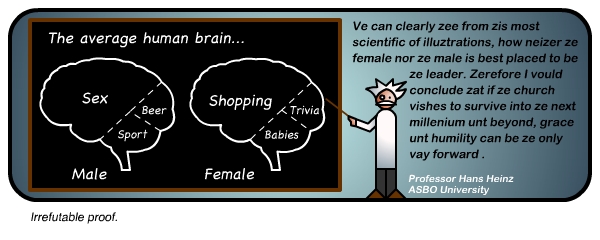
complementarianism
Apparently Mark Heath is a sexist ... well, I don't think so but some others may. He (and I) is a complementarian. Here is his simple yet clear summary of what that means.
But this position leaves him labeled sexist and it bothers him especially in light of the culture that he often finds himself. Ironic.
This position does not seek to deny "equality" between the sexes. On the contrary, it positively affirms that men and women are...
- equally bearers of the image of God
- equal in value or worth
- equal in dignity
- equal in moral responsibility
- equal in salvation (the same "way in" for all)
- equal as recipients of the gift of the Spirit
- (and I would add as a charismatic) equal as recipients of the gifts of the Spirit
However, complementarians also believe that there are differences between male and female, and that these differences are good. They come from God's creative intention. Rather than competing with one another, men and women actually complement one another. One of the ways that complementarians see these differences outworking is in leadership of the local church, specifically the eldership. They believe the New Testament teaches that men are to be called as elders in the church, to serve by exercising authority and taking responsibility for the care and spiritual well-being of those in the congregation.
But this position leaves him labeled sexist and it bothers him especially in light of the culture that he often finds himself. Ironic.
Technorati Tags: women
sola scriptura
Today's theological word of the day ...
Sola Scriptura
(Latin, “the Scripture alone”)
Belief of Protestants that Christian Scripture is the final and only infallible authority for the Christian in matters of faith and practice. Sola Scriptura was coined during the Protestant Reformation of the sixteenth century, but according to Protestants, is found throughout Christian history. The belief in Sola Scriptura contrasts both the Catholic, Mormon, Jehovah’s Witness, and Eastern Orthodox belief that along with Scripture there necessarily exists an infallible authority which either interprets the Scripture with ultimate authority or adds new revelations to supplement the Scripture. Hence, in these traditions, the Scripture is not the final, ultimate, or only infallible authority as there are other authorities equal to that of Scripture. Protestants, on the other hand, while respecting the existence of other authorities (tradition, experience, reason, creation, etc.), do not believe that these are equal to that of Scripture and therefore must always be tested by, and submitted to, Scripture.
Michael Patton offers a 5 part defense at his blog (part 1, 2, 3, 4, 5). I like what he wrote, perhaps you will as well ... regardless, it's worth your time since Patton is the master of the use of charts and you will surely like those.
Update ... part 6, 7
Sola Scriptura
(Latin, “the Scripture alone”)
Belief of Protestants that Christian Scripture is the final and only infallible authority for the Christian in matters of faith and practice. Sola Scriptura was coined during the Protestant Reformation of the sixteenth century, but according to Protestants, is found throughout Christian history. The belief in Sola Scriptura contrasts both the Catholic, Mormon, Jehovah’s Witness, and Eastern Orthodox belief that along with Scripture there necessarily exists an infallible authority which either interprets the Scripture with ultimate authority or adds new revelations to supplement the Scripture. Hence, in these traditions, the Scripture is not the final, ultimate, or only infallible authority as there are other authorities equal to that of Scripture. Protestants, on the other hand, while respecting the existence of other authorities (tradition, experience, reason, creation, etc.), do not believe that these are equal to that of Scripture and therefore must always be tested by, and submitted to, Scripture.
Michael Patton offers a 5 part defense at his blog (part 1, 2, 3, 4, 5). I like what he wrote, perhaps you will as well ... regardless, it's worth your time since Patton is the master of the use of charts and you will surely like those.
Update ... part 6, 7
Sunday, July 06, 2008
bentley and the haters
I've said it before and I'll say it again, I really don't like what I see going on in Lakeland surrounding Todd Bently. I am NOT his defender. But I'll add that I dislike just as much if not more what I see in the detractors exemplified in the likes of Schlueter and Silva.
Here's how their "biblical analysis" runs ...
First - I'm wondering why someone hasn't hunted down this glass-eyeball dude. I don't think that would prove anything overall but it sure would be interesting to find out if this is fact or fiction and if these guys are sincere, easily duped, or flat-out liars.
Then Ingrid Schlueter begins her quite obviously biased analysis. I couldn't help but wonder how easily she could have made the same analysis with Jesus and His followers.
Then Ken Silva makes his sad claim regarding those gold toothed Dutch folks (again it seems like some simple follow-up could be done relative to that). Silva states, "Where exactly do we see gold teeth being popped into people's mouth in Scripture. We don't. ... God doesn't do a new thing that has no bearing in Scripture." What can I say to that? Unbelievable. These guys have such low view of Scripture and the God of the Bible that I am simply at a loss for words.
Jon Sharp then states that this simply repeats the same narrow understanding of God as voiced by Silva. On the other hand, I do like his statement regarding evidence of fruit. I myself would like to see some of this although I'm not sure enough time has passed for that. At this point I am skeptical at best.
Sharp and Silva then respond to Bentley's "violent" methods. Again, I don't like what's going on in Lakeland but I really struggle with the analysis these guys provide. Silva mentions Elijah and says even he didn't do the extreme stuff that Bentley is doing. True. On the other hand it's pretty clear that these guys would not have approved of Elijah either had the stories not been captured in Scripture. Net - they wouldn't accept anyone doing any level of this kind of thing so I find it hypocritical that they are judging Bentley as if he could ever meet their standard.
Schlueter then plays the fruit of the Spirit card which in her analysis could also discredit Our Lord Himself. Net - just plain poor use of Scriptural standards. She claims that the gap is a missing knowledge of the Word of God. Actually I would say these guys have a wrong and limited understanding themselves. They even take this opportunity to poke at the emerging church.
Well I got through 18 minutes of this nonsense and heard enough. They would prefer we simply sit quietly in prayer while reading the Word as a model of Christian living. Sorry, no thanks. I'm glad God offers much more than that.
Oh well ... sin abounds on both sides of this conversation. Me, I'm going to go love God and share that with some others. Bye for now. Let me know if you listened to the rest and learned anything of substance but I pray you also have something better to do.
Here's how their "biblical analysis" runs ...
First - I'm wondering why someone hasn't hunted down this glass-eyeball dude. I don't think that would prove anything overall but it sure would be interesting to find out if this is fact or fiction and if these guys are sincere, easily duped, or flat-out liars.
Then Ingrid Schlueter begins her quite obviously biased analysis. I couldn't help but wonder how easily she could have made the same analysis with Jesus and His followers.
Then Ken Silva makes his sad claim regarding those gold toothed Dutch folks (again it seems like some simple follow-up could be done relative to that). Silva states, "Where exactly do we see gold teeth being popped into people's mouth in Scripture. We don't. ... God doesn't do a new thing that has no bearing in Scripture." What can I say to that? Unbelievable. These guys have such low view of Scripture and the God of the Bible that I am simply at a loss for words.
Jon Sharp then states that this simply repeats the same narrow understanding of God as voiced by Silva. On the other hand, I do like his statement regarding evidence of fruit. I myself would like to see some of this although I'm not sure enough time has passed for that. At this point I am skeptical at best.
Sharp and Silva then respond to Bentley's "violent" methods. Again, I don't like what's going on in Lakeland but I really struggle with the analysis these guys provide. Silva mentions Elijah and says even he didn't do the extreme stuff that Bentley is doing. True. On the other hand it's pretty clear that these guys would not have approved of Elijah either had the stories not been captured in Scripture. Net - they wouldn't accept anyone doing any level of this kind of thing so I find it hypocritical that they are judging Bentley as if he could ever meet their standard.
Schlueter then plays the fruit of the Spirit card which in her analysis could also discredit Our Lord Himself. Net - just plain poor use of Scriptural standards. She claims that the gap is a missing knowledge of the Word of God. Actually I would say these guys have a wrong and limited understanding themselves. They even take this opportunity to poke at the emerging church.
Well I got through 18 minutes of this nonsense and heard enough. They would prefer we simply sit quietly in prayer while reading the Word as a model of Christian living. Sorry, no thanks. I'm glad God offers much more than that.
Oh well ... sin abounds on both sides of this conversation. Me, I'm going to go love God and share that with some others. Bye for now. Let me know if you listened to the rest and learned anything of substance but I pray you also have something better to do.
Technorati Tags: charismata
small groups
I love hanging out with my small group friends ... even if it's just to sit around enjoying God's creation.

Technorati Tags: small groups
remembering the past
The only thing worse than nostalgia is amnesia. ~ Ravi Zacharias, Deliver Us From Evil
radical corruption
Here's just a small example of "radical corruption" as compared with "total depravity". This man is corrupt. Every fiber of his being is affected by Sin. Yet not every fiber of his being does evil continuously.
A bomb-laden van found on a Brooklyn street by a car thief was wired to detonate by remote control, and had likely been sitting there for more than five months, sources said yesterday. ... A thief who broke into the vehicle as it was parked on 53rd Street near Second Avenue saw the explosives, then drove the van from the mostly residential block to a remote location near the waterfront. The thief, who has an arrest record, then phoned a cop he knew from a previous run-in with the law.
Technorati Tags: Calvinism
Saturday, July 05, 2008
the gospel
RC Sproul on the Gospel:
There is no greater message to be heard than that which we call the Gospel. But as important as that is, it is often given to massive distortions or over simplifications. People think they’re preaching the Gospel to you when they tell you, ‘you can have a purpose to your life’, or that ‘you can have meaning to your life’, or that ‘you can have a personal relationship with Jesus.’ All of those things are true, and they’re all important, but they don’t get to the heart of the Gospel.
The Gospel is called the ‘good news’ because it addresses the most serious problem that you and I have as human beings, and that problem is simply this: God is holy and He is just, and I’m not. And at the end of my life, I’m going to stand before a just and holy God, and I’ll be judged. And I’ll be judged either on the basis of my own righteousness – or lack of it – or the righteousness of another. The good news of the Gospel is that Jesus lived a life of perfect righteousness, of perfect obedience to God, not for His own well being but for His people. He has done for me what I couldn’t possibly do for myself. But not only has He lived that life of perfect obedience, He offered Himself as a perfect sacrifice to satisfy the justice and the righteousness of God.
The great misconception in our day is this: that God isn’t concerned to protect His own integrity. He’s a kind of wishy-washy deity, who just waves a wand of forgiveness over everybody. No. For God to forgive you is a very costly matter. It cost the sacrifice of His own Son. So valuable was that sacrifice that God pronounced it valuable by raising Him from the dead – so that Christ died for us, He was raised for our justification. So the Gospel is something objective. It is the message of who Jesus is and what He did. And it also has a subjective dimension. How are the benefits of Jesus subjectively appropriated to us? How do I get it? The Bible makes it clear that we are justified not by our works, not by our efforts, not by our deeds, but by faith – and by faith alone. The only way you can receive the benefit of Christ’s life and death is by putting your trust in Him – and in Him alone. You do that, you’re declared just by God, you’re adopted into His family, you’re forgiven of all of your sins, and you have begun your pilgrimage for eternity.
HT:MR via PC
There is no greater message to be heard than that which we call the Gospel. But as important as that is, it is often given to massive distortions or over simplifications. People think they’re preaching the Gospel to you when they tell you, ‘you can have a purpose to your life’, or that ‘you can have meaning to your life’, or that ‘you can have a personal relationship with Jesus.’ All of those things are true, and they’re all important, but they don’t get to the heart of the Gospel.
The Gospel is called the ‘good news’ because it addresses the most serious problem that you and I have as human beings, and that problem is simply this: God is holy and He is just, and I’m not. And at the end of my life, I’m going to stand before a just and holy God, and I’ll be judged. And I’ll be judged either on the basis of my own righteousness – or lack of it – or the righteousness of another. The good news of the Gospel is that Jesus lived a life of perfect righteousness, of perfect obedience to God, not for His own well being but for His people. He has done for me what I couldn’t possibly do for myself. But not only has He lived that life of perfect obedience, He offered Himself as a perfect sacrifice to satisfy the justice and the righteousness of God.
The great misconception in our day is this: that God isn’t concerned to protect His own integrity. He’s a kind of wishy-washy deity, who just waves a wand of forgiveness over everybody. No. For God to forgive you is a very costly matter. It cost the sacrifice of His own Son. So valuable was that sacrifice that God pronounced it valuable by raising Him from the dead – so that Christ died for us, He was raised for our justification. So the Gospel is something objective. It is the message of who Jesus is and what He did. And it also has a subjective dimension. How are the benefits of Jesus subjectively appropriated to us? How do I get it? The Bible makes it clear that we are justified not by our works, not by our efforts, not by our deeds, but by faith – and by faith alone. The only way you can receive the benefit of Christ’s life and death is by putting your trust in Him – and in Him alone. You do that, you’re declared just by God, you’re adopted into His family, you’re forgiven of all of your sins, and you have begun your pilgrimage for eternity.
HT:MR via PC
love satisfies
In the end, love will satisfy the radical demands of the gospel. Love calls us to poverty. Love calls us to holiness. Without love, poverty becomes an empty and life-draining curse. Without love, holiness degenerates into cold and heartless self-righteousness. ... Is our Christianity radical or fanatical? A fanatic fulfills the radical externals of poverty and holiness but does so without love. Love softens the edge of razor-sharp issues and changes the cutting edge from a sword that kills and maims into a surgical knife that heals. It brings us to a balance between no-compromise and the leniency of wisdom. ~ John Michael Talbot
Technorati Tags: love
Friday, July 04, 2008
amillennialism
I'm thinking of converting to amillennialism ... here's Bobby Grow's primer ...
The Amillennialist affirms that the people of Israel have not been cast off or replaced, but rather, that the Gentiles have now been included among the Jews in God's Covenantal promises. In other words, not replacement but expansion. God's redemptive plan, as first promised to Abraham, was that "all nations" would be blessed through him. Israel is, and always has been, saved the same as any other nation: by the promises to the seed, Christ. Amillennialists, do not believe in a literal 1000 year reign of Christ on earth after His second coming. Rather, they affirm that when Christ returns, the resurrection of both the righteous and wicked will take place simultaneously (see John 5), followed by judgment and and the eternal state where heaven and earth merge and Christ reigns forever.
Strong points of Amillennialism
* It is highly Christocentric: it makes Christ the center of all the biblical covenants (even the “Land” covenant or Siniatic)
* It notes the universal scope of the Abrahamic Covenant (as key) to interpreting the rest of the biblical covenants * It sees salvation history oriented to a person (Christ), instead of a people (the nation of Israel)
* It emphasizes continuity between the “people of God” (Israel and the Church are one in Christ Eph. 2:11ff)
* It provides an ethic that is rooted in creation, and “re-creation” (continuity between God’s redemptive work now, carried over into the eternal state then)
* It emphasizes a trinitarian view of God as it elevates the “person”, Christ Jesus, the second person of the trinity as the point and mediator of all history
* It flows from a hermeneutic that takes seriously the literary character of the Scriptures (esp. the book of Revelation)
HT:JR
Contrary to John McArthur, I may not need to turn in my Calvin Card to make this move ... I hope not.
The Amillennialist affirms that the people of Israel have not been cast off or replaced, but rather, that the Gentiles have now been included among the Jews in God's Covenantal promises. In other words, not replacement but expansion. God's redemptive plan, as first promised to Abraham, was that "all nations" would be blessed through him. Israel is, and always has been, saved the same as any other nation: by the promises to the seed, Christ. Amillennialists, do not believe in a literal 1000 year reign of Christ on earth after His second coming. Rather, they affirm that when Christ returns, the resurrection of both the righteous and wicked will take place simultaneously (see John 5), followed by judgment and and the eternal state where heaven and earth merge and Christ reigns forever.
Strong points of Amillennialism
* It is highly Christocentric: it makes Christ the center of all the biblical covenants (even the “Land” covenant or Siniatic)
* It notes the universal scope of the Abrahamic Covenant (as key) to interpreting the rest of the biblical covenants * It sees salvation history oriented to a person (Christ), instead of a people (the nation of Israel)
* It emphasizes continuity between the “people of God” (Israel and the Church are one in Christ Eph. 2:11ff)
* It provides an ethic that is rooted in creation, and “re-creation” (continuity between God’s redemptive work now, carried over into the eternal state then)
* It emphasizes a trinitarian view of God as it elevates the “person”, Christ Jesus, the second person of the trinity as the point and mediator of all history
* It flows from a hermeneutic that takes seriously the literary character of the Scriptures (esp. the book of Revelation)
HT:JR
Contrary to John McArthur, I may not need to turn in my Calvin Card to make this move ... I hope not.
Technorati Tags: eschatology

Subscribe to:
Posts (Atom)