Tuesday, April 29, 2008

"s-bomb" at church

From the good folks at TBNN ...

Pastor in Trouble for Dropping "S-Bomb" in Sermon

AKRON, OHIO - Life was good for Reverend Frank Grant, pastor of Abundant Life United Methodist Church. He and his family had recently relocated from Wheeling, WV in order for him to pastor at Abundant Life. The first five months went very well, with seventeen new people joining the church. The church family seemed to be united, they were reaching out to the community, and even the youth at least looked excited to be in church. Everyone was happy.

Then Rev. Grant shocked everyone, including his wife. During his sermon last Sunday morning, Grant dropped the "S-bomb."

Unlike most pastors, Grant has the habit of preaching through books. He loves the book of Romans. This past Sunday, Grant was preaching out of Romans 9 when he reached the section on Jacob and Esau. That's when it happened. Grant said to his church, "As difficult as it is for us to understand and admit, it sure seems like God is sovereign over this situation."

The audience reportedly just sat there in stunned silence for a few seconds. They tried to take it in. They tried to comprehend what they had just heard from the pulpit. A few were heard to say, "Did he just say what I think he said?" A few mothers quickly ushered their young children back to the nursery. The rumbling in the congregation gradually grew from a whisper to a discussion to a dull roar.

Needless to say, both the sermon and the service came to a quick end. Several of the leaders of the church approached Rev. Grant in confusion and disgust. Sunday School Director Ed Thomas said to Grant, "How could you do that? How could you use the 'S-word' in our church? Just as things were going so well for us, you had to go and ruin everything. I feel so bad for you and us."

Grant did not quite comprehend the gravity of the situation. At least not at first.

Then Philip Simms, a long-time member of Abundant Life, approached Grant, shouting, "I don't ever want to hear that kind of language from this pulpit again. You know better than that - you attended Asbury Seminary. How dare you try to take away my free will?!"

Now Grant understood. He slowly walked back to his office and started packing up his books.

Technorati Tags:

Sunday, April 27, 2008

missional triad

I find this diagram by Steve McCoy helpful in thinking about what our community of believers are about.

Missional Triad 423

McCoy points to this post for detail on the "shapes" and this one for some of the implications. Both are posted by Joe Thorn.

controversy

Controversy - it's everywhere and it surrounds every idea ... The Negative Side of Controversy by Darryl Dash.

In 1740, John Wesley preached a sermon called Free Grace. Wesley debated whether or not to preach the sermon because he knew that it would lead to controversy. He decided to go ahead after casting lots.

Wesley was not irenic in his words. He spoke against predestination, a view held and taught by his friend and mentor George Whitefield. "It is a doctrine full of blasphemy," he said. "This doctrine represents our blessed Lord...as an hypocrite, a deceiver of the people, a man void of common sincerity...You represent God as worse than the devil!"

Whitefield responded in writing a few days later:

"I hear, Honoured Sir, that you are about to print a sermon against predestination. It shocks me to think of it! What will be the consequences but controversy? If people ask my opinion, what shall I do? I have a critical part to act. God enable me to behave aright! Silence on both sides will be best. It is noised abroad already that there is a division between you and me, and my heart within me is grieved."

Later Whitefield wrote again to Wesley, noting that the last part of Martin Luther's life was spent in controversy with Zwingli and others. He encouraged Wesley to focus on preaching Christ and to avoid needless controversy.

"Let this, dear Sir, be a caution to us, I hope it will to me; for by the blessing of God, provoke me to it as much as you please, I do not think ever to enter the lists of controversy with you on the points wherein we differ. Only I pray to God, that the more you judge me, the more I may love you, and learn to desire no one's approbation, but that of my Lord and Master, Jesus Christ...I wish you as much success as your own heart can wish."

A few reflections:

Controversy is damaging. I can understand why many avoid controversy over theological issues. Doctrinal debate is sometimes viewed as destructive, and sometimes it can be. It's sad to see debates like this one divide friends and entire movements. This controversy caused a rift that continues today, hundreds of years later. Controversy may sometimes be necessary, but it should be avoided whenever possible.

Tone matters. I know that tone is subjective, but I wonder if things would have turned out differently if Wesley had chosen less a less confrontational approach.

It's hard to know what's worth fighting over. Wesley believed that predestination was a fighting matter. Whitefield wanted to focus on the message on the gospel and evangelism. The same happens today. We often disagree over what's worth fighting about.

original sin

I am currently in a place of having a lot of fun within the community of believers. Historically I have held positions of "official" leadership related to the organization. For the past 2 years I have had the pleasure of simply being a Christian rather trying fill a role assigned by "the church". It has been great.

One of the activities I participate in within our community is to lead a small group. In the past when I have been involved in small groups the membership was relatively mature in the knowledge of Scripture and highly opinionated in their thinking regarding how "church" should work. This group is different. On average they are relatively new believers and not very informed regarding Scripture. It is a joy to be with them and yet it has its challenges.

This past week we talked about justification and righteousness. One of the group members quickly jumped off to "children are innocent" to which the rest piled on in agreement. I expressed some disagreement but since it was off topic I sacrificed adequately addressing the point. I guess the other reason I let it go was because from the perspective of "how shall we then live?", I find it irrelevant.

Anyway, I was reminded of the conversation by the following piece posted in The Expositor. It is by J.I. Packer in his Concise Theology.

“Surely I was sinful at birth, sinful from the time my mother conceived me” (Ps. 51:5)

Scripture diagnoses sin as a universal deformity of human nature, found at every point in every person (1 Kings 8:46; Rom. 3:9-23; 7:18; 1 John 1:8-10). Both Testaments have names for it that display its ethical character as rebellion against God’s rule, missing the mark God set us to aim at, transgressing God’s law, disobeying God’s directives, offending God’s purity by defiling oneself, and incurring guilt before God the Judge. This moral deformity is dynamic: sin stands revealed as an energy of irrational, negative, and rebellious reaction to God’s call and command, a spirit of fighting God in order to play God. The root of sin is pride and enmity against God, the spirit seen in Adam’s first transgression; and sinful acts always have behind them thoughts, motives, and desires that one way or another express the willful opposition of the fallen heart to God’s claims on our lives.

Sin may be comprehensively defined as lack of conformity to the law of God in act, habit, attitude, outlook, disposition, motivation, and mode of existence. Scriptures that illustrate different aspects of sin include Jeremiah 17:9; Matthew 12:30-37; Mark 7:20-23; Romans 1:18-3:20; 7:7-25; 8:5-8; 14:23 (Luther said that Paul wrote Romans to “magnify sin”); Galatians 5:16-21; Ephesians 2:1-3; 4:17-19; Hebrews 3:12; James 2:10-11; 1 John 3:4; 5:17. Flesh in Paul usually means a human being driven by sinful desire; the niv renders these instances of the word as “sinful nature.” The particular faults and vices (i.e., forms and expression of sin) that Scripture detects and denounces are too numerous to list here.

Original sin, meaning sin derived from our origin, is not a biblical phrase (Augustine coined it), but it is one that brings into fruitful focus the reality of sin in our spiritual system. The assertion of original sin means not that sin belongs to human nature as God made it (God made mankind upright, Eccles. 7:29), nor that sin is involved in the processes of reproduction and birth (the uncleanness connected with menstruation, semen, and childbirth in Leviticus 12 and 15 was typical and ceremonial only, not moral and real), but that (a) sinfulness marks everyone from birth, and is there in the form of a motivationally twisted heart, prior to any actual sins; (b) this inner sinfulness is the root and source of all actual sins; (c) it derives to us in a real though mysterious way from Adam, our first representative before God. The assertion of original sin makes the point that we are not sinners because we sin, but rather we sin because we are sinners, born with a nature enslaved to sin.

The phrase total depravity is commonly used to make explicit the implications of original sin. It signifies a corruption of our moral and spiritual nature that is total not in degree (for no one is as bad as he or she might be) but in extent. It declares that no part of us is untouched by sin, and therefore no action of ours is as good as it should be, and consequently nothing in us or about us ever appears meritorious in God’s eyes. We cannot earn God’s favor, no matter what we do; unless grace saves us, we are lost.

Total depravity entails total inability, that is, the state of not having it in oneself to respond to God and his Word in a sincere and wholehearted way (John 6:44; Rom. 8:7-8). Paul calls this unresponsiveness of the fallen heart a state of death (Eph. 2:1, 5; Col. 2:13), and the Westminster Confession says: “Man by his fall into a state of sin, hath wholly lost all ability of will to any spiritual good accompanying salvation; so as a natural man, being altogether averse from that good, and dead in sin, is not able by his own strength to convert himself, or to prepare himself thereunto” (IX. 3).

Technorati Tags:

texting god

Facetoface

I'm with David.

Saturday, April 26, 2008

wesley as proof of calvinism

As a "Calvinistic" "Charismatic", I found this quote by Martin-Lloyd Jones humorous.

Is there not a real danger of our becoming guilty of a very subtle form of Arminianism if we maintain that correct doctrine and understanding are essential to our being used by the Spirit of God ... I said that John Wesley was to me the greatest proof of Calvinism. Why? Because in spite of his faulty thinking he was greatly used of God to preach the gospel and convert souls! That is the greatest proof of Calvinism, predestination and election.

Dr Lloyd-Jones - "The Puritans: Their Origins and Successors" - Banner of Truth Trust, Edinburgh (1991) - (p297)

HT:DB

Friday, April 25, 2008

prayer joke

Maxine was driving down the street in a sweat because she had an important meeting and couldn't find a parking place. Looking up toward heaven, she said, 'Lord, take pity on me. If you find me a parking place I will go to church every Sunday for the rest of my life and give up sex and wine.'

Miraculously, a parking place appeared.

She looked up again and said, 'Never mind. I found one.'

modern day prophetess

My friend Randy Noblog thought this might be an example of a modern day prophetess.

Wednesday, April 23, 2008

keller humility

The Christian gospel is that I am so flawed that Jesus had to died for me, yet I am so loved and valued that Jesus was glad to die for me. This leads to deep humility and deep confidence at the same time. It undermines both swaggering and sniveling. I cannot feel superior to anyone, and yet I have nothing to prove to anyone. I do not think more of myself nor less of myself. Instead, I think of myself less. ~ Timothy Keller, The Reason For God

HT:JH

Sunday, April 20, 2008

god's sovereignty

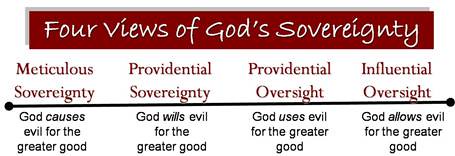
Michael Patton provides the following useful chart regarding views on God's Sovereignty.

2427981628 E87C255A94

He defines these four views as follows.

1. Meticulous sovereignty: God is the instrumental cause behind every action and reaction there has ever been. In other words, you chose white socks instead of the black socks because God caused it to happen. You have an itch on your eyebrow right now because God is actively causing it. In other words, every molecule that bounces into another is a result of God active agency in being the first and instrumental cause to the action.

This position holds little or no tension with regards to the human will and the divine will.

God is actively controlling everything.

Adherents: Hyper-Calvinists and some Calvinists


2. Providential sovereignty: While God is bringing about his will in everything (Eph 1:11), his will is not the instrumental cause of all that happens. God’s will plays a providential role in “causing” all things. In other words, all that happens happens because God did in some sense will it, but secondary causes are usually the instrumental cause behind the action. In the case of your socks, you chose them because you decided to, but it was also part of God’s will. God allows evil as it is part of his imperfect will to bring about a perfect end, but he is not the instrumental cause of evil.

This position holds much tension with regards to human will and divine will.

God is in control of everything.

Adherents: Calvinists and some Arminians


3. Providential oversight: Here God’s sovereignty is more of an oversight. He has a general plan, but is not married to the details. When necessary, God will intervene in the affairs of humanity to bring about his purpose, but this does not necessarily involve an intimate engagement with all that happens. God does not care what color socks you pick unless it somehow effects his meta plan.

This position holds much tension with regards to human will and divine will.

God could control everything, but only controls some things.

Adherents: Arminians and some Calvinists


4. Influential oversight: Here God’s sovereignty is self-limited. God could control things, but to preserve human freedom, he will not intervene in the affairs of men to the degree that the human will is decisively bent in one direction or another. He is hopeful that his influence will be persuasive to change a person’s heart or to guide them to his will, but is not sure if this will happen. Being all-wise, however, God will make strategic moves in people’s lives that will manipulate the situation to his advantage.

This position holds little or no tension with regards to the human will and the divine will.

God could control everything, but decides only to influence.

Adherents: Open Theist Arminians and some Arminians

For reference, I think I fit category 1 but I'm sure God will lead some of you to correct me.

more packer on god speaking

The Bible is not only man’s word, but God’s also; not merely a record of revelation, but a written revelation in its own right, God’s own witness to Himself in the form of human witness to Him. Accordingly, the authority of the Scriptures rests, not simply on their worth as an historical source, a testament of religion, and a means of uplift, real though this is, but primarily and essentially on the fact that they come to us from the mouth of God. Therefore the real task for reason in this connection is not to try to censure and correct the Scriptures, but rather, with God’s help, to try to understand and apply them, so that God may effectively censure and correct us. ~ J.I. Packer, God Has Spoken

Technorati Tags:

power of the gospel

Jonathan Brink brings us this great quote from Pope Benedict XVI:
Only when their faith permeates every aspect of their lives do Christians become truly open to the transforming power of the Gospel.

orthodoxy

n. pron. [or-the-dock-see]

Gr. orthos (right, true) + doxa (opinion, thinking)

Orthodoxy has been widely acknowledged to refer to adhering to the teachings and traditions in an established faith or religion. With respect to Christianity, the concept generally means recognizing and accepting the fundamental teachings and doctrines found in the Bible. All three branches of Christianity (Roman Catholic, Protestant, and Eastern Orthodox) consider the early ecumenical confessions such as the Apostles’ Creed, Athanasian Creed, and Nicean Creed to be their primary sources relating to orthodoxy.

While I want so much to stay orthodox, Tony Jones has suggested that "orthodoxy doesn't 'exist.' Instead, orthodoxy is an event, in the Derridean/Caputoean sense. That is, orthodoxy happens when human beings get together and practice it (talk about God, worship God, pray to God, write books about God, etc.). There's no orthodoxy somewhere out there that one can point to and say, "See that? That's orthodoxy. That's what we're trying to get to."

I've said before that we need orthodoxy, orthopraxy, and orthopathy (right doctrine, right practice, and right motive). John Wimber taught that leaders "need to remain congruent with orthodoxy and orthopraxy, to maintain our focus on the 'main and the plain' in Scripture." If we have right doctrine but it does not manifest itself in right love, it is for naught. On the other hand, we cannot have right love without right doctrine.

you can't teach a sneetch

Doctor Seuss says you can't teach a Sneetch ... but can you teach a Christian?

justification

Justification by Faith does not mean salvation by believing things instead of by doing right. It means pleading the merits of Christ before the throne of grace instead of our own merits. ~ B.B. Warfield, “Justification by Faith: Out of Date?”, The Christian Irishman, May 1911

HT:OFI

Technorati Tags:

Saturday, April 19, 2008

god speaks

If we cannot be sure that what Scripture says, God says, we cannot be sure that He has actually made any of the promises which Scripture ascribes to Him. (Indeed if we deny that revelation is propositional, we make it quite certain that He has not. A God who uses no words cannot make any promises). ~ J. I. Packer, God Has Spoken

HT:MD

whopper v. religion

Apparently the Whopper and Religion have the same kind of following ... and result when no longer served.


Technorati Tags:

more wright worship

It always happens, when people decide to worship Jesus without inhibition - to pour out their valuables, their stories, their dancing, their music, before him just the way they feel like doing - that others, looking on, find the spectacle embarrassing and distasteful…Not everyone is called to pour out expensive ointment over Jesus’ head; but if someone is, the rest should respect it. ~ NT Wright, Mark for Everyone

HT:MD

Technorati Tags:

most beautiful object in south africa

The high speed condom applicator was been named the most beautiful object in South Africa for 2007.

Applicator-2G

For those that prefer video over the above photo, check this out.

where is truth

A friend of mine, Daniel Chew, recently asked why I would quote a heretic, specifically Henry Nouwen? Before I start this post, let me first say that I don't know Nouwen. I'm sure that if I search the internet I will find plenty of bad things about him and some of you will even be tempted to tell me bad things about him here. But all of that would be besides the point. The quote I used was:

When we say, ‘I love Jesus, but I hate the Church,’ we end up losing not only the Church but Jesus too. The challenge is to forgive the Church. This challenge is especially great because the Church seldom asks us for forgiveness.

The question is simply do you agree or not? I do. I believe that to hate the Bride of Christ is to hate Christ Himself and I also believe that that the Bride sadly fails to recognize, confess, repent, and ask forgiveness for Her sins.

So whether or not Nouwen is a heretic, I cannot, nor will not say. What I can say is that I believe he spoke truth.

Bill Walsh recently posted on the concept of accepting the truth wherever it may be found. Walsh quotes John Calvin who may also be a heretic ... or may be a "God-fearing reformer who made some errors along the way" (see the comments between Rick Frueh and Daniel in my post). In Calvin's Institutes we find:

In reading profane authors, the admirable light of truth displayed in them should remind us that the human mind, however fallen and perverted from its original integrity, is still adorned and invested with admirable gifts from the Creator. If we reflect that the Spirit of God is the only fountain of truth, we will be careful, as we should avoid offering insults to Him, not to reject or condemn truth wherever it appears. In despising the gifts we insult the giver.

Walsh then cites the following quote from Hilary Brand and Adrienne Chaplin.

Dualism is a word that can be applied to any split-vision worldview. It separates God’s creation into distinct and opposing realms, one representing good, the other representing evil: holy versus profane, sacred versus secular, material versus spiritual....

[A] truly biblical worldview will not let us get away with such simplistic divides. The Bible frequently speaks in paradox, explaining truths not in terms of either/or by both/and: creation is both gloriously beautiful and tainted by sin; humanity is both made in God’s image and fallen; Jesus is both fully human and fully divine; Christians are both redeemed from the curse and still suffering its consequences.

The problem comes when the line is drawn compartmentally rather than spiritually, putting certain aspects of culture inside the Kingdom of God and others outside. Rather we need to understand that the battle lines between good and evil run across all aspects of culture and every facet of life.

I agree. Can one make "errors along the way" and still be godly? Can one speak or teach a heresy and not be a heretic? Can both blessing and cursing come from the same mouth? I think it ought not be so but I think it can and I think Walsh makes an interesting argument.

So this is how I can quote Nouwen. I first do not judge him either way and then I evaluate his words. At least for these words I find them to be truthful, penetrating, and helpful. I hope that from time to time you might find the same for the words here in this blog.

reftagger